Research
Kernelized Edge Attention: Addressing Semantic Attention Blurring in Temporal Graph Neural Networks
Overview Research area: Temporal Graph Neural Networks (TGNNs), specifically attention mechanisms for continuous-time dynamic graphs. Technical level: Intermediate. The paper assumes familiarity with
- arXiv
- 2602.00596
- Published
- 2026-01-31
- Authors
- Govind Waghmare, Srini Rohan Gujulla Leel, Nikhil Tumbde, Sumedh B G, Sonia Gupta, Srikanta Bedathur
AI summary
Overview
Research area: Temporal Graph Neural Networks (TGNNs), specifically attention mechanisms for continuous-time dynamic graphs.
Technical level: Intermediate. The paper assumes familiarity with transformer attention, graph neural networks, message passing, and time encodings, but its core idea is expressible in a few sentences.
Scope: This paper identifies and names a failure mode it calls "semantic attention blurring," then proposes a kernel-based edge attention module (KEAT) that modulates only edge features by elapsed time, and evaluates it as a drop-in addition to TGN and DyGFormer on the Temporal Graph Benchmark (TGB) and other datasets.
What This Paper Is About
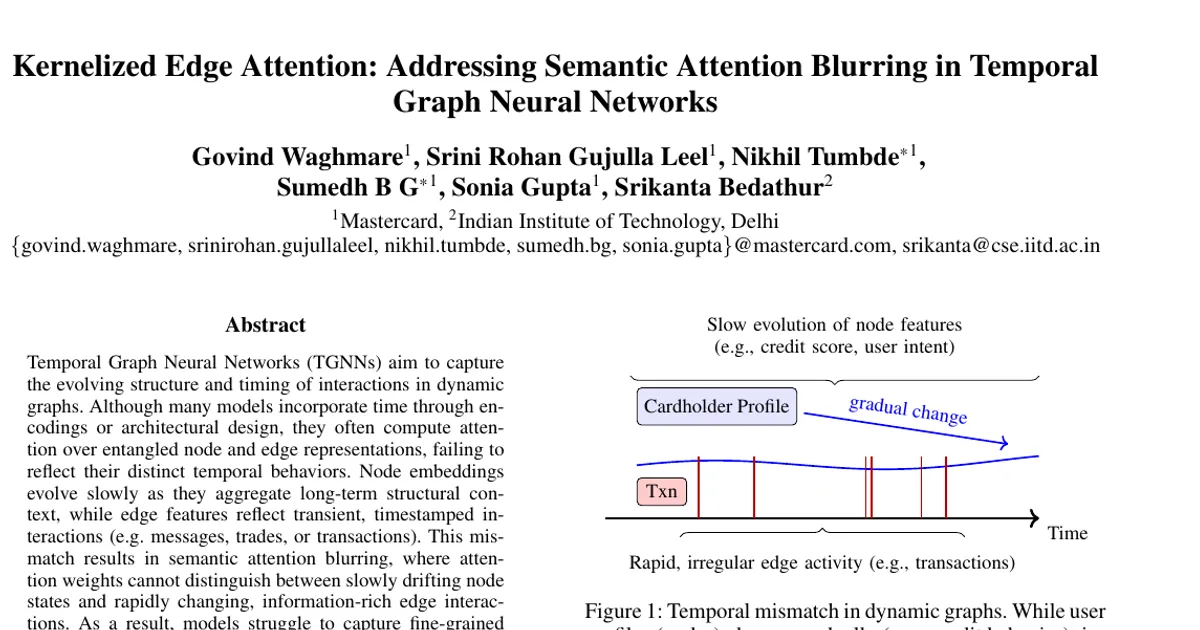
In dynamic graphs, node features (such as a cardholder's profile) change slowly, while edge features (such as individual transactions) change rapidly and irregularly. Existing attention-based TGNNs compute attention scores over the sum of projected node and edge representations, so these two differently-paced signals get mixed together. The result is "semantic attention blurring": attention weights cannot tell recent, information-rich edge events apart from slowly drifting node context. The paper's goal is to fix the attention formulation itself — rather than designing better time encodings — by scaling edge features with continuous-time kernels before they enter the attention computation.
Key Contributions
-
Formal identification of semantic attention blurring. The authors characterize the problem in Transformer-style TGNNs, where attention scores are computed over combined node and edge projections (following the
TransformerConvformulation used by TGN, DyGFormer, and others), arguing this entangles temporally distinct signals and limits both precision and interpretability. -
The KEAT mechanism. A time-aware attention formulation that applies continuous-time kernels — Laplacian, RBF, and a learnable MLP variant — exclusively to edge features (raw edge attributes plus time encodings), leaving node semantics untouched. The modulation is applied within the key and value projections.
-
Architecture- and encoding-agnostic integration. KEAT requires minimal architectural change, no additional supervision, and works with both Transformer-style (DyGFormer) and message-passing (TGN) backbones, and with fixed, learnable, and LeTE time encodings.
-
Empirical and theoretical validation. Experiments on TGB link prediction, node classification, JODIE datasets, and DGraphFin, plus a theorem showing kernel weighting suppresses higher-order moments of the inter-arrival time distribution and reduces variance in attention logits.
Main Findings
-
Consistent link prediction gains over both backbones. KEAT-TGN improves test MRR over TGN on all four
tgbldatasets, with gains reported as +7.76% (tgbl-wiki), +3.10% (tgbl-review), +4.62% (tgbl-coin), and +2.10% (tgbl-comment). KEAT-DyGFormer improves over DyGFormer by +1.69% (tgbl-wiki), +18.80% (tgbl-review), +5.10% (tgbl-coin), and +10.60% (tgbl-comment). The abstract summarizes this as up to 18% MRR improvement over DyGFormer and 7% over TGN. -
Best test performance on all four TGBL datasets. KEAT-DyGFormer achieves the top test MRR on
tgbl-wiki,tgbl-review,tgbl-coin, andtgbl-commentamong the methods listed in Table 1 — for example, 0.815 ± 0.005 ontgbl-wiki, 0.412 ± 0.012 ontgbl-review, 0.803 ± 0.003 ontgbl-coin, and 0.776 ± 0.001 ontgbl-comment. -
Kernels beat no kernel, but kernel choice matters. On the TGN backbone, the Laplacian kernel reaches an MRR of 0.474 ± 0.031 on
tgbl-wiki, described as a +7.8% improvement over the no-kernel baseline of 0.396 ± 0.060. The RBF kernel achieves the highest MRR ontgbl-coinat 0.636 ± 0.021, surpassing the baseline by +5.0%. Laplacian and RBF are reported as most consistent, while the MLP kernel is more expressive but higher variance. -
Gains on node classification. On
tgbn-tradeandtgbn-genre, KEAT-TGN improves test NDCG@10 by +5.30% and +5.29% respectively. Ontgbn-tokenit improves by +1.1%, and ontgbn-redditthe gain is slight but consistent. -
Robust across time encodings. On
tgbl-wiki, KEAT improves test MRR by +7.8% with TGN/TGAT encodings and +7.3% with LeTE. Reduced variance across runs is reported when KEAT is used. -
Attention becomes time-sensitive. Attention plots show standard attention assigning near-uniform weights across time, while KEAT emphasizes recent, lower-Δt edges. Attention heatmaps show weights shifting gradually as edge timestamps grow older.
-
Theoretical grounding. Theorem 1 states that for a non-negative, monotonically decreasing kernel ψ(t) and analytic time encoding φ(t), the kernel-to-base ratio R_n = E[ψ(t)t^n] / E[t^n] is strictly decreasing and converges to zero, so the kernel-weighted encoding is dominated by lower-order terms. A complementary result says temporal kernels reduce the variance of attention logits.
-
Negligible overhead. With Laplacian or RBF kernels, KEAT adds no computational overhead and retains the same time and space complexity as TGN and DyGFormer. The MLP kernel operates on scalar time gaps with a few parameters, and similar inference complexity is observed under standard TGBL settings.
Methodology in Plain English
The researchers start from a standard temporal attention setup: each interaction between nodes i and j has raw edge features and a timestamp, and the time gap Δt between the current query and past interaction is converted into a time encoding, then concatenated with the edge features. In conventional TransformerConv-style attention, that combined edge-time vector is added to a projected node embedding and then used to compute attention scores — so time influences the score only weakly and indirectly.
KEAT changes one thing: before the edge-time vector enters the key and value projections, it is multiplied by a scalar kernel value ψ(Δt) that depends only on elapsed time. Three kernel families are tested:
- Laplacian: exp(−Δt / σ)
- RBF: exp(−Δt² / σ²)
- Learned (MLP): MLP(Δt)
Here σ is the standard deviation of inter-event time differences computed from the training set. Because only edge features are scaled, node embeddings keep their slow-evolving structural role and the node and edge contributions are disentangled. Everything else about the backbone — tokenization, aggregation, time encodings — stays the same.
For DyGFormer, which divides interaction histories into patches, only the edge features within each patch are modulated using a representative patch timestamp (such as the mean edge time). The query is scaled by exp(t_patch) and the key by exp(−t_patch), producing attention scores of the form exp(t_query − t_key), a directional temporal bias introduced without changing DyGFormer's architecture.
Evaluation uses the Temporal Graph Benchmark (TGB), extended with JODIE datasets for link prediction and DGraphFin for dynamic node classification. Dynamic link prediction is framed as ranking and measured with MRR (AUC and Average Precision for JODIE datasets); dynamic node classification uses NDCG@10 for tgbn datasets and AUC for DGraphFin. Experiments follow TGB default hyperparameters, and each experiment is run five times with different random seeds. Results are reported for KEAT-TGN and KEAT-DyGFormer against their vanilla counterparts, plus baselines DyRep, TNCN, CTAN, EdgeBank_tw, and EdgeBank_∞ drawn from the TGB leaderboard.
Why This Matters
Impact on research. The paper reframes an active line of work: instead of asking how to build better time encodings (TGAT, TGN, LeTE, GraphMixer), it argues that encoding improvements have limited returns if the attention formulation cannot separate node and edge dynamics. It supplies a named failure mode, a minimal intervention, a moment-based theoretical justification, and evidence that the intervention is orthogonal to encoding choice — a combination that gives other researchers a clean component to build on or compare against.
Real-world applications:
- Fraud and financial transaction monitoring: cardholder profiles drift slowly while transaction behavior changes abruptly; the paper uses exactly this example, and DGraphFin is included as a financial dataset.
- Recommendation and user-item interaction modeling: JODIE-style user-item datasets are used to test whether recency-sensitive attention improves link prediction.
- Event forecasting: temporal graphs of event streams where recency of interaction is informative.
- Temporal user behavior or content modeling: the
tgbl-commentandtgbn-reddit/tgbn-genredatasets cover user interaction and topical content settings.
Industry relevance. KEAT is framed as a plug-and-play module requiring no architectural redesign, no extra supervision, and — for the Laplacian and RBF variants — no additional time or space complexity relative to the backbone. That combination matters for production systems that already run TGN or DyGFormer style models and want accuracy gains without retraining from scratch. Interpretability, via attention heatmaps that shift with edge age, is also presented as a practical benefit for auditing decisions in sensitive domains such as finance.
Future Directions
-
Sparse or temporally clustered edge activity. The paper explicitly names this as a limitation: when edge activity is extremely sparse or highly clustered in time, temporal modulation may be less informative. Addressing these regimes is called an important direction for future work.
-
Better handling of the MLP kernel's variance. The learned kernel is more expressive but lacks built-in inductive bias and depends heavily on data, underperforming when supervision is limited. Finding ways to regularize or hybridize it with structured kernels is an open question.
-
Automatic kernel selection. The paper gives qualitative guidance (Laplacian for recency-driven short-term dynamics, RBF for smoother mid-range dependencies, MLP for high-data regimes with non-monotonic patterns) but leaves open how a system should choose the kernel automatically per dataset.
-
Distribution shift in inter-arrival times. The paper notes that p(Δt) often shifts between training and validation sets, with early interactions sparse and later ones denser. Theorem 1 argues kernel modulation improves robustness to this shift, but evaluating KEAT under explicitly measured shift conditions is not reported in the provided content.
Target Audience
Researchers and practitioners working on dynamic or temporal graph learning, particularly those building on TGN, DyGFormer, TGAT, or the Temporal Graph Benchmark. It is also relevant to applied machine learning engineers in fraud detection, payments, and recommendation who want a low-overhead way to make existing temporal graph models more recency-aware, and to readers interested in attention interpretability on time-stamped data. Readers without prior exposure to graph attention and message passing will need background reading first, since the paper assumes that vocabulary throughout.
Authors’ abstract
Temporal Graph Neural Networks (TGNNs) aim to capture the evolving structure and timing of interactions in dynamic graphs. Although many models incorporate time through encodings or architectural design, they often compute attention over entangled node and edge representations, failing to reflect their distinct temporal behaviors. Node embeddings evolve slowly as they aggregate long-term structural context, while edge features reflect transient, timestamped interactions (e.g. messages, trades, or transactions). This mismatch results in semantic attention blurring, where attention weights cannot distinguish between slowly drifting node states and rapidly changing, information-rich edge interactions. As a result, models struggle to capture fine-grained temporal dependencies and provide limited transparency into how temporal relevance is computed. This paper introduces KEAT (Kernelized Edge Attention for Temporal Graphs), a novel attention formulation that modulates edge features using a family of continuous-time kernels, including Laplacian, RBF, and learnable MLP variant. KEAT preserves the distinct roles of nodes and edges, and integrates seamlessly with both Transformer-style (e.g., DyGFormer) and message-passing (e.g., TGN) architectures. It achieves up to 18% MRR improvement over the recent DyGFormer and 7% over TGN on link prediction tasks, enabling more accurate, interpretable and temporally aware message passing in TGNNs.