Research
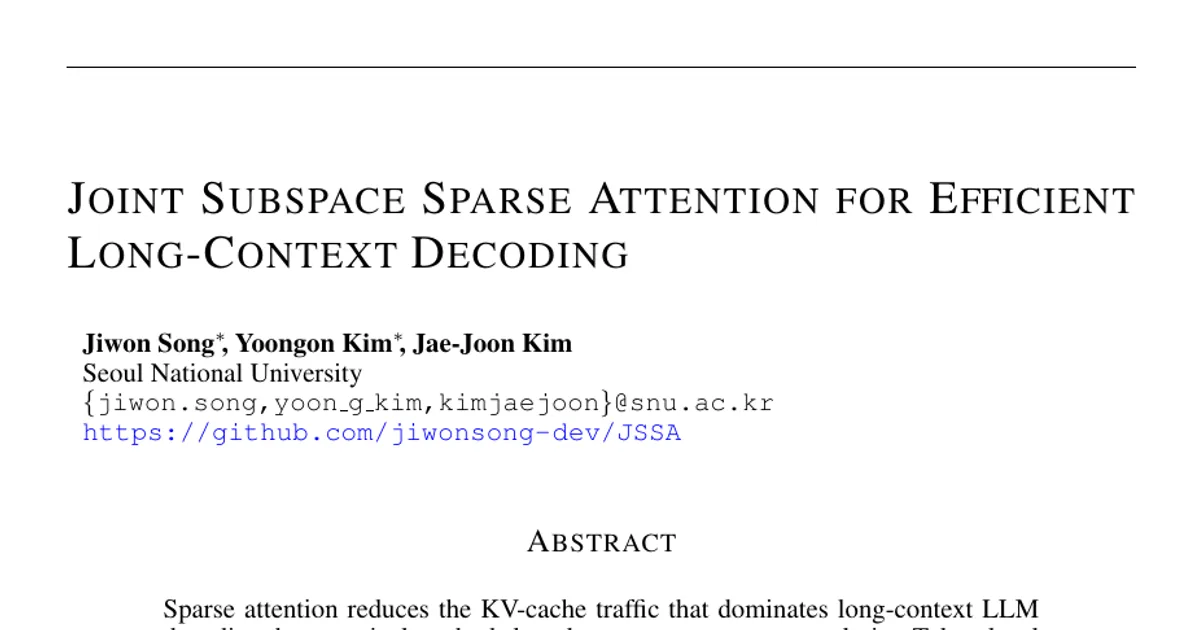
Joint Subspace Sparse Attention for Efficient Long-Context Decoding
Overview Research area: Efficient inference for large language models — specifically sparse attention and KV-cache optimization for long-context autoregressive decoding. Technical level: Advanced. The
- arXiv
- 2610.19026
- Published
- 2026-10-13
- Authors
- Jiwon Song, Yoongon Kim, Jae-Joon Kim
AI summary
Overview
Research area: Efficient inference for large language models — specifically sparse attention and KV-cache optimization for long-context autoregressive decoding.
Technical level: Advanced. The paper combines spectral linear algebra (eigen-decompositions, projectors, marginal bounds) with GPU kernel engineering (Triton indexed attention, GQA/MLA cache layouts).
Scope (one sentence): The paper introduces Joint Subspace Sparse Attention (JSSA), a training-free token-level sparse attention method that learns a shared query–key scoring subspace in closed form and executes selection without gathering, evaluated across GQA, hybrid local/global, and MLA models up to roughly 700B parameters.
What This Paper Is About
Long-context decoding is bottlenecked by repeatedly reading the growing KV cache, and sparse attention reduces that traffic by selecting only part of the context at each step. Token-level selection offers finer control than block- or page-level selection, but it faces two problems: low-dimensional scoring can lose the query–key structure needed to rank tokens accurately, and physically gathering scattered selected tokens can erase the latency benefit. JSSA's goal is to solve both problems at once — with a scoring subspace chosen to preserve the bilinear attention scores used for ranking, and with an attention kernel that reads irregular per-head selections directly instead of staging them in a contiguous buffer.
Key Contributions
-
Score-preserving joint query–key projection. The authors formulate an exact bilinear score-error objective for token selection, derive a tractable marginal upper bound of the form
L_sel(P) ≤ (1/4) · L_marg(P)², and obtain a closed-form spectral solutionM* = TopEig_r(G̃_Q̄ + G̃_K)ᵀ. They report that directly refining the exact objective fromM*produces negligible subspace changes and no measurable improvement in oracle top-B recall in the tested settings. -
Gather-free per-KV-head token-level attention for GQA. They design what they describe as, to the best of their knowledge, the first indexed-attention kernel supporting distinct per-KV-head selections under the standard GQA KV-cache layout without physically gathering selected entries. It is a Triton kernel that launches once per layer and resolves per-head index sets internally.
-
Validation across architectures and scales. JSSA is evaluated on standard GQA, hybrid sliding-window/global attention, and MLA models, achieving up to 6.43× the decoding throughput of full-KV attention at 128K context on an NVIDIA B200 GPU, and reasoning accuracy comparable to model-native DSA at 700B scale without any model training.
Main Findings
-
LongBench (KV budget 256 tokens): JSSA achieves the best or near-best sparse result on all three evaluated models and remains within 0.67 points of full-KV. On LLaMA-3.1-8B-Instruct, JSSA scores 49.16 versus full-KV 48.35, ahead of QUEST (46.94), SqueezedAttn (47.95), SnapKV (43.53), FASA (46.74), and Loki (45.65). On Qwen3-14B, JSSA scores 49.82 versus full-KV 50.49. On Ministral-3-8B-Instruct-2512, JSSA scores 47.79 versus full-KV 47.90 (Loki scores 48.07 on this model).
-
RULER (fixed 1.5625% KV budget, 32K–128K): JSSA remains closest to full-KV attention overall and achieves the highest sparse accuracy at 128K. On Ministral-3-8B-Instruct-2512, JSSA matches full-KV at 128K and is within 2 points at 32K and 64K. The budget corresponds to 512, 1,024, and 2,048 selected tokens at 32K, 64K, and 128K context respectively.
-
PG-19 perplexity (32K–128K): JSSA stays close to full-KV across all three models, with a maximum gap of 1.11 perplexity points, whereas baselines are less consistent — Loki degrades sharply on LLaMA despite doing well on Ministral, and FASA's perplexity spikes on LLaMA at 128K (56.59 versus full-KV 10.38).
-
Reasoning (KV budget 1,024 tokens): JSSA provides the strongest overall accuracy–length trade-off, remaining within 1.3 points of full-KV accuracy on most benchmarks while limiting generation-length inflation to 2–17% on Qwen3-8B and Gemma4-26B-A4B-It, versus substantially longer generations for TriAttention, QUEST, and SeerAttention-R. The gap over FASA is largest on Gemma4 (12.92 points on AIME 2025) and on GLM-4.7-Flash, where JSSA matches or exceeds full-KV accuracy on all three benchmarks (AIME 2025, MATH-500, GPQA-Diamond).
-
Decoding throughput: At 128K context with a KV budget of B = 2,048 tokens, JSSA reaches up to 1.51×, 1.88×, and 6.43× the throughput of full-KV on Qwen3-8B, Gemma4-26B-A4B-It, and GLM-4.7-Flash respectively, with the advantage generally growing at 128K as KV-cache traffic becomes more dominant. On GLM-4.7-Flash, JSSA matches FASA's throughput while providing substantially higher reasoning accuracy.
-
Large scale (700B, post-hoc, no training): JSSA matches native DSA on AIME 2025 for both DeepSeek and GLM-5.2, and the two methods are identical on GPQA-Diamond for GLM-5.2 (90.91 each). The authors interpret the small numerical differences as showing accuracy comparable to model-native DSA rather than a consistent advantage. JSSA reaches 96.1–99.2% of native DSA's decoding throughput, and up to 3.49× the throughput of full-KV attention at 128K context at batch size 8.
-
Projection rank ablation: JSSA performs best at every rank from 4 to 32, with the largest gains under the tightest constraints — +5.40 and +24.48 LongBench points over FASA and Loki at r = 4.
-
Calibration robustness: JSSA is largely insensitive to the calibration corpus (LongAlign, NarrativeQA, LooGLE yield nearly identical perplexity). Calibration length matters more: bases calibrated at 32K degrade sharply when evaluated at 128K (perplexity 16.05–18.31, versus 11.31–11.48 for 128K-calibrated bases).
-
Gather-free execution: At 128K on LLaMA-3.1-8B-Instruct, gather-free execution roughly doubles the attention-stage speedup over full-KV at batch sizes 4 and 16 (25.35× to 65.26× at batch 16). On Gemma4-26B-A4B-It it improves end-to-end throughput by 1.07×–2.22× over gather-then-attend, with gains growing with batch size.
-
Gather overhead evidence (motivation): At 128K context on LLaMA-3.1-8B-Instruct, gathering remains comparable to the reduced-attention computation itself and accounts for more than half of the residual latency at batch size 16.
-
Calibration cost: End-to-end wall-clock calibration takes 203 s (LLaMA-3.1-8B), 295 s (Qwen3-14B), 129 s (Ministral-3-8B), 365 s (Gemma4-26B), and 247 s (GLM-4.7-Flash) on an NVIDIA B200 GPU.
Methodology in Plain English
At each decoding step, JSSA must decide which tokens in the context to actually attend to, without reading the whole KV cache at full dimension. It adds a small auxiliary cache of projected keys — the original keys multiplied by a low-dimensional matrix — and scores a projected version of the query against it. Because scoring happens in few dimensions, it is cheap; the final attention is still computed with the original full-dimensional queries, keys, and values for the tokens that were selected.
The distinctive choice is how the projection is chosen. Rather than picking a projection that reconstructs keys well (as Loki does) or selecting a subset of original channels (as FASA does), JSSA picks the projection that best preserves the product of query and key — the bilinear score that determines token ranking. The exact objective for this is non-convex, so the authors derive a marginal upper bound that has a closed-form solution: take the top-r eigenvectors of the sum of the trace-normalized second-moment matrices of queries and keys. That reduces calibration to accumulating second moments over a few long sequences followed by one eigendecomposition per layer and KV head. No gradients, no training.
For execution, the authors avoid the usual "gather then attend" approach. Because each token's key or value slice is already contiguous over the head dimension, an indexed read of a scattered token is still a burst-sized transaction. In grouped-query attention, however, each KV head occupies a separate partition and may select a different token set, which is what makes existing kernels unsuitable. The authors write a Triton kernel that launches once per layer and resolves each query head's indices from its associated KV head internally. In MLA, where each token contributes one shared latent vector per layer, selection yields a single index set and the released FlashMLA sparse kernels are used.
In the default GQA configuration, they choose r so that the FP8 projected-key cache occupies at most 6.25% of the original BF16 KV cache (r = 32 for LLaMA, Qwen, and Ministral; r = 64 for Gemma4). For MLA they use a 128-dimensional scoring representation of 64 latent plus 64 RoPE dimensions, matching the total dimensionality of the DSA indexer for an equal-capacity comparison. JSSA reserves no sink tokens, enforces no recent-token window, and applies no special handling to any positions; the same token budget is applied to every sparse-attention layer and head. For Gemma4, only the global-attention layers are sparsified.
Why This Matters
This paper argues that the two obstacles to token-level sparse attention — a scoring subspace that loses ranking information, and gather overhead that eats the speedup — are separable engineering problems that can both be addressed without training a model. The closed-form spectral solution matters because it makes high-quality token selection cheap to calibrate (minutes, not training runs), and the gather-free kernel matters because it shows the residual latency of token-level sparsity is largely an implementation artifact rather than a fundamental cost. The large-scale comparison is also notable in framing: a post-hoc, training-free method is compared directly against model-native DSA, which was introduced through continued pre-training.
Real-world applications:
- Long-context assistants and document-analysis tools that must serve many concurrent users over 128K-token contexts, where KV-cache bandwidth, not compute, limits throughput.
- Reasoning and agentic workloads, where the paper measures not only final-answer accuracy but also generation-length inflation — degraded sparse attention can destabilize reasoning trajectories even when answers remain correct.
- Retrieval-augmented and codebase-scale generation, where long contexts are routine and serving cost scales with context length.
- Deployment on existing checkpoints: because JSSA is training-free, it can be bolted onto already-released GQA, hybrid-attention, and MLA models without retraining.
Industry relevance: The throughput numbers (up to 6.43× over full-KV at 128K, 96–99% of native DSA's throughput at 700B scale) and the fact that JSSA is integrated into a vLLM-based serving stack with CUDA graph capture point toward direct serving-cost reduction for long-context inference.
Future Directions
-
Calibration length versus deployment length. The ablation shows that bases calibrated at 32K degrade sharply at 128K (perplexity 16.05–18.31 versus 11.31–11.48). The paper states calibration should cover sequences near the maximum deployment context length, but does not establish how to handle deployments whose context length is not known in advance or exceeds available calibration text.
-
Tightness of the marginal bound. The authors note the bound provides a tractable surrogate but does not establish tightness or global optimality. Whether a different surrogate narrows the gap between the marginal objective and the exact bilinear objective is left open.
-
Asymmetric versus shared scoring subspaces. JSSA constrains both operands to a single shared subspace, unlike asymmetric factorizations such as KQ-SVD. The paper reports an adapted asymmetric comparison in Appendix B.6, but the question of when asymmetric projections would outperform the shared one is not settled.
-
Extending gather-free indexed attention beyond GQA and MLA. The kernel is presented as the first supporting distinct per-KV-head selections under standard GQA layouts; how such kernels should be designed for other cache layouts and for other sparse-selection granularities remains an open engineering question.
Target Audience
This paper is aimed at systems and inference-optimization researchers and engineers working on long-context LLM serving — particularly those implementing or evaluating KV-cache reduction and sparse attention. Readers need familiarity with grouped-query attention, multi-head latent attention, and KV-cache layouts to follow the kernel discussion, and with spectral methods (projectors, eigendecompositions, second-moment matrices) to follow the scoring-objective derivation. Practitioners deploying long-context models on bandwidth-limited accelerators will find the throughput and calibration-cost measurements most directly useful. Those looking for an introduction to sparse attention should start elsewhere, since the paper assumes the reader already understands the block-level versus token-level distinction and the standard baselines (QUEST, SnapKV, FASA, Loki, and others) it compares against.
Authors’ abstract
Sparse attention reduces the KV-cache traffic that dominates long-context LLM decoding, but practical methods largely operate at coarse granularity. Token-level selection offers finer control, yet presents two challenges: low-dimensional scoring may lose query--key structure needed for accurate ranking, while gathering scattered selected tokens can offset the resulting latency benefit. We introduce Joint Subspace Sparse Attention (JSSA) to address both challenges. For selection quality, JSSA learns a shared low-dimensional query--key subspace by minimizing token-score preservation error. We upper-bound the resulting non-convex objective with a tractable marginal objective that admits a closed-form spectral solution; direct refinement of the exact objective provides no measurable improvement in the tested settings. For execution efficiency, we develop a gather-free token-level indexed-attention kernel that supports distinct per-KV-head selections under the standard grouped-query attention (GQA) KV-cache layout. Across standard GQA, hybrid sliding-window/global attention, and Multi-head Latent Attention (MLA) models, JSSA consistently remains close to full-KV accuracy while avoiding the substantial generation-length inflation and architecture-dependent failures observed with competing methods. On an NVIDIA B200 GPU, JSSA achieves up to $6.43\times$ the decoding throughput of full-KV attention at 128K context. JSSA achieves reasoning accuracy comparable to model-native DSA without model training and reaches 96--99\% of its decoding throughput even at 700B scale large models.