Research
Irresponsible AI: big tech's influence on AI research and associated impacts
Irresponsible AI: big tech's influence on AI research and associated impacts Overview Research area: AI ethics, AI governance, and the political economy of AI research (arXiv category cs.CY; listed un
- arXiv
- 2512.03077
- Published
- 2025-11-27
- Authors
- Alex Hernandez-Garcia, Alexandra Volokhova, Ezekiel Williams, Dounia Shaaban Kabakibo, Mélisande Teng
AI summary
Irresponsible AI: big tech's influence on AI research and associated impactsOverview
- Research area: AI ethics, AI governance, and the political economy of AI research (arXiv category cs.CY; listed under AI Safety & Ethics).
- Technical level: Beginner-Friendly. No machine learning background is required; the paper is a position paper built on a literature review plus a bibliometric analysis of conference authorship.
- Scope: A position paper arguing that big tech's growing influence over AI research is a key driver of irresponsible AI development, tracing the environmental, social and military impacts of that influence and calling on AI researchers to counter it.
What This Paper Is About
The paper argues that the accelerated development, deployment and adoption of AI has been fuelled by the increasing presence of big tech, and that this influence — not technical shortcomings — is a major driver of irresponsible AI. It reviews literature showing how big tech shapes the research agenda toward scaling and general-purpose systems, connects that agenda to documented environmental and societal harms, and asks why the underlying economic forces make this outcome likely. The authors then invite AI researchers to act, through strategies based on responsibility of implicated actors and collective action.
Key Contributions
- A quantitative picture of big tech's presence in AI research. The authors analyse authorship in publications at NeurIPS, ICML and ICLR from 2013 to 2025, finding that on average 21.1% (NeurIPS), 23.5% (ICML) and 31.4% (ICLR) of papers have at least one author affiliated with big tech.
- An explicit link between the industry research agenda and harm. The paper argues that the scaling paradigm and the push for general-purpose systems are fundamentally at odds with responsible, ethical and sustainable AI development, and traces current environmental, societal and military impacts back to those priorities.
- An economic explanation of why big tech behaves this way. The paper attributes the pattern to a growth imperative in for-profit firms and explains why government regulation has so far done little to rein in irresponsible AI.
- A call to action for researchers. It proposes concrete individual and collective strategies — critical reflection on research projects, community-centred and narrowly scoped research, cooperatives and non-profits, grass-roots organising, and unionisation for researchers inside industry — framed around the concept of "implicated subjects."
Main Findings
- Big tech presence at top conferences is large but its share has declined since peaking. The absolute number of big tech publications at NeurIPS, ICML and ICLR grew across 2013–2025, while the fraction of total papers peaked in 2020 at NeurIPS and ICML and in 2016 at ICLR before decreasing. The authors attribute the post-2020 decrease to faster growth in total publications and big tech's shift toward less costly, non-peer-reviewed publishing venues.
- Big tech dominates highly cited work. Citing Birhane et al. (2022), the share of big tech affiliations among the most highly cited papers at ICML and NeurIPS rose from 13% in 2008/09 to 47% in 2018/19. At NeurIPS 2019, 167 publications (more than 10% of 1428 accepted papers) were co-authored by Google-affiliated researchers.
- Industry-funded papers cite industry-funded work. Work by Gnewuch et al. (2026) is cited as showing that industry-funded papers preferentially cite industry-funded publications, suggesting a higher self-citation tendency that helps maintain prominence and shape the field's agenda.
- Corporate involvement extends beyond publications. Big tech sponsors the major ML conferences — NeurIPS, ICML and ICLR — as well as other AI events including FAccT; 7 out of 12 board members of NeurIPS 2025, plus the Treasurer and the Secretary, were affiliated with corporate organisations; and ICML announced a partnership with Google to incorporate one of its AI products for optional automated paper feedback.
- Talent has shifted from academia to industry. Citing Ahmed et al. (2023), the share of PhD graduates from AI-related fields in US and Canadian universities going to industry rose from 21% in 2004 to 70% in 2020, and the number of professors who moved from academia to industry increased eightfold since 2006.
- Two research threads drive irresponsible development. The authors single out "scale thinking" — the belief that progress comes mainly from more training data and bigger models — and the drive toward general-purpose systems, epitomised by the Artificial General Intelligence slogan. They argue these align with corporate business models: Amazon, Google and Microsoft alone control more than two thirds of the cloud computing market, per Widder and Kim (2025).
- Environmental costs are concentrated in the actors driving scaling. Amazon, Microsoft and Google accounted for 63% of the global cloud market as of April 2026, which grew 35% year-on-year — its highest rate since 2022 — closely tracking the generative AI boom. Examples cited include Meta's largest data centre in Louisiana, which could consume up to 30% of the state's power supply; Project Stargate, a joint venture by OpenAI, Oracle and SoftBank consisting of a $500 billion data centre powered by a $500 million natural gas plant; and $10 billion in data centre investments by Microsoft, Google and Amazon in Mexico.
- Societal and labour harms are documented. The paper cites reinforced inequality, discrimination and worker exploitation, the use of text and image datasets built largely from artists' work without remuneration, and datasets that draw on copyrighted material. It notes that about half of all internet articles in English are now primarily generated by language models (Paredes et al., 2026) and references the "Is This What We Want?" silent album, which brought together over 1,000 artists.
- Military involvement is a growing concern. Google, Amazon and Microsoft are described as providing cloud services, AI tools and infrastructure to the Israeli military; Google announced a partnership with Lockheed Martin; Meta announced partnerships with Palantir and Anduril; and Amazon, Microsoft and Google all contributed to Project Maven. The authors argue that large general-purpose systems are inherently dual-use, unlike narrowly purposed systems.
- Economic forces, not just bad intentions, explain the pattern. The paper points to AI's current unprofitability, firms' reliance on a perception of continued growth to attract investment and avoid bankruptcy, and the fact that AI companies are among the biggest drivers of US market growth. The Uber example is used as a tech-internal comparison: the company operated at a yearly loss between 2014 and 2022 and only recovered profitability in 2023.
- Regulation has been weak, for two stated reasons. First, big tech can use wealth and the "monopolization of knowledge" to escape regulation, including through lobbying — in 2025, the top AI and big tech firms spent nearly $250 million on US government lobbying. Second, governments themselves face growth imperatives and may under-regulate industries seen as growth drivers.
- The paper engages counterarguments directly. On the claim that AI progress justifies the agenda, it questions whether progress outweighs current and potential socioecological impacts and whether recent AI development would truly benefit the general population. On the claim that environmental impacts are overstated, it notes data centre consumption rose from 1% of global electricity demand in 2005 to 1.5% in 2024 (IEA, 2025), but stresses reporting uncertainties, and that the United States accounted for the largest share of global data centre electricity consumption in 2024 (45%) while remaining heavily reliant on fossil fuels. Microsoft reported in 2023 that 42% of its water consumption came from areas with "water stress," and Google stated that 15% of its freshwater withdrawal occurred in regions with "high water scarcity."
Methodology in Plain English
This is a position paper, not an experimental study, so there is no model training or benchmark evaluation. The authors combine three approaches. First, they perform a bibliometric analysis of authorship at NeurIPS, ICML and ICLR from 2013 to 2025 to measure the share of papers with at least one big tech affiliation (details are given in the paper's Appendix A). Second, they review and synthesise literature from a wide range of fields — AI ethics, environmental science, economics, labour studies, law and journalism — to connect big tech's influence to documented impacts. Third, they develop a normative argument, drawing on economic theory about growth imperatives and corporate capture, and on the concept of "implicated subjects" (Rothberg, 2019) to frame researchers as indirect beneficiaries of the system producing these harms. They explicitly present counterarguments in a dedicated "Alternative Views" section and respond to each.
Why This Matters
- Impact on research: The paper argues that technical solutions alone cannot deliver responsible AI without addressing corporate influence and industry incentives. It invites AI researchers to examine how corporate funding, publications and collaborations shape which questions get asked and which methods get used, and how self-citation patterns and agenda-setting by industry may narrow the field.
- Real-world applications:
- Conference governance: decisions about corporate sponsorship, organisational board composition and industry partnerships for services such as automated paper feedback.
- Institutional procurement: whether universities uncritically adopt AI-powered tools from Google and Microsoft into standard software and procedures.
- Research practice: designing projects around the needs of specific communities, such as geospatial data modelling for agriculture informed by farmers' needs.
- Researcher organising: forming unions, joining grass-roots organisations, or building cooperatives and non-profits as alternatives to venture-funded start-ups.
- Industry relevance: For researchers inside big tech, the paper suggests raising awareness among colleagues, advocating for more bespoke models for specific problems over general models and scale, and using collective actions such as petitions, walk-outs, sit-ins or whistle-blowing, with union formation described as perhaps the most crucial step.
Future Directions
- Testing the proposed strategies. The paper offers a menu of actions — critical reflection, community-centred research, cooperatives, grass-roots organising, unions — but does not report evidence on which are most effective or under what conditions.
- Resolving the top-down versus bottom-up tension. The paper raises the objection that placing responsibility on individual researchers may burden those with limited institutional power, and that policy-makers should bear primary responsibility instead. The paper's content as provided is truncated during this discussion, so the authors' full response is not reported here.
- Better measurement of impacts. The authors cite uncertainty in data centre energy reporting and argue that aggregate figures obscure localised effects on grids, water, land use and heat, which points to a need for more granular and more transparent reporting.
- Assessing the counterfactual. The paper questions whether scaling and general-purpose approaches are worth their cost and whether alternative approaches could bring the same or greater benefits, but does not report a systematic comparison.
Target Audience
AI researchers and graduate students who want to understand how their field is shaped by corporate interests; conference organisers and academic administrators making decisions about sponsorship, procurement and industry partnerships; AI ethics and policy scholars looking for a synthesised argument connecting research agendas to environmental, social and military impacts; and researchers employed inside big tech who are considering what responsible AI work looks like "from the inside."
Authors’ abstract
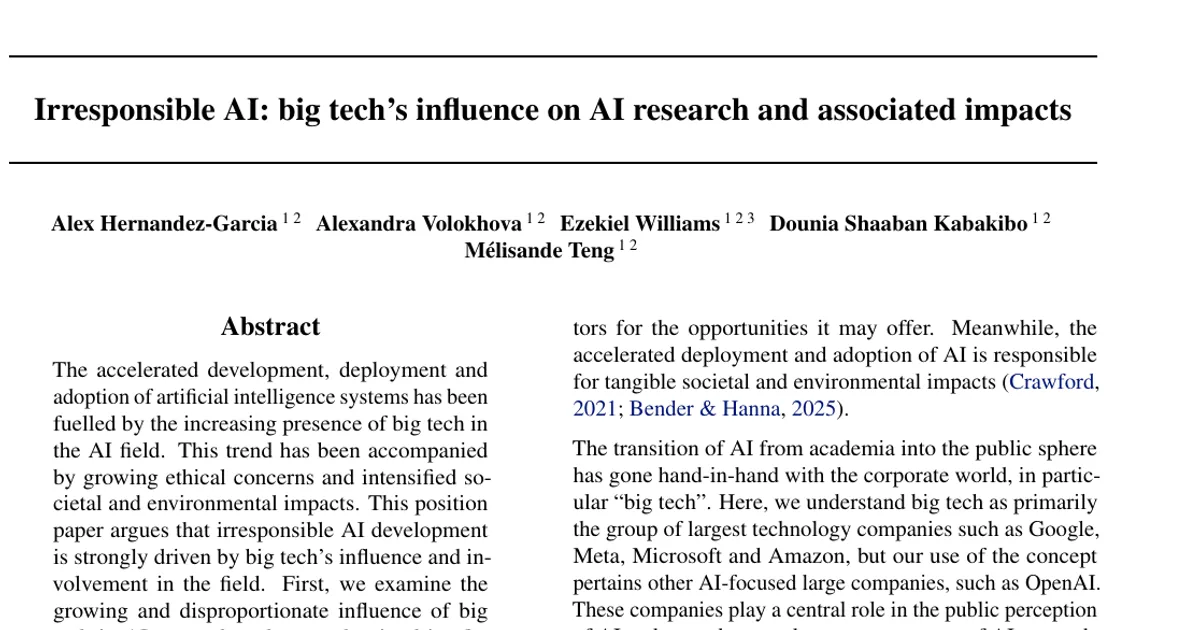
The accelerated development, deployment and adoption of artificial intelligence systems has been fuelled by the increasing presence of big tech in the AI field. This trend has been accompanied by growing ethical concerns and intensified societal and environmental impacts. This position paper argues that irresponsible AI development is strongly driven by big tech's influence and involvement in the field. First, we examine the growing and disproportionate influence of big tech in AI research and argue that its drive for scaling and general-purpose systems is fundamentally at odds with the responsible, ethical, and sustainable development of AI. Second, we review key current environmental and societal negative impacts of AI and trace their connections to big tech's influence. Third, we discuss the underlying economic forces driving big tech's actions. Finally, as a call to action, we invite AI researchers to counter big tech's influence in irresponsible AI development through strategies that build on the responsibility of implicated actors and collective action.