Research
Introducing Echo Networks for Computational Neuroevolution
Overview Research area: Neuroevolution (population-based evolution of artificial neural networks) and minimal neural network architectures for extreme-edge computing, applied to biomedical time-series
- arXiv
- 2604.08204
- Published
- 2026-04-09
- Authors
- Christian Kroos, Fabian Küch
AI summary
Overview
- Research area: Neuroevolution (population-based evolution of artificial neural networks) and minimal neural network architectures for extreme-edge computing, applied to biomedical time-series classification.
- Technical level: Advanced. The paper relies on matrix algebra, recurrent network dynamics, and genetic algorithm terminology (speciation, crossover, elitism, stochastic universal sampling).
- Scope in one sentence: The authors propose "Echo Networks," a recurrent network type fully defined by a single connection matrix with no layers and freely assignable input/output neurons, and compare them against evolved RNNs on a binary electrocardiography classification task.
What This Paper Is About
Evolutionary algorithms can produce tiny, task-specific neural networks, but the standard approach of encoding every weight separately gives mutation and recombination little systematicity, and combining two good parent networks often produces worse children. The authors introduce Echo Networks, in which the entire network topology and all weights live in one square connection matrix, so that mutation and recombination can in principle be expressed as matrix operations. They test whether such networks can compete with conventionally evolved RNNs on a real-world task.
Key Contributions
- A new network definition: Echo Networks, recurrent networks containing only a connection matrix (rows = source neurons, columns = destination neurons, entries = weights, zero = missing connection), with no layers and all neurons on the same level.
- Flexible input/output assignment: Input and output neurons (sets denoted I and O) can be assigned arbitrarily to any neuron, using optional input functions and a dedicated output function such as a sigmoid, with the output function applied to the aggregation state before the neuron's own activation.
- A genome as a single matrix: Because the genetic representation is one square matrix, matrix computations and factorisations become candidates for mutation and recombination operators, removing the need for NEAT-style historical markers or full topological analysis.
- An empirical comparison: Evolved Echo Networks were evaluated against evolved RNNs on binary classification of PTB-XL electrocardiography signals, plus a second scaled-up experiment using island populations.
Main Findings
- Echo Networks slightly outperform evolved RNNs: Over 10 evolution runs, Echo Networks reached a mean accuracy of 0.687 (std 0.005, min 0.679, max 0.696), while evolved RNNs reached a mean of 0.671 (std 0.007, min 0.662, max 0.684).
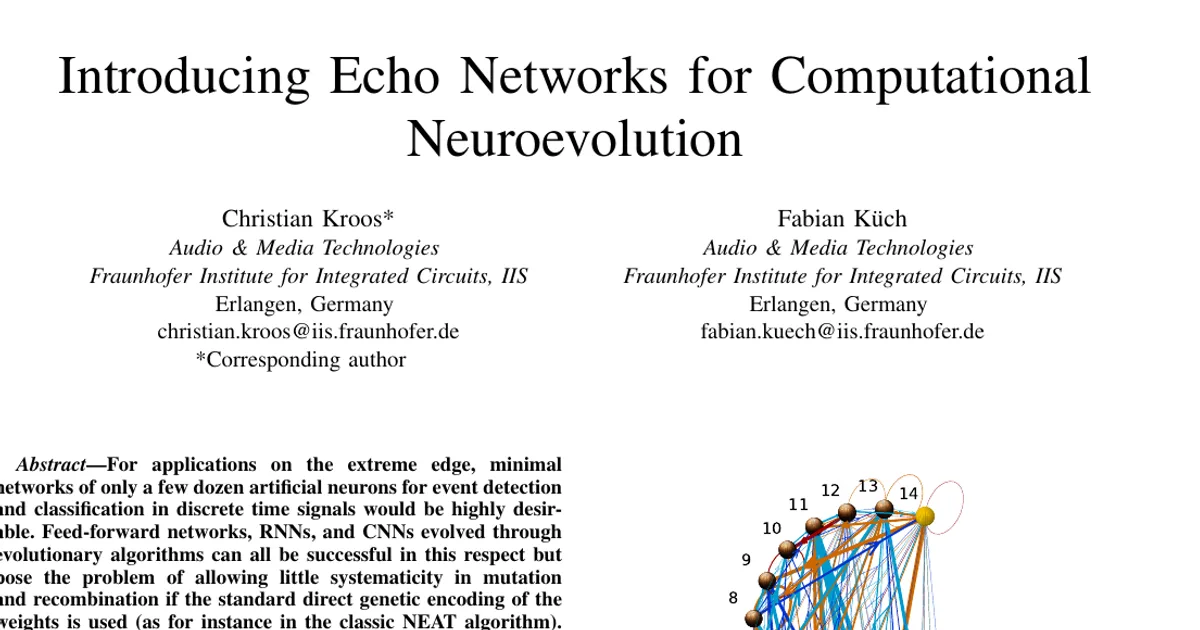
- Smaller networks achieved higher accuracy: The best Echo Network reported (Fig. 4, accuracy 0.696) had 11 neurons and 121 weights, of which 97 were non-zero; a sample evolved RNN (Fig. 1, accuracy 0.684) had 21 neurons and 250 weights.
- Scaling up helped: A second experiment with 8 populations of 120 individuals using islands (individual exchange every 4 generations) produced a mean accuracy of 0.701, std 0.009, and a maximum of 0.717. That best network had 24 neurons and 576 weights (447 non-zero).
- Validation tracked across generations: The best network was retained based on validation error and reached its best at generation 195 (Fig. 6), with the run cut off at 200 generations to keep networks small enough to visualise.
- Initialisation mattered: Initialising post-activation values to 1 gave better results than the seemingly obvious choice of 0.
- Data filtering shaped the benchmark: From 21,837 ten-second recordings of 18,885 patients, 5,041 recordings without human annotation and 243 low-confidence training recordings (plus 65 validation and 71 test ones) were excluded, and 2,174 recordings were held aside; the final unbalanced split was 9,960 training / 2,133 validation / 2,112 test recordings, balanced to 1,796 and 1,768 for validation and test.
Methodology in Plain English
The authors used computational neuroevolution, starting from the method of their previous work (itself based on NEAT) and modifying it for the ECG task. A single population of 200 individuals evolved for 200 generations. In each generation only 5% of the training recordings (498 recordings) were selected stochastically for evaluation. Each network received triplets of consecutive raw data points at each evaluation step through three input neurons, produced a binary value via sigmoid and rounding (0 = normal, 1 = atypical), and the 998 resulting output values were averaged with a threshold applied to classify the whole recording. Fitness was the inverse of the classification error, smoothed by averaging with the previous generation's value to temper the strong variability of stochastic neuroevolution.
Speciation assigned sufficiently different networks to their own species, with fitness comparison only within species, and shared fitness normalised an individual's fitness by its species size. Selection used stochastic universal sampling, elimination was 66%, and the top 6 fittest individuals were carried over unchanged (elitism). Mutation used either a fresh Gaussian draw or Gaussian perturbation with equal probability 0.5, and recombination used crossover or weight averaging with equal probability 0.5. Networks could gain or lose neurons and synapses. The starting generation contained only three input neurons, the output neuron, a bias neuron and their connections; the activation function was ReLU and was not mutated. Input functions in Echo Networks were the identity for two neurons and a sign reversal for one. Each run was repeated ten times for a coarse estimate of random variability, and the best-validation network was finally applied to the test set.
For the ECG data, only the standard limb lead III channel at 100 Hz was used (the 500 Hz original version was also offered), arranged into all instances of 3 consecutive samples without zero-padding, giving a matrix of 998 x 3. Training used PTB-XL subsets 1 to 8, subset 9 for validation, and subset 10 as test. Bias behaviour in Echo Networks is created implicitly by setting a neuron's column to 0 and its diagonal entry to 1, keeping all genetic information in one matrix.
Why This Matters
- Research impact: The paper targets a known weakness of direct genetic encoding in neuroevolution, namely that small genetic changes can cause large performance changes and that recombining good parents often yields poor children. Representing the genome as a single matrix opens the door to theory-guided, matrix-based mutation and recombination, and to analysing the solution space for a given task.
- Real-world applications:
- Minimal event detection and classification in discrete time signals on extreme-edge devices with tight energy and memory limits.
- Wearable or embedded electrocardiography monitoring, given the demonstrated binary normal-versus-atypical classification.
- Acoustic event detection and anomaly detection, the task family that motivated the original method.
- Any embedded classification task where a network of a few dozen neurons rather than a few thousand parameters is required.
- Industry relevance: The authors are based at Fraunhofer Institute for Integrated Circuits IIS (Audio & Media Technologies), and the work was funded by the Bavarian Ministry of Economic Affairs, Regional Development and Energy within the Digital Signal Processing using Artificial Intelligence (DSAI) project, indicating direct relevance to embedded signal-processing products.
Future Directions
- Broaden the empirical evaluation of Echo Networks across a wide range of tasks and datasets, since the authors state that more evaluations and comparisons are clearly needed beyond this single ECG experiment.
- Test whether Echo Networks can be trained by methods other than neuroevolution: gradient descent and backpropagation, the forward gradient, or the forward-forward algorithm. How well they would perform is described as currently unclear.
- Develop principled, matrix-based mutation and recombination operators (including factorisations) to replace the current heuristics, and verify the claim that similar connection matrices yield similar inference performance.
- Scale Echo Networks into larger composite networks, either strictly recursively (Echo Networks containing Echo Networks) or as irregular nettings of differently sized Echo Networks without hierarchy, possibly combined with a dynamic routing mechanism exploiting the fact that input and output neurons are not structurally fixed.
Target Audience
Researchers and practitioners in neuroevolution, evolutionary computation, and neural architecture search; engineers working on extreme-edge or embedded machine learning with severe memory and energy constraints; and biomedical signal-processing researchers interested in minimal models for ECG or similar time-series classification. Readers should be comfortable with recurrent network formulations and basic matrix algebra, since the core contribution is defined mathematically.
Authors’ abstract
For applications on the extreme edge, minimal networks of only a few dozen artificial neurons for event detection and classification in discrete time signals would be highly desirable. Feed-forward networks, RNNs, and CNNs evolved through evolutionary algorithms can all be successful in this respect but pose the problem of allowing little systematicity in mutation and recombination if the standard direct genetic encoding of the weights is used (as for instance in the classic NEAT algorithm). We therefore introduce Echo Networks, a type of recurrent network that consists of the connection matrix only, with the source neurons of the synapses represented as rows, destination neurons as columns and weights as entries. There are no layers, and connections between neurons can be bidirectional but are technically all recurrent. Input and output can be arbitrarily assigned to any of the neurons and only use an additional (optional) function in their computational path, e.g., a sigmoid to obtain a binary classification output. We evaluated Echo Networks successfully on the classification of electrocardiography signals but see the most promising potential in their genome representation as a single matrix, allowing matrix computations and factorisations as mutation and recombination operators.