Research
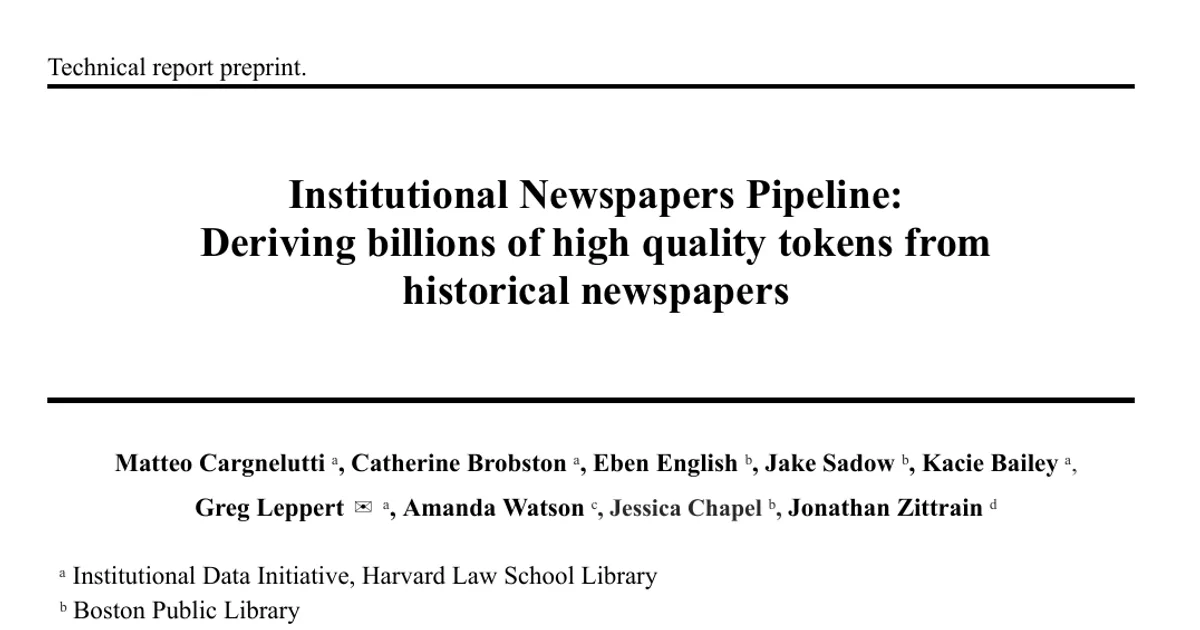
Institutional Newspapers Pipeline: Deriving billions of high quality tokens from historical newspapers
Overview Research area: Natural Language Processing / digital humanities — document layout analysis and large-scale OCR-based corpus construction from historical newspaper scans. Technical level: Inte
- arXiv
- 2608.18972
- Published
- 2026-08-19
- Authors
- Matteo Cargnelutti, Catherine Brobston, Eben English, Jake Sadow, Kacie Bailey, Greg Leppert, Amanda Watson, Jessica Chapel, Jonathan Zittrain
AI summary
Overview
Research area: Natural Language Processing / digital humanities — document layout analysis and large-scale OCR-based corpus construction from historical newspaper scans.
Technical level: Intermediate. The abstract describes a modular multi-stage pipeline combining computer vision, OCR, classification, and NLP, but presents it at a system-design level rather than diving into model architectures.
Scope: A description of a jointly designed pipeline (built with Boston Public Library) that converts historical newspaper scans into structured, annotated datasets, along with the release of the pipeline, trained models, and an open dataset derived from a portion of the library's holdings.
What This Paper Is About
Historical newspapers are a rich record of public life, but their dense, irregular, and sometimes noisy page layouts make them hard to process computationally, so access to these materials has remained limited. The authors built a modular pipeline with Boston Public Library that turns newspaper scans into high-quality structured datasets, processing each scan through segmentation, OCR, and a series of downstream text analyses. The goal is to make historical newspaper content usable at scale while keeping the system interpretable, customizable, and cheap enough to run on ordinary workstation hardware.
Key Contributions
-
A modular, interpretable pipeline design. Every processing step was architected to remain individually interpretable and customizable, and the whole system was designed to be computationally frugal enough to run on workstation-level hardware rather than requiring large-scale infrastructure.
-
A multi-stage processing chain applied uniformly to every scan. Each scan is segmented into individual type-agnostic crops, OCR is run on each segment, and then each crop receives text analysis, type classification, reading order detection, named entity recognition, subject classification, language detection, and pre-computed embedding generation.
-
Small, purpose-trained models. The authors trained their own small models for the pipeline's processing steps and report on them as part of the work.
-
An open dataset and open release. Running the pipeline over a portion of Boston Public Library's holdings produced a released open dataset, and the paper accompanies the public release of the pipeline, the models, and the dataset.
Main Findings
-
Scale of extracted text: The OCR output represents 16.3 billion o200k_base tokens.
-
Scale of segmentation: Those tokens come from 83.1 million individual crops.
-
Source material: The crops were extracted from 1,473,635 public domain newspaper scans, published between 1795 and 1930.
-
Per-crop enrichment: Beyond OCR text, every crop carries annotations produced by the downstream steps — type classification, reading order, named entities, subject classification, language, and pre-computed embeddings.
-
Evaluation and measurements were collected: The report describes evaluation results and dataset-scale measurements gathered during processing, though the abstract itself does not state the specific evaluation figures or metric values.
-
Positioning claim: The authors frame this as a substantial step toward unlocking high-quality data from tens of millions of newspaper scans.
Methodology in Plain English
The researchers started from raw page images of historical newspapers and designed a pipeline that handles one scan at a time in a fixed sequence of steps. First, each scan is broken into separate crops without assuming what kind of content each crop holds (type-agnostic segmentation), which lets later stages decide what each region actually is. Each crop then goes through optical character recognition to produce text. On top of that text, a set of analyses run for every crop: general text analysis, classification of what type of content it is, detection of the order in which the text should be read, recognition of named entities, assignment of subject categories, language detection, and generation of embeddings that are stored ahead of time so downstream users do not have to recompute them.
Two design constraints shaped the work. Each step was kept interpretable and customizable so that institutions could inspect and adjust behavior, and the whole pipeline was kept inexpensive enough to run on workstation-class hardware, making the approach feasible for libraries without large compute budgets. The authors also trained small models for the pipeline's tasks rather than relying solely on large general-purpose models. The pipeline was then run over part of Boston Public Library's holdings, and the outputs were packaged as an open dataset released alongside the pipeline and models. The abstract notes that the report documents methods for each step, the trained small models, evaluation results, and dataset-scale measurements, but it does not provide those evaluation details.
Why This Matters
Impact on research: Historical newspapers have been difficult to use computationally because of their dense, irregular layouts. A pipeline that produces structured, annotated, embedding-ready text at scale gives researchers in NLP, history, linguistics, and the digital humanities a path to work with this material directly rather than treating it as inaccessible imagery.
Real-world applications:
- Digital humanities and historical scholarship: Searching, tracing, and analyzing topics, people, and language across centuries of newspaper text.
- Cultural heritage institutions: Libraries and archives can adopt or adapt the pipeline to expose their own holdings as structured data without enterprise-scale infrastructure.
- Language model and NLP training data: Pre-computed embeddings and large volumes of cleaned OCR text support downstream model development, particularly for historical or domain-specific language.
- Named entity and subject-based discovery tools: The entity recognition and subject classification outputs enable browsing and indexing by people, places, and topics rather than only by keyword.
Industry relevance: The emphasis on modularity, interpretability, and workstation-level compute speaks directly to organizations with valuable document archives but limited budgets. Pre-computed embeddings and per-crop metadata are directly useful to search, retrieval, and content-discovery products built on archival text.
Future Directions
-
Scaling beyond the current holdings: The authors explicitly position the work as a step toward processing tens of millions of newspaper scans, so extending coverage beyond the portion of Boston Public Library's holdings used here is the obvious next move.
-
Reuse and adaptation by other institutions: Because the pipeline is modular and customizable by design, a natural follow-up is adoption by other libraries and archives with different layouts, languages, and publication conventions.
-
Evaluation of downstream usefulness: Since the abstract reports 16.3 billion tokens and 83.1 million crops but not how well the individual analysis steps perform in detail, further work could establish how usable these annotations are for specific research and model-training tasks.
-
Open questions about generalization: Public domain scans from 1795 to 1930 are one narrow slice; how the small trained models and each processing step hold up on later material, non-English newspapers, or very different print quality remains open.
Target Audience
This paper is most useful to digital library and cultural heritage practitioners evaluating how to make archival scans computationally accessible, and to NLP and digital humanities researchers who need large, structured historical text corpora. It also serves ML engineers interested in building interpretable, low-compute document processing pipelines, and anyone planning to use the released dataset, models, or pipeline in their own work.
Authors’ abstract
Historical newspapers are an abundant record of public life, but their dense, irregular and sometimes noisy layouts make computational access to these materials both challenging and limited. We present the Institutional Newspapers Pipeline, a modular system we jointly designed with Boston Public Library to extract high-quality, structured datasets from historical newspaper scans. It was architected so that each step remains interpretable and customizable, and so that the pipeline as a whole remains computationally frugal enough to run on workstation-level hardware. The pipeline runs each scan through a multi-step process: it segments scans into individual type-agnostic crops and performs OCR on each resulting segment before then performing text analysis, type classification, reading order detection, named entities recognition, subject classification, language detection, and pre-computed embeddings generation on every crop. We ran this pipeline against a portion of Boston Public Library's holdings and released the results as an open dataset. The optical character recognition (OCR) output represents 16.3 billion o200k_base tokens across 83.1 million individual crops, extracted from 1,473,635 public domain newspaper scans published between 1795 and 1930. This report describes our methods for each processing step, the small models we trained, as well as the evaluation results and dataset-scale measurements we collected in the process. It accompanies the release of the pipeline, models, and dataset. We position this work as a substantial step towards unlocking high-quality data from tens of millions of newspaper scans.