Research
Improving Predictive Confidence in Medical Imaging via Online Label Smoothing
Overview Research area: Medical image classification with deep learning; specifically, confidence calibration and label-smoothing techniques for convolutional neural networks. Technical level: Interme
- arXiv
- 2510.20011
- Published
- 2025-10-22
- Authors
- Kushan Choudhury, Shubhrodeep Roy, Ankur Chanda, Shubhajit Biswas, Somenath Kuiry
AI summary
Overview
- Research area: Medical image classification with deep learning; specifically, confidence calibration and label-smoothing techniques for convolutional neural networks.
- Technical level: Intermediate. The paper assumes familiarity with CNNs, softmax classification, label smoothing, and knowledge distillation, but its central idea — adjusting training targets dynamically — is conceptually accessible.
- Scope: An evaluation of Online Label Smoothing (OLS) as a training strategy for medical image classification, tested on one large-scale dataset across three standard architectures and compared against several alternative training approaches.
What This Paper Is About
Convolutional neural networks classify medical images well, but they tend to output overly confident probabilities — a serious problem when clinicians or automated systems rely on those probabilities to judge how much to trust a prediction. Standard label smoothing is a common fix, but it applies the same small penalty to every incorrect class, ignoring the fact that some classes are genuinely more similar to the correct one than others. The paper's goal is to test whether Online Label Smoothing, which updates these training targets over the course of training based on what the model itself is learning, produces better and more trustworthy predictions than existing alternatives in the medical imaging setting.
Key Contributions
-
Application of Online Label Smoothing to medical imaging. The authors bring OLS — a dynamic soft-labeling scheme that revises non-target class targets during training according to the model's own prediction patterns — into the medical image classification domain, where overconfidence is especially consequential.
-
A comparative evaluation against multiple training regimes. OLS is benchmarked against plain hard labels, conventional (static) label smoothing, and teacher-free knowledge distillation, giving a broader picture than a single baseline comparison.
-
Cross-architecture testing. The evaluation spans three widely used convolutional architectures — ResNet-50, MobileNetV2, and VGG-19 — on the large-scale RadImageNet dataset, so the findings are not tied to one model family.
-
Analysis beyond accuracy. The paper reports that OLS also yields more compact and better-separated feature embeddings, connecting the label-smoothing choice to the quality of the learned representation, not just to classification scores.
Main Findings
-
Improved accuracy over standard training: OLS is reported to consistently improve both Top-1 and Top-5 classification accuracy relative to standard training methods. The abstract does not state the magnitude of these gains or any numeric results.
-
Improvement holds across comparison methods: The accuracy advantage is described as holding against hard labels, conventional label smoothing, and teacher-free knowledge distillation — meaning OLS outperformed a static smoothing baseline and a distillation-based alternative, not just unregularized training.
-
Consistency across architectures: The benefit is described as consistent across ResNet-50, MobileNetV2, and VGG-19, suggesting the method is not specific to a single network design. The abstract does not report per-architecture figures.
-
Better-structured feature representations: Beyond accuracy, OLS is said to produce more compact and well-separated feature embeddings, which the authors interpret as evidence of improved representation learning. No quantitative embedding metrics are given in the abstract.
-
Improved calibration as an inferred benefit: The authors frame the result as strengthening both predictive performance and calibration, supporting the use of OLS for trustworthy AI in healthcare. The abstract does not report separate calibration metrics such as expected calibration error.
Methodology in Plain English
When a network is trained, each image is normally paired with a target that says "this class is correct, all others are wrong." Label smoothing softens that target slightly, spreading a small amount of probability mass onto the other classes so the model is not pushed to be maximally confident. The catch is that this spreading is fixed and uniform — every other class receives the same small share, whether it looks nothing like the correct class or a great deal like it.
Online Label Smoothing changes this by making the targets dynamic. Rather than fixing them in advance, the method adjusts the soft labels as training proceeds, using the model's own evolving predictions to decide how much weight each non-target class should receive. Classes the model finds genuinely confusable with the correct one end up with a different share than classes it easily distinguishes.
The authors trained three standard architectures on RadImageNet under this scheme and compared the outcomes against hard labels, conventional label smoothing, and teacher-free knowledge distillation. They examined both classification accuracy and the geometry of the learned feature space. The abstract does not describe the specific update rule, the training schedule, or the precise evaluation protocol used.
Why This Matters
Medical AI systems are increasingly used in settings where a wrong prediction can harm a patient, so a model that says "99 percent confident" when it is in fact guessing is dangerous regardless of its average accuracy. This work addresses that reliability gap with a change to the training procedure that requires no new network architecture, no additional labeled data, and no separate teacher model — which makes it comparatively easy to adopt.
Real-world applications:
- Computer-aided diagnosis: Confidence scores from diagnostic classifiers feed into triage or referral decisions; better-calibrated scores make those downstream decisions safer.
- Radiology workflow prioritization: Systems that flag urgent studies for human review depend on confidence thresholds, which behave more predictably when the underlying model is not overconfident.
- Uncertainty-aware referral to specialists: Models that can express genuine uncertainty can route ambiguous cases to a human expert rather than forcing a classification.
- Regulatory documentation and post-market monitoring: Regulators and hospital systems increasingly expect evidence about model reliability and calibration, not accuracy alone.
Industry relevance: Medical device companies and health-AI vendors need methods that improve trustworthiness without retraining pipelines from scratch or adding inference cost, since OLS modifies only the training targets and leaves the deployed model unchanged. That combination — no architectural change, no extra inference overhead — is attractive for teams that must validate and certify a fixed production model.
Future Directions
- Calibration-specific measurement: The abstract argues for enhanced calibration but does not report dedicated calibration metrics. A natural follow-up is to quantify reliability directly, for example with calibration error and reliability diagrams, rather than inferring it from accuracy and embedding structure.
- Generalization beyond RadImageNet: Testing on other medical imaging modalities and datasets — and on smaller, more imbalanced clinical datasets rather than a single large-scale benchmark — would clarify whether the gains depend on dataset scale or class structure.
- Extension to other task types: The paper studies classification. Whether online label smoothing helps segmentation, detection, or multi-label diagnostic tasks, where the notion of a "non-target class" is less straightforward, remains open.
- Interaction with other regularization and uncertainty methods: How OLS combines with data augmentation, ensembling, or explicit Bayesian and evidential uncertainty approaches is not addressed and could matter in practice.
- Update-rule and hyperparameter sensitivity: Because OLS depends on the model's evolving predictions, the design of the update schedule and its sensitivity to training length and learning rate are questions the abstract leaves unanswered.
Target Audience
- Medical imaging and clinical ML researchers looking for training-time interventions that improve reliability without architectural changes.
- Practitioners building diagnostic or triage systems who need calibration improvements that survive deployment constraints.
- Machine learning researchers working on label smoothing, calibration, and knowledge distillation, who will find the comparison against conventional smoothing and teacher-free distillation directly relevant.
- Graduate students and engineers with working knowledge of CNNs who want an accessible entry point into why overconfidence matters and how training targets can be adjusted dynamically.
Note: Only the abstract was available for this summary. Numerical results, dataset statistics, experimental protocols, and calibration measurements referenced in the full paper are not reported here because the abstract does not contain them.
Authors’ abstract
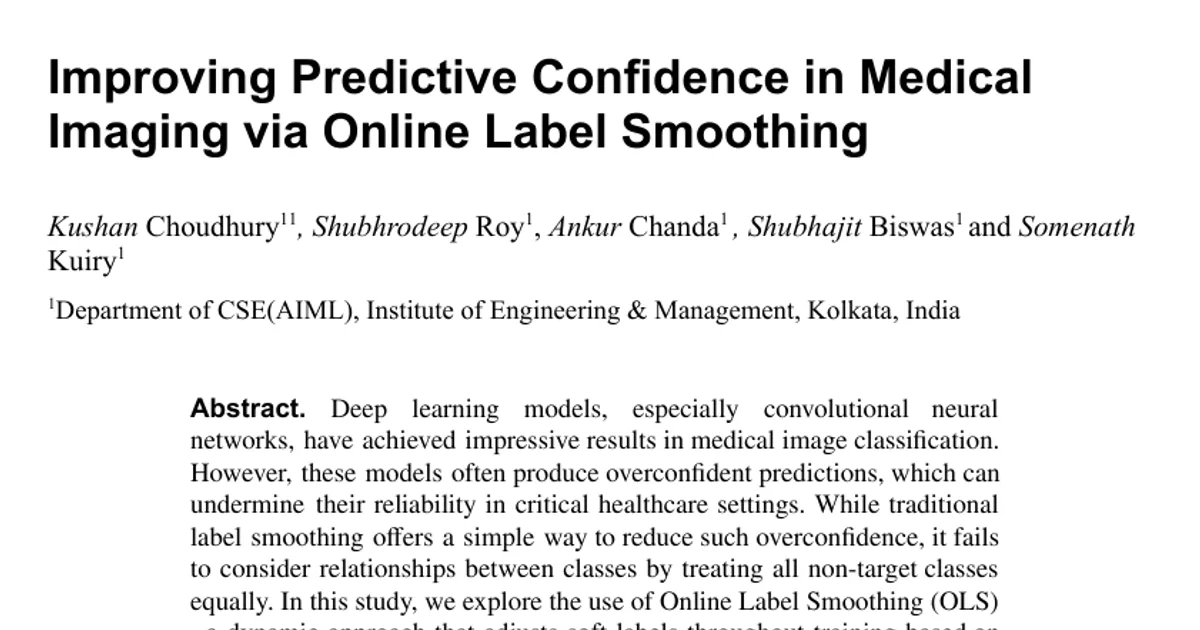
Deep learning models, especially convolutional neural networks, have achieved impressive results in medical image classification. However, these models often produce overconfident predictions, which can undermine their reliability in critical healthcare settings. While traditional label smoothing offers a simple way to reduce such overconfidence, it fails to consider relationships between classes by treating all non-target classes equally. In this study, we explore the use of Online Label Smoothing (OLS), a dynamic approach that adjusts soft labels throughout training based on the model's own prediction patterns. We evaluate OLS on the large-scale RadImageNet dataset using three widely used architectures: ResNet-50, MobileNetV2, and VGG-19. Our results show that OLS consistently improves both Top-1 and Top-5 classification accuracy compared to standard training methods, including hard labels, conventional label smoothing, and teacher-free knowledge distillation. In addition to accuracy gains, OLS leads to more compact and well-separated feature embeddings, indicating improved representation learning. These findings suggest that OLS not only strengthens predictive performance but also enhances calibration, making it a practical and effective solution for developing trustworthy AI systems in the medical imaging domain.