Research
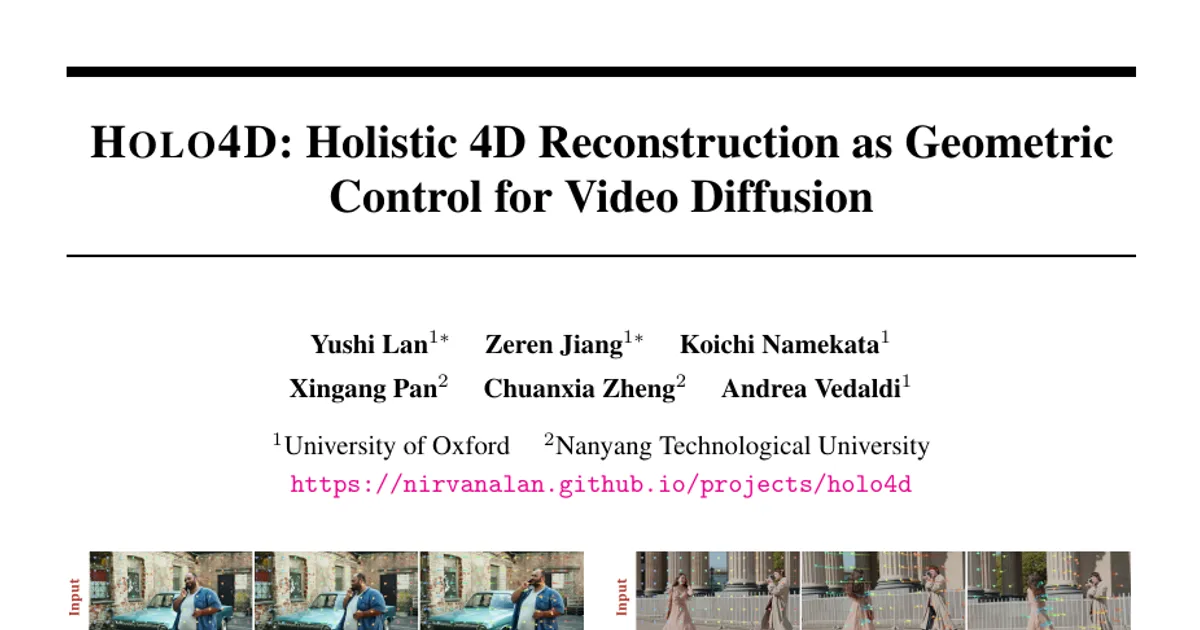
Holo4D: Holistic 4D Reconstruction as Geometric Control for Video Diffusion
Overview Research area: Computer vision, specifically 4D scene reconstruction combined with camera-controlled video diffusion for novel-view video synthesis (video "reshooting"). Technical level: Adva
- arXiv
- 2610.25276
- Published
- 2026-10-18
- Authors
- Yushi Lan, Zeren Jiang, Koichi Namekata, Xingang Pan, Chuanxia Zheng, Andrea Vedaldi
AI summary
Overview
Research area: Computer vision, specifically 4D scene reconstruction combined with camera-controlled video diffusion for novel-view video synthesis (video "reshooting"). Technical level: Advanced. The paper assumes familiarity with diffusion transformers, latent video models, point-map reconstruction, and camera parameterization. Scope (one sentence): Holo4D converts persistent 3D point trajectories recovered from a source video into a geometric conditioning signal that steers a pretrained video diffusion model to re-render that video from a new camera path.
What This Paper Is About
Given a single monocular video, the goal is to generate the same scene and the same motion as seen from a different, user-specified camera trajectory — not a different scene, and not a different action. Reconstruction alone cannot do this because surfaces never observed in the source video leave holes, and video diffusion alone cannot do it because a plausible video may not preserve the specific geometry and dynamics of the recorded scene. Holo4D bridges the two: reconstructed 4D trajectories define where observed content should land in each target frame, and the diffusion prior fills in what the newly revealed regions should look like.
Key Contributions
- A holistic 4D geometric scaffold. Static and dynamic scene content are represented uniformly as persistent 3D trajectories, each carrying the appearance sampled from its source observation. A static point is simply a trajectory with constant position, so one encoder handles both cases.
- A channel-wise conditioning design. Projected trajectory features are concatenated into the hidden channels of every diffusion transformer (DiT) block rather than appended as extra attention tokens, combined with source-video context (concatenated along width) and Plücker-ray camera features.
- Reconstructor-agnostic interface. Because the condition consists of explicit geometric quantities (positions, colors, target-camera depth, validity) rather than reconstructor-specific hidden features, the video generator can be paired with different 4D reconstructors without retraining.
- Broad evaluation. Camera-adherence and held-out-view benchmarks against ReCamMaster, TrajectoryCrafter, EX-4D, Gen3C, and Vista4D, plus reconstructor-substitution studies, trajectory-noise perturbation analysis, long-video rollout, and zero-shot robot-video reshooting.
Main Findings
- Best trajectory accuracy on DAVIS. Across 100 video–trajectory pairs evaluated with VGGT-Ω camera recovery, Holo4D records ATE 1.657 and RPE-T 2.415 (tabulated in units of ×10² and ×10³ respectively), versus Vista4D's 3.576 and 3.608. With both methods using 4RC source reconstruction, this is a 54% reduction in ATE and a 33% reduction in RPE-T.
- Rotation is a partial exception. ReCamMaster achieves a slightly lower rotation error (0.099° versus 0.102°), but it also has the largest trajectory error of all methods (ATE 9.547), consistent with outputs that stay near the source viewpoint.
- Best PSNR and LPIPS on iPhone held-out views. With the two-stage VGGT-Ω + CoWTracker backend, Holo4D reaches PSNR 13.20, LPIPS 0.465, masked PSNR 14.03, and masked LPIPS 0.379, ahead of EX-4D and Vista4D; EX-4D retains the best SSIM.
- Strongest results on Syn4D with ground-truth geometry. Using exact source geometry removes reconstruction error: ATE 1.065, RPE-R 0.073°, PSNR 16.52, SSIM 0.441, LPIPS 0.119, and FVD 973, versus Vista4D's FVD of 1214.
- Better generated-view depth. Reconstructing depth from the generated videos, Holo4D has the lowest AbsRel and highest δ₁ under both VGGT-Ω and 4RC; the VGGT-Ω AbsRel falls from Vista4D's 0.628 to 0.423.
- Track-attached color is essential. Removing per-track source color raises ATE by 44% (1.621 to 2.327) even though the source video is still available, showing the color channel is not redundant with video context. Removing target depth matters less; adding rendered RGB and mask features improves no camera metric.
- Backends trade off differently. Without retraining, CoWTracker gives the best ATE, PSNR, and SSIM (1.205, 15.09, 0.294), V-DPM the best rotation error (0.079°), and 4RC the best LPIPS (0.131). Ground-truth geometry improves all five metrics, indicating headroom from better reconstructors.
- Geometric noise hurts disproportionately. Adding Gaussian noise at only α = 0.1 to ground-truth tracks triples rotation error (0.073° to 0.221°) and degrades SSIM and LPIPS despite the clean source video being available.
- Backend substitution fixes rotation on Vista4D's 110 trajectories. Switching from 4RC to the two-stage backend cuts rotation error by 74% under VGGT-Ω and 59% under Pi3 (14.98° to 6.098°), though Pi3 rotation remains above Vista4D's 4.169°.
- Faster denoising, similar end-to-end time. Channel-wise injection adds no attention tokens: 1.34× denoising speedup (7.39 s versus 9.89 s) at similar peak memory, but per-video end-to-end time is comparable (570.9 s versus 581.9 s) because loading, conditioning, decoding, and writing offset the gain.
- Zero-shot robot reshooting works. Holo4D-14B, trained without robot data, reshoots DROID manipulation episodes and humanoid clips; a 196-frame DROID episode is rolled out in five 49-frame windows.
- Mixed policy-learning transfer. Initializing Fast-WAM's 30 video self-attention blocks from a 5B Holo4D variant gives 96.45% on LIBERO versus 95.60% for a Wan2.2 control, and 52.10% versus 50.81% on LIBERO-plus (+1.29 points overall, with +7.1 on background texture and +3.9 on lighting), but loses on the spatial suite. The authors call the result mixed and single-seed.
Methodology in Plain English
The pipeline has two halves. The top half runs a feed-forward 4D reconstructor on the source video to recover camera poses and a set of 3D trajectories — one per scene point, tracked across frames, each tagged with a color sampled from the frame where it was observed. Everything is expressed in the coordinate frame of the first source camera, so static points sit still and moving points trace their motion. Each trajectory point is then projected into the requested target cameras, giving a pixel location, a target-camera depth, and a validity flag. These attributes are encoded by a small network, splatted onto a target-view grid, merged per cell with a channel-wise maximum (plus an occupancy channel), and passed through a causal 3D convolution so they match the diffusion model's token grid. Empty cells get a learned null embedding, and the volume size does not depend on how many trajectories there are.
The bottom half is a pretrained video diffusion transformer (Wan2.1-T2V-14B). The source video is encoded into latents and concatenated with the noisy target latents along the width, so synchronized source and target frames share a temporal index. The trajectory features are concatenated along channels inside every DiT block before self-attention, alongside Plücker-ray camera features added to the projected hidden state. The projection is zero-initialized in the ControlNet style, so training starts from the pretrained behavior. Only the target latents are supervised, with a rectified-flow objective; no geometry is predicted.
Training uses 49-frame clips, 15k steps at 144×256 then 4.5k steps at 384×672, on a mixture of synthetic multiview dynamic scenes, real static-scene videos, and synthetic static sequences. The second stage deliberately perturbs trajectory density, query-frame sampling, and geometry so the model tolerates imperfect conditions. Conditioning modules and DiT self-attention are trained; cross-attention and feed-forward layers stay frozen. At inference, reconstruction is paid once per source video and reused across all target trajectories; only projection and encoding repeat.
Why This Matters
Research impact. The paper reframes the reconstruction-versus-generation debate: instead of asking the generator to infer geometry implicitly, it supplies an explicit, reconstructor-agnostic scaffold. The demonstration that swapping the 4D reconstructor improves camera adherence without retraining the generator is a practical recipe — the video model inherits future gains in reconstruction for free.
Real-world applications.
- Video post-production and VFX: re-shooting a captured take from a new camera angle without reshooting the actors or rebuilding the set.
- Robotics: generating additional viewpoints of recorded manipulation and humanoid episodes for data augmentation and policy pretraining, as shown on DROID and LIBERO.
- Immersive media: producing stereo or six-degrees-of-freedom viewing content from ordinary monocular footage for VR and AR.
- Sports and event replay: synthesizing an alternate camera path over a recorded dynamic scene while preserving the actual motion that occurred.
Industry relevance. The method is built on an open pretrained backbone (Wan2.1-T2V-14B) and adds a lightweight, token-free conditioning path, which keeps inference costs close to the base model. That makes it attractive for production pipelines where camera control must be reliable rather than merely plausible, and where upstream reconstruction tools are expected to keep improving.
Future Directions
- Joint reconstruction and generation. The authors propose a single model that performs 4D reconstruction and novel-view synthesis together so both improve in tandem, motivated by the view that video generators are general-purpose vision learners.
- Querying trajectories in every source frame. Current inference queries points only in the first source frame, which misses content that appears later; the authors point to UniQueR as an example of the alternative.
- Stronger base models. Scaling to backbones such as MiniMax H3 is expected to improve visual quality.
- Robustness to geometry and coverage. The noise study shows small trajectory errors cause large rotation degradation, and the authors acknowledge sensitivity to geometric error, incomplete source coverage, and difficult camera trajectories as open limitations. Whether novel-view training actually helps embodied policies also remains unresolved.
Target Audience
Researchers and graduate students working on video diffusion, camera-controlled generation, and 4D/novel-view synthesis will get the most from this paper, particularly those interested in how geometric conditions should be interfaced with diffusion transformers. It is also relevant to practitioners building video re-shooting or VFX tools on top of pretrained video models, and to robotics researchers exploring video-generation backbones as world models or policy initializations. Readers without a background in diffusion models or multi-view geometry will find the method sections demanding.
Authors’ abstract
Synthesizing a monocular video from a new camera trajectory requires preserving the observed scene geometry and motion while completing regions that become newly visible. Feed-forward 4D reconstructors recover the structure of the observed scene, whereas video diffusion models provide a generative prior for completing unseen content. We introduce Holo4D, a video reshooting framework that uses reconstructed 3D trajectories as a holistic source-view 4D scaffold. We project these trajectories into the requested views and encode their geometry and source appearance to guide a pretrained video diffusion model. Together with the source video and target cameras, the scaffold grounds generation in reconstructed observations while leaving unsupported regions to the generative prior. Experiments demonstrate the value of trajectory-based conditioning for camera control and novel-view synthesis. The framework accommodates different 4D reconstructors without retraining the video generator, allowing it to benefit from future advances in source reconstruction. More details can be found in our project page.