Research
Histopath-C: Towards Realistic Domain Shifts for Histopathology Vision-Language Adaptation
Overview Research area: Medical computer vision — test-time adaptation (TTA) of histopathology vision-language models (VLMs) under realistic image corruptions. Technical level: Advanced. The paper ass
- arXiv
- 2601.12493
- Published
- 2026-01-18
- Authors
- Mehrdad Noori, Gustavo Adolfo Vargas Hakim, David Osowiechi, Fereshteh Shakeri, Ali Bahri, Moslem Yazdanpanah, Sahar Dastani, Ismail Ben Ayed, Christian Desrosiers
AI summary
Overview
- Research area: Medical computer vision — test-time adaptation (TTA) of histopathology vision-language models (VLMs) under realistic image corruptions.
- Technical level: Advanced. The paper assumes familiarity with contrastive vision-language pretraining (CLIP-style), test-time adaptation, entropy minimization, pseudolabeling, and low-rank adaptation (LoRA).
- Scope: The paper introduces Histopath-C, a benchmark of 10 synthetic histopathology corruptions that can be applied on the fly to any dataset, and proposes LATTE, a transductive low-rank adaptation method with multi-template loss ensembling, evaluated across five histopathology datasets and three pathology VLMs.
What This Paper Is About
Histopathology VLMs such as Quilt, PathGen, and CONCH perform well on clean slides but degrade sharply when images are affected by real-world artifacts like staining variation, dust, air bubbles, blur, noise, and illumination changes. Existing test-time adaptation methods were designed for natural images and behave inconsistently on these shifts. The paper's goal is to build a controlled benchmark that reproduces these histopathology-specific shifts and to propose an adaptation method that stays robust under them.
Key Contributions
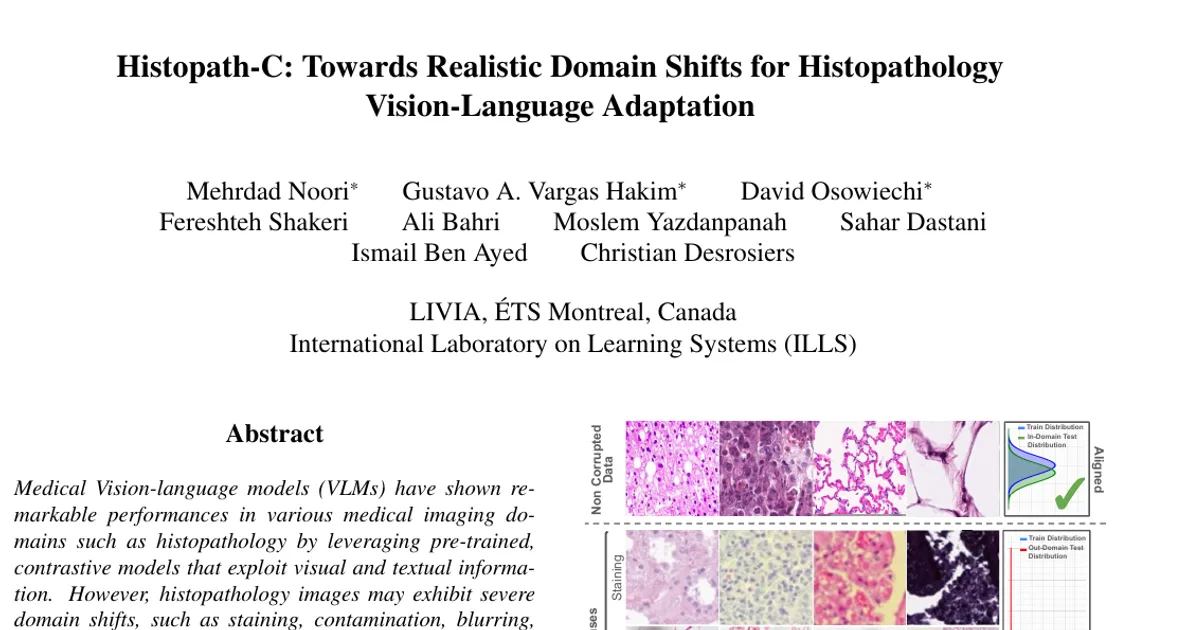
- Histopath-C benchmark: A new benchmark comprising 10 diverse domain shifts (grouped into Staining, Contamination, Blurring, Noise, and Illumination) that resemble real-world histopathology corruptions, with a framework for applying them on the fly to any existing dataset.
- Baseline evaluation of TTA methods: An evaluation of recent VLM TTA methods (TENT, LAME, TPT, CLIPArTT) showing that the benchmark severely degrades their performance and that existing baselines fail to address it consistently.
- LATTE: Low-rank Adaptation with Transductive Template Ensembling, an adaptation method combining loss-level aggregation across multiple text templates, transductive pseudolabeling, and low-rank adaptation of Queries, Keys, Values, and MLP layers alongside normalization layers.
- General-purpose enhancement: LATTE improves zero-shot performance even in the absence of corruptions, not only under domain shift.
Main Findings
- Entropy-based TTA is unreliable in histopathology: TENT and TPT, which rely on entropy minimization, sometimes degrade performance on certain datasets — notably on NCT-100K — which the authors attribute to high intra-class variability and subtle structural differences in the domain.
- Pseudolabeling methods are more robust: CLIPArTT and LATTE, both pseudolabeling-based, show significantly greater robustness, and LAME performs strongly without backpropagation. LATTE consistently outperforms all methods across many datasets, improving over the baseline by approximately 9% for NCT7K with Quilt (60.86 to 69.24, reported as +8.4).
- Large gains across corruptions (Quilt): LATTE reaches 65.26 on NCT7K-C Stain-Light (baseline 46.77, +18.5), 66.95 on Stain-Heavy (baseline 35.72, +31.2), 69.72 on Gaussian Noise (baseline 26.77, +43.0), and 67.42 on Shot Noise (baseline 21.59, +45.8). Mean corrupted accuracy is 61.78 for LATTE versus 56.96 for the second-best method and 40.43 for the source model (+21.4).
- Consistent gains on other VLMs: With PathGen, LATTE scores 79.95 on NCT7K (+15.2) and 74.05 on NCT7K-C (+30.5); on LC25K-Lung-C it reaches 89.37 (+22.3). With CONCH, NCT7K goes from 67.55 to 82.12 (+14.6), NCT7K-C from 37.35 to 67.91 (+30.6), and Skin from 34.56 to 64.32 (+29.8).
- CONCH degrades more severely under corruption: Although CONCH achieves strong accuracy on clean datasets, its drop under corruption is larger — an "interesting robustness gap" noted by the authors.
- Air Bubble is an exception: On NCT7K with Quilt, the Air Bubble corruption improves performance over the baseline, suggesting Quilt may have encountered similar artifacts during pretraining on colorectal cancer images.
- Occasional weak spots: LATTE can be less effective on Motion Blur and Brightness on NCT7K, where CLIPArTT achieves slightly better results. On Quilt with Renal clean data, LATTE scores 46.14 versus a baseline of 49.76 (-3.6), and with CONCH on MHIST-C it scores 56.59 versus a baseline of 57.89 (-1.3).
- Updating both LoRA and normalization layers works best overall: Ablation means across NCT7K and selected corruptions are 58.87 (normalization layers only), 60.13 (LoRA only), and 60.71 (LoRA + normalization layers). Normalization-only updating is better for Contrast (43.74 vs 41.52 for LoRA), while LoRA is better for Dust (70.05 vs 69.72).
- Loss averaging beats text averaging at scale: Using four templates improves accuracy under both strategies, but as the number of templates grows, text averaging degrades during adaptation while loss averaging keeps improving. The authors adopt loss averaging over a set of 25 templates.
- Small LoRA settings are best: Smaller scaling factor and rank perform better, with α = 1 and r = 2 optimal.
- Average gain over second-best on corrupted data: LATTE achieves an average performance improvement of at least 4% over the second-best method across the corrupted datasets, and improvements of roughly 10% to 20% over CLIPArTT and the baseline for Stain-Light.
Methodology in Plain English
The researchers first built a corruption engine. Each clean histopathology image can be transformed in one of ten ways: two levels of staining variation (light and heavy), dust, air bubbles, defocus blur, motion blur, Gaussian noise, shot noise, brightness shifts, and contrast shifts. Staining perturbation is done in Hematoxylin-Eosin-DAB (HED) color space by multiplying and adding jitter to each stain channel independently. Dust is drawn as blurred darkened smudges or thin lines, bubbles as translucent circles with local defocus blur and highlights, blur uses fixed kernels, and noise and illumination use standard image transformations. Because corruptions are applied at test time, they can be layered onto any dataset without storing a corrupted copy, and each image gets a fixed deterministic corruption, preventing the model from exploiting consistency between samples.
For adaptation, LATTE uses a pretrained VLM with a visual encoder and a text encoder. Instead of minimizing entropy — which the authors argue causes collapse from overconfident wrong predictions — LATTE builds pseudolabels by combining two similarity matrices: one measuring similarity between image embeddings within a batch, and one measuring similarity between the text embeddings of the batch's predicted classes. These are averaged and passed through a softmax to form transductive pseudolabels, and the cross-entropy between the model's new logits and those pseudolabels is the adaptation loss. Because medical VLMs are sensitive to how prompts are phrased, the loss is computed for each of 25 text templates and the template losses are averaged with equal weights (loss-level ensembling), with text averaging applied only at final prediction. Adaptation updates the normalization layers plus LoRA adapters on the Queries, Keys, Values, and MLP layers. Evaluation uses 10 iterations, a learning rate of 10^-3 on the Adam optimizer, and batches of 128 images.
Why This Matters
- Research impact: Histopath-C provides a controlled, factor-isolated testbed — unlike benchmarks such as Histo-VL that aggregate heterogeneous datasets for broad generalization — letting researchers pinpoint which real-world artifacts most degrade each model and compare TTA methods head-to-head under identical conditions. It is described as one of the first benchmarks of its type to emulate real-world histopathology shifts.
- Real-world applications:
- Cross-laboratory deployment of pathology AI, where reagent concentration, staining protocols, scanner calibration, and fixation practices differ.
- Quality control and triage of slide batches corrupted by dust, air bubbles, tissue folds, or scanner shake.
- Handling acquisition artifacts such as defocus and motion blur from whole-slide scanning, and low-photon or noisy microscopy.
- Keeping diagnostic assistance reliable under illumination and contrast differences from uneven lighting or scanner calibration.
- Industry relevance: Digital pathology vendors, slide-scanner manufacturers, and computational pathology companies can use the benchmark to stress-test foundation models before deployment, since the paper shows zero-shot performance collapses on corrupted slides (e.g., Quilt dropping to 21.59 on NCT7K-C
Authors’ abstract
Medical Vision-language models (VLMs) have shown remarkable performances in various medical imaging domains such as histo\-pathology by leveraging pre-trained, contrastive models that exploit visual and textual information. However, histopathology images may exhibit severe domain shifts, such as staining, contamination, blurring, and noise, which may severely degrade the VLM's downstream performance. In this work, we introduce Histopath-C, a new benchmark with realistic synthetic corruptions designed to mimic real-world distribution shifts observed in digital histopathology. Our framework dynamically applies corruptions to any available dataset and evaluates Test-Time Adaptation (TTA) mechanisms on the fly. We then propose LATTE, a transductive, low-rank adaptation strategy that exploits multiple text templates, mitigating the sensitivity of histopathology VLMs to diverse text inputs. Our approach outperforms state-of-the-art TTA methods originally designed for natural images across a breadth of histopathology datasets, demonstrating the effectiveness of our proposed design for robust adaptation in histopathology images. Code and data are available at https://github.com/Mehrdad-Noori/Histopath-C.