Research
HD$^2$-SSC: High-Dimension High-Density Semantic Scene Completion for Autonomous Driving
Overview Research area: Camera-based 3D semantic scene completion (SSC) for autonomous driving — predicting both the occupancy and the semantic class of every voxel in a 3D scene from 2D images alone.
- arXiv
- 2511.07925
- Published
- 2025-11-11
- Authors
- Zhiwen Yang, Yuxin Peng
AI summary
Overview
Research area: Camera-based 3D semantic scene completion (SSC) for autonomous driving — predicting both the occupancy and the semantic class of every voxel in a 3D scene from 2D images alone.
Technical level: Advanced.
Scope: This paper identifies and names two structural problems in camera-based SSC — an input-output dimension gap and an annotation-reality density gap — and proposes a two-module framework (HSD and HOR) that expands/decouples 2D pixel semantics and refines voxel occupancy to close both gaps.
Paper details as reported: "HD²-SSC: High-Dimension High-Density Semantic Scene Completion for Autonomous Driving," by Zhiwen Yang and Yuxin Peng, Wangxuan Institute of Computer Technology, Peking University. arXiv:2511.07925v2 [cs.CV], 13 Nov 2025. Code is listed at https://github.com/PKU-ICST-MIPL/HD2-AAAI2026.
What This Paper Is About
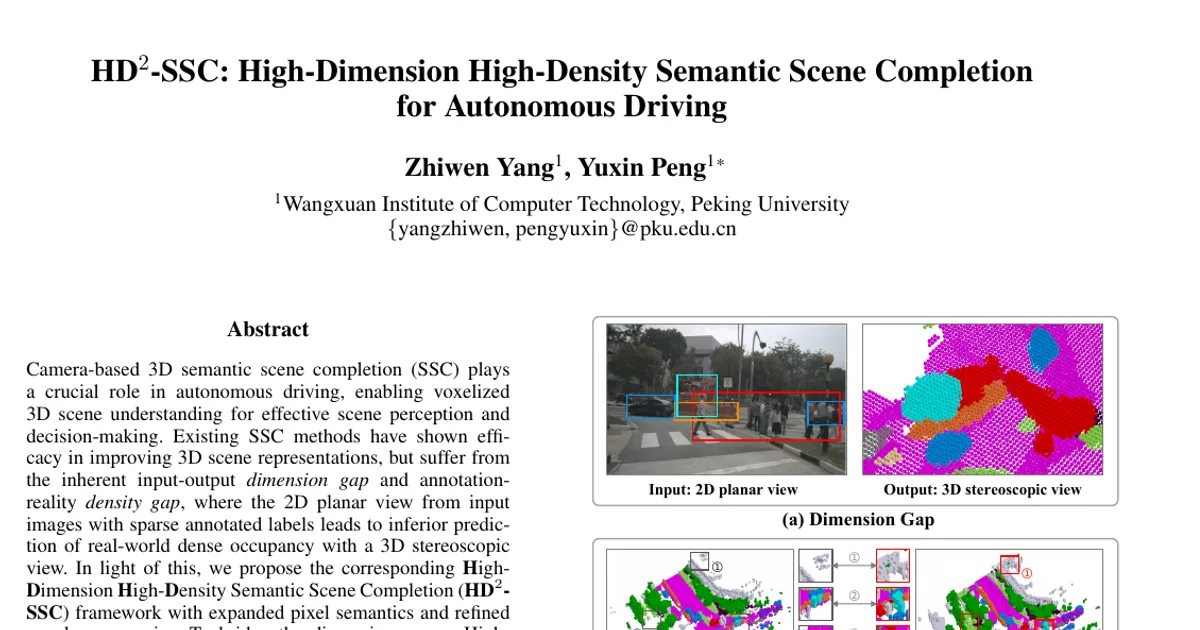
Camera-based SSC methods take 2D images and must output a dense 3D voxel grid labeled with occupancy and semantic classes. The authors argue that existing methods treat 2D pixel features and 3D voxel semantics indiscriminately, even though the input is a flat, occlusion-confused 2D view and the output needs fine-grained, distinct 3D semantics — a dimension gap. Separately, ground-truth annotations come from LiDAR and are inherently sparse and full of interspace, whereas real scenes are densely occupied — a density gap. The goal of the paper is a framework that expands and decouples coarse pixel semantics and then refines semantic density, so the model can complete missing voxels and correct erroneous ones.
Key Contributions
- HD²-SSC framework. A camera-based SSC framework that explicitly targets the dimension gap and the density gap, improving SSC performance through the completion of missing voxels and correction of erroneous ones.
- High-dimension Semantic Decoupling (HSD). Expands and decouples coarse pixel semantics using an orthogonal loss (
L_orth), then aggregates high-dimension voxelized semantics by semantic clustering with a decoupling loss (L_decouple). - High-density Occupancy Refinement (HOR). A "detect-and-refine" architecture that identifies geometric critical voxels (detection phase) and semantic critical voxels (refinement phase), then aligns the overall critical distributions so contextual geometry and semantics stay consistent.
- Extensive validation. Experiments and analyses on SemanticKITTI and SSCBench-KITTI-360, plus ablation studies on modules and loss terms, an expanded-dimension study, efficiency analysis, a generalization test on Occ3D-nuScenes, and an EfficientNet-B7 backbone evaluation.
Main Findings
- State-of-the-art on SemanticKITTI validation: HD²-SSC reaches 47.59 IoU and 17.44 mIoU, versus 46.21 IoU / 15.32 mIoU for the best comparison method, SGN — a gain of 1.38% IoU and 2.12% mIoU.
- State-of-the-art on SSCBench-KITTI-360 test: HD²-SSC reaches 48.58 IoU and 20.62 mIoU, versus SGN's 47.06 IoU / 18.25 mIoU — a gain of 1.52% IoU and 2.37% mIoU.
- Both modules help individually and together: Starting from a baseline of 44.15 IoU / 13.35 mIoU, adding HSD alone gives 46.45 IoU / 15.58 mIoU (+2.30% IoU, +2.23% mIoU), adding HOR alone gives 46.07 IoU / 16.12 mIoU (+1.92% IoU, +2.77% mIoU), and combining both gives 47.59 IoU / 17.44 mIoU.
- Every loss term matters: Removing
L_orthdrops performance to 46.93 IoU (-0.66) / 16.64 mIoU (-0.8); removingL_decouplegives 46.85 (-0.74) / 16.78 (-0.66); removingL_criticalgives 46.49 (-1.1) / 16.31 (-1.13) — the largest single degradation. - Expanded dimension has a sweet spot: Best performance occurs at D_exp = 4; increasing the expanded dimension further begins to degrade SSC performance, which the authors attribute to "imaginary" semantics that do not correspond to real-world objects and that have no explicit pixel semantic labels to supervise them.
- Efficiency is competitive: Against SGN on 1 NVIDIA A6000 GPU, HD²-SSC uses 28.96M params vs. 28.16M, 14.42G memory vs. 15.83G, 842.76 GFLOPs vs. 725.05, and 0.56s inference vs. 0.61s. The authors attribute the memory and latency advantage to predicting accurately with (128,128,16) feature grids rather than SGN's costly up-sampling to (256,256,32) grids.
- Generalizes to another dataset: On Occ3D-nuScenes, HD²-SSC scores 75.4 IoU / 44.2 mIoU, ahead of OccFormer (70.1 / 37.4) and BEVDet4D (73.8 / 39.3).
- Works with a stronger backbone: With EfficientNet-B7 on the SSCBench-KITTI-360 test set, HD²-SSC scores 49.03 IoU / 21.13 mIoU, versus CGFormer (48.07 / 20.05) and L2COcc (48.07 / 20.11).
- Qualitative improvement: In visualizations on SemanticKITTI validation, the paper marks ground-truth occupancy in blue boxes, false predictions of SGN in red boxes, and improved predictions of HD²-SSC in green boxes, framing the gains as completion of missing voxels and correction of erroneous ones.
- Known failure modes: The authors report that false occupancy predictions and incomplete object boundaries still occur in severe occlusion and distant areas with confusing features.
Methodology in Plain English
The framework has four main parts: an image encoder, a High-dimension Semantic Decoupling (HSD) module, a view transform module, and a High-density Occupancy Refinement (HOR) module.
Image encoding and view transform. As in prior work, a ResNet-50 with FPN extracts 2D features from the RGB input. The view transformer projects 3D voxel centroids into 2D pixels using camera intrinsics (K) and extrinsics (T = [R, t]) and samples image features accordingly.
Bridging the dimension gap (HSD). A "Pseudo Voxelization" block uses a Dim Expansion layer to lift each pixel feature along a pseudo "semantic dimension," producing several candidate feature slices for the same 2D coordinate — the intuition being that the same flat pixel location may hide more than one occluded object. An orthogonal loss (L_orth) on the expansion weight matrix pushes these candidates to be distinct rather than near-identical. A "Semantic Aggregation" block then uses pixel queries and cross attention to gather global semantics, clusters those semantics into D_exp groups (DPC-kNN), and applies a decoupling loss (L_decouple) that penalizes similarity between different cluster centroids. Finally, each pseudo-voxelized slice is weighted by its similarity to the best-matching semantic cluster and summed into an aggregated high-dimension feature — so regions with discriminative fine semantics are emphasized.
Bridging the density gap (HOR). This module works in two phases. In the detection phase, a binary classification head over voxel queries and voxel features produces score maps for occupied-vs-free and foreground-vs-background; these are summed into a "geometric density score," and the top-k voxels by that score become the geometric critical voxels (k = 4096). In the refinement phase, a class-wise head produces initial SSC predictions, and the top-k voxels by maximum class confidence become the semantic critical voxels. The two sets are then aligned with a symmetric KL divergence loss (L_critical), which acts as a soft constraint tying geometry and semantics together. A small refined MLP takes the concatenation of both critical-voxel sets and adds a correction to the initial prediction to produce the final refined output.
Training setup as reported. Input crops are 1220×370 (SemanticKITTI cam2) and 1408×376 (SSCBench-KITTI-360 cam1); 2D features are at 1/16 of input resolution with C = 128. The 3D feature volume is 128×128×16, upsampled to final predictions of 256×256×32. Channel dimensions are C_2D = 256 and C_3D = 32; D_exp = 4; N_query = 100; k = 4096. Training runs for 24 epochs on 4 A6000 GPUs with total batch size 4, using AdamW with initial learning rate 2e-4 and weight decay 1e-2.
Data setup. SemanticKITTI contains 22 autonomous driving sequences with 20 semantic classes, split as (00-07, 09-10) / (08) / (11-21) for training / validation / test. SSCBench-KITTI-360 contains 9 densely annotated urban driving sequences, split as (00, 02-05, 07, 10) for training, (06) for validation, and (09) for test. Semantic labels span [0~51.2m, -25.6~25.6m, -2~4.4m], and target voxel grids are 256×256×32 at 0.2 m resolution. Metrics are IoU for class-agnostic scene completion (SC) and mIoU for semantic scene completion (SSC).
Why This Matters
Impact on research. The paper reframes camera-based SSC as a problem of two named structural mismatches rather than another architecture-tuning exercise. Naming the dimension gap (2D planar input vs. 3D stereoscopic output) and the density gap (sparse LiDAR-derived labels vs. dense real occupancy) gives the field concrete, testable targets, and the ablation results quantify how much each targeted module and each loss term contributes. The fact that the approach also transfers to Occ3D-nuScenes and to an EfficientNet-B7 backbone suggests the ideas are not tied to a single dataset or backbone.
Real-world applications:
- Autonomous driving perception: Dense voxel occupancy and semantics feed planning, navigation, and interaction with dynamic environments, as the introduction states.
- Cost-sensitive vehicle platforms: Camera-only SSC avoids the sensor cost and limited LiDAR data scalability the paper cites, making deployment more scalable for large fleets.
- Robotics and mobile autonomy in outdoor scenes: The KITTI-360-style urban driving scenes and dense-occupancy output are relevant to any system that needs occupancy prediction, not just cars.
- Voxelized 3D scene understanding pipelines: The framework's output is a labeled 3D grid, which can act as an intermediate representation for downstream reasoning modules.
Industry relevance. Efficiency numbers matter for deployment: HD²-SSC uses slightly more parameters and GFLOPs than SGN but less GPU memory (14.42G vs. 15.83G) and less inference time (0.56s vs. 0.61s) on an A6000, while outperforming it on both IoU and mIoU. The code release, the backbone swap test, and the cross-dataset test on Occ3D-nuScenes all point toward practical adoption beyond the original benchmark.
Future Directions
- Handling severe occlusion and distant regions. The authors explicitly identify false predictions and incomplete boundaries in heavily occluded and distant areas as remaining failures, and state that future work aims to incorporate physical regularities to complement low-quality semantic features in those areas.
- Supervising or selecting the expanded dimension. The expanded-dimension study shows performance peaks at D_exp = 4 and degrades beyond it because there are no explicit pixel semantic labels to ground additional "imaginary" semantics; how to supervise or prune these dimensions is left open.
- Combining with temporal inputs. The paper's own tables separate mono-input and temporal-input methods, and HD²-SSC is evaluated alongside temporal methods like VoxFormer, DepthSSC, Symphonies, CGFormer and SGN; whether these gains compound with temporal fusion is not reported.
- Broadening dataset coverage. Generalization is demonstrated on Occ3D-nuScenes in the appendix, but the main results are on SemanticKITTI and SSCBench-KITTI-360 (both KITTI-derived), so behavior on other sensor setups and geographies is not reported.
Target Audience
This paper suits graduate students and researchers working on 3D perception, occupancy prediction, and autonomous driving, particularly those already familiar with camera-based SSC and view-transformation pipelines. It will also interest engineers evaluating camera-only alternatives to LiDAR for deployment, since the appendix reports parameters, GPU memory, GFLOPs and inference time. Readers focused on transformer-based 3D representations, semantic clustering, or loss design for dense prediction tasks will find the HSD and HOR designs and the module/loss ablations directly applicable.
Authors’ abstract
Camera-based 3D semantic scene completion (SSC) plays a crucial role in autonomous driving, enabling voxelized 3D scene understanding for effective scene perception and decision-making. Existing SSC methods have shown efficacy in improving 3D scene representations, but suffer from the inherent input-output dimension gap and annotation-reality density gap, where the 2D planner view from input images with sparse annotated labels leads to inferior prediction of real-world dense occupancy with a 3D stereoscopic view. In light of this, we propose the corresponding High-Dimension High-Density Semantic Scene Completion (HD$^2$-SSC) framework with expanded pixel semantics and refined voxel occupancies. To bridge the dimension gap, a High-dimension Semantic Decoupling module is designed to expand 2D image features along a pseudo third dimension, decoupling coarse pixel semantics from occlusions, and then identify focal regions with fine semantics to enrich image features. To mitigate the density gap, a High-density Occupancy Refinement module is devised with a "detect-and-refine" architecture to leverage contextual geometric and semantic structures for enhanced semantic density with the completion of missing voxels and correction of erroneous ones. Extensive experiments and analyses on the SemanticKITTI and SSCBench-KITTI-360 datasets validate the effectiveness of our HD$^2$-SSC framework.