Research
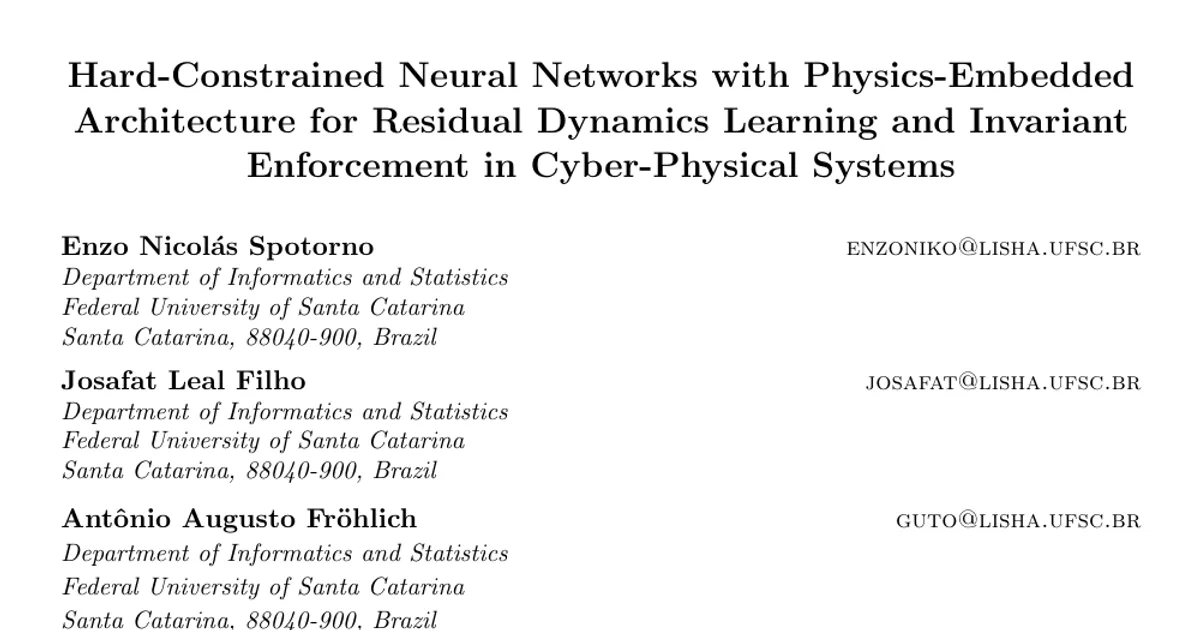
Hard-Constrained Neural Networks with Physics-Embedded Architecture for Residual Dynamics Learning and Invariant Enforcement in Cyber-Physical Systems
Overview Research area: Physics-informed machine learning (PIML) for cyber-physical systems, specifically hybrid grey-box modeling of dynamical systems governed by ordinary differential equations (ODE
- arXiv
- 2511.23307
- Published
- 2025-11-28
- Authors
- Enzo Nicolás Spotorno, Josafat Leal Filho, Antônio Augusto Fröhlich
AI summary
Overview
Research area: Physics-informed machine learning (PIML) for cyber-physical systems, specifically hybrid grey-box modeling of dynamical systems governed by ordinary differential equations (ODEs) and semi-explicit index-1 differential-algebraic equations (DAEs).
Technical level: Advanced. The paper assumes familiarity with ODE/DAE formulations, index theory, numerical integrators (Forward Euler, RK4), Karush-Kuhn-Tucker (KKT) conditions, the implicit function theorem, and backpropagation through time.
Scope: The paper formalizes a recurrent residual-learning architecture (HRPINN) and a projected extension that enforces algebraic invariants exactly (PHRPINN), and supports both with a representational-equivalence theorem and a stated two-case validation plan.
What This Paper Is About
Engineered systems such as vehicles, robots, and batteries are described by physical laws that engineers know well, but also by messy effects they do not fully model — friction, wear, thermal coupling. Purely first-principles models miss these effects, while purely data-driven models can drift off physical laws over long horizons. This paper proposes a neural architecture that hard-codes the known physics inside a recurrent integrator so the network learns only the leftover "residual" dynamics, plus an extension that projects the predicted state back onto the constraint manifold at every step to guarantee algebraic invariants hold exactly.
Key Contributions
-
Formalization of HRPINN (Hybrid Recurrent Physics-Informed Neural Network): A general-purpose grey-box architecture that embeds known ODE structure as a hard structural constraint inside a recurrent integrator cell and learns only the unknown residual dynamics, demonstrated for partially observed systems.
-
Introduction of PHRPINN (Projected HRPINN): A predict–project extension that strictly enforces algebraic invariants by design, with an analysis of the trade-offs between its "robust" variant (solving the full nonlinear KKT system to a tolerance, e.g. via Newton's method) and its "fast" variant (a single-factorization tangent-space projector).
-
Theoretical and empirical evidence: A proof of representational equivalence (Theorem 2) between HRPINN and standard PINN formulations under stated assumptions, alongside a described experimental program reporting improved data efficiency, physical consistency, and optimization stability.
-
Reproducibility artifacts: Release of the implementation, hyperparameter tables, and ablation scripts.
Main Findings
-
Hard-coding beats penalizing for the known part: Rather than adding physics as a loss penalty, HRPINN embeds $\mathbf{f}{\mathrm{phys}}$ directly in the state update $\mathbf{h}{k+1}=\Phi_{\Delta t}\big(\mathbf{h}{k}; \mathbf{f}{\mathrm{phys}}(\cdot)+\hat{\mathbf{f}}_{\boldsymbol{\theta}}(\cdot)\big)$, which the authors argue avoids the soft-constraint loss-balancing problem and the "gradient flow pathologies" they attribute to PINNs.
-
Projection gives inference-time guarantees: PHRPINN performs a two-stage update — predict an unconstrained intermediate state, then solve the constrained optimization $\mathbf{x}^{*}=\Pi(\tilde{\mathbf{x}})=\arg\min_{\mathbf{x}} \frac{1}{2}|\mathbf{x}-\tilde{\mathbf{x}}|_2^2$ subject to $\mathbf{g}(\mathbf{x})=\mathbf{0}$ — so the returned state is on the manifold regardless of what the network outputs. The paper distinguishes this from semi-hard methods (Augmented Lagrangian, OptNet-style differentiable layers) whose constraint satisfaction is a learned, training-time property, not an algorithmic guarantee at inference.
-
Gradients flow through the projection via implicit differentiation: Because the projection is defined implicitly by the KKT system, the authors use the implicit function theorem (following PNODEs and OptNet) with discrete adjoints, rather than continuous adjoints, arguing that time-continuous interpolants of a discrete trajectory can leave the constraint manifold and destabilize adjoint computation.
-
A cheap projector with a stated approximation: The "fast" variant uses $J_{\Pi}=I-G(\mathbf{x}^{})^{\top}(G(\mathbf{x}^{})G(\mathbf{x}^{})^{\top})^{-1}G(\mathbf{x}^{})$, which the paper describes as the orthogonal projector onto the tangent space. The authors note the PNODE justification as a single Newton step and offer an alternative justification via sensitivity analysis in which Hessian (manifold-curvature) terms are neglected. For numerical stability they recommend computing it with an orthonormal basis from QR or SVD to avoid forming the possibly ill-conditioned $GG^{\top}$.
-
Representational equivalence, not optimization equivalence: Theorem 2 states that, under assumptions A1–A6 and A6′, exact initial state ($\mathbf{e}_0=\mathbf{0}$), and the universal approximation theorem holding on a compact tubular neighborhood of the true trajectory, a PINN-representable solution implies an HRPINN-representable one and vice versa, with error bounded by the integrator's local truncation error plus network approximation error. The authors explicitly clarify that the theorem makes no claims about optimization difficulty, convergence speed, or sample complexity; the conjectures about optimization conditioning and generalization are framed as practical hypotheses to be evaluated empirically.
-
Scope is deliberately restricted to index-1 DAEs: The framework requires the constraint Jacobian $G(\mathbf{x})=\partial\mathbf{g}/\partial\mathbf{x}$ to have full row rank (Linear Independence Constraint Qualification, A6), which guarantees the KKT system has a unique solution and the projection operator is locally well-defined and differentiable. Higher-index DAEs would make $G$ rank-deficient and the projection ill-posed; index reduction via symbolic differentiation is noted as possible but noise-amplifying.
-
Secondary non-degeneracy condition: Assumption A6′ (a second-order sufficient condition, SOSC) requires the Lagrangian Hessian restricted to the tangent space, $v^{\top}[I+\sum_i \lambda_i^{\star}\nabla^2 g_i(\mathbf{x}^{\star})]v>0$ for all $v \in \ker G(\mathbf{x}^{\star})$, or equivalently that the bordered KKT Jacobian is nonsingular, so the projection problem is well-posed and locally stable for solver convergence.
-
Stated validation targets: The abstract reports validating HRPINN on a real-world battery prognostics DAE and evaluating PHRPINN on a suite of standard constrained benchmarks. The numerical results, benchmark names, dataset sizes, and error metrics for those experiments are not present in the available content; the text stops partway through the proof sketch of Theorem 2, and Sections 5 through 9 are referenced but not included.
-
Comparison table positioning: Table 1 places HRPINN/PHRPINN against soft PINNs (soft penalty, no inference guarantee, gradient pathologies), HNNs/LNNs (architectural, learn a scalar potential, conserves the learned $H$ or $L$, inflexible and poor for non-ideal systems), black-box PNODEs (inference projection, high sample complexity), and ALM/OptLayer (semi-hard, training-time only). HRPINN/PHRPINN are listed as learning residual dynamics $\mathbf{f}_{\mathrm{unk}}$ with known physics enforced and, for PHRPINN, the state on the manifold; the stated limitation is that they need the known model part.
Methodology in Plain English
The approach starts from a decomposition of the system's rate of change into two pieces: a term the engineer already knows from first principles, and a term that is unknown. The known term is written directly into the code of the model's update step, so the network never has to learn it and cannot violate it. Only the unknown term is represented by a neural network.
The model then behaves like a recurrent simulator: it marches forward in time step by step, at each step computing the known physics plus the network's residual prediction and feeding the sum through a standard numerical integrator such as Forward Euler or RK4. It is trained end-to-end on measured time series using backpropagation through time, which here acts as a discrete adjoint over the unrolled integrator.
For systems with algebraic invariants — quantities that must remain exactly zero at all times, such as a fixed-length constraint — the extended model adds a second stage to each step. The integrator first proposes a new state, which may sit slightly off the constraint surface. Then a corrective optimization finds the nearest point that satisfies the constraints exactly, using Lagrange multipliers and solving the resulting KKT system. Two versions of this correction are offered: a slower one that solves the nonlinear system to a tolerance, and a faster one that linearizes and reuses a single matrix factorization per step.
Because the correction is defined implicitly rather than by an explicit formula, the authors differentiate through it using the implicit function theorem instead of unrolling the solver. They also check the representational claim: they argue that under smoothness, Lipschitz, universal-approximation, and integrator-order assumptions, a standard PINN and an HRPINN can each represent the trajectories the other can, using a discrete Grönwall inequality for one direction and a cubic Hermite interpolant for the other.
Why This Matters
Impact on research. The paper argues that current PIML methods force a trade-off among three properties — hard architectural encoding of known ODE structure, residual-only learning for data efficiency, and exact inference-time enforcement of algebraic invariants — and claims no single prior approach provides all three. The proposed synthesis targets that gap, and the representational-equivalence result gives a formal bridge between the hard-constrained and penalty-based families.
Real-world applications (as identified in the paper):
- Battery prognostics, used as the real-world DAE validation case for HRPINN.
- Digital twins for real-time prediction, control, and safety assessment.
- Autonomous vehicles and industrial robotics, where predictive accuracy alone is described as insufficient and physical consistency is required for safe decision-making.
- Constrained mechanical systems such as multi-body pendulums away from singular configurations, and power grid models; the paper also cites electrical circuit models via Modified Nodal Analysis, where the algebraic constraints are Kirchhoff laws.
Industry relevance. The motivation is explicitly economic and operational: real-world operational data is limited and often expensive, so data efficiency matters; and safety-conscious deployments need models whose outputs stay physically meaningful even over long horizons. The paper also frames the projection as a deployment-time guarantee, noting that the expensive solver used during training by semi-hard methods is typically absent at inference.
Future Directions
- Higher-index DAEs. The paper restricts itself to index-1 systems and states that extensions to higher-index DAEs are left to future work, noting that index reduction can increase model complexity and amplify noise.
- More exhaustive benchmarking. The paper explicitly leaves more exhaustive benchmarking to future work; the reported benchmark suite and battery prognostics evaluation results are not available in the provided content.
- Handling LICQ violations and degeneracy. The authors acknowledge that systems can exhibit discontinuities, higher-index dynamics, or operate near singular configurations. Their suggested fallbacks are relaxing the hard projection to a soft penalty or using an Augmented Lagrangian Method during training, and they recommend ALM or smooth penalty relaxation when constraints become redundant, when inequality constraints are present, or when the manifold self-intersects.
- Keeping predictors inside the normal injectivity radius. The paper notes that orthogonal projection is locally unique only within the manifold's normal injectivity radius, so differentiability and Newton convergence are local properties. This raises the open practical question of choosing predictor steps that keep $\tilde{\mathbf{x}}$ within a tubular neighborhood of the manifold, with regularization or continuation strategies needed when it leaves that neighborhood.
- Testing the stated optimization and generalization conjectures. The paper frames its conjectures about optimization conditioning and generalization as hypotheses to be evaluated empirically and revisited in the discussion section.
Target Audience
Researchers and graduate students working on physics-informed machine learning, hybrid or grey-box modeling, scientific machine learning for dynamical systems, and neural differential equations; numerical analysts interested in DAE index theory, projection methods, and differentiable optimization layers; and practitioners in safety-critical domains such as battery prognostics, digital twins, robotics, and power systems who need models that are simultaneously data-efficient and guaranteed to respect known physical structure.
Authors’ abstract
This paper presents a framework for physics-informed learning in complex cyber-physical systems governed by differential equations with both unknown dynamics and algebraic invariants. First, we formalize the Hybrid Recurrent Physics-Informed Neural Network (HRPINN), a general-purpose architecture that embeds known physics as a hard structural constraint within a recurrent integrator to learn only residual dynamics. Second, we introduce the Projected HRPINN (PHRPINN), a novel extension that integrates a predict-project mechanism to strictly enforce algebraic invariants by design. The framework is supported by a theoretical analysis of its representational capacity. We validate HRPINN on a real-world battery prognostics DAE and evaluate PHRPINN on a suite of standard constrained benchmarks. The results demonstrate the framework's potential for achieving high accuracy and data efficiency, while also highlighting critical trade-offs between physical consistency, computational cost, and numerical stability, providing practical guidance for its deployment.