Research
GEM: Generative Entropy-Guided Preference Modeling for Few-shot Alignment of LLMs
Overview Research area: Alignment of large language models with human preferences, specifically few-shot and domain-specific preference modeling without a separately trained reward model. The work sit
- arXiv
- 2511.13007
- Published
- 2025-11-17
- Authors
- Yiyang Zhao, Huiyu Bai, Xuejiao Zhao
AI summary
Overview
Research area: Alignment of large language models with human preferences, specifically few-shot and domain-specific preference modeling without a separately trained reward model. The work sits at the intersection of reinforcement learning from human feedback (RLHF), Chain-of-Thought (CoT) reasoning, and entropy-based decision theory.
Technical level: Advanced. The paper assumes familiarity with policy-gradient methods, advantage estimation, Bradley–Terry preference models, and token-level entropy.
Scope: The paper proposes GEM (Generative Entropy-Guided Preference Modeling), a pipeline combining entropy-guided CoT filtering (Cognitive Filtering) with a listwise policy-optimization algorithm called SEGA, evaluated on general preference benchmarks, math reasoning, and medical QA under a few-shot data regime.
What This Paper Is About
Standard alignment pipelines such as RLHF need thousands of high-quality preference comparisons plus a separately trained reward model, which is impractical in domains like medicine and law where expert preference labels are scarce and expensive. The paper's goal is to let an LLM align itself from a small number of preference pairs by extracting fine-grained cognitive signals out of its own generated reasoning chains. GEM does this by scoring multiple sampled CoTs with a token-level entropy signal and then using those scores as implicit rewards for a group-based policy update.
Key Contributions
- Generative preference modeling. The LLM infers and maximizes an implicit reward by extracting multi-dimensional, fine-grained cognitive signals from human preference data, removing the need for an external reward network or proxy judge.
- Entropy-guided token scoring. An information-theoretic scorer rewards confident final answers (low entropy at the answer tokens) while encouraging exploratory, high-entropy "fork" tokens in the middle of reasoning, producing a graded quality signal for each CoT.
- SEGA (Self-Evaluated Group Advantage). A novel listwise policy-optimization algorithm that computes intra-group advantages across multiple candidate CoTs per query, described as providing more stable updates than pairwise objectives.
- Empirical validation. Experiments on UltraFeedback, RewardBench, PKU-SafeRLHF, GSM8K, MATH, TruthfulQA, MT-Bench, and a specialized medical QA setting, reporting consistent improvements of 5–10 pp in preference-prediction accuracy and up to 15 pp in downstream task performance in a low-resource regime.
Main Findings
- Preference-prediction accuracy (Table 1). GEM scores 77.1 on UltraFeedback, 74.6 on PKU-SafeRLHF, and 75.4 on RewardBench, for an average of 75.7. Baselines: Supervised (SFT) averages 58.6, Reward Model + PPO 60.0, DPO 64.4, PRO 66.8, and IPO 68.6.
- Medical expert agreement (Table 2). On a 500-sample validation set, GEM reaches 78.2% agreement with medical-expert preferences, versus 72.5% for Reward Model + PPO, 70.1% for DPO, and 65.3% for SFT.
- Downstream tasks (Table 3). GEM reports 55.6% GSM8K accuracy, 10.5% MATH accuracy, 38.2% TruthfulQA exact match, and a 68% MT-Bench win-rate against the SFT baseline (SFT: 40.1, 5.8, 32.4, 35; DPO: 50.2, 8.5, 35.6, 52; Reward Model + PPO: 44.7, 7.3, 34.0, 47).
- Ablations (Table 4). Removing both Cognitive Filtering and SEGA drops UltraFeedback accuracy to 69.0, GSM8K to 48.3, and medical expert agreement to 70.5, compared with 77.1, 55.6, and 78.2 for the full GEM. Keeping Cognitive Filtering but substituting DPO for SEGA gives 74.5, 53.4, and 73.0. Removing the final-entropy term gives 74.2, 50.1, 73.5; removing the fork-entropy term gives 73.8, 52.7, 75.0.
- Both entropy terms matter, in opposite directions. Disabling the final-answer entropy reward hurt math performance and produced chains that never reached a final answer or expressed uncertainty; disabling the fork-entropy reward made the model "too greedy" and start hallucinating.
- Training stability. SEGA is reported to outperform pairwise DPO in the full pipeline, with the gap larger in the early training phase and on more complex tasks; on the medical dataset SEGA reached 78% while pairwise DPO capped at around 70%, with smoother validation curves shown in Figure 2.
- Sample efficiency (Appendix B, Figure 3). With only 500 pairs, SEGA reaches 63.0% accuracy, exceeding IPO by 4.5 pp and PPO by 7.5 pp. At 3,000 pairs it attains 75.7%, a +7.1 pp edge over IPO and +17.1 pp over the SFT baseline. Integrated accuracy over sample size (AUC) is 174,675 for SEGA versus 159,025 for IPO.
- Comparison to GPT-4. The paper states its 7B model is within 5% of GPT-4's performance on the preference tests; GPT-4's per-benchmark scores are not reported in the tables.
- On MT-Bench dialogue. GEM responses were preferred over the SFT baseline about 68% of the time by GPT-4 judgments, and the paper states GEM still won 60% of the time against the PPO baseline.
- Case studies (Appendix A). In a sky-color explanation example, the entropy-guided score was 0.31 for the baseline answer and 0.72 for the CoT answer, and 5/5 judges preferred the CoT answer. In a TruthfulQA MMR-vaccine example, the baseline scored 0.22 and GEM's self-checked answer 0.67, with the baseline graded "incorrect & confident" and GEM's answer "correct & calibrated."
Methodology in Plain English
The training data consists of a small set of preference pairs (a query plus a preferred and a dispreferred answer). For each query, the model is prompted to produce multiple candidate answers with step-by-step reasoning chains; the default setting is k = 5 candidates per query, sampled with temperature to ensure diversity.
Each candidate is then scored by looking at how confident the model was while generating it. The score combines two signals: a penalty on entropy at the final answer (so confident conclusions score higher) and a bonus on the average entropy of the top-m highest-entropy tokens inside the chain (so chains that pass through genuine decision points score higher). Formally, S(a_i) = -H_final(a_i) + λ · (average of the top-m entropy values). The resulting scores rank candidates from best to worst, producing a graded preference ordering rather than a single binary label.
Those rankings drive a policy update called SEGA. Scores are converted into rewards, a group baseline (e.g., the group mean) is subtracted, and each candidate receives an advantage — positive if above the group average, negative if below. The policy is then updated to raise the likelihood of positive-advantage candidates and lower that of negative-advantage ones. The paper notes this loss reduces to DPO when k = 2. Because every candidate in the group is used, the update is described as more balanced and stable than pairwise DPO, and no separate reward model or value network is needed.
Setup details: experiments use Llama-3-8B-Instruct, initialized with a short supervised fine-tuning stage on the same preference pairs. Training uses 3,000 preference pairs from the Skywork Reward Preference dataset, and a medical QA preference dataset built from 3,500 iCliniq QA pairs (3,000 training, 500 validation). The general-domain training set is an order of magnitude smaller than typical RLHF pipelines of 30k–100k+ comparisons. Training used PyTorch, HuggingFace Transformers, and DeepSpeed with mixed precision and gradient checkpointing on a single node with eight NVIDIA A100 80 GB SXM4 GPUs, learning rate 1e-5 and batch size 128.
Why This Matters
Impact on research. The work reframes preference learning as a form of inverse reinforcement learning in which the model infers a latent reward from its own generations, and it argues that listwise, group-based advantage estimation can replace both external reward models and pairwise objectives. It offers a concrete recipe for extracting dense signals from sparse preference labels, and the SEGA module is presented as applicable beyond this pipeline.
Real-world applications:
- Medical question answering, where preferences must reflect guidelines, caution under uncertainty, and patient-friendly phrasing, and where the paper reports 78.2% agreement with expert preferences from few-shot data.
- Legal and other expert-knowledge domains, which the paper explicitly cites as settings where large-scale preference annotation is costly or impractical.
- Mathematical reasoning tutoring and step-by-step solution generation, where GSM8K accuracy rose from 40.1 to 55.6 and Math from 5.8 to 10.5.
- Safety-critical factual QA, where entropy-based self-checking is shown suppressing confidently wrong answers on a TruthfulQA example.
- Reranking and aggregation of multiple generated candidates, weighting AI feedback in RLAIF pipelines, and within-group comparisons from user clicks or weak labels in multimodal generation.
Industry relevance. Removing the reward-model training step and reducing labeled preference data to a few thousand pairs lowers the annotation and compute cost of aligning domain-specific models. The method is designed to work with high-throughput inference engines such as vLLM, and the paper notes stable updates matter for production-scale alignment where reward-model over-optimization is a documented risk.
Future Directions
- Extending GEM to extract cognitive signals from more complex modalities beyond text.
- Adapting entropy-guided preference modeling to large-scale RLAIF pipelines, which the authors expect could yield more stable alignment strategies.
- Applying the SEGA module to other settings that require learning preferences from multiple candidate generations, such as reranking, AI-feedback aggregation, and click- or weak-label-based within-group comparison in multimodal tasks.
- Open questions raised by the results: how the entropy-based score behaves when the model is systematically wrong but confident, how much the noisy self-generated comparisons contribute versus the original human pairs, and whether the reported generalization holds beyond the tasks tested — the paper reports that generalization across tasks was one of its evaluation goals but presents cross-task evidence mainly through the benchmark table rather than a dedicated transfer study.
Target Audience
Researchers and practitioners working on LLM alignment, RLHF alternatives, and low-resource or domain-specific fine-tuning will get the most from this paper. It is also relevant to applied teams in healthcare, law, and other expert domains who cannot assemble large preference datasets, and to readers interested in entropy-based signals for self-evaluation, CoT quality estimation, and listwise preference optimization. Readers without a background in policy-gradient methods or information theory will find the method sections demanding.
Authors’ abstract
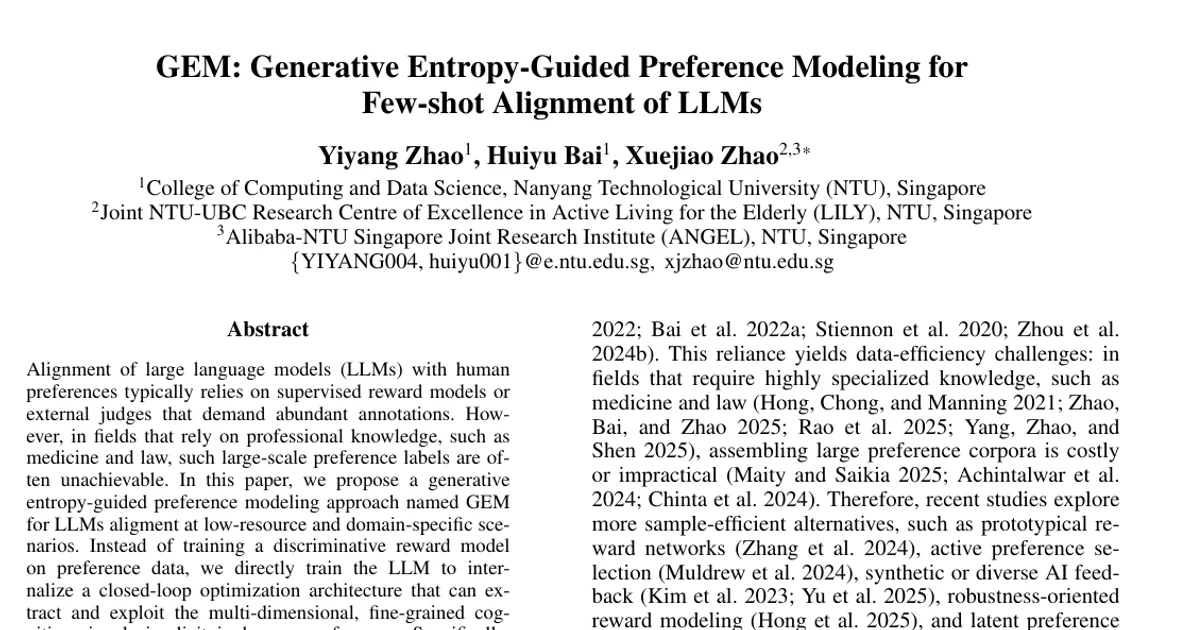
Alignment of large language models (LLMs) with human preferences typically relies on supervised reward models or external judges that demand abundant annotations. However, in fields that rely on professional knowledge, such as medicine and law, such large-scale preference labels are often unachievable. In this paper, we propose a generative entropy-guided preference modeling approach named GEM for LLMs aligment at low-resource and domain-specific scenarios. Instead of training a discriminative reward model on preference data, we directly train the LLM to internalize a closed-loop optimization architecture that can extract and exploit the multi-dimensional, fine-grained cognitive signals implicit in human preferences. Specifically, our Cognitive Filtering module, based on entropy theory in decision making, first leverages Chain-of-Thought (CoT) prompting to generate diverse candidate reasoning chains (CoTs) from preference data. Subsequently, it introduces a token scoring mechanism to rank and weight the sampled CoTs, boosting the importance of high-confidence answers and strategically high-entropy tokens. Building on these filtered preferences, we fine-tune the LLM using a novel self-evaluated group advantage algorithm, SEGA, which effectively aggregates group-level cognitive signals and transforms the entropy-based scores into implicit rewards for policy optimization. In these ways, GEM empowers the LLM to rely on its own judgments and establishes an entropy-guided closed-loop cognitive optimization framework, enabling highly efficient few-shot alignment of LLMs. Experiments on general benchmarks and domain-specific tasks (such as mathematical reasoning and medical dialogues) demonstrate that our GEM achieves significant improvements with few-shot preference data.