Research
Gaussian Match-and-Copy: A Minimalist Benchmark for Studying Transformer Induction
Overview Research area: Mechanistic interpretability and in-context learning in sequence models, specifically the study of "match-and-copy" retrieval circuits in Transformers. Technical level: Advance
- arXiv
- 2602.07562
- Published
- 2026-02-07
- Authors
- Antoine Gonon, Alexandre Cordonnier, Nicolas Boumal
AI summary
Overview
Research area: Mechanistic interpretability and in-context learning in sequence models, specifically the study of "match-and-copy" retrieval circuits in Transformers.
Technical level: Advanced (the paper includes both empirical benchmarking and a formal optimization-theory result), though the empirical parts are accessible to intermediate readers.
Scope: The paper introduces Gaussian Match-and-Copy (GMC), a synthetic regression benchmark that isolates long-range, correlation-based retrieval, shows that Transformers learn a previous-token-head-to-induction-head circuit on it while non-attention models do not, and proves a conditional max-margin implicit-bias result for gradient descent in a minimal attention model.
What This Paper Is About
Large language models can answer prompts like "Granny Susie comes tomorrow. I love Granny ___" by retrieving an earlier matching token from the context and copying its successor ("Susie"). This "match-and-copy" behavior can come either from memorized associations or from an actual inference-time search-and-retrieve procedure, and on natural language data the two are entangled.
The authors propose a minimal synthetic task, Gaussian Match-and-Copy, in which the only signal is a single hidden second-order correlation between the query and one randomly placed context token, so memorization is useless and the model must learn genuine retrieval.
Key Contributions
-
A minimalist benchmark (GMC). A prediction task with i.i.d. Gaussian context tokens where the query is correlated with exactly one hidden context token, at a uniformly random position in {1, ..., T−1}, and the target is that token's successor passed through a value matrix plus noise. There is no fixed association to memorize, no local statistic that identifies the match, and the match can occur arbitrarily far away.
-
Reliable PTH-to-IH emergence. Standard Transformers trained on GMC spontaneously develop a previous-token head (PTH) followed by an induction head (IH), and the appearance of these heads coincides exactly with a sharp drop in validation loss—mirroring observations from prior work on LLMs ranging from 13M to 13B parameters.
-
Transfer and architectural separation. Freezing the attention blocks after GMC training and fine-tuning only the input/output embeddings enables rapid adaptation to the Omniglot ICL benchmark, and the GMC-trained model reaches 0.9 accuracy with at least 3× fewer FLOPs than training from scratch. Meanwhile, Gated RNNs (GRU) and state-space/convolutional models (S4, H3, Hyena) plateau at significantly higher loss under matched budgets.
-
A max-margin implicit-bias theorem. In a minimal two-layer attention-only model with a frozen exact PTH, the authors prove that any gradient-descent trajectory that drives the empirical MSE to zero while the cumulative squared gradient norm remains finite converges in direction to the max-margin separator and diverges at a logarithmic rate.
Main Findings
-
Plateau-drop-plateau dynamics. Test loss on GMC follows a plateau, then a sharp drop, then another plateau. The PTH score (average attention weight from a query position to the immediately preceding position) and the IH scores follow the same pattern, remaining near random baselines during the initial plateau and rising sharply to values close to 1 exactly when the loss drops (Figure 2).
-
Correct circuit topology. Layer-wise analysis shows PTHs always appear in an earlier layer than IHs. In the 2-layer default configuration, Layer 0 specializes as PTH and Layer 1 as IH.
-
Robustness across configurations. The authors ran sweeps over Llama 3 and GPT-2 architectures across depths n_layer ∈ {2, 4, 8, 16, 32}, context lengths up to T = 1024, data dimensions up to d_in = 1024, and varying correlation strength and optimization hyperparameters. Suboptimal choices can affect the timing or sharpness of the transition, or prevent convergence, but whenever a model solves the task it does so with high PTH/IH scores rising concurrently with the loss drop.
-
Abstract, transferable mechanism. After training on GMC only, a Llama 3 model's internals are frozen and its linear input/output embeddings are replaced with new ones of compatible dimensions for Omniglot (a standard ICL benchmark). Fine-tuning only these embeddings rapidly solves Omniglot, suggesting the learned heads implement a general match-and-copy strategy rather than Gaussian-specific heuristics.
-
Clear architecture gap. At matched parameter counts (approximately 2.5–3 M), matched inference GFLOPS (approximately 24), and matched training FLOPs, Transformers hit the noise floor while all non-attention baselines plateau at significantly higher loss—even with 30× more training steps, or when trading off depth against width.
-
Counterintuitive comparison with prior associative-recall designs. H3 and Hyena were explicitly designed for associative recall tasks, yet they still struggle on GMC, suggesting small differences in task structure matter and that long-range correlation-based retrieval remains a regime where attention has a clear advantage.
-
Divergence with increasing margins in the minimal model. Empirically, in the minimal setting, MSE decreases to a small value while the cumulative squared gradient norm stays bounded, the Frobenius norm of the merged key-query matrix grows, its normalized direction aligns with the max-margin separator, and the minimum margins increase so attention becomes asymptotically hard on the true match.
-
Alignment is not always complete within budget. In some configurations, the cosine similarity between the normalized key-query matrix and the normalized max-margin separator does not reach 1 within the iteration budget; it reaches the range [0.8, 0.95] in general, and it is unclear whether this reflects slow convergence or convergence to a different asymptotic direction.
-
A geometric event drives the behavior. The theorem's conditions depend on an explicit geometric event on the sampled GMC sequences, expressed as inequalities involving token Gram matrices and difference vectors. This event rules out any finite-norm zero-loss interpolant, forces successful trajectories into a monotonically increasing-margin regime, and is proven to hold with high probability, with the probability improving as d_in grows relative to the effective number of distractors.
-
MSE-specific complications. Unlike monotone margin losses (such as logistic or exponential losses in binary classification), MSE can admit finite-norm minimizers, and MSE gradients contain interaction and cross-terms. The authors handle this with Assumption 4.2, which requires these coefficients to stabilize asymptotically and the cross-terms to become negligible relative to the main margin terms.
Methodology in Plain English
The authors start from the observation that "match-and-copy" in language models can be achieved either by memorizing token associations or by actively searching the context at inference time. Natural-language experiments mix the two and are expensive, so the authors build a synthetic task that strips memorization away.
In their task, a sequence of T random Gaussian vectors forms the context. One of those tokens is secretly designated as the match. The query vector is that match token passed through a correlation matrix plus noise, so it shares a second-order statistical relationship with exactly one context token and nothing else. The target is the token immediately after the match, passed through a value matrix plus noise. Because the matched token and its successor are statistically independent of each other, and because all context tokens have identical marginal distributions, the only way to succeed is to compare the query against every context token, find the one with the strongest correlation, and copy its successor.
They train standard Transformers (Llama 3 and GPT-2 style) on this regression objective and measure two attention-head scores borrowed from prior mechanistic interpretability work: a previous-token score, and an induction-head score tailored to the task. They watch how the loss and these scores evolve together during training.
To test whether the learned mechanism is abstract, they freeze the trained attention layers and swap in fresh input/output embeddings for Omniglot, fine-tuning only the embeddings. To test architecture, they benchmark against GRU, S4, H3, and Hyena under matched compute.
Finally, they peel the problem down to a two-layer attention-only model with a single head per layer, freezing the first layer as a perfect previous-token head so the second layer only has to do match selection. They optimize the merged key-query matrix under MSE, observe empirically that its norm grows while its direction aligns with the SVM max-margin separator, and then prove this alignment under explicit conditions.
Why This Matters
Impact on research. The paper offers a controlled, inexpensive testbed for studying when and why induction circuits emerge, decoupling retrieval from memorization. It also supplies a rare theoretical result about optimization dynamics on a benchmark where the PTH-to-IH circuit reliably appears, and it gives the interpretability community a clean way to compare attention and non-attention architectures on long-range correlation-based retrieval.
Real-world applications.
- Architecture selection and design. Teams choosing between attention, state-space, and recurrent models for tasks involving long-range retrieval get a cheap diagnostic that exposes a capability gap not visible on standard associative-recall benchmarks.
- Efficient fine-tuning. The transfer result suggests that adapting only lightweight embeddings on top of frozen, pretrained attention layers can reuse an abstract retrieval circuit for new data distributions at lower FLOP cost.
- Mechanistic auditing. Practitioners who track or ablate induction-style heads in deployed models gain a minimal, reproducible setting for validating their probes and metrics.
- Curriculum and pretraining design. Understanding which data properties reliably produce general-purpose retrieval circuits, versus conditional or memorization-based shortcuts, informs how training data is structured.
Industry relevance. Model and hardware budgets make architecture choice consequential, and any compute advantage in adapting to new tasks is directly monetizable. A benchmark that predicts which architectures will handle long-range retrieval, and that costs only a 1000-step run on a single GPU, is attractive for rapid iteration.
Future Directions
- Whether the implicit bias changes when optimizing the unmerged key-query parameterization rather than the merged matrix—for example, whether it tends toward a nuclear-norm max-margin solution as suggested by prior work.
- Whether the max-margin analysis extends beyond the minimal two-layer, one-head-per-layer setting to more realistic attention models.
- What additional ingredients are needed to explain the sharp loss-drop dynamics observed in deeper Transformers, which the current theory does not account for.
- Whether the incomplete alignment observed in some runs (cosine similarity in [0.8, 0.95]) reflects slow convergence or a genuinely different asymptotic direction, possibly related to locally optimal rather than globally optimal max-margin solutions.
Target Audience
This paper is aimed at machine learning researchers working on mechanistic interpretability, in-context learning, and optimization theory for Transformers; architecture researchers looking for diagnostics that distinguish attention from state-space and recurrent models; and graduate students or advanced practitioners who want a self-contained, inexpensive benchmark for studying how retrieval circuits form. Readers without a background in attention mechanisms, max-margin classifiers, or optimization dynamics will find the theorem section demanding, but the empirical sections and the benchmark definition itself are broadly accessible.
Authors’ abstract
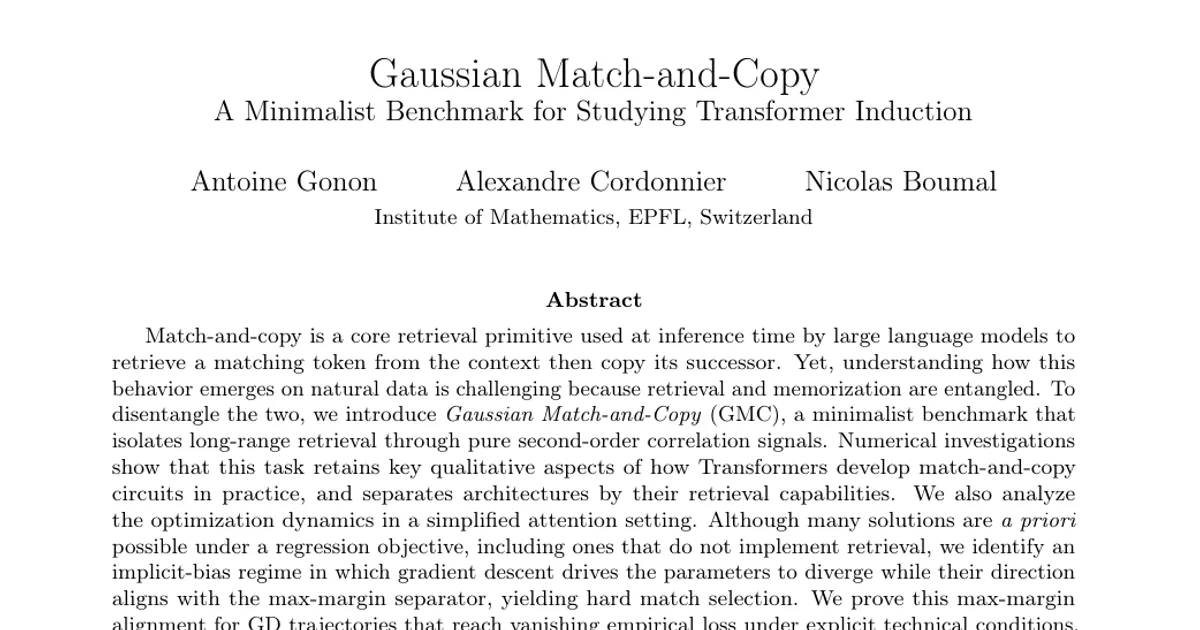
Match-and-copy is a core retrieval primitive used at inference time by large language models to retrieve a matching token from the context then copy its successor. Yet, understanding how this behavior emerges on natural data is challenging because retrieval and memorization are entangled. To disentangle the two, we introduce Gaussian Match-and-Copy (GMC), a minimalist benchmark that isolates long-range retrieval through pure second-order correlation signals. Numerical investigations show that this task retains key qualitative aspects of how Transformers develop match-and-copy circuits in practice, and separates architectures by their retrieval capabilities. We also analyze the optimization dynamics in a simplified attention setting. Although many solutions are a priori possible under a regression objective, including ones that do not implement retrieval, we identify an implicit-bias regime in which gradient descent drives the parameters to diverge while their direction aligns with the max-margin separator, yielding hard match selection. We prove this max-margin alignment for GD trajectories that reach vanishing empirical loss under explicit technical conditions.