Research
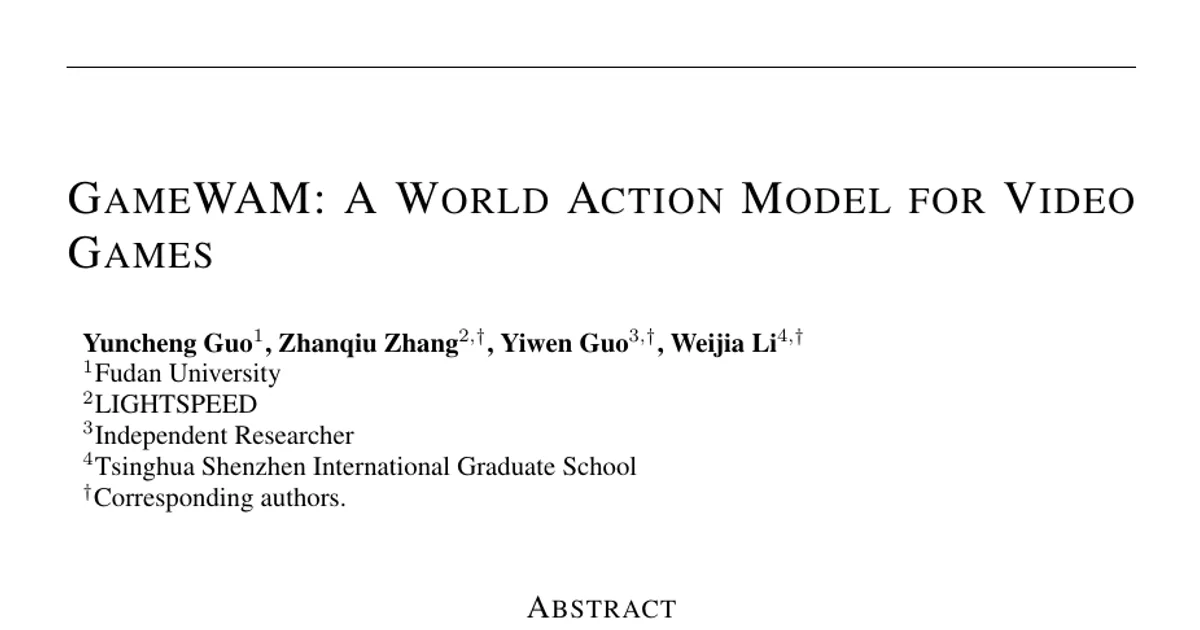
GameWAM: A World Action Model for Video Games
Overview Research area: Artificial intelligence for interactive agents — specifically World-Action Models (WAMs) applied to video game play and graphical user interface (GUI) control. Technical level:
- arXiv
- 2608.26200
- Published
- 2026-08-25
- Authors
- Yuncheng Guo, Zhanqiu Zhang, Yiwen Guo, Weijia Li
AI summary
Overview
Research area: Artificial intelligence for interactive agents — specifically World-Action Models (WAMs) applied to video game play and graphical user interface (GUI) control.
Technical level: Advanced. The abstract assumes familiarity with world models, action policies, flow matching, causal conditioning, and generative control.
Scope: The paper introduces GameWAM, a model that simultaneously predicts future visuals and generates executable keyboard-and-mouse actions for native, closed-loop gameplay and GUI control, and it reports a newly observed failure mode in generative action sampling.
What This Paper Is About
Game agents typically map what they see plus the task description straight to actions, without explicitly modeling how the game world evolves. Conversely, interactive game world models predict future frames from actions they are given, but they are not themselves task-solving policies. World-Action Models aim to unify both capabilities, yet the abstract states this combination is largely unexplored in the demanding setting of video games, where perception is first-person, visuals change quickly, world state persists, and controls are heterogeneous and native. The goal of GameWAM is to close that gap by learning to generate visual futures and executable controls together in a single closed-loop system.
Key Contributions
-
GameWAM itself: The authors present what they describe as, to their knowledge, the first World-Action Model for native closed-loop gameplay and GUI control, jointly generating future visual observations and executable keyboard-mouse trajectories.
-
A joint generative architecture: Visual and action generation run as parallel generative processes, connected through block-causal conditioning and trained with flow matching, so world prediction and control are learned together rather than separately.
-
Mode-aware handling of heterogeneous native controls: GameWAM predicts a gameplay-or-GUI mode for each action step and generates actions using mode-specific prediction distributions together with continuous-action normalization.
-
Block-cycle control for long-horizon interaction: A control scheme that coordinates prediction, execution, and temporal context by predicting beyond the committed horizon, executing short action blocks, replanning from fresh observations, and organizing context hierarchically — from fine-grained within-cycle history to persistent cross-cycle history — supported by a constructed dataset of synchronized gameplay and GUI trajectories.
Main Findings
-
Competitive task success with fewer native actions: The abstract reports that experiments show competitive task success while executing fewer native actions than the compared agents. The abstract does not state success rates, action counts, which games, or which baselines, so the magnitude of the advantage is not available.
-
Joint world-action learning is workable in games: The authors position GameWAM as the first WAM demonstrated for native closed-loop gameplay and GUI control, claiming that simultaneous visual-future generation and executable action generation can be unified in this setting.
-
Mode prediction addresses heterogeneous control: The claimed mechanism for coping with native keyboard-mouse control is a per-step gameplay/GUI mode prediction feeding mode-specific action distributions and continuous-action normalization — presented as the design that makes mixed control tractable.
-
Long-horizon interaction is handled structurally: Rather than a single flat prediction-execution loop, block-cycle control is claimed to coordinate prediction, execution, and context across cycles so the agent can sustain extended interaction.
-
Low-Frequency Action Source Imprinting (LASI): The paper reports uncovering a failure mode in which the low-frequency components of the sampled action source systematically steer coarse generated camera motion even under fixed conditioning. This is described as a source-sensitivity failure mode in generative control, meaning the noise/source used for sampling can leak into and bias the generated behavior.
Methodology in Plain English
The researchers built a dataset of recorded gameplay and GUI sessions in which what is on screen and what the player (or controller) did are synchronized in time. They then trained a single model with two coupled jobs running in parallel: one stream generates the next visual observations, and the other stream generates the actual keyboard and mouse actions to take. The two streams are linked by conditioning that respects the block structure of time, so each generation step only depends on the relevant past, and the model is trained with flow matching — a technique for learning to transform simple noise into complex data.
Because games and GUI applications use very different controls, the model first decides at each step whether it is in gameplay mode or GUI mode, then generates the action using a prediction distribution and normalization scheme specific to that mode. To keep the agent going over long stretches, the model uses a cyclic control loop: it looks further ahead than it commits to, actually executes only a short block of actions, then replans once it sees the new frames. The context it conditions on is organized in layers, from very recent within-cycle history up to a persistent summary that survives across cycles.
Why This Matters
Research impact: The paper argues that agents and world models have been developed in parallel — policies without explicit dynamics, world models without policy behavior — and that unifying them is underexplored for video games. It also introduces LASI, which is a caution for any generative control system that samples actions from a learned generative process: if the sampling source can systematically steer generated motion, then behavior may be biased by something other than the conditioning signal. That finding is a methodological flag beyond games.
Real-world applications (as suggested by the problem setting):
- Automated game testing and QA, where an agent plays natively through the same keyboard-mouse interface a human would use.
- GUI automation and software agents, since the model is explicitly designed to handle both gameplay and GUI control.
- Generating synchronized video-and-action data, which is useful for training other embodied or game-playing models.
- Playtesting and difficulty analysis, where a model that predicts both world state and actions can explore scenarios systematically.
Industry relevance: Game studios, interactive entertainment companies, and teams building general computer-use or GUI agents all depend on agents that can act through native, unmodified interfaces rather than privileged APIs — which is exactly the regime GameWAM targets. The LASI result is relevant to anyone shipping generative controllers, since it identifies a reliability concern that would surface as inexplicable camera drift in production.
Future Directions
-
Mitigating LASI: The abstract identifies source sensitivity as a failure mode but does not describe a fix; developing sampling or training procedures that prevent the action source from steering coarse motion is a natural next step.
-
Broadening coverage: Extending joint world-action learning across more games, more control layouts, and richer GUI environments than the constructed synchronized trajectories cover.
-
Scaling and evaluating long-horizon control: The abstract claims long-horizon interaction support via block-cycle control, but does not quantify how far behavior stays coherent; measuring and extending the horizon is open.
-
Benchmarks and comparability: Given that success is reported relative to "compared agents" without numbers in the abstract, establishing standard metrics and published baselines for native game/GUI world-action models would let claims be checked and compared.
Target Audience
Researchers and advanced practitioners working on game-playing agents, world models, embodied AI, and computer-use/GUI agents. It is also relevant to engineers building generative control systems who need to understand failure modes like LASI, and to game industry teams evaluating native-interface automation. Readers without background in generative modeling and causal conditioning will find the architecture and findings difficult to follow from the abstract alone.
Authors’ abstract
Modern video games combine first-person perception, rapid visual changes, persistent world state, and heterogeneous native controls. Existing game agents map visual and task context directly to actions but lack explicit world dynamics modeling, whereas interactive game world models predict visual futures from supplied actions but do not serve as task policies. World-Action Models (WAMs) unify these objectives, but remain largely unexplored under the dynamics and open-ended interaction of video games. We introduce GameWAM, to our knowledge the first WAM for native closed-loop gameplay and GUI control. GameWAM jointly generates future visual observations and executable keyboard-mouse trajectories through parallel visual and action generative processes with block-causal conditioning and flow matching. To support joint world-action learning, we construct synchronized gameplay and GUI trajectories. To handle heterogeneous native control, GameWAM predicts a gameplay/GUI mode per action step and generates actions with mode-specific prediction distributions and continuous-action normalization. For long-horizon interaction, block-cycle control coordinates prediction, execution, and temporal context: it predicts beyond the committed horizon, executes short action blocks, replans from new observations, and hierarchically structures context from fine-grained within-cycle history to persistent cross-cycle history. Experiments demonstrate competitive task success with fewer executed native actions than the compared agents. We further uncover Low-Frequency Action Source Imprinting (LASI), in which low-frequency components of the sampled action source systematically steer coarse generated camera motion under fixed conditioning, revealing a source-sensitivity failure mode in generative control. Project page is available at https://yunncheng.github.io/GameWAM/.