Research
From Short Clips to Real-Time Streams: Identity-Aware Supervision and Context-Efficient Generation for Video Face Swapping
Overview Research area: Computer vision — video face swapping, specifically reference-guided diffusion/flow-matching video generation for streaming, long-duration use. Technical level: Advanced. The p
- arXiv
- 2610.26681
- Published
- 2026-10-19
- Authors
- Zekai Luo, Yuwei Liang, Ruiqi Ma, Haoyu Huang, Xuehao Wang, Huanyi Zheng, Mingyu Liu, Linhao Zhong, Chenchen Jing, Yuling Xi, Hao Chen
AI summary
Overview
Research area: Computer vision — video face swapping, specifically reference-guided diffusion/flow-matching video generation for streaming, long-duration use.
Technical level: Advanced. The paper assumes familiarity with flow matching, diffusion transformers, latent VAEs, and autoregressive/rollout training for video models.
Scope: The paper diagnoses two structural inefficiencies in reference-guided video face swapping (weak identity sensitivity of latent reconstruction, and redundant background/long-context computation) and proposes StreamingSwap, a two-phase training recipe plus a 1,000-hour dataset, HumanFaceVid, that reaches 21.174 FPS on a single NVIDIA RTX 4090 with stable generation on videos up to 10 minutes.
What This Paper Is About
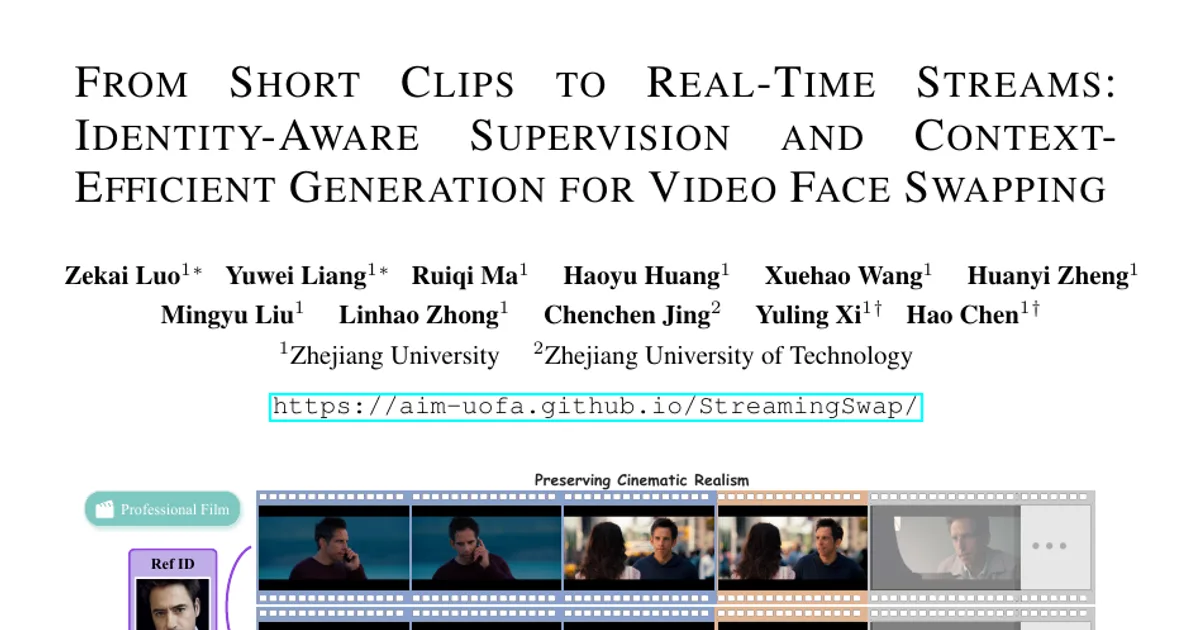
Video face swapping replaces a person's identity in a target video while keeping their expression, pose, gaze, lighting, and background intact. Recent "reference-guided" methods keep the full target video as a visual reference, which preserves detail well but makes the source identity hard to inject and keeps generation computationally heavy. This paper asks how to make such models both faithful to the source identity and fast enough to run continuously on long streams, and answers with new supervision, a face-region-only generation scheme, and a streaming-oriented training procedure.
Key Contributions
- Two task-specific diagnoses. (a) The flow-matching objective is only weakly sensitive to identity changes because swapping identity alters a small fraction of the latent content; (b) because the target video already supplies content and motion, generation can use far fewer spatial tokens and a much shorter temporal context.
- StreamingSwap, a reference-guided flow-matching framework for real-time long-duration video face swapping, combining Joint Rec-ID Loss (noise-level-dependent balancing of clean-latent reconstruction and explicit identity supervision), Face-RoI Generation (conditioning and generation restricted to dilated face-region tokens, blended back into the full latent grid with a feathered mask), and Short-Context Rollout Training (autoregressive self-rollout with a short generated history, bidirectional attention retained within each window).
- HumanFaceVid, a cinematic face-swapping dataset built from OpenHumanVid, with 1,000 hours of training data and evaluation sets of 200 short and 200 long videos.
- Efficiency results: 21.174 FPS and 1.782 s latency on a single NVIDIA RTX 4090, with stable generation on videos up to 10 minutes long.
Main Findings
- Identity supervision is necessary, not optional. In the Phase-I ablation on short videos, removing identity supervision collapses identity similarity from 0.573 to 0.241 (while target-attribute scores improve, e.g. Pose 5.723 to 4.813), confirming that reconstruction loss alone does not enforce the intended identity edit.
- Flow matching barely penalizes identity errors. Across 64 sampled real videos with five identity images each, identity similarity changed by more than 0.75 while mean face-region latent MSE varied by less than 0.05. A mildly blurred identity-preserving control produced latent MSE around 0.15 — comparable to or larger than visible identity changes.
- Background tokens cost a lot and contribute little. Narrowing retained spatial tokens from 100% to 39% largely preserved identity similarity and a combined fidelity-and-quality score while raising throughput from approximately 1.3 to 2.2 FPS and cutting computation from 8,900 to 2,200 TFLOPs.
- Short temporal context suffices. Reducing temporal attention from full (K = 20) to six neighboring latent frames caused only moderate quality degradation; performance dropped sharply below that, particularly at K = 2.
- Face-RoI is a large speedup at similar quality. In ablation, "w/o Face-RoI" gives ID Sim 0.564 at 2.355 FPS versus 0.573 at 6.702 FPS for full Phase I.
- Self-rollout trades a little similarity for streaming stability. On long videos, "w/o self-rollout" scores ID Sim 0.590 versus 0.576 for full Phase II (both at 21.174 FPS), but the qualitative results show error accumulation and progressive degradation without it.
- Balanced benchmark performance. On short videos StreamingSwap reports ID Sim 0.577, Pose 5.354, Expr 2.484, Light 0.242, Gaze 0.881, FVD 129.09, 21.174 FPS, 1.782 s latency; on long videos 0.576, 6.336, 2.466, 0.238, 0.881, 136.23, 21.174 FPS, 1.782 s. InSwapper (0.735 / 0.723) and DreamID-V (0.734 / 0.715) score higher identity similarity, but the paper attributes this partly to lighting/pose drift and lower realism in those outputs; DreamID-V runs at 1.815 FPS with 44.891 s latency.
- Streaming configuration. Best results use N_ctx = 3 history latent frames and N_gen = 9 newly generated latent frames, with a 4-step denoising schedule in Phase II (the paper reports 4 and 25 steps give comparable identity and attribute performance in Phase I, at substantially different throughput).
Methodology in Plain English
The authors start from an existing strong reference-guided model, DreamID-V, which is built on a Wan video diffusion/flow transformer and takes both a source image (identity) and the full target video (everything to preserve) as conditions. Their training data is built in reverse: given a real video of person A and a face-swap of that video to person B, they train the model to take A's photo plus B's swapped video and reconstruct the original real video. This way the ground truth is real footage rather than synthesis artifacts.
Three changes are layered on top.
- Identity-aware supervision. They decode a small subset of predicted frames and score them with a frozen face-recognition encoder, penalizing low cosine similarity to the source identity. This identity loss is combined with ordinary latent reconstruction, with the reconstruction weight set high at high noise levels and low at low noise levels, so early denoising recovers structure and later denoising refines identity detail.
- Face-region-only generation. Face masks are downsampled and dilated, and only the latent patches intersecting that region are fed to the transformer; identity tokens are still concatenated. The predicted face-region latents are scattered back onto the full grid and feathered into the target video's latents, so the untouched background comes directly from the target.
- Short-context rollout. Phase II fine-tunes the model to generate chunks of frames conditioned on a short history of its own previous outputs, keeping bidirectional attention inside each window. Training uses the model's own generated history rather than ground truth, with a randomly chosen denoising step as the backpropagation point, so inference-time error accumulation is experienced during training.
The diagnostic experiments use the same 64 real videos to isolate each design decision before committing to it.
Why This Matters
Research impact. The paper reframes reference-guided face swapping as a supervision-sensitivity and compute-allocation problem rather than a pure architecture problem, and its measurements (identity similarity changing by >0.75 while latent MSE varies by <0.05) give a concrete, reusable argument for why reconstruction-only objectives under-specify identity editing in generative video models.
Real-world applications:
- Film and television post-production — identity replacement that preserves cinematic lighting and the original performance, including partially occluded shots.
- Live and online video — continuous streaming at roughly 21 FPS with 1.782 s latency, matching live frame-rate and buffering expectations.
- AI-generated short dramas — a post-processing pass that stabilizes a character's identity when large motion, complex lighting, or exaggerated expressions cause drift, without regenerating the scene.
- Long-form content pipelines — processing up to 10 minutes of video without progressive degradation, which matters for episodic or broadcast-length material.
Industry relevance. Running at 21.174 FPS on a single consumer-grade RTX 4090, rather than a multi-GPU cluster, moves streaming face swapping from offline rendering toward deployable pipelines. The paper's ethics statement also flags the corresponding misuse risk, noting that efficient streaming may increase it.
Future Directions
- Closing the identity-similarity gap. StreamingSwap's ID Sim (0.577 short / 0.576 long) trails InSwapper (0.735 / 0.723) and DreamID-V (0.734 / 0.715); the paper argues the metric does not capture perceptual fidelity, but a combined metric that rewards both remains an open problem.
- Principled context and window sizing. N_ctx = 3 and N_gen = 9 were chosen empirically to balance quality, throughput, and latency; the analysis shows sharp degradation below six neighboring frames, so how to adapt context length to motion content is unresolved.
- Beyond face-region editing. The Face-RoI insight (background tokens cost compute but carry little information) plausibly generalizes to other reference-guided editing tasks, which the paper does not explore.
- Supervision and data quality. Training data relies on InSwapper plus facial-contour warping and metric-based filtering with manual spot checks; dependence on a synthetic swap model and the residual identity cues it leaves are open robustness questions.
Target Audience
Graduate students and applied researchers in generative video and diffusion/flow-matching modeling; engineers building real-time avatar, dubbing, or post-production pipelines; and dataset builders working on identity-centric video benchmarks. Readers need comfort with latent diffusion, transformer attention, and training-loop details, since the contributions are supervision and compute-allocation designs rather than a self-contained tutorial.
Authors’ abstract
Video face swapping transfers the reference identity to a target video while preserving its other attributes and motion. Despite recent progress in reference-guided flow-based methods, jointly achieving faithful identity transfer, high fidelity, and real-time generation over long video streams remains challenging. To address this challenge, we rethink the task-specific structure of reference-guided video face swapping. First, face swapping changes only identity while preserving most visual content, yet flow-matching supervision is weakly sensitive to these changes. We therefore develop Joint Rec-ID Loss, which balances explicit identity supervision and latent reconstruction according to the noise level. Second, the target video already provides non-edited attributes and temporal dynamics, enabling generation with fewer spatial tokens and shorter temporal contexts through Face-RoI Generation and Short-Context Rollout Training. By integrating these designs, we propose StreamingSwap, a reference-guided flow-matching framework for real-time streaming video face swapping. We also introduce HumanFaceVid, comprising 1,000 hours of cinematic training data and evaluation sets of 200 short and 200 long videos. Experiments demonstrate that our method achieves competitive identity transfer and visual quality at 20 FPS on a single NVIDIA RTX 4090 GPU, with stable generation over videos up to 10 minutes long. Project webpage: https://aim-uofa.github.io/StreamingSwap/