Research
From Pattern Recognizers to Personalized Companions: A Survey of Large Language Models in Mental Health
From Pattern Recognizers to Personalized Companions: A Survey of Large Language Models in Mental Health Overview Research area: Mental health applications of large language models, categorized on arXi
- arXiv
- 2609.25186
- Published
- 2026-09-21
- Authors
- He Hu, Yucheng Zhou, Qianning Wang, Yingjian Zou, Chiyuan Ma, Juzheng Si, Jianzhuang Liu, Zitong Yu, Laizhong Cui, Fei Ma, Qi Tian
AI summary
From Pattern Recognizers to Personalized Companions: A Survey of Large Language Models in Mental HealthOverview
Research area: Mental health applications of large language models, categorized on arXiv under AI Safety & Ethics (cs.CY). The work sits at the intersection of computational psychiatry, natural language processing, and language-agent design.
Technical level: Intermediate. The survey is organized for accessibility but covers a wide technical surface, including pre-training, fine-tuning, reinforcement learning alignment, retrieval augmentation, multimodal fusion, and multi-agent architectures. Readers without some background in LLM training and agent design will find the middle sections dense, while the three-phase framing and dataset tables are readable by non-specialists.
One-sentence scope: The survey organizes the fragmented literature on LLMs in mental healthcare into a three-phase evolutionary narrative—Information Tool, Empathetic Conversationalist, and Longitudinal Personalized Companion—and reviews the technologies, agent components, datasets, and benchmarks that underpin each phase.
Note on the supplied text: The paper content available here is truncated. It cuts off mid-sentence in Section IV-E, so the detailed discussion of Sections V, VI, and VII (datasets, benchmarks, and conclusions) is only partially present. Statements below about those areas reflect only what appears in the available excerpt, and specifics that are not reported are flagged as such.
What This Paper Is About
The rising global prevalence of depression, anxiety, and loneliness, combined with barriers in traditional care such as limited resources, high cost, stigma, and privacy concerns, has created demand for scalable mental health support. LLMs promise to help meet that demand, but the resulting body of research is rapidly expanding and fragmented, lacking a coherent story about how the field is developing. This survey supplies that story by arguing that LLMs in mental health have moved through three increasingly sophisticated phases, and by mapping the technical literature, agent architectures, datasets, and benchmarks onto that trajectory.
Key Contributions
-
A three-phase evolutionary framework. The survey proposes a narrative arc running from Information Tool (Phase I) to Empathetic Conversationalist (Phase II) to Longitudinal Companion (Phase III), giving the field a shared vocabulary for describing where any given system sits.
-
A systematic, phase-linked review of core technologies. It reviews adaptation methods (domain-specific pre-training, supervised fine-tuning, reinforcement learning alignment), inference-time strategies (prompt engineering, chain-of-thought, retrieval-augmented generation), and multimodal integration, explicitly tying each to the developmental phase it enables.
-
An in-depth analysis of the Phase III frontier. The survey details an agent architecture composed of Profile, Memory, Reasoning, Planning, and Tool Use modules, and argues that progress toward genuine long-term therapeutic support requires a shift from better conversational models to stateful cognitive architectures.
-
A roadmap and resource collection. It identifies key challenges and promising directions for responsible, human-centered mental health AI, and maintains a curated collection of reviewed resources in a project repository named Awesome-Mental-Health-LLMs.
Main Findings
-
The field has a directional trajectory, not just a pile of papers. Phase I systems analyze static text for classification and risk assessment, such as detecting depression from social media posts or classifying suicide risk from online forums. Phase II systems shift to active, in-the-moment engagement within a single session, enabled by fine-tuning on specialized dialogue corpora and explicit training in frameworks such as Cognitive Behavioral Therapy (CBT) and person-centered support. Phase III seeks proactive, stateful agents that maintain therapeutic relationships over time. Figure 2 places this taxonomy on a 2021–2025 timeline across five branches: Training-based Methods, Inference-time Methods, Multimodality, LLM-based Agents, and Datasets & Benchmarks.
-
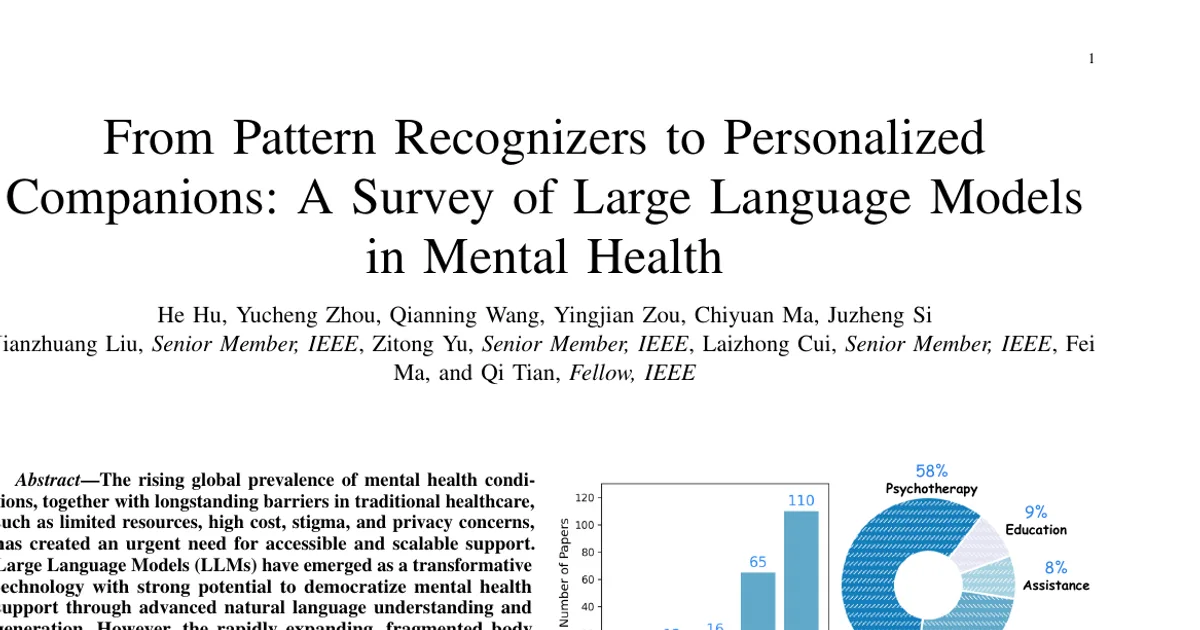
Paper growth is concentrated in psychotherapy. Figure 1 shows rapid growth in mental health LLM research across four categories, with psychotherapy as the predominant application focus, followed by diagnosis, education, and assistance. The figure notes that "2025*" denotes January to November 2025, and that collected papers mainly come from ACL Anthology, PubMed, arXiv, Web of Science, and other major scholarly sources, organized by first public availability date.
-
Phase distinctions can be operationalized. Table I separates the phases along six criteria: interaction (single-turn, multi-turn, longitudinal), user state (none, session, persistent), cross-session continuity (none, none, yes), personalization (none, session, persistent), memory (none, context, long-term), and autonomy (reactive, interactive, goal-directed).
-
Four application pillars structure the field. The survey organizes applications into mental health assessment and diagnosis, therapeutic and clinical interventions, education, and professional assistance. Assessment builds on traditions such as DSM-5 and ICD-11 and can assist in scoring scales like PHQ-9 and GAD-7. Education uses LLMs as simulators that generate virtual patients with varied symptom profiles. Professional assistance targets clinician burden in documentation, treatment planning, and case summaries.
-
Training pipelines follow a common three-stage shape. Domain-specific pre-training injects mental health knowledge, illustrated by ProMind-LLM. Supervised fine-tuning teaches therapeutic competence, either through full fine-tuning or parameter-efficient methods such as LoRA and QLoRA, used for CBT, Narrative Therapy, and Socratic reasoning. Reinforcement learning then refines behavior using preference-based methods including DPO, KTO, and ORPO, with Psyche-R1 using GRPO to enhance reasoning on difficult cases. The survey also warns that SFT is a double-edged sword: it improves task alignment but can constrain flexibility, exacerbate dataset biases, and degrade performance in out-of-distribution scenarios.
-
Inference-time control is as important as training. Prompt engineering aligns reasoning with clinical theory without parameter updates, including integrating psychometric instruments like the BDI into prompts. Chain-of-thought prompting makes reasoning transparent, as in PsyLLM and PsyMix. Retrieval-augmented generation grounds responses in verified material such as CBT worksheets or crisis helpline information, and can be made dynamic by conditioning retrieval on the user's emotional state or conversational intent.
-
Multimodality cuts both ways. Multimodal LLMs can incorporate speech prosody, facial expressions, and gestures; Empatheia combines text, speech, and avatar video to generate emotionally consistent empathetic responses, and the lightweight LQ-former projects audio-visual inputs into a unified semantic space to produce interpretable multimodal explanations. Graph-based models integrate audio-visual cues into dialogue representations for depression severity prediction, and LLM-extracted psychological features have been fused with facial expression data to improve PHQ-8 score prediction. However, the survey reports that non-verbal signals are ambiguous and context-dependent, that multimodal systems can overfit to dataset-specific artifacts, and that they are prone to spurious correlations from incidental features such as lighting or background noise. Cultural, personality, and situational variation can introduce bias and misclassification.
-
Five agent components define the Phase III frontier. The Profile module maintains a dynamic user model tracking emotional states, psychological indicators, and traits such as personality type. The Memory module recalls past interactions across sessions through hierarchical short- and long-term structures or retrieval paradigms, with advanced systems simulating the Ebbinghaus forgetting curve or tracking cognitive distortions. The Reasoning module forms clinical judgments and can generate explainable thought traces. The Planning module turns reactive responders into goal-oriented coordinators using hierarchical planning, stage-based alignment, and dynamic topic steering. The Tool Use module connects agents to clinical guidelines, CBT scripts, or crisis helpline directories.
-
Longitudinal engagement is framed as relationship management, not retrieval. MusPsy uses a longitudinal dataset to train agents on the gradual evolution of a client's state; the CA+ framework uses planning to align each session with long-term therapeutic goals; iPET links dialogue to a virtual pet simulation to deepen the user's bond. The survey describes this as a shift from a data-retrieval challenge about "what was said" to a relationship-management challenge about "where the therapeutic journey is going."
-
Clinical grounding happens through three routes. Data-driven imitation trains agents on specialized corpora, including CACTUS and PsyChatbot on synthetic CBT dialogues, Korean Motivational Interviewing corpora, and spiritual counseling based on the Bhagavad Gita. Explicit process guidance encodes therapeutic workflows into the architecture, as in narrative therapy agents and CAMI for Motivational Interviewing. Reasoning augmentation targets clinical skills such as identifying cognitive distortions and emulating diagnostic reasoning from the DSM and ICD.
-
Multi-agent designs address three kinds of complexity. Cognitive complexity is handled through multi-agent debate that improves accuracy on tasks like cognitive distortion analysis. Procedural complexity is handled by modularizing workflows: AutoCBT allocates separate agents to CBT phases, and MAGI operationalizes the branching logic of the MINI psychiatric interview across four specialized agents. Social complexity is modeled through simulated multi-perspective interactions, as in the MIND framework's dialogue between a user and facets of their inner world ("Devil", "Guide"), or the system by Yang et al. that assembles virtual specialists including an occupational health expert, an HR advisor, and a peer.
-
Safety mechanisms differ in what they actually control. EmoAgent adds a guardian module for real-time monitoring and intervention. PsyLite uses the ORPO algorithm for alignment against jailbreak attacks. RHealthTwin is built around the WHO's six responsible AI principles. The survey cautions that alignment methods shape response style and policy compliance, guardrails filter unsafe outputs, and grounding improves factual consistency, but none of these guarantee clinically appropriate behavior: systems may still produce false reassurance, delayed escalation, or overconfident pseudo-clinical reasoning that looks safe on the surface.
-
Evaluation is moving beyond standard NLP metrics. The ψ-Arena framework assesses systems through tripartite feedback from simulated clients, the agent, and a supervisor. The "Innovative Moment Assessment" (IMA) tracks narrative change in therapy, and tools such as PHQ-9 provide a clinical basis for agent-led assessments. The survey states that LLM-as-a-Judge is a scalable proxy requiring calibration against expert judgment and validated clinical constructs, not a substitute for clinical evaluation.
-
The dataset landscape is dominated by social media and English. Table II catalogs detection resources by year, source, task, size, and language. Sources include Twitter, Reddit, Weibo, SMS, Yixinli, NAVER, and task-based generation. Scale varies enormously, from 1,249 examples in SOS-HL-1K to 14,097,946 in MentalHelp. Other large entries include SWDD at 4,854,421 (Chinese), UMD at 1,556,194, and SWMH at 54,412. Language coverage in the table is largely English, with Chinese entries including SWDD, SOS-HL-1K, CDPR, and C2D2 (listed as English and Chinese), and one Korean dataset, KoACD, with 108,717 entries. Task categories span depression, suicide, stress, and cognitive distortion detection, with newer additions covering bipolar disorder risk and mood estimation (BD-Risk), self-harm intent (SHINES), and mental disorder classification (SWMH, T-SID).
Methodology in Plain English
This is a literature survey, so the method is structured review rather than experiment. The authors collected papers using a consistent set of search keywords applied across all years, with two inclusion criteria: the work must involve large language models, and it must target mental health-related tasks. Sources included ACL Anthology, PubMed, arXiv, Web of Science, and other major scholarly sources, organized by first public availability date such as the arXiv submission date.
The papers were then sorted two ways. First, they were fitted into a proposed three-phase narrative and a six-criterion comparison table so that systems could be classified by interaction type, user state, memory, personalization, and autonomy. Second, Figure 2 arranges them into a taxonomy tree with five branches covering training-based methods, inference-time methods, multimodality, LLM-based agents, and datasets and benchmarks.
From there, the survey walks through applications, technical methods, agent components, and infrastructure in sequence, using named systems as concrete illustrations at each step. Datasets and benchmarks are tabulated with year, source, task, size, and language so that coverage and gaps are visible. The authors position the work against prior surveys that focus on social-media disorder detection, single-session psychotherapy dialogue systems, or generative AI in mental health broadly, claiming broader coverage of papers and a unifying thesis rather than a catalog.
Why This Matters
For research, the survey's value is organizational. It supplies a shared vocabulary—Phase I, II, and III—that lets authors state precisely which problem they are solving, and it links technical choices to developmental stages rather than treating them as interchangeable components. The operational criteria in Table I give reviewers and readers a checklist for judging whether a system's claims match its architecture. The compilation of datasets and the curated repository lower the cost of entry for newcomers.
Real-world applications:
-
Screening and risk triage. Phase I capabilities support automated identification of linguistic markers of depression, anxiety, and suicide risk from social media and online forums, plus assistance in scoring standardized instruments such as PHQ-9 and GAD-7.
-
Therapeutic and emotional support conversations. Phase II systems deliver CBT-inspired interventions and everyday emotional companionship, with multimodal variants reading tone and nonverbal behavior.
-
Clinician training. LLMs generate virtual patients with varied symptom profiles and communication styles, letting trainees practice diagnostic interviewing, therapeutic communication, and crisis management without depending solely on scarce human supervisors. Systems such as PATIENT-ψ create customizable simulated patients, and work by Chaszczewicz et al. uses LLMs to simulate clinical supervisor feedback.
-
Reducing clinician administrative burden. LLMs generate structured session summaries, extract key clinical themes, and assist in formulating treatment plans by synthesizing patient data with established guidelines, freeing clinician time for direct care.
Industry relevance: the survey speaks directly to companies building mental health chatbots, digital therapeutics, and telehealth triage, because it separates capabilities that are currently demonstrable from those that remain aspirational. Its safety analysis warns that automated guardrails and alignment gains do not substitute for clinical validation, which matters for product claims and regulatory positioning. The inclusion of RHealthTwin's grounding in the WHO's six responsible AI principles, privacy-constrained approaches like FedMentalCare's on-device fine-tuning, and the ethical issues around synthetic and simulated data gives product and policy teams a concrete set of design constraints.
Future Directions
-
Evaluation protocols that match the ambition of Phase III. The survey calls for criteria incorporating clinical context, longitudinal dynamics, and risk-sensitive decision criteria, rather than single-turn helpfulness scores and uncalibrated LLM-as-a-Judge outputs.
-
Closing the gap between surface safety and clinical appropriateness. Systems can appear safe while producing false reassurance, delayed escalation, or overconfident pseudo-clinical reasoning. How to detect and prevent these failure modes is framed as an open problem.
-
Validating multimodal signals across diverse populations. Because non-verbal cues are ambiguous, prone to spurious correlation, and sensitive to cultural, personality, and situational variation, the field needs validation across diverse populations and settings before multimodal models can be trusted for clinical use.
-
Sustainable data and personalization infrastructure. Privacy constraints push researchers toward theory-guided synthetic datasets and anonymized multi-session corpora, but the survey notes that synthetic and simulated resources introduce further concerns that the truncated text does not fully spell out. Related open questions include mitigating data bias, maintaining persistent cross-session user models, and moving from one-shot help to long-term companionship without overstating what current systems can do.
Target Audience
This survey is most useful to researchers and graduate students entering or already working in mental health NLP who need a map of the field and a defensible way to position their contributions. It also serves AI engineers and product teams building mental health applications who need to understand which capabilities are established, which are frontier, and where safety evaluation remains unresolved. Clinicians and clinical informatics specialists will find the application pillars and the discussion of simulated patients and documentation support relevant to practice, while policy and ethics reviewers will benefit from the safety infrastructure analysis and the WHO-aligned design example.
Authors’ abstract
The rising global prevalence of mental health conditions, together with longstanding barriers in traditional healthcare, such as limited resources, high cost, stigma, and privacy concerns, has created an urgent need for accessible and scalable support. Large Language Models (LLMs) have emerged as a transformative technology with strong potential to democratize mental health support through advanced natural language understanding and generation. However, the rapidly expanding, fragmented body of work in this area lacks a coherent evolutionary narrative, making it difficult to contextualize current progress and identify future directions. This survey addresses this gap by organizing and analyzing the literature around a central thesis: the role of LLMs in mental health is evolving through three distinct, increasingly sophisticated phases. We trace this trajectory from Phase I, in which LLMs act primarily as passive Information Tools and Pattern Recognizers for assessment; through Phase II, where they function as Empathetic Conversationalists for in-the-moment, stateless interactions; to the current frontier, Phase III, which seeks Longitudinal, Personalized Companions implemented as stateful cognitive agents. To support this framework, we systematically review core technologies, agent architectures (Profile, Memory, Reasoning, and Planning), and the critical infrastructure of datasets and benchmarks, highlighting how their evolution underpins this developmental path. Viewing the field through this developmental lens, we provide a comprehensive synthesis of existing work, an insightful narrative of its trajectory, and a clear roadmap for future innovation in responsible, effective, and human-centered AI for mental healthcare. A curated collection of the resources reviewed in this survey is available at our project repository: https://github.com/Emo-gml/Awesome-Mental-Health-LLMs.