Research
From Measurement to Expertise: Empathetic Expert Adapters for Context-Based Empathy in Conversational AI Agents
From Measurement to Expertise: Empathetic Expert Adapters for Context-Based Empathy in Conversational AI Agents Overview Research area: Human-Computer Interaction (HCI), conversational AI, affective c
- arXiv
- 2511.03143
- Published
- 2025-11-05
- Authors
- Erfan Shayegani, Jina Suh, Andy Wilson, Nagu Rangan, Javier Hernandez
AI summary
From Measurement to Expertise: Empathetic Expert Adapters for Context-Based Empathy in Conversational AI AgentsOverview
- Research area: Human-Computer Interaction (HCI), conversational AI, affective computing, and empathetic large language model (LLM) alignment.
- Technical level: Intermediate. The work combines survey-based empathy measurement with reward modeling, synthetic data generation, and parameter-efficient fine-tuning, but each stage is described conceptually.
- Scope: The paper analyzes a real-world multi-turn human–AI conversation dataset, defines task-specific empathy patterns, builds synthetic empathetic conversations plus reward models, and trains per-task "empathetic expert adapters" to close the gap between users' desired and perceived empathy.
What This Paper Is About
Conversational AI models can express empathy, but that empathy tends to be generic and uniform regardless of what the user is actually doing, while users' empathy needs differ sharply by context. The authors analyze real human–AI conversations to quantify the mismatch between the empathy users want before a conversation and the empathy they perceive afterward, then build measurement tools and context-specific fine-tuned adapters that steer model responses toward the empathy level each task calls for. The goal is to reduce that measured empathy gap while keeping empathy stable across long, multi-turn dialogues.
Key Contributions
- A context-specific empathy analysis of real conversations. The authors extend analysis of the SENSE-7 dataset (Suh et al.), covering 672 multi-turn conversations from 151 participants (109 of whom completed at least five conversations and the exit survey), and show that average perceived empathy correlates with post-conversation satisfaction (Pearson's Correlation = 0.64) while desired empathy varies significantly by task.
- A synthetic multi-turn conversation and steering pipeline. They cluster the 8 tasks into 4 task clusters, use GPT-4o with in-context learning examples to generate opening user prompts and Llama-3-8B-Instruct to generate subsequent turns, then steer conversations toward either empathetic or non-empathetic patterns for each cluster.
- Two families of empathy reward models. They train a GPT-4o-based generative judge ("LLM Score") and a learning-based classifier/reward model built on a frozen fsFairX-LLaMA3-RM-v0.1 backbone with an MLP regression head, using a combined regression and Bradley-Terry loss; the generic reward model achieves MSE = 0.0301, MAE = 0.1335, and correlation with ground truth of 0.43.
- Empathetic Expert Adapters. They train one QLoRA adapter per task cluster on steered conversations, and show these adapters outperform both an unmodified Baseline and a System Prompt approach on task-specific reward scores, preference win rates, and LLM-judged scores — while better preserving empathy as conversations lengthen.
Main Findings
- Perceived empathy tracks satisfaction. Across the real dataset, average perceived empathy highly correlates with self-reported satisfaction after the conversation (Pearson's Correlation = 0.64).
- Desired empathy is task-dependent. Tasks such as overcoming personal issues and handling distressing situations require much more empathy than learning new skills or thinking through work assignments.
- The empathy gap shrank by 72.66%. The average gap between pre-desired empathy and PostTask Empathy Average was 0.49 ± 0.36, reduced to 0.12 ± 0.10 after adaptation, corresponding to an average gap reduction of 72.66% across tasks.
- Adapters beat prompts on every task cluster. In Table VI, on Llama-3-8B-Instruct the Empathetic Expert Adapter reached reward scores of 0.87 (T1), 0.79 (T2), 0.84 (T3), and 0.80 (T4), versus System Prompt scores of 0.66, 0.64, 0.62, and 0.61, and Baseline scores of 0.27, 0.41, 0.31, and 0.42.
- Preference win rates favor adapters. On Llama-3-8B-Instruct, adapter P-WR was 71% (T1), 60% (T2), 67% (T3), and 59% (T4), compared with System Prompt P-WR of 26%, 30%, 28%, and 30%, and Baseline P-WR of 3%, 10%, 5%, and 11%.
- LLM-judged scores follow the same ordering. Adapter LLM Scores on Llama-3 were 0.71 (T1), 0.69 (T2), 0.69 (T3), and 0.72 (T4), against System Prompt values of 0.51, 0.55, 0.63, and 0.51 and Baseline values of 0.42, 0.43, 0.39, and 0.43.
- A larger model performed better. Llama-3-8B-Instruct consistently outperformed Phi-3-mini-128k-instruct (3.8B) across all settings; for example, on T1 the Phi-3 adapter reached a reward score of 0.77 and P-WR of 72%, versus 0.87 and 71% for Llama-3.
- System prompts decay over turns. The authors attribute the larger System Prompt–versus–Adapter gap for Phi-3 to its weaker long-context handling and instruction-following, and note that long system prompts get diluted as context grows, a drift they call "context contamination."
- Adapters are more robust in long conversations. When all settings were conditioned on an identical empathetic conversation history about a cancer diagnosis and treatment, only the Empathetic Expert Adapter consistently sustained empathy; the System Prompt occasionally produced empathetic sentences and the Baseline defaulted to purely technical responses. Figure 6 shows the adapter has the most stable distribution across turn counts of 2, 6, and 10, with the Baseline showing the largest distribution shift and least empathy.
Methodology in Plain English
The team started from real data rather than assumptions. They re-analyzed an existing dataset of in-the-wild chats in which people rated, before each conversation, how much empathy they wanted, and afterward, how much they felt they received, along dimensions including Affective, Cognitive, and Contextual. From these ratings, they found that empathy needs cluster by task, so they grouped the eight original tasks into four clusters: Distressing/Social/Personal Situations, Learning Skills, Work Issues/Career/Self-Improvement, and Work Assignment/Help with Writing.
Because empathetic conversations are scarce and variable, they generated their own. GPT-4o wrote opening user questions for each cluster, prompted with real dataset examples and instructed to produce 30 specific, detailed questions across 40 calls with varying temperature and top-p. Llama-3-8B-Instruct then played out the rest of each conversation, generating assistant replies and subsequent user turns with a short system prompt to keep the dialogue on topic. Two authors with backgrounds in empathy and affective sciences, HCI, and computer science defined target empathy patterns per cluster, and GPT-4o was used to rewrite both real and synthetic conversations toward empathetic or non-empathetic versions of those patterns.
To measure empathy, they trained two kinds of scorers on a 0–1 scale: a GPT-4o judge prompted to reason about the conversation, and a learning-based model that attaches a small MLP regression head to a frozen fsFairX-LLaMA3-RM-v0.1 backbone. That model's loss combines a regression term against real participants' scores with two Bradley-Terry preference terms that teach it steered empathetic conversations should score above original ones, and original ones above non-empathetic ones.
Finally, they trained separate LoRA adapters per task cluster using supervised fine-tuning with 4-bit quantization (QLoRA), updating only adapter weights while the base model stayed frozen. Target modules were q_proj, k_proj, v_proj, and mlp_proj, with rank 32, LoRA alpha 16, dropout 0.05, learning rate 1e-4, batch size 2, gradient accumulation of 4, 3 epochs, and max sequence length 8192. Evaluation compared three settings — Baseline, System Prompt, and Empathetic Expert Adapter — using task-specific Reward Scores, Preference Win Rate (P-WR), and LLM Scores.
Why This Matters
Impact on research. The paper treats empathy not as a single fixed behavior to be maximized but as a context-dependent target that must be measured against user expectations. It contributes reusable infrastructure — an empathy reward model and a preference model whose predictions separate empathetic from non-empathetic steered conversations as β varies — plus a synthetic generation pipeline for a data-scarce problem, and it extends the SENSE-7 dataset analysis with per-task empathy profiles.
Real-world applications.
- Mental health and emotional support agents, where the Distressing/Social/Personal Situations cluster demands the highest empathy and showed some of the strongest adapter gains (reward score 0.87 on Llama-3, versus 0.27 baseline).
- Professional and workplace assistants handling work issues, career and self-improvement questions, where lower or differently shaped empathy is appropriate.
- Writing and productivity assistants, where too much emotional language can be counterproductive and the adapter still led with a reward score of 0.80 versus 0.42 baseline.
- Learning and skill-development tutors, where T2 showed adapter reward scores of 0.79 on Llama-3 and a 60% preference win rate.
Industry relevance. The finding that long system prompts lose influence as conversations grow matters directly for deployed chat products, where system prompts are the standard way empathy instructions are currently delivered. The paper's evidence that per-task fine-tuned adapters preserve empathy over turns of 2, 6, and 10 suggests a practical alternative: swapping lightweight adapters by recognized task instead of relying on increasingly long prompts. The consistent model-size effect (Llama-3-8B outperforming Phi-3-mini-128k-instruct at 3.8B) also gives product teams a concrete trade-off between capability and efficiency.
Future Directions
The available paper content is truncated before Section VI, so the authors' specific stated limitations and future research directions are not reported here. The work itself, however, raises several clear open questions:
- Task recognition in the wild. The framework assumes the task cluster is known so the correct adapter can be selected; how to dynamically detect user context and route among adapters is not reported.
- Scaling beyond four clusters and two models. Whether the approach generalizes to more granular task taxonomies, additional languages, or larger and smaller backbones than Llama-3-8B-Instruct and Phi-3-mini-128k-instruct (3.8B) is not reported.
- Validation with human raters. Evaluation relied on the authors' own reward models, preference models, and GPT-4o judging; whether human users experience the same improvement in perceived empathy is not reported.
- Synthetic data fidelity. The pipeline relies on GPT-4o and Llama-3-8B-Instruct to generate questions and turns, and the authors note topic drift is a challenge they suppress with short system prompts; the downstream effect of residual drift on adapter behavior is not reported.
Target Audience
This paper is most useful to researchers and practitioners working on conversational AI alignment, affective computing, and human-centered AI evaluation, particularly those interested in reward modeling and parameter-efficient fine-tuning as alternatives to prompt engineering. It is also relevant to HCI researchers studying empathy measurement and subjective user ratings, to product and engineering teams responsible for deployed assistants that must modulate tone across domains, and to readers interested in how small specialized adapters can outperform long instruction prompts in long conversations.
Authors’ abstract
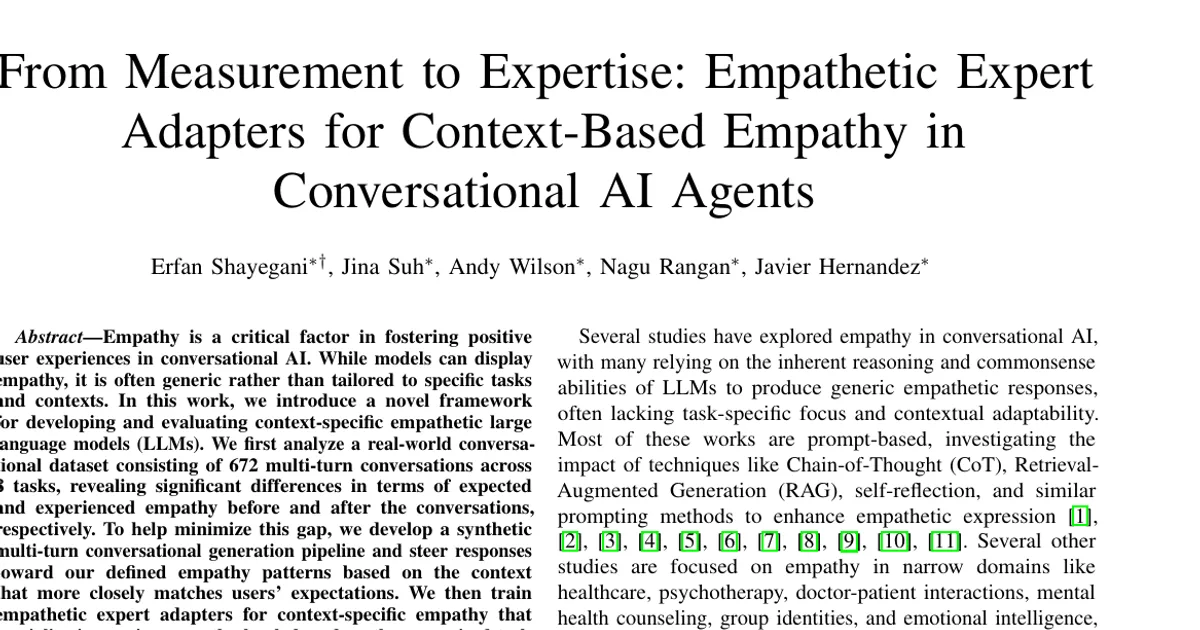
Empathy is a critical factor in fostering positive user experiences in conversational AI. While models can display empathy, it is often generic rather than tailored to specific tasks and contexts. In this work, we introduce a novel framework for developing and evaluating context-specific empathetic large language models (LLMs). We first analyze a real-world conversational dataset consisting of 672 multi-turn conversations across 8 tasks, revealing significant differences in terms of expected and experienced empathy before and after the conversations, respectively. To help minimize this gap, we develop a synthetic multi-turn conversational generation pipeline and steer responses toward our defined empathy patterns based on the context that more closely matches users' expectations. We then train empathetic expert adapters for context-specific empathy that specialize in varying empathy levels based on the recognized task. Our empirical results demonstrate a significant gap reduction of 72.66% between perceived and desired empathy with scores increasing by an average factor of 2.43 as measured by our metrics and reward models. Additionally, our trained empathetic expert adapters demonstrate superior effectiveness in preserving empathy patterns throughout conversation turns, outperforming system prompts, which tend to dramatically diminish in impact as conversations lengthen.