Research
Frame of Reference: Addressing the Challenges of Common Ground Representation in Situational Dialogs
Overview Research area: Natural Language Processing, specifically conversational grounding, common ground representation, and long-term memory for spoken situational dialog systems (embodied conversat
- arXiv
- 2601.09365
- Published
- 2026-01-14
- Authors
- Biswesh Mohapatra, Théo Charlot, Giovanni Duca, Mayank Palan, Laurent Romary, Justine Cassell
AI summary
Overview
- Research area: Natural Language Processing, specifically conversational grounding, common ground representation, and long-term memory for spoken situational dialog systems (embodied conversational agents and social robots).
- Technical level: Intermediate. The paper assumes familiarity with LLM evaluation, retrieval-augmented generation, knowledge graphs, and reinforcement learning, but its core argument is accessible without deep mathematical background.
- Scope: The paper proposes a benchmark (IndiRef) for testing whether dialog systems can resolve "relational references" back to previously established common ground, evaluates existing representation techniques against it, and tests whether in-context learning and GRPO-based reinforcement learning on synthetic dialog data can improve performance.
What This Paper Is About
In long conversations, speakers build up shared knowledge ("common ground") and later refer back to it indirectly, as in "let's go to that café near the park we went to yesterday." Current LLMs can perform simple grounding acts like acknowledgments, but it is unclear whether they can actually use grounded information later. The paper asks how to measure that capability, how well common representations of common ground support it under context constraints, and whether training can improve it.
Key Contributions
- A new evaluation benchmark, IndiRef. The authors manually construct 400 Question/Answer pairs (100 each for Temporal, Spatial, Attributive, and Inferred grounding categories) built from the Meetup and Spot the Difference dialog corpora, where each question targets an entity identified only through a relational reference. A human validation study on the benchmark yielded 87.5% accuracy.
- Empirical evaluation of common ground representations. They compare full-dialog context against three resource-constrained representations (Summarisation, Utterance Chunking with BM25 and NV-Embed-V2 embedders, and an agentic Ontology-based representation) using the Writer/Reader/Generator framework inspired by Zhang et al. (2025).
- A synthetic data generation pipeline and RL training results. They build a three-phase pipeline (Grounded World Generation, Dialog Synthesis, Q/A Synthesis) producing roughly 600 Q/A pairs from synthetic dialog scenarios, and show that GRPO training on this data improves accuracy by 15–20% on Meetup and Spot-the-Difference.
- A negative result on end-to-end RL for representation itself. They test training the common ground Writer directly with RL and find that both template-constrained and open-ended variants underperform the off-the-shelf ontology pipeline, with the open-ended variant collapsing to near-zero accuracy.
Main Findings
- Full-context baselines are weak. Across Gemma2 (2B, 9B, 27B), Llama 3.1 8B, and Qwen QwQ 32B, no baseline achieved an accuracy exceeding 50% across all categories on IndiRef.
- Larger Gemma models do better in Meetup. On Meetup, performance improved with model size, with Gemma2-2B consistently lowest. Gemma2-27B was the top performer overall on Meetup.
- Reasoning-tuned model behaves unexpectedly. Qwen QwQ 32B, despite being slightly larger and specifically trained for reasoning, was outperformed by Gemma2-27B on Meetup; the authors attribute this to logical reasoning difficulties and frequent hallucinations, possibly from scarcity of spoken dialog in its training data. However, Qwen QwQ excelled on inferred grounding questions, the category where other models performed poorly.
- Dataset-specific model behavior. On Spot the Difference, Gemma models underperformed compared to Llama; the authors hypothesize that the longer dialog context in STD favored Llama's use of RoPE over Gemma's sliding window attention.
- Perspective-taking is a failure mode. Models showed significant limitations distinguishing speaker perspectives (e.g., "your" vs "mine") and isolating information conveyed by individual speakers, often erroneously merging conversational content.
- Resource-constrained representations all underperform. Summarisation, Chunking with both embedders, and the agentic Ontology-based approach all yielded poorer performance than the full-dialog baseline, which the authors attribute to information loss during extraction.
- Sparse retrieval had a slight edge. BM25 slightly outperformed the dense NV-Embed-V2 embedder, possibly due to better named-entity retrieval.
- Ontology-based was best among constrained methods, but not uniformly. The agentic ontology-based system outperformed other resource-constrained techniques, performing relatively well on Meetup but struggling on Spot the Difference, where it often merged the two participants' image representations due to their similarity.
- In-context learning helps substantially. Adding examples for each reference type, plus guidance on decoupling speaker-specific information, significantly improved Llama 3.1 8B across all categories on both datasets (for example, Meetup Temporal rose from 0.38/0.32 to 0.60/0.56 on FEM / LLM-as-Judge).
- GRPO on synthetic data helps anchored answers. GRPO-trained Llama 3.1 8B improved on Meetup and Spot-the-Difference categories, with the paper reporting a 15–20% accuracy improvement. On incorrect responses, models often reasoned in the right direction but hallucinated the final answer.
- GRPO modestly helps the ontology representation. Applying the GRPO-trained model to the agentic ontology pipeline outperformed its non-GRPO counterpart on Meetup (for example, Meetup Attributive rose from 0.38/0.30 to 0.52/0.44) but continued to struggle on Spot-the-Difference.
- Direct RL on the representation fails. Training the Writer directly with RL as the policy underperformed the off-the-shelf ontology pipeline (template-constrained) or collapsed to near-zero accuracy (open-ended). The authors attribute this to the credit assignment problem in multi-step agentic pipelines, producing spurious rewards and unjustified penalties.
- Reference-type frequencies in human data. Manual analysis of the two corpora found the following counts — Meetup: Temporal 5, Spatial 34, Comparative 0, Attributive 33, Inferred grounding 177; Spot the Difference: Temporal 4, Spatial 72, Comparative 6, Attributive 8, Inferred grounding 67.
Methodology in Plain English
The authors start from the observation that humans often refer back to shared knowledge obliquely — by time ("the Thai restaurant that we went to after watching Spiderman"), by space ("the bottle on the table"), by intrinsic property ("yellow house"), or by comparison ("bigger chair") — and that speakers also ground things that were only implied. They call these "relational references" and argue that resolving them is a good test of whether a system actually built usable common ground.
They manually annotate two existing dialog corpora (Meetup, with 5131 utterances, and Spot the Difference, with 54 dialogs and 4934 utterances) to confirm these reference types occur, then hand-construct IndiRef: 400 Q/A pairs spread evenly across the four categories, deliberately written with distractors (e.g., multiple sofas in different rooms) so that keyword matching fails and only correct grounding succeeds. Questions are posed as a participant's final utterance, which tests whether the model can keep "self" and "other" perspectives distinct.
For evaluation they use two metrics: Fuzzy Exact Matching (FEM), where an answer is correct if it contains a predefined keyword or phrase, and an LLM-as-a-judge setup using Qwen2.5-32B-Instruct, which sees only the question and both answers (not the dialog context) and judges semantic equivalence. A human evaluation on a subset of answer pairs showed 90% agreement with the automated judge.
They then evaluate five open-weight instruction-tuned models with the full dialog history as context, and separately simulate resource-constrained settings where context is limited, comparing summarization, chunked retrieval (7-utterance chunks, stride 3, top-3 retrieved), and an ontology-based "agentic" pipeline where a Writer extracts entities, properties, relations, and speaker attribution, and a Reader issues multi-step queries (RAG[n], Process, Final) before the Generator answers.
Finally, they try to improve performance two ways: in-context learning with reference-type examples and speaker-decoupling guidance, and GRPO training. Because suitable training data does not exist, they build a synthetic data pipeline that first generates a simulated world with two exploring navigators (with logged spatio-temporal ground truth), then synthesizes dialogs constrained by a programmatic script, then deterministically generates Q/A pairs from preselected facts. They also test using RL directly on the representation step itself, with the final answer's correctness as the reward.
Why This Matters
Impact on research. The paper reframes grounding evaluation away from immediate acknowledgment acts toward the harder question of whether grounded information can be retrieved and used later — a distinction the authors describe as the difference between genuine grounding and an "illusion of grounding." It supplies a concrete benchmark, a negative result about end-to-end RL on representations, and evidence that structured templates carry an inductive bias that open-ended generation does not replace reliably.
Real-world applications (as implied by the paper's framing of situated spoken dialog, ECAs, and social robots):
- Social robots and embodied conversational agents that must remember people, places, and objects across multiple interactions in a shared physical space.
- Long-running personal assistants that need to refer back to earlier sessions without exceeding a context window.
- Multi-session task agents that need to track which speaker contributed which fact, and to model a partner's perspective.
- Evaluation tooling for conversational AI developers who need an adversarial test of whether a system truly grounded information rather than matching keywords.
Industry relevance. The comparison of summarization, retrieval chunking (with both sparse and dense embedders), and ontology-based extraction gives practitioners a direct signal about which memory-management approaches hold up under context constraints — and the finding that all of them underperformed full context suggests current off-the-shelf memory strategies are not sufficient for relational reference resolution. The result that sparse BM25 slightly beat a dense embedder on entity retrieval is also practically relevant for retrieval system design. The failure of end-to-end RL on the representation step is a caution for anyone considering reward-driven optimization of multi-step agentic pipelines.
Future Directions
- Scaling the training experiments. The authors trained only the 8-billion-parameter Llama 3.1 instruction-tuned model due to computational limits, and explicitly state that replicating and extending the experiments with larger models is a valuable direction — with the hypothesis that scale may reduce hallucination.
- Better representation methods. The paper concludes that inconsistent performance highlights the need for more robust representation methods, and suggests exploring more efficient parametric approaches beyond interpretable textual representations.
- Data closer to real interaction. The ideal dataset would be spontaneous, multi-session spoken dialogs; the authors note that Meetup and Spot the Difference, while effective game-based proxies with fragmented context, may not capture the nuances of spontaneous multi-topic, multi-session human interaction.
- Beliefs and assumptions. The benchmark does not comprehensively test a model's capacity to handle "assumptions" and "beliefs" — deeper cognitive elements the authors say are essential for robust conversational grounding, while noting this tilts toward theory-of-mind research.
- Fixing credit assignment. The failure of direct RL on the representation points to the credit assignment problem in multi-step agentic pipelines as an open problem, including spurious rewards and unjustified penalties.
Target Audience
Researchers and graduate students working on dialog systems, conversational grounding, and long-term memory for LLMs will get the most from this paper, particularly those interested in benchmarks for situated and embodied interaction. It is also useful for engineers building memory pipelines for conversational agents or social robots, who want evidence on how summarization, chunked retrieval, and ontology-based extraction compare under context constraints, and for RL practitioners interested in a documented failure case of end-to-end reward optimization in an agentic pipeline.
Authors’ abstract
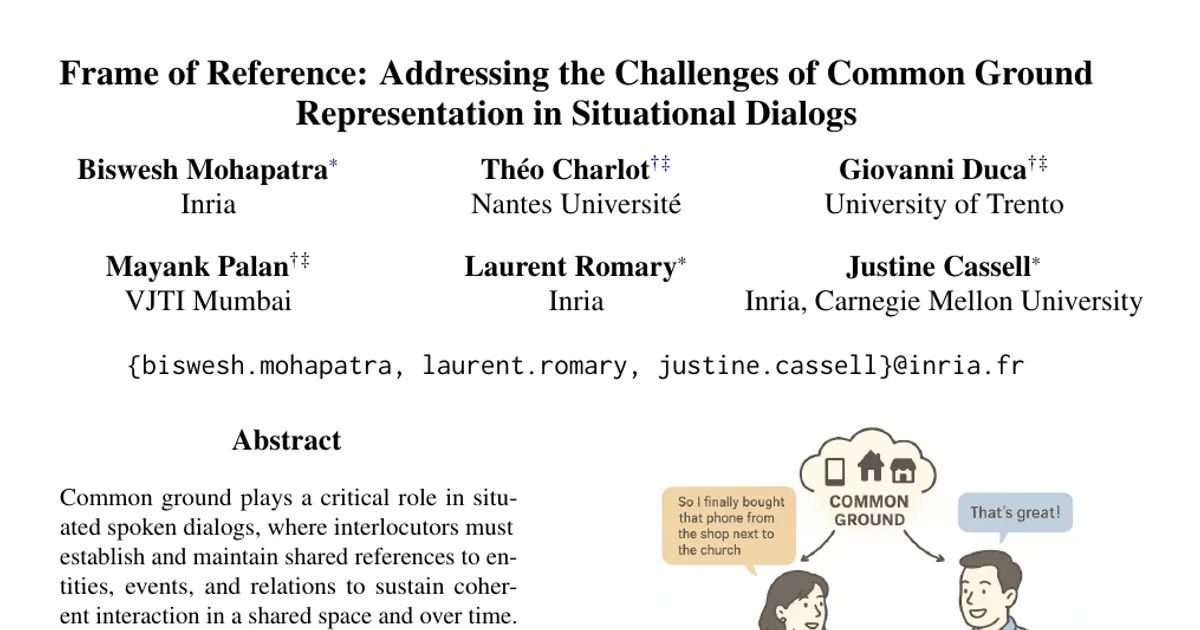
Common ground plays a critical role in situated spoken dialogs, where interlocutors must establish and maintain shared references to entities, events, and relations to sustain coherent interaction in a shared space and over time. With the increasing presence of embodied conversational agents and social robots, the ability to correctly ground this kind of conversational content in order to refer back later also becomes important for dialog systems. Prior studies have demonstrated that LLMs are capable of performing certain grounding acts like acknowledgments. However, relatively little work has investigated their capacity to leverage the grounded information, like in complex scenarios involving space and time (e.g., "let's go to that café near the park we went to yesterday"). To that end, in this work, we evaluate a model's ability to establish common ground by utilizing these "relational references" in the dynamic and shared environments of situated dialogs. We then test multiple methods for representing common ground and further propose approaches to improve their performance by using reinforcement learning on our synthetically generated dialog data .