Research
Flash RNN-T: Memory-Efficient Joint Network and Transducer Loss Computation
Overview Research area: Speech recognition systems and memory-efficient deep learning training, specifically the joint network and transducer loss of recurrent neural network transducer (RNN-T) models
- arXiv
- 2610.23409
- Published
- 2026-10-16
- Authors
- Mahmoud Ashraf
AI summary
Overview
Research area: Speech recognition systems and memory-efficient deep learning training, specifically the joint network and transducer loss of recurrent neural network transducer (RNN-T) models.
Technical level: Advanced. The paper assumes familiarity with RNN-T alignment lattices, forward–backward recursions, GPU kernel fusion, activation checkpointing, and mixed-precision training.
Scope (one sentence): The paper introduces and benchmarks Flash RNN-T, a GPU implementation of RNN-T joint-network and loss computation with optional tiled checkpointing, and measures its throughput–memory tradeoffs against Apex, NeMo Numba, and Optimized Transducer on short, medium, and long workloads on NVIDIA H100 (80 GB) and RTX 5090 (32 GB) GPUs.
What This Paper Is About
Training an RNN-T requires summing over all alignments between an audio encoder sequence and a transcript. At every one of the T(U+1) valid alignment positions, the joint network produces a hidden state and a full vocabulary-sized logit vector, and conventional batched training keeps all of these tensors in memory for the backward pass. Existing tricks — packing only valid positions instead of padding, or processing one utterance at a time — reduce waste but do not bound the large intermediates produced within a single utterance. The goal of Flash RNN-T is to control that memory directly: compute the joint network in small groups of alignment positions, keep only the compact blank and target log probabilities the recurrence actually needs, and recompute the discarded tensors tile by tile during backpropagation.
Key Contributions
-
Tiled joint computation with checkpointing. Valid alignment positions from a batch of B utterances are packed into approximately balanced tiles of at most R positions, which may span utterance boundaries. Each tile keeps only its blank and target transition log probabilities; hidden states and vocabulary logits are discarded and recomputed one tile at a time inside autograd backward, so the training loop is unchanged.
-
Specialized joint and normalization kernels. The joint kernel gathers projected states, fuses addition, activation, and dropout, and in backward fuses the dropout and activation derivatives with reductions along the encoder and target axes so both encoder and prediction-network gradients come from one read. The normalization kernel reads all V logits but returns only blank and target log probabilities, and in backward overwrites the tile's logits with logit gradients instead of allocating a new tensor. Coordinate mapping between packed tiles and lattice tensors is computed arithmetically rather than stored as an index per position.
-
A storage analysis of the tradeoff. Retaining intermediates for all N packed positions costs O(N(H+V)); checkpointing reduces this to O(min(N,R)(H+V)). The compact log probabilities and forward–backward buffers remain rectangular at O(BT_max(U_max+1)), and projected states, parameters, gradients, and metadata add further storage, so R bounds the large joint intermediates rather than total device memory.
-
A measured throughput–memory characterization with an ablation. The paper releases benchmark scripts and results, compares tiled and untiled Flash against three external implementations under two backward schedules, and isolates how much of the gain comes from kernel specialization versus recomputation.
Main Findings
- Untiled Flash beats baselines where it fits. On H100, untiled Flash achieves 24–39% higher throughput with 26–56% less memory than the fastest baseline on the medium and long workloads wherever it fits.
- Tiled Flash sets the low-memory end on medium. The selected tiled configuration reaches 2,839 samples/s at 1.84 GiB, a ninefold memory reduction relative to Apex under retain scheduling at 16.3% lower throughput. Apex under release narrows the memory advantage to a factor of 3.7 with a similar throughput gap.
- Untiled Flash improves both metrics on medium. It provides 24–25% higher throughput with 49–56% less memory than Apex across the retain and release schedules.
- Long workloads are only feasible with tiling. Every tested retain configuration of untiled Flash and of the external implementations runs out of memory even with 80 GB, while all six tiled Flash configurations fit. The selected tiled configuration reaches 163.6 samples/s at 4.26 GiB, fourfold less memory than Apex release at 12.3% lower throughput, and does so with one backward call per batch rather than one per sub-batch.
- Release scheduling helps untiled execution. On long, untiled Flash with release achieves 39% higher throughput than Apex with 26% less memory. On medium, switching untiled Flash from retain to release with 16-utterance sub-batches cuts peak memory from 7.89 to 1.70 GiB while maintaining throughput; on long, release with four-utterance sub-batches makes untiled execution feasible at 243.0 samples/s and 7.23 GiB.
- Short workloads are a tradeoff, not a sweep. Untiled Flash uses 60% less memory than Apex under retain with 7.8% lower throughput, and 73% less memory under release with 6.6% lower throughput.
- Apex has the highest peak throughput among external implementations on all three workloads.
- Specialized normalization drives throughput; specialized joint drives memory. Replacing compiled normalization improves tiled throughput by 13–16%. Adding the specialized joint reduces peak memory by a further 17–33%, but its throughput effect is GPU-dependent, decreasing 2.5–4.3% on H100 while increasing on RTX 5090. Together the specialized components remain 9–11% faster than compiled components while using 51–53% less memory.
- Gains survive fully compiled comparisons. Even when the joint, vocabulary projection, and normalization are compiled together, tiled Flash achieves 8–9% higher throughput with 42–45% less memory.
- Checkpointing is the main memory lever. With the same specialized kernels, tiled checkpointing reduces peak memory approximately twofold on short and tenfold on medium, at 24.5% and 29.6% lower throughput respectively.
- The frontier result holds on the smaller GPU. The RTX 5090 experiments show the same medium- and long-workload frontier advantage with nearly identical peak memory for matched configurations, though relative throughput differs across GPUs.
Methodology in Plain English
The authors treat the joint network's output as too big to keep, and the recurrence's inputs as small enough to keep.
- Split the work by alignment position. Instead of materializing hidden states and logits for every (t, u) pair in a batch, they flatten the valid positions into one list, chop that list into tiles of at most R positions (allowing a tile to straddle two utterances), and process one tile at a time.
- Keep only what the recurrence needs. Per tile, they store just the T(U+1) blank and TU target log probabilities. The bulky tensors are thrown away.
- Recompute during backward. Gradients for the joint must wait until the forward–backward recurrence over the whole utterance is finished, because they depend on all alignments. After that, each tile is recomputed and differentiated in turn, and its tensors are released before the next tile. Projected encoder and prediction-network states stay outside the checkpoint and are reused; a saved seed per tile reproduces the original dropout mask without storing it.
- Fuse aggressively. Addition, activation, and dropout are fused in the joint kernel; the normalization kernel computes logit gradients directly and reuses the logit buffer; index bookkeeping is replaced with integer division and remainder by U_b + 1.
- Benchmark carefully. They fix B = 128, H = 640, and a SentencePiece BPE vocabulary of V = 1024 including blank, with 80 ms encoder steps and joint dropout of 0.1. Short and medium workloads come from the English subset of Granary, the long workload from the linked long-form training split of TED-LIUM 3, with 2D bucketing by audio duration and transcript length (30 duration buckets, two transcript-length sub-buckets each). Joint inputs and computation use FP16; parameters, parameter gradients, normalization, and the recurrence use FP32. The tile limit is swept from 25k to 800k positions; comparators are swept over sub-batch sizes of 1–64 utterances under a "retain" schedule (hold sub-batch graphs for one combined backward) and a "release" schedule (differentiate each sub-batch immediately). For headline comparisons they pick each implementation's lowest-memory configuration that still reaches at least 95% of its peak measured throughput.
Why This Matters
Impact on research. RNN-T training is often limited by memory rather than arithmetic, and prior memory savings either pack padded positions away or shrink the batch one utterance at a time. This work shows that the joint intermediates inside a single utterance can be bounded independently of utterance length, and quantifies the cost of doing so. It also gives the community a reproducible frontier: the claim is not a single speedup number, but that tiled and untiled Flash together occupy the entire measured throughput–memory frontier on the medium and long workloads on both GPUs.
Real-world applications.
- Streaming and on-device speech recognition, where RNN-T is a practical choice under real-time constraints and memory budgets are tight.
- Long-form transcription such as lectures, meetings, and talks, represented here by the ~69.6 s mean-duration TED-LIUM 3 workload with 41,122,726 valid alignment positions.
- Training on workstation-class GPUs with 32 GB, since the RTX 5090 experiments reproduce the medium and long frontier advantage.
- Integration into existing training pipelines without rewriting the training loop, because tiled recomputation runs inside autograd backward and keeps a single backward call per batch.
Industry relevance. Lower peak memory maps to larger batches, longer utterances, or fewer GPUs for the same job; the single-backward-call property matters for teams unwilling to restructure distributed training around per-utterance gradient accumulation. The paper is authored from an industry affiliation (Tarteel AI) and ships code, benchmark scripts, and results.
Future Directions
- End-to-end training throughput. The reported measurements cover joint-and-loss computation only, not full training throughput, so the wall-clock benefit inside a complete ASR training job remains unquantified.
- Bounding lattice storage. The compact log probabilities and forward–backward buffers still grow as O(BT_max(U_max+1)); tiling bounds only the joint intermediates, leaving the remaining rectangular buffers as an open target.
- Broader evaluation. Results cover three corpus-derived batches on two GPU architectures with a single model configuration; scaling behavior across vocabulary sizes, hidden dimensions, encoder step rates, and other hardware is not reported.
- Combining with alignment restriction. The paper contrasts its approach with work that restricts the alignment sum (Kuang et al.) rather than changing how the full sum is evaluated; composing tiling with such pruning, and automating tile-size selection, are natural next steps.
Target Audience
Speech recognition engineers and ML systems researchers who train or deploy transducers; practitioners who are memory-bound on RNN-T training and want either a drop-in implementation or a clear picture of the throughput they would trade away for memory; and anyone building GPU kernels for sequence losses who wants a worked example of fusing normalization, activation, and dropout while using checkpointing to bound intermediate tensors. Readers without background in RNN-T alignments or GPU memory management will find the implementation and results sections difficult.
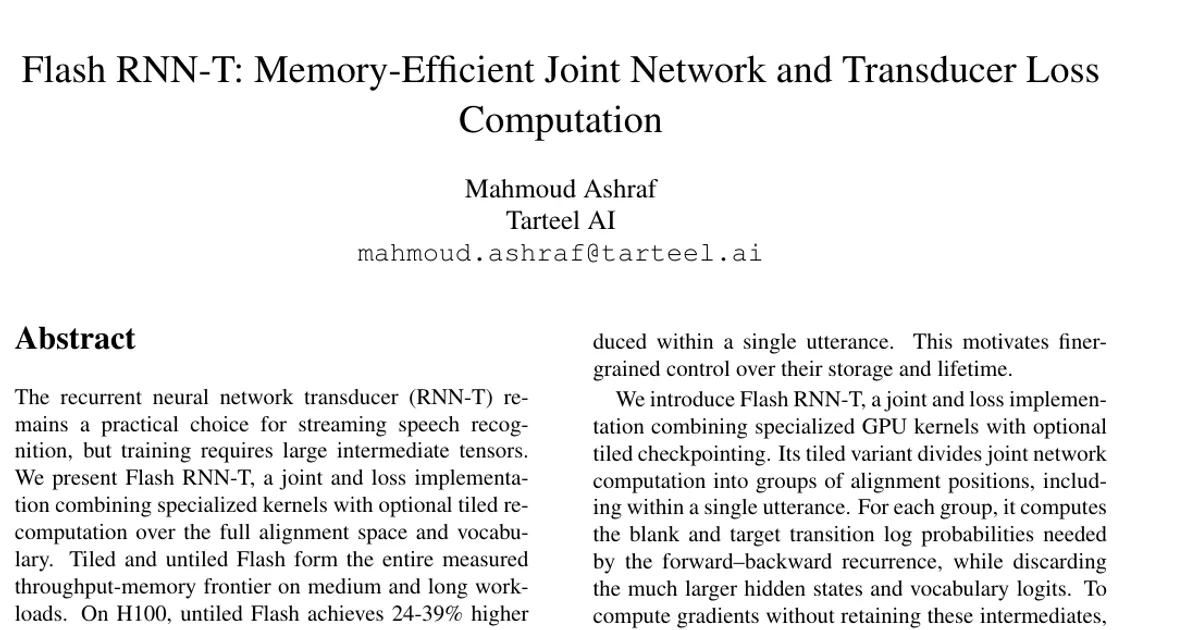
Authors’ abstract
The recurrent neural network transducer (RNN-T) remains a practical choice for streaming speech recognition, but training requires large intermediate tensors. We present Flash RNN-T, a joint and loss implementation combining specialized kernels with optional tiled recomputation over the full alignment space and vocabulary. Tiled and untiled Flash form the entire measured throughput-memory frontier on medium and long workloads. On H100, untiled Flash achieves 24-39% higher throughput with 26-56% less memory than the fastest baseline on these workloads wherever it fits. Tiling reduces memory further through recomputation. On medium, tiled Flash uses ninefold less memory than that baseline at 16% lower throughput when both use one backward call per batch. On long, it fits where all tested alternatives with that backward schedule run out of memory with 80 GB. These comparisons use each implementation's lowest-memory configuration reaching at least 95% of its peak throughput.