Research
Field-Theoretic Memory for AI Agents: Continuous Dynamics for Context Preservation
Overview Research area: Natural language processing and AI agent memory systems, specifically long-context and multi-session memory for conversational agents, drawing on classical field theory and par
- arXiv
- 2602.21220
- Published
- 2026-01-31
- Authors
- Subhadip Mitra
AI summary
Overview
- Research area: Natural language processing and AI agent memory systems, specifically long-context and multi-session memory for conversational agents, drawing on classical field theory and partial differential equations.
- Technical level: Advanced. The paper assumes familiarity with reaction-diffusion equations, Laplacian operators, Von Neumann stability analysis, sparse numerical representations, and statistical effect sizes (Cohen's d), though the motivation is explained in accessible terms.
- Scope: The paper proposes and evaluates a memory system in which stored information is a continuous scalar field evolving under PDE dynamics rather than discrete entries in a database, benchmarked on LoCoMo (ACL 2024) and LongMemEval (ICLR 2025).
What This Paper Is About
Conventional agent memory — key-value stores, vector databases, and RAG pipelines — treats each memory as an isolated entry retrieved by explicit similarity matching at query time, with no mechanism for memories to age, consolidate, or influence one another. The authors argue this breaks down in scenarios like a technical support agent that must recall a user's nginx setup and custom authentication module a week after the original conversation, where similarity retrieval surfaces unrelated issues and time-based pruning may have deleted the relevant context. Their goal is to replace discrete storage with a continuous field that diffuses through semantic space, decays thermodynamically according to importance, and couples across agents, then measure whether that formulation improves multi-session and temporal reasoning.
Key Contributions
- A field-theoretic formulation of agent memory based on a reaction-diffusion equation — the heat equation augmented with a linear decay term and a source term — defined over a 2D semantic manifold.
- An importance-weighted evolution scheme in which an importance mask modulates both diffusion and decay, so frequently accessed or high-weight memories resist spreading and forgetting, with the mask itself evolving through its own update equation.
- Field coupling for multi-agent knowledge sharing without centralized coordination, where a coupling term drives each agent's field toward the others', tested across 2, 4, and 8 agents.
- Rigorous evaluation on LoCoMo and LongMemEval, reporting +116% F1 on multi-session reasoning and +43.8% on temporal reasoning, alongside an open-source JAX implementation with 518x speedup through JIT compilation.
Main Findings
- Multi-session reasoning gains on LongMemEval: F1 of 0.042 for FieldMem versus 0.020 for the vector database baseline, a +116.0% improvement (p = 0.002, Cohen's d = 3.06).
- Temporal reasoning gains: F1 of 0.120 versus 0.084, +43.8% (p < 0.001, d = 9.21).
- Preference recall gains: F1 of 0.268 versus 0.168 for single-session-pref, +59.1% (p < 0.001, d = 8.96).
- Largest effect sizes appear on the tasks field dynamics target: the paper reports d > 3 on the multi-session and temporal results, which it interprets as practically meaningful rather than marginal.
- Neutral results on single-session and knowledge-update F1: single-session-user improved +14.8% (0.066 vs 0.058) but was not significant (p = 0.647, d = 0.46), and knowledge-update showed +0.0% (0.086 vs 0.086, p = 1.000, d = 0.00).
- Retrieval recall improves on multi-session and knowledge-update tasks: 0.230 vs 0.167 (+38.1%, p < 0.001, d = 8.00) and 0.147 vs 0.115 (+27.8%, p < 0.001, d = 5.00) respectively; single-session-user was 0.100 vs 0.080 (+25.0%, p = 0.083, d = 1.73).
- LoCoMo gains are much more modest: the only significant result was Category 3 F1, 0.017 vs 0.016 (+9.5%, p = 0.033, d = 2.14). Category 4 exact match was 0.271 vs 0.256 (+6.1%, p = 0.778, d = 0.04) and Category 5 adversarial exact match was identical at 0.391 (+0.0%, p = 1.000, d = 0.00).
- Aggregate scores mask the effect: overall exact match was 0.204 vs 0.198 (+3.0%) and overall F1 was 0.049 vs 0.048 (+2.1%), which the authors attribute to averaging across question types where field dynamics do and do not help.
- Near-perfect multi-agent collective intelligence: 0.9998 ± 0.0001 with 2 agents, 0.9991 ± 0.0003 with 4 agents, and 0.9985 ± 0.0005 with 8 agents (n = 30), with 100.0% sharing efficiency in all configurations.
- Coordination time stays roughly flat with agent count: 2.78 ± 0.44s for 2 agents, 3.20 ± 0.69s for 4 agents, and 2.72 ± 0.56s for 8 agents. The paper attributes the slight decrease at 8 agents to the parallel nature of field coupling.
- Retrieval latency actually improves: 22.5 ms vs 27.0 ms at 10k memories (0.83x), because field amplitude acts as a fast pre-filter. But processing time is 19.8 ms/op vs 2.1 ms (9.4x) and memory usage is 7.02 MB vs 1.01 MB (6.9x).
- Overhead is concentrated in field evolution: the breakdown is field evolution 41%, retrieval scoring 23%, serialization 16%, memory injection 11%, and sparse updates 9%.
- Field evolution is the most critical component in ablation: removing it costs 45.2% of context retention, followed by thermodynamic decay at 31.8%, semantic clustering at 22.4%, and importance weighting at 18.7%.
- A known failure mode is reported: on single-session-assistant questions in LongMemEval, the field-theoretic approach underperforms the baseline by 33.3%, which the authors suggest comes from importance weighting over-emphasizing user messages relative to assistant responses.
Methodology in Plain English
The system represents memory as a single scalar field defined over a flat 2D "semantic map," where each memory's embedding is projected down to a coordinate pair. New memories enter as localized Gaussian bumps assigned an importance score. Between queries, the field evolves in discrete time steps under a reaction-diffusion equation with three terms: a diffusion term that spreads activation to semantically neighboring regions, a decay term that causes unreinforced memories to fade exponentially (matching Ebbinghaus-style forgetting curves), and a source term that injects new information. The linearity of the equation lets overlapping memories superpose rather than overwrite each other.
To prevent important memories from eroding, the authors add an importance mask that divides both the diffusion and decay coefficients, so high-importance regions spread and decay more slowly. The mask itself decays at a baseline rate and is boosted by access events. For multi-agent settings, each agent keeps its own field and the fields exchange knowledge through a coupling term proportional to the difference between them, with the authors noting that fully connected coupling produces rapid consensus but can dilute specialized knowledge while sparse coupling preserves individuality.
Retrieval scores candidates as a weighted combination of four signals: cosine similarity between query and memory embedding, the absolute field amplitude at the memory's position, importance, and recency. The field amplitude term is the paper's stated novelty because it folds the memory's history — how it spread, what decayed around it, whether related memories reinforced it — into the retrieval score.
Implementation-wise, the field is discretized with a 5-point Laplacian stencil and forward Euler time stepping, with a CFL stability condition. A 1000x1000 dense field would need 8 MB per field in float64 or 4 MB in float32, so the authors use a sparse hash-map representation that tracks only active cells plus a boundary layer and prunes cells whose amplitude falls below 10^-6, reducing memory and per-step time from O(N^2) to O(S). Operations are implemented in JAX with JIT compilation, vectorization via vmap, convolution for the Laplacian, and .at[].set() for sparse in-place updates. The experimental configuration uses N = 128, D = 0.02, λ = 0.02, Δt = 0.1, α = 2.0, retrieval weights of w1 = 0.60 (similarity), w2 = 0.15 (field strength), w3 = 0.15 (importance), and w4 = 0.10 (recency), with OpenAI text-embedding-3-small embeddings (1536 dimensions) projected to 2D via random projection. Note that Appendix A's stability example uses different values (D = 0.01, λ = 0.005, h = 0.001, Δt = 0.01), which do not match the Section 5.2 configuration; the paper does not reconcile the two sets. The baseline is a vector database with the same embeddings and cosine similarity retrieval. Evaluation uses exact match, F1, retrieval recall, and retrieval precision, with multiple random seeds, reported means and standard deviations, independent t-tests, and Cohen's d.
Why This Matters
Impact on research. The paper reframes agent memory as a dynamical system rather than a lookup table, and it is a deliberate follow-up to the authors' earlier Field-Theoretic Context System (FTCS). If the reported effect sizes hold, the work suggests that a meaningful part of long-context memory difficulty is not a retrieval-ranking problem but a memory-lifecycle problem: what persists, what fades, and what mutually reinforces. The ablation results make the specific claim sharper — over 45% of the retention benefit comes from letting the field evolve at all, not from any single retrieval heuristic. The multi-agent coupling results also open a line of inquiry into coordination-free knowledge sharing as an alternative to explicit message passing between agents.
Real-world applications (as motivated by the paper):
- Technical support agents that must retain a user's specific configuration and error patterns across conversations weeks apart, the opening scenario of the paper.
- Long-running personal assistants that need preference recall and knowledge updates as a user's details change over time — though the paper's own knowledge-update F1 result on LongMemEval was +0.0%.
- Temporal reasoning tasks such as tracking time-dependent facts, where the paper reports its second-largest gain (+43.8% F1).
- Multi-agent collaborative systems where 2-8 agents must converge on shared understanding; the paper reports 100% sharing efficiency and coordination times under roughly 3.2 seconds.
Industry relevance. The cost profile is the practical caveat. Retrieval latency improves 0.83x, but processing time rises 9.4x and memory 6.9x, and the largest gains land on multi-session and temporal workloads while single-session retrieval and adversarial question handling are unchanged or worse. That makes the approach most defensible as a complement to — not a replacement for — vector databases, which the authors state explicitly. The JAX implementation with 518x JIT speedup and sub-linear scaling to 100k+ memories suggests the overhead is manageable at production scale, but the parameter-sensitivity limitation (the four retrieval weights need per-domain tuning) is an operational cost that any deployment would absorb.
Future Directions
- Learned field dynamics via neural PDEs rather than fixed hand-specified equations, which would let the diffusion, decay, and coupling behavior be fit from data.
- Adaptive field resolution that allocates finer detail to active semantic regions instead of a uniform grid.
- Hierarchical fields with different time scales to separate short-term from long-term memory.
- Integration with transformer architectures as a differentiable memory module, which would fold the field directly into model computation rather than sitting beside it.
Open questions the paper leaves unresolved include why retrieval recall degrades by 33.3% on single-session-assistant questions, whether the 2D projection (which the appendix notes loses information from 768D embeddings, with 3D and 4D giving only marginal improvement at substantial cost) can be improved without prohibitive expense, and whether the LoCoMo/HongMemEval performance gap stems from topical coherence as the authors suggest or from something else.
Target Audience
Researchers and engineers working on long-context language models, agent memory architectures, and retrieval-augmented generation who are comfortable with numerical methods and PDEs. It is also relevant to physicists and applied mathematicians interested in importing field-theoretic machinery into machine learning, and to practitioners building multi-session conversational agents who want to weigh a 9.4x processing-time increase against measured gains on multi-session and temporal tasks. Readers looking for a drop-in vector database replacement will not find one here; the paper is explicit that the approach is not a universal substitute.
Authors’ abstract
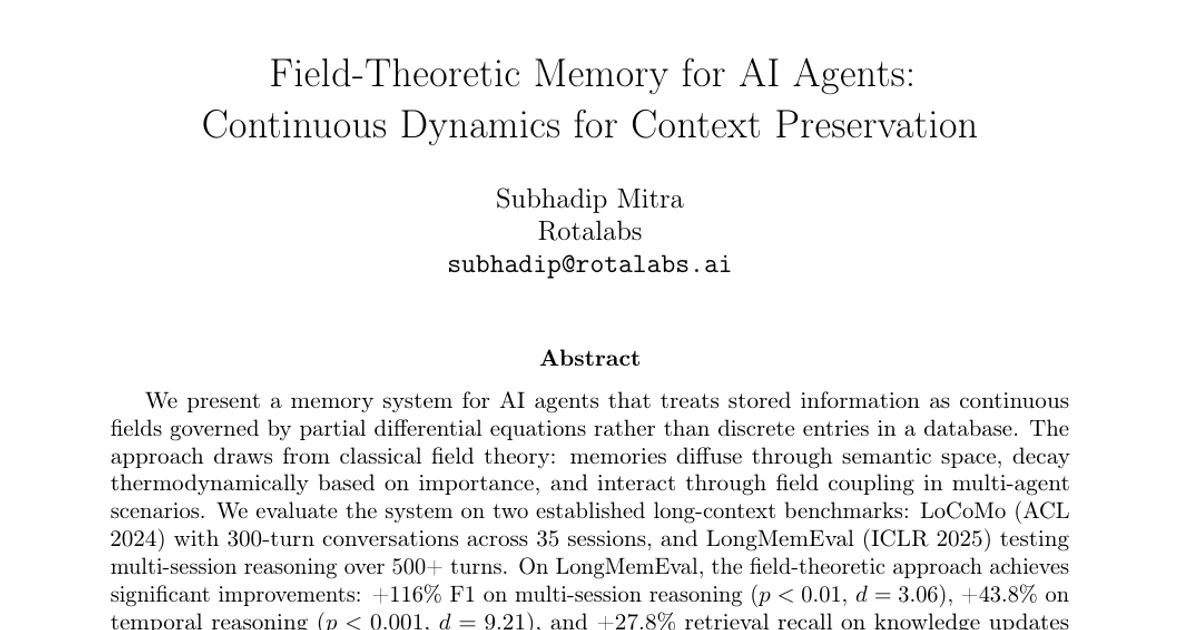
We present a memory system for AI agents that treats stored information as continuous fields governed by partial differential equations rather than discrete entries in a database. The approach draws from classical field theory: memories diffuse through semantic space, decay thermodynamically based on importance, and interact through field coupling in multi-agent scenarios. We evaluate the system on two established long-context benchmarks: LoCoMo (ACL 2024) with 300-turn conversations across 35 sessions, and LongMemEval (ICLR 2025) testing multi-session reasoning over 500+ turns. On LongMemEval, the field-theoretic approach achieves significant improvements: +116% F1 on multi-session reasoning (p<0.01, d= 3.06), +43.8% on temporal reasoning (p<0.001, d= 9.21), and +27.8% retrieval recall on knowledge updates (p<0.001, d= 5.00). Multi-agent experiments show near-perfect collective intelligence (>99.8%) through field coupling. Code is available at github.com/rotalabs/rotalabs-fieldmem.