Research
Fast SceneScript: Fast and Accurate Language-Based 3D Scene Understanding via Multi-Token Prediction
Overview Research area: Language-based 3D perception — specifically autoregressive structured language models that read 3D point clouds and emit scene layouts or 3D bounding boxes as token sequences.
- arXiv
- 2512.05597
- Published
- 2025-12-05
- Authors
- Ruihong Yin, Xuepeng Shi, Oleksandr Bailo, Marco Manfredi, Theo Gevers
AI summary
Overview
Research area: Language-based 3D perception — specifically autoregressive structured language models that read 3D point clouds and emit scene layouts or 3D bounding boxes as token sequences.
Technical level: Intermediate. The paper assumes familiarity with autoregressive decoding, speculative decoding, and Transformer decoders, but its central ideas (predicting several tokens per forward pass, then filtering unreliable ones) are explained concretely.
Scope: The paper proposes Fast SceneScript, a structured language model that uses multi-token prediction (MTP), token filtering, and parameter sharing to speed up 3D scene understanding on the ASE, Structured3D, and SceneCAD benchmarks while preserving or improving accuracy.
What This Paper Is About
Language-based perception models such as SceneScript produce 3D scene layouts and 3D object detections by generating tokens one at a time, which is accurate but slow because every token requires a separate decoder pass. Fast SceneScript asks whether several tokens can be emitted per pass using multi-token prediction, and whether the accuracy loss that normally comes with that shortcut can be recovered by detecting and discarding unreliable tokens. The goal is a model that is both faster and comparably accurate, without the large parameter increase that naive multi-token prediction introduces.
Key Contributions
-
A structured language model with multi-token prediction for 3D scene understanding, claimed by the authors to be the first application of MTP to language-based perception models. It generates up to 9 tokens per decoder inference step on average without compromising accuracy.
-
A study of decoding and token-filtering strategies for structured languages. The authors adapt self-speculative decoding (SSD) by adding a distance-based tolerance for numerical tokens (coordinates, heights, thicknesses), and propose confidence-guided decoding (CGD), a new on-the-fly scoring mechanism for judging token reliability.
-
A parameter-efficient mechanism for MTP heads. All n token heads share parameters, with a lightweight projection block generating distinct hidden states for the additional heads. This reduces parameters by roughly 43% relative to standard MTP while maintaining accuracy.
-
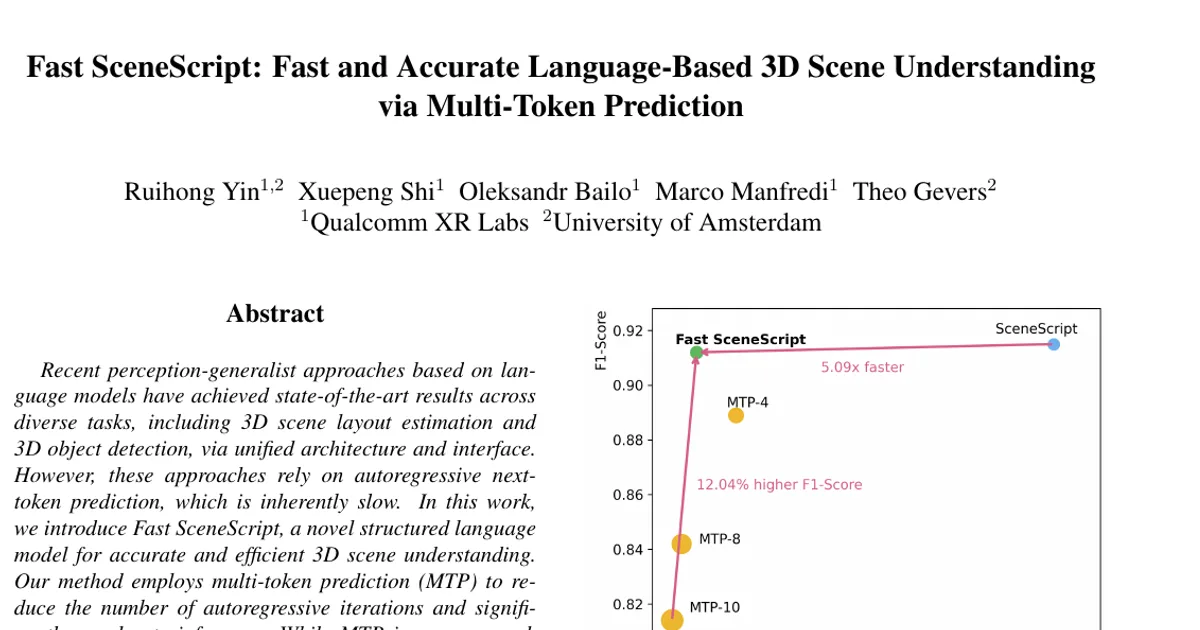
Empirical validation across synthetic and real datasets (ASE, Structured3D, SceneCAD), reporting up to 9 tokens accepted per decoding step with only about 7.5% more parameters than SceneScript, and 5.09x and 5.14x faster decoding for layout estimation and object detection respectively.
Main Findings
-
Speed-up over SceneScript: Fast SceneScript achieves a 5.09x speed-up for layout estimation and a 5.14x speed-up for object detection compared to SceneScript. On Structured3D, the SSD variant is 5.57x faster (Row i vs Row b in Table 2) and the CGD variant is 4.58x faster (Row j vs Row b).
-
Accuracy largely preserved or improved. On Structured3D, Fast SceneScript with SSD improved mean F1-Score by 2.07% over SceneScript while being 5.57x faster. On ASE, Fast SceneScript (SSD, n=10) reached a mean test F1 of 0.912 and an α_test of 8.99 accepted tokens per decoder inference, versus 0.915 and 1 for SceneScript.
-
Naive MTP degrades accuracy badly. SceneScript + MTP with 10 heads had a mean test F1 on ASE 11.04% lower than SceneScript, and increased decoder parameters by 88.79% (69.07% at 8 heads). Fast SceneScript (Row i, Table 1) showed 12.04% higher mean test F1 than SceneScript + MTP (Row h) while requiring 43.06% fewer parameters.
-
Object detection results. On the ASE test set (1k scenes), Fast SceneScript (SSD) reached F1@.25 of 0.858 and F1@.50 of 0.829 at 104 ms latency and 7.16 accepted tokens per step; CGD reached 0.859 and 0.832 at 108 ms and 6.53 tokens. SceneScript took 535 ms for 0.851 and 0.823; SceneScript + MTP took 83 ms but scored 0.815 and 0.772. CGD gave a 7.38% accuracy gain over MTP on ASE.
-
Real-world data results. On SceneCAD val, Fast SceneScript (SSD, Row c) achieved a 2.57x efficiency gain over SceneScript (Row a) while matching its layout F1 of 0.556; for object detection it delivered a 3.35x efficiency improvement with an 18% accuracy gain. Row d improved F1-Score by 20% over SceneScript + MTP in Row b.
-
Token filtering comparisons. In the ASE val ablation (n=8), CGD accepted 6.29 tokens per inference at 91 ms and 0.911 mean F1, whereas ProductThre accepted 4.67 tokens at 112 ms (0.909) and SoftmaxThre accepted 4.53 tokens at 116 ms (0.908). The loosened numerical tolerance helped: SSD with τ=0 accepted 6.53 tokens at 90 ms, τ=2 accepted 7.46 at 80 ms, τ=5 accepted 7.52 at 80 ms. τ=2 was chosen as the default.
-
Parameter sharing works. The shared-head design reduced decoder parameters by 48.11% relative to the unshared version (Row i vs Row j, Table 4) without hurting accuracy.
-
Softmax scores do not reflect token reliability. Figure 7 shows Fast SceneScript can stop when softmax confidence is high yet still accept tokens with low softmax confidence, which is why the cumulative-product and softmax-threshold baselines reject many correct tokens.
-
More heads stop helping. In Table S1, using 12 or 16 heads in Fast SceneScript produced an accuracy drop with no obvious latency advantage, so the paper focuses on n=8 and n=10.
-
Comparison to a specialist model. Against RoomFormer on Structured3D, Fast SceneScript achieved a higher mean F1 (0.790–0.795 for n=10 variants vs 0.702), though RoomFormer is faster (54 ms) and is limited to layout estimation only.
Methodology in Plain English
The pipeline starts by encoding a 3D point cloud with a sparse 3D ResNet. A Transformer decoder (8 layers: 4 self-attention, 4 cross-attention, feature dimension 512, 8 attention heads) then reads the 3D features together with the tokens generated so far, and predicts the next n tokens at once instead of just one. During training, the model uses a multi-token prediction loss where each successive head's contribution is down-weighted by a decaying factor, because later tokens are inherently more uncertain.
The risk with predicting several tokens at once is that some of them are wrong, and a wrong token poisons everything after it. The paper handles this in two ways. The first is self-speculative decoding: draft n tokens, feed the sequence back through the network, and compare the two sets of predictions, keeping the longest consistent prefix. For numerical tokens such as coordinates and heights, the paper relaxes "consistent" to mean "within a tolerance τ" (default 2), and for non-numerical tokens like make_wall or stop it requires exact equality.
The second approach, confidence-guided decoding, trains an extra confidence head alongside each token head. Its training target is whether a later head's prediction agrees with the first head's prediction under the same tolerance rule, and a binary cross-entropy loss is added to the total objective. At inference, tokens whose confidence falls below a threshold are treated as unreliable, and only the longest reliable prefix is accepted — so the model predicts, verifies, and accepts in a single pass rather than waiting for a verification step.
To keep parameter growth small, all n heads share the same parameters, and a lightweight projection block (two feed-forward blocks, each with 2 linear layers, 1 ReLU, and 1 layer normalization) produces the distinct hidden states the additional heads need. The token head and confidence head each consist of three linear layers and two ReLU activations. Latency is measured on an NVIDIA RTX 2080 Ti, and accuracy is reported as per-class F1 computed at 5 cm intervals from 0 m to 1 m for layout, and F1 at 0.25 and 0.5 IoU for detection.
Why This Matters
Autoregressive decoding is the main latency bottleneck in language-based perception. This paper shows that for structured visual languages — which the authors argue are more deterministic and weakly coupled than natural language — the bottleneck can be relaxed substantially without giving up accuracy. For research, it opens a direction: MTP plus reliability filtering as a general recipe for perception generalist models, rather than something confined to large language models like DeepSeek-V3 and Medusa. It also challenges the assumption that softmax probability is a good proxy for token reliability, at least in structured 3D languages.
Real-world applications:
- XR and AR headsets: Fast, on-device layout estimation supports placing virtual objects against real walls, windows, and doors in real time (the work comes from Qualcomm XR Labs).
- Interior design and floor-plan digitization: Automatically recovering wall/window/door geometry from scanned rooms for renovation planning or 3D walkthroughs.
- Robotics and navigation: Lower-latency 3D object detection for cabinet, chair, table, sofa, and bed categories helps mobile robots map and interact with indoor spaces.
- Smart-home and facility management: Structured scene representations can drive automation that reasons about room layout and object placement.
Industry relevance: The reported speed-ups matter most where compute and power are constrained, such as head-mounted devices or mobile platforms, and the parameter-efficiency mechanism (roughly 43% fewer parameters than standard MTP, about 7.5% more than SceneScript) speaks directly to on-device deployment budgets. The paper also positions Fast SceneScript as a general framework covering layout estimation, object detection, and potentially 3D object part reconstruction, rather than a single-task specialist.
Future Directions
- Extending to 3D object part reconstruction and other perception tasks. The paper names coarse 3D object part reconstruction as a plausible next application but does not report results for it.
- Scaling the number of heads. Results with 12 and 16 heads show both an accuracy drop and no obvious latency advantage, so the useful operating range of MTP head counts is still unclear.
- Better reliability scoring. Since softmax scores were shown to be poor indicators of correctness, alternative confidence signals — or confidence targets calibrated with different τ values (0, 2, and 5 were tested, with 2 best) — remain an open design space.
- Studying failure cases and data limits. The supplementary material mentions failure cases, and the authors note that SceneCAD's training set contains only around 1k scenes, which may limit the expressive power of a language model; how MTP behaves under tighter data or more diverse real-world capture conditions is unresolved.
Target Audience
Researchers and engineers working on 3D perception, vision-language models, and efficient inference will get the most from this paper. It is also relevant to practitioners building on-device or XR systems who need to trade off latency, accuracy, and parameter count, and to anyone studying speculative decoding or token-filtering methods outside the usual natural-language setting. Readers looking for a first introduction to structured language models for 3D scenes may want background on SceneScript first, since Fast SceneScript is framed as an extension of it.
Authors’ abstract
Recent perception-generalist approaches based on language models have achieved state-of-the-art results across diverse tasks, including 3D scene layout estimation and 3D object detection, via unified architecture and interface. However, these approaches rely on autoregressive next-token prediction, which is inherently slow. In this work, we introduce Fast SceneScript, a novel structured language model for accurate and efficient 3D scene understanding. Our method employs multi-token prediction (MTP) to reduce the number of autoregressive iterations and significantly accelerate inference. While MTP improves speed, unreliable token predictions can significantly reduce accuracy. To filter out unreliable tokens, we adapt self-speculative decoding (SSD) for structured language models and introduce confidence-guided decoding (CGD) with an improved scoring mechanism for token reliability. Furthermore, we design a parameter-efficient mechanism that reduces the parameter overhead of MTP. Extensive experiments on synthetic and real-world benchmarks demonstrate that Fast SceneScript can generate up to 9 tokens per decoder inference step without compromising accuracy, while adding only $\sim7.5\%$ additional parameters.