Research
FairSCOSCA: Fairness At Arterial Signals -- Just Around The Corner
Overview Research area: Traffic engineering and AI safety and ethics — specifically fairness-aware traffic signal control at signalized intersections in arterial road networks. Technical level: Interm
- arXiv
- 2601.06275
- Published
- 2026-01-09
- Authors
- Kevin Riehl, Justin Weiss, Anastasios Kouvelas, Michail A. Makridis
AI summary
Overview
Research area: Traffic engineering and AI safety and ethics — specifically fairness-aware traffic signal control at signalized intersections in arterial road networks.
Technical level: Intermediate. The paper assumes familiarity with traffic signal control concepts (cycle length, green phases, offsets, degree of saturation) and standard fairness metrics (Gini coefficient, delay distributions), but presents its two methodological contributions in straightforward formulas.
Scope: This paper proposes and evaluates FairSCOSCA, a fairness-enhancing extension to the widely deployed SCOOTS and SCATS traffic light control systems, tested in a calibrated microsimulation of a five-intersection arterial network in Esslingen am Neckar, Germany.
What This Paper Is About
Traffic signal control systems like SCOOTS and SCATS are deployed globally but are designed almost purely around traffic efficiency, which can produce unfair outcomes such as excessive waiting times for some road users — particularly those on feeder roads that intersect busy arterial roads. The paper's goal is to add fairness to these existing systems through two practical design modifications, rather than replacing them with new learning-based frameworks, and to test whether fairness can be improved without major efficiency losses.
Key Contributions
-
A feasible fairness extension to deployed systems: The authors propose FairSCOSCA, a fairness-enhancing adaptation of SCOOTS and SCATS (referred to jointly as SCOSCA) rather than another learning-based control framework, emphasizing real-world deployability.
-
Two design features: (1) green phase optimization that incorporates cumulative waiting times on opposing phases, and (2) early termination of underutilized or unfavourable green phases with a compensation mechanism in the following cycle.
-
A multi-perspective fairness benchmark: The study evaluates controllers across four normative fairness notions — Egalitarian, Rawlsian, Utilitarian, and Harsanyian — plus a horizontal equity analysis comparing vehicles originating from arterial versus feeder roads.
-
A benchmark against established controllers: The proposed method is compared with pre-timed Fixed-Cycle, Max-Pressure, and standard SCOOTS/SCATS controllers in a demand-calibrated microsimulation, with an open-source implementation released on GitHub.
Main Findings
-
FairSCOSCA_1 improves both fairness and efficiency: Against SCOSCA, FairSCOSCA_1 increased flow by 2.39%, speed by 6.35%, and throughput by 2.77%, and achieved significant improvements across all four fairness measures (Gini of delays, maximum delay, total travel time, average delay).
-
FairSCOSCA_2 improves fairness selectively: FairSCOSCA_2 showed significant improvements in Egalitarian (Gini 0.4955 versus SCOSCA's 0.5085) and Rawlsian fairness (maximum delay 808.15 s versus 877.90 s) only, with no significant efficiency difference from SCOSCA.
-
Baseline controllers perform substantially worse on equity: Max-Pressure recorded a Gini of 0.5773 and Fixed-Cycle 0.6414, both significantly worse than SCOSCA's 0.5085. Fixed-Cycle's maximum delay was 2676.60 s and Max-Pressure's 1247.35 s, compared with 877.90 s for SCOSCA.
-
SCOSCA already has an inherent fairness property: Because the degree of saturation is weighted by the allocated green time, phases already receiving substantial green time exhibit lower DS values, creating a feedback mechanism that naturally prevents over-allocation to favoured phases.
-
Feeder roads are discriminated against across controllers: All controllers showed worse delay outcomes for feeder-originating vehicles. SCOSCA's median delay was 115.41 s for arterial and 137.70 s for feeder vehicles, with Gini values of 0.4588 and 0.5632 respectively.
-
FairSCOSCA_1 reduces horizontal discrimination: It lowered median delay for arterial vehicles to 97.98 s and feeder vehicles to 128.86 s, and reduced the feeder Gini to 0.5435, narrowing the discrimination gap.
-
FairSCOSCA_2 shifts discrimination onto arterial roads: In the delay-per-kilometre analysis, FairSCOSCA_2 caused discrimination of arterial-originating vehicles (Gini 0.4714 arterial versus 0.4617 feeder in delays per kilometre).
-
Network capacity ranking: The macroscopic fundamental diagram showed Fixed-Cycle with the lowest network capacity, Max-Pressure gaining improvements, and the proposed design features obtaining further gains similar to those of SCOSCA.
Methodology in Plain English
The researchers first reconstructed a working model of how SCOOTS/SCATS operate, describing three interlocking optimizers: one that distributes green time across phases based on differences in degree of saturation, one that adjusts cycle length to keep the maximum degree of saturation near a target of 0.9 (increasing above 0.925, decreasing below 0.875), and one that sets offsets between intersections to form green waves. Several control parameters in this baseline are tuned through Bayesian optimization.
They then made two changes. The first change alters the green phase optimizer so that green time allocation depends not just on demand differences between phases, but also on how long vehicles on opposing lanes have cumulatively been waiting. This penalty term grows exponentially with the maximum cumulative waiting time on opposing approaches, so very long waits are penalized more strongly. A tunable parameter α balances the demand term against the waiting-time penalty.
The second change adds an early-termination rule: if a vehicle arrives on red and the currently active green phase will remain active for longer than a threshold called TTG, the active green is shortened by a duration called TEG and the waiting phase is extended by the same amount, keeping the cycle length constant. To prevent long-term imbalance, the shortened phase receives the lost time back in the next cycle, and at most one pre-emption is allowed per junction per cycle, with no pre-emptions permitted in the cycle immediately following one.
The evaluation ran a SUMO microsimulation of the Schorndorfer Strasse network: five signalized intersections, 22 traffic lights, 29 loop detector sensors, 26 bus stops, and 11 bus lines, covering car, motorcycle, truck, and bus traffic. The model was calibrated to real-world demand for an afternoon peak working day (March 4th, 2024), with vehicle fleet composition matched to Kraftfahrt-Bundesamt statistics and public transport timetables. Results are reported as means across 20 random seeds, with statistical significance marked relative to SCOSCA at 1%, 2%, and 5% levels.
Why This Matters
Impact on research: The paper argues that prior fair signal control work is limited by insufficient real-world applicability, neglect of fairness multidimensionality, and lack of benchmarking against established non-learning-based controllers. It contributes a case for adapting deployed systems rather than replacing them, and provides an open-source, reproducible implementation.
Real-world applications:
- Municipal traffic authorities operating SCOOTS or SCATS installations could apply the two design features as incremental software-level changes rather than full system replacements.
- Arterial networks where feeder-road traffic experiences excessive queueing and waiting could benefit from the cumulative-waiting-time penalty in green allocation.
- Transit corridors with multiple bus lines and stops (the case study includes 11 bus lines and 26 bus stops) could see improved delay distributions across modes.
- Cities seeking public and political acceptance for signal control investments could use documented fairness improvements as supporting evidence.
Industry relevance: SCOOTS has led the market in more than 350 cities globally since the 1980s, and SCATS has been used in 216 cities and 32 countries since 1975. Together they control more than 60,000 intersections and 565 cities worldwide, so small design changes to these systems have potential reach across a large installed base.
Future Directions
-
Real-world deployment validation: The authors call for comparing simulation results against actual SCOOTS and SCATS deployments using floating car data, complemented by driver perception and acceptance surveys.
-
Multi-objective optimization: The current work optimized control parameters for efficiency only (average delay). Optimizing for both efficiency and fairness measures might achieve equity gains with a pure SCOSCA controller.
-
Transferability beyond arterial networks: Testing on more diverse urban layouts — grid layouts, suburban sprawls, and multimodal intersections — would assess robustness beyond the Schorndorfer Strasse case study.
-
Robustness under stress: Assessing how FairSCOSCA and other controllers perform under incidents, sensor failures, or unplanned events, and whether fairness properties degrade gracefully or disproportionately. The paper also raises exploring modifications of SCOSCA to incorporate prioritization of specific modes, though the provided content is truncated at this point.
Target Audience
This paper is most useful to traffic engineers and transportation researchers working on signal control, municipal traffic management authorities considering fairness requirements for deployments, and AI ethics researchers interested in how normative fairness definitions (Egalitarian, Rawlsian, Utilitarian, Harsanyian) are operationalized in a real infrastructure domain. Practitioners familiar with SCOOTS or SCATS will find the design changes directly interpretable, while readers new to traffic control will need to follow the notation in Section III to understand the mechanics.
Authors’ abstract
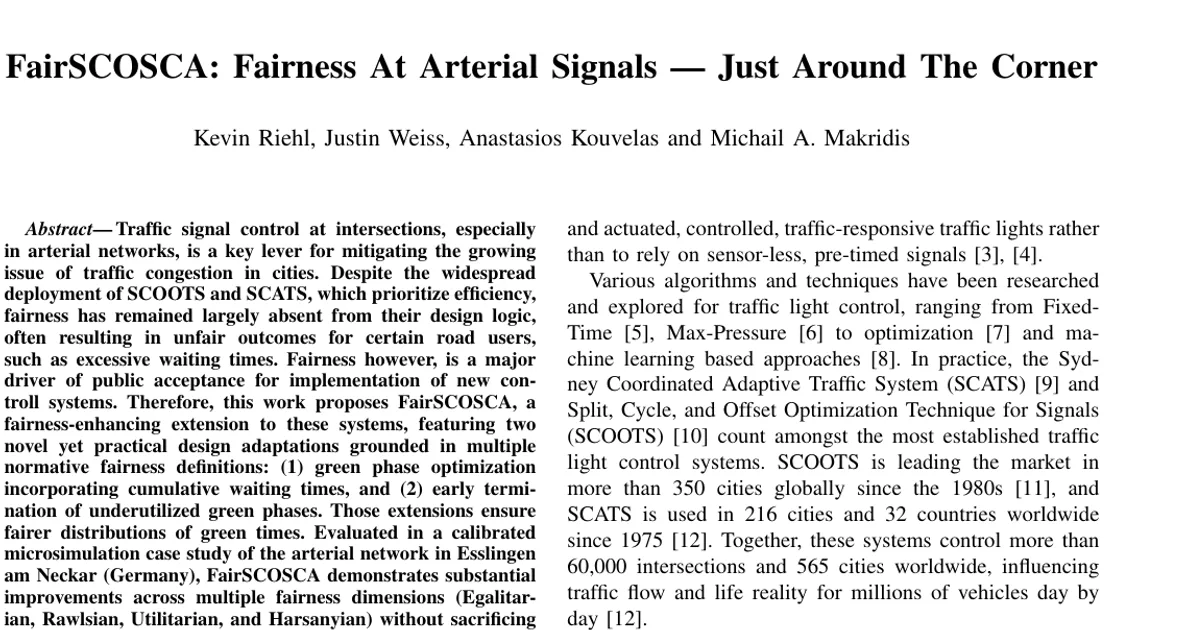
Traffic signal control at intersections, especially in arterial networks, is a key lever for mitigating the growing issue of traffic congestion in cities. Despite the widespread deployment of SCOOTS and SCATS, which prioritize efficiency, fairness has remained largely absent from their design logic, often resulting in unfair outcomes for certain road users, such as excessive waiting times. Fairness however, is a major driver of public acceptance for implementation of new controll systems. Therefore, this work proposes FairSCOSCA, a fairness-enhancing extension to these systems, featuring two novel yet practical design adaptations grounded in multiple normative fairness definitions: (1) green phase optimization incorporating cumulative waiting times, and (2) early termination of underutilized green phases. Those extensions ensure fairer distributions of green times. Evaluated in a calibrated microsimulation case study of the arterial network in Esslingen am Neckar (Germany), FairSCOSCA demonstrates substantial improvements across multiple fairness dimensions (Egalitarian, Rawlsian, Utilitarian, and Harsanyian) without sacrificing traffic efficiency. Compared against Fixed-Cycle, Max-Pressure, and standard SCOOTS/SCATS controllers, FairSCOSCA significantly reduces excessive waiting times, delay inequality and horizontal discrimination between arterial and feeder roads. This work contributes to the growing literature on equitable traffic control by bridging the gap between fairness theory and the practical enhancement of globally deployed signal systems. Open source implementation available on GitHub.