Research
Fair Feed Ranking for Participatory Budgeting
Overview Research area: Fairness in recommender systems applied to civic technology — specifically feed ranking on digital participatory budgeting (PB) platforms, with a case study of Consul Democracy
- arXiv
- 2609.29819
- Published
- 2026-09-24
- Authors
- Carina I. Hausladen
AI summary
Overview
Research area: Fairness in recommender systems applied to civic technology — specifically feed ranking on digital participatory budgeting (PB) platforms, with a case study of Consul Democracy and Munich's MünchenBudget.
Technical level: Intermediate. The paper is written in accessible prose but includes a formal simulation model with explicit equations, parameter settings, and quantitative results.
Scope: The paper diagnoses how current PB platform feeds concentrate attention and expose ranking to manipulation, then proposes and simulates a ranking design called FairFeed that ranks on declared preferences, boosts under-exposed proposals, and adds a rate-limited reject channel.
What This Paper Is About
Large-scale participatory budgeting now draws proposal pools in the thousands, so citizens cannot inspect every proposal before voting — the order in which proposals are shown becomes a form of agenda-setting power. The paper argues that fair exposure should therefore be treated as a democratic-design goal, and shows that widely deployed platforms (Consul Democracy, used by more than 200 public institutions in over 35 countries and serving more than 100 million people) rely on popularity, recency, and comment-activity orderings that amplify already-visible proposals. The goal is to propose a ranking design, FairFeed, that broadens which proposals citizens discover while also giving them a rationed way to flag weak, duplicate, or infeasible submissions.
Key Contributions
-
A conceptual argument: in large-scale PB, feed ranking is a form of agenda-setting power, and fair exposure should be treated as a democratic-design goal, defined as a floor on visibility so that a proposal's failure is not merely a failure of exposure.
-
An empirical audit: the paper audits Consul deployments and MünchenBudget field data, showing that deployed orderings rely on popularity, recency, and especially comment signals, and that comments are sparse (69% of 2025 proposals received no comments) and vulnerable to manipulation (self-comments rose from 13% in 2025 to 38% in 2026, with a single account producing around 40% of all 2026 comments).
-
A design, FairFeed: a ranking rule built from three components — transparently declared preference signals, an under-exposure boost, and a rate-limited reject channel gated by the D21–Janeček rule (a reject unlocks only after two approvals) — plus an onboarding prototype that maps natural-language interest descriptions to want/avoid signals via an LLM.
-
A calibrated simulation study: FairFeed is evaluated against random, newest, and most-commented feeds in a simulation anchored on Munich's 2025 PB round, with code and public calibration data released under MIT and CC-BY-4.0 licences respectively.
Main Findings
-
FairFeed holds attention longer on relevant proposals. Assuming citizens continue browsing while what they see stays relevant, current feed designs sustain at most about 3.8 viewed proposals per citizen, of which only approximately 0.3 are on-topic. FairFeed raises this to approximately 5.2 proposals per citizen with near-perfect topical relevance.
-
Popularity sorts starve most proposals of exposure. Spreading exposure evenly would show each of the 459 proposals about 97 times, with a visibility floor at half that, approximately 49 views. Newest and most-commented feeds leave the median proposal seen only nine times. All proposals clear the floor under FairFeed and 98% under random, against just 7–8% under the popularity sorts.
-
Equalisation beyond the floor is uneven. At the perfect-equality benchmark of approximately 97 views, 39% of proposals reach it under FairFeed but only 5% under random, whose relevance-blind feed cuts browsing short.
-
Exposure correction costs no relevance in this simulation. With the browse budget held fixed, 99.5% of browsed proposals are on-topic (97% of boosted ones). Across ten topics a citizen has about 46 on-topic proposals available but browses only approximately 10, so the under-exposure boost reorders within the citizen's topic. The rare off-topic browse falls to the heaviest browsers (V > 46, under 1% of citizens).
-
Cross-cutting support roughly doubles. FairFeed produces 1.4 cross-cutting votes per citizen on average, against about 0.7 under random, newest, and most-commented, and 67% of citizens cast at least one, against about 44%.
-
Extra votes are placement-robust. Reading the support model's fit factor alone (where fit ≥ 0.5 requires an on-topic proposal with q_j ≥ 0.5), 35% of FairFeed's votes clear the bar against 12% under most-commented.
-
A gated reject channel improves shortlist quality. At an optional-reject-button rate of approximately 0.10, top-20 quality rises 18% over FairFeed's own approve-only ballot, from 0.41 to 0.48, and average shortlist divisiveness falls 21%. Simulating the full range of reject rates shows a knee at approximately 0.30, where quality lifts 32% and divisiveness drops 35%, after which both flatten.
-
Negative feedback changes the economics of gaming. Without a reject channel, pushing a low-quality proposal onto the ballot takes a median of 36 verified identities; a weaponised reject strategy that also downvotes rivals lowers the cost to 25 identities (0.35%). Pure vandalism displaces half the shortlist only at about 75 identities (1.1% of voters), and below about 20 identities only a few slots move. By contrast, manufactured comments on weak proposals drop most-commented's top-20 quality from 0.35 to 0.27.
-
Quality–reach independence matters and was checked. Synthetic proposals assume quality and reach are independent. Re-pairing them at ρ ∈ {0.3, 0.6} weakens the least-seen quartile (mean q from 0.31 at ρ = 0 to 0.28 at ρ = 0.6), but top-20 quality holds or rises (+22% at ρ = 0.3).
Methodology in Plain English
The author first audited what real platforms do: the stock Consul interface offers most-voted and random orderings, and individual deployments add newest, comment-count, and vote-based sorts. To ground the work in a real process, the author downloaded proposal identifiers, pseudonymised authors, and comment authors from MünchenBudget's completed 2025 round (1,043 proposals, of which 459 passed admissibility and 20 most-liked advanced to the final vote) and its ongoing 2026 round (1,059 proposals).
The evaluation is a simulation calibrated to that data, not a live experiment. It creates 459 proposals and 7,134 citizens, the participant count MünchenBudget reported for 2025. Each proposal gets a latent quality score: the 14 proposals with recorded outcomes are anchored directly (the 10 funded ones mapped linearly to the interval [0.70, 1], the four vetoed ones set to 0.55), and the remaining 445 are synthetic with quality drawn from Beta(2,5). Proposals also get a reach parameter drawn from Pareto(1.5)+1, a topic category, and a divisiveness score drawn from Beta(1.5,4).
Citizens arrive one at a time through a single "seed" proposal chosen with probability proportional to reach, then browse a number of cards (modelled as geometric with mean 10). Whether they support a card is the product of three factors: fit, which compares quality against a personal threshold centred at 0.5 and counts off-topic proposals at only 0.3 weight; a divisiveness discount capped at half; and a position decay of 1/(1+kr) with k = 0.15, calibrated between web-search position bias and ballot-order primacy. The dials (β, λ, k) = (5, 0.5, 0.15) are fixed across feeds so differences come from the ranking, not the voters. A second, literature-based rule lets browsing length respond to how relevant the recent stream has been, using (β0, β_R, β_F) = (0.5, 4.0, 0.05) and an exponential moving average with α = 0.6.
Against that backdrop the paper compares random, newest, and most-commented feeds with FairFeed, which scores proposals on topical match plus a boost (b = 0.5) for proposals seen fewer than half as often as average, minus a reject penalty (w_r = 1.5) normalised by the current maximum. FairFeed reads no engagement volume at all. A manipulation analysis then estimates how many verified identities an attacker would need under different strategies.
Why This Matters
Impact on research. The paper connects recommender-system fairness literature — exposure fairness, equity of attention, expected exposure — to democratic theory and civic technology, and provides a reproducible simulation with released code and data as a testbed for ranking rules in PB.
Real-world applications.
- City PB administrators can see, before deployment, how ordering choices affect which proposals get seen and which reach the ballot, since MünchenBudget balloting depended directly on ranking in the interface.
- Civic platform developers (Consul Democracy and comparable platforms) gain a concrete alternative ranking rule that avoids engagement signals entirely.
- Platform and marketplace designers outside civic tech face the same rich-get-richer dynamics; the under-exposure boost and rate-limited negative channel are transferable design patterns.
- Crowd-sourced moderation systems can use the D21–Janeček 2:1 gating idea as a way to ration negative feedback and raise the cost of coordinated manipulation.
Industry relevance. The paper quantifies the attack surface of engagement-based ranking. The contrast is stark: unlimited comment posting from one account can degrade most-commented top-20 quality from 0.35 to 0.27, while reject-based attacks scale only with distinct verified identities. That is a direct argument for identity verification and rate limiting in any ranking that admits negative feedback.
Future Directions
-
Human-subjects evaluation of onboarding. The onboarding interface is a working prototype, but the simulation proxies elicited preferences with broad topic categories. Whether real voters describe interests with enough accuracy is the paper's central open empirical question.
-
Trust and perceived agency. The paper asks whether transparent preference signals increase trust and whether exposure correction remains cheap once real interests are narrower and more fragmented than the stylised topic categories used here.
-
A fuller (q, κ, ξ) sweep. The independence of quality and reach among synthetic proposals is a conservative assumption for the shortlist claim; the author flags a complete sweep of the quality, reach, and divisiveness joint distribution as future work.
-
Institutional design for the reject channel. Contestability, auditing, and identity verification remain open, along with the unresolved question of whether the gated reject removes weak items or suppresses legitimately contested proposals that deliberative theory would treat as material for debate. Preference drift — the assumption that ranking affects discovery and possibly turnout but not underlying preferences — is flagged as a threat to validity, with the supporting citation concerning turnout rather than preference formation.
Target Audience
Researchers in computational social choice, recommender-system fairness, and e-participation; civic technology practitioners and platform developers working on Consul Democracy or similar systems; municipal PB administrators and policy makers deciding how proposals are displayed; and anyone studying how ranking rules shape democratic deliberation at scale. Readers need no specialist mathematics background, though familiarity with ranking systems or digital democracy helps.
Authors’ abstract
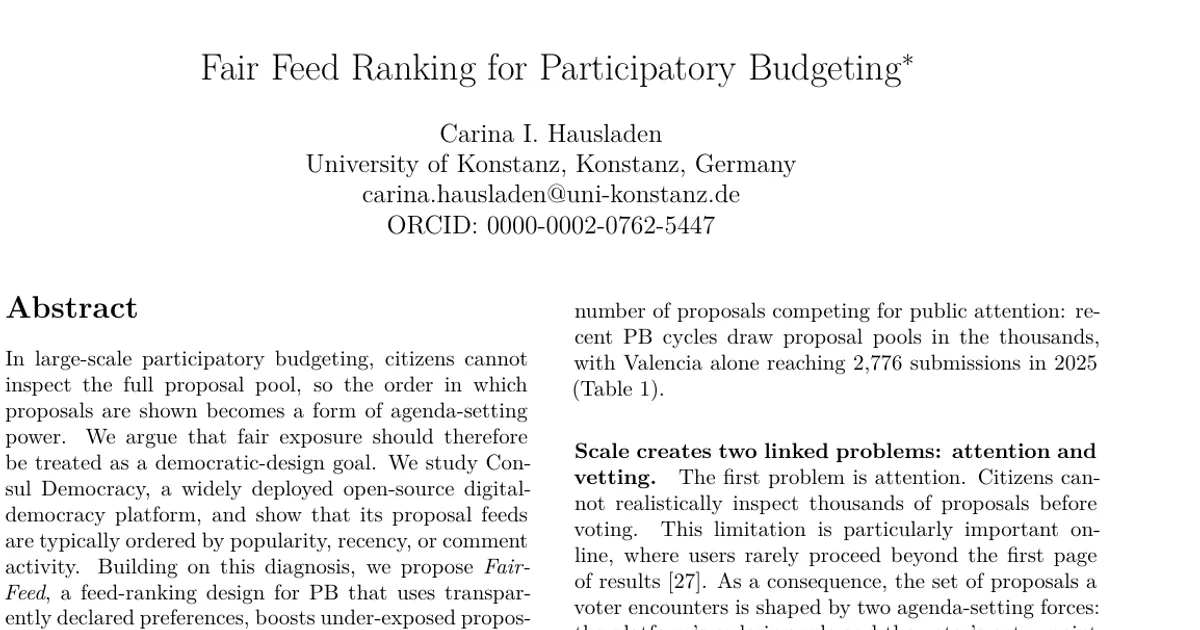
In large-scale participatory budgeting, citizens cannot inspect the full proposal pool, so the order in which proposals are shown becomes a form of agenda-setting power. We argue that fair exposure should therefore be treated as a democratic-design goal. We study Consul Democracy, a widely deployed open-source digital-democracy platform, and show that its proposal feeds are typically ordered by popularity, recency, or comment activity. Building on this diagnosis, we propose FairFeed, a feed-ranking design for PB that uses transparently declared preferences, boosts under-exposed proposals, and admits a rate-limited reject channel for crowd-sourced vetting. We evaluate the design in a simulation anchored in Munich's 2025 PB process and compare it with random, newest, and most-commented feeds. In this simulation, FairFeed broadens proposal discovery, distributes visibility more evenly across the eligible pool, increases cross-cutting support, and improves resistance to manipulation relative to comment-based ranking. We conclude by outlining the human-subjects evaluation needed to test whether onboarding can recover voter preferences accurately enough for deployment in practice.