Research
Exploring the Heterogeneity of Tabular Data: A Diversity-aware Data Generator via LLMs
Overview Research area: Synthetic tabular data generation, specifically using Large Language Models (LLMs) with in-context learning to generate labeled records for heterogeneous (multi-distribution) t
- arXiv
- 2512.21915
- Published
- 2025-12-26
- Authors
- Yafeng Tang, Xiaoou Ding, Jianzhuo Du, Zishuo Yan, Zhuang Ma, Zheng Liang, Zekai Qian, Hongzhi Wang
AI summary
Overview
Research area: Synthetic tabular data generation, specifically using Large Language Models (LLMs) with in-context learning to generate labeled records for heterogeneous (multi-distribution) tabular datasets.
Technical level: Advanced. The paper defines formal predicate spaces, rule languages (DNF-based Distribution-Guiding Rules), error thresholds, and states propositions and a theorem with proofs deferred to an appendix.
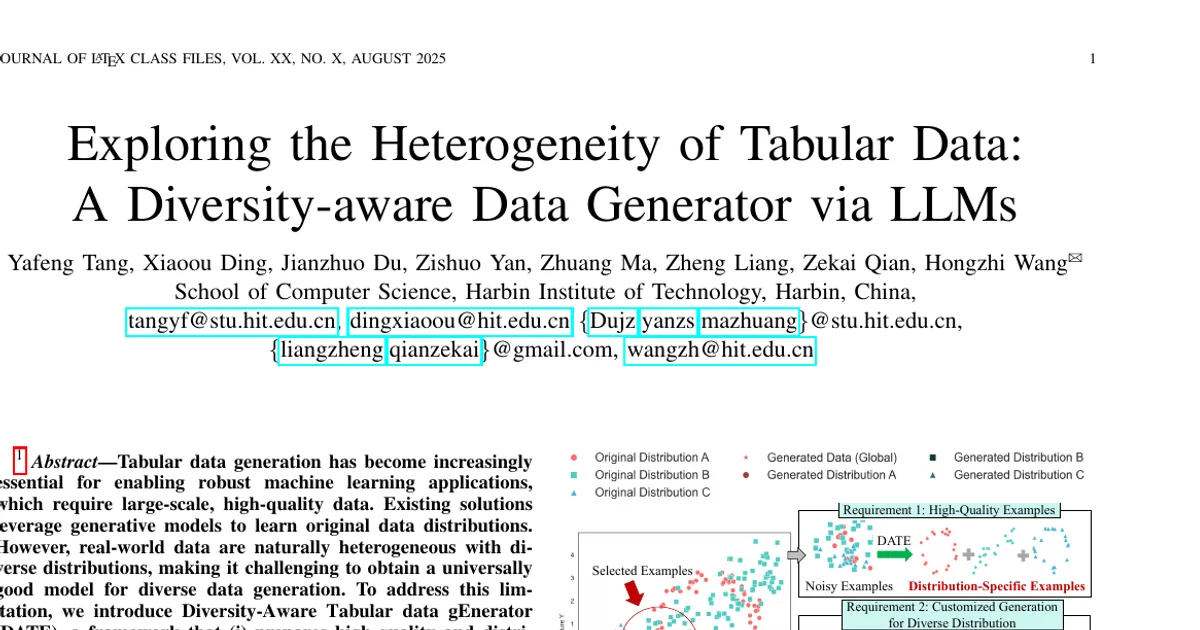
One-sentence scope: The paper proposes DATE, a prompt-based LLM framework that partitions heterogeneous tabular data into distribution-specific rule-annotated subsets, iteratively generates synthetic records for each, and then samples the generated pool to balance diversity against quality.
What This Paper Is About
Real-world tabular datasets are not drawn from a single distribution: fraud records, clinical histories, and weather observations mix populations from different regions, hospitals, or climate zones. Existing generators (GANs, VAEs, diffusion models, and LLM-based prompting or fine-tuning methods) try to learn one model of the whole dataset, so they tend to underfit some sub-populations and hallucinate spurious patterns. DATE's goal is to give each distinct sub-distribution its own interpretable rule, its own prompt, and its own generated records, then select which generated records to keep rather than greedily taking the "validation-best" ones.
Key Contributions
- The DATE framework. A diversity-aware tabular data generator that uses an LLM to explore the distinct distributions inside heterogeneous data and generate customized labeled records for each one.
- Distribution-Guiding Rules (DGR). A DNF-structured, decision-tree-shaped rule representation that bridges the semantic gap between raw heterogeneous tables and LLM prompts, providing interpretable and controllable guidance for generation.
- The DGR Discovery algorithm. An incremental partitioning algorithm using model sharing and top-down predicate construction that builds high-quality, concise in-context examples while retraining models as little as possible, with time complexity O(|T|² log |T|).
- A DGR-guided iterative generation algorithm plus a Multi-Arm Bandit (MAB) sampling algorithm. The generator refines DGRs from decision-tree reasoning feedback to capture distribution-specific dependencies, and the sampler selects generated data toward a diversity–quality balance with a controllable error bound. The paper proves that selection in heterogeneous settings lacks the greedy-choice property, which is why the greedy "validation-best" approach fails.
Main Findings
- Average error reduction: DATE achieves a 23.75% reduction in error rate on average with just 100 generated data (abstract).
- Breakdown by task type: DATE achieved an average reduction of 14.3% in error rate on classification tasks and 61.5% in MSE on regression tasks, using 89% less generated data compared with GAN-based, prompt-based, and fine-tuning-based solutions.
- Benchmark coverage: Evaluation spans 8 classification and 2 regression tasks in domains described as highly practical, including healthcare and finance.
- Greedy selection is provably inadequate here: The paper proves that in heterogeneous settings, selecting the "validation-best" data does not possess the greedy-choice property, motivating the MAB-based sampling algorithm with a controllable error bound.
- Downstream usefulness: Data generated by DATE empirically improves the accuracy of Direct Preference Optimization (DPO) and enhances LLM reasoning capability on the target data.
- Model sharing works: Reusing a trained model
macross DGRs with identical prefixes (when max_{t in T_r} error(m(T_r)) ≤ ρ_m) avoids repeated training, and Proposition 2 establishes that such a shared-model example can always be reached. Propositions 3 (Fusion) and 4 (Generalization) allow aggregating and tolerating examples into a more concise example set. - Search-cost improvement: Brute-force DGR traversal costs O(Σ_{A_i ∈ A} |domain(A_i)| × |Φ|^d) where d is the max DGR depth; Algorithm 1 reduces this to O(|T|² log |T|), decoupling complexity from attribute domain size. LLM-call complexity is O(I|T|), simplifying to O(|T|) when the iteration count I is constant.
- Predicate budget bound: Theorem 1 states that to guarantee at least one constructed DGR is shared, the selected predicate space must satisfy |P'| ≥ ⌈(1 − ind(r))|T_r|⌉.
- Candidate-space cost of naive partitioning: Enumerating every combination of records as a candidate subset spans O(2^n) candidates, and each candidate requires retraining a partitioning model.
- Not reported in the available content: the specific LLM backbone used, the sizes of the ten benchmark datasets, the numeric value of the error bound, and the full MAB sampling details (the text is truncated mid-sentence at the start of Section IV-B).
Methodology in Plain English
DATE runs in three steps.
Step 1 — Partition the data with rules. The researchers define a predicate space where a predicate is an attribute compared to a constant with one of the operators {>, ≥, <, ≤}. A Distribution-Guiding Rule (DGR) is a disjunction of conjunctions of such predicates, so it can catch records of one distribution even when they are scattered across the table. Rules are grown the way a decision tree is grown: start from an empty rule, pick predicates top-down (preferring low Gini index nodes), and keep splitting until every record inside the partition is predicted by an evaluation model with error under a threshold ρ. To cut cost, a model trained for one rule is reused for a new rule whenever that model's maximum error on the new partition still satisfies the threshold. Each rule plus its data subset plus the model plus the threshold becomes one in-context example (m, ρ, r, T_r) in the prompt.
Step 2 — Generate per distribution. Examples are grouped by shared model so that each prompt covers one sub-distribution. The LLM generates candidate records. A decision tree then classifies each generated record by its prediction path; all records sharing a path form a group H_k, which becomes a new DGR-based example. A score Δ_k measures how much adding H_k improves validation error over the current partitioned data T_m; only groups with positive Δ_k are kept. The LLM is then asked to propose new rules r^new not already covered by the existing examples, and generates more data with them. This loops for up to I iterations, stopping when validation score stops improving or I rounds are reached. This use of decision-tree paths as interpretable feedback is what keeps the LLM from drifting into the patterns it learned during pre-training.
Step 3 — Select what to keep. Because the generated pool is large and diverse, and because greedy "validation-best" selection provably fails in heterogeneous settings, DATE uses a Multi-Arm Bandit-based sampling algorithm with a controllable error bound to pick the final diversity–quality-balanced set.
Why This Matters
Impact on research. The paper reframes tabular data synthesis as a distribution-partitioning and resource-allocation problem rather than a single-density-estimation problem. It contributes a formal negative result (no greedy-choice property in heterogeneous selection), a rule-based prompt representation that is inspectable, and a proof-backed reduction in search cost from domain-size-dependent to table-cardinality-dependent. It also connects synthetic data generation to LLM alignment, showing DATE-generated data can improve DPO accuracy.
Real-world applications (as cited in the paper):
- Healthcare. Disease diagnosis from clinical histories; the paper cites MIT researchers showing that although hundreds of AI tools were created for COVID-19 detection, none succeeded in practice with heterogeneous clinical histories.
- Finance. IEEE-CIS fraud detection, which integrates transaction records from different regions.
- Weather and climate. HadISD weather forecasting, which aggregates observations from various climate zones.
- General ML workloads in database systems, where data scarcity and uneven long-tailed sample distributions make models unreliable and unable to generalize.
Industry relevance. Assembling high-quality labeled tables is costly because of annotation burden, and privacy or scarcity limits access to real records. DATE requires only 100 generated data to reach its headline 23.75% average error reduction and uses 89% less generated data than the compared methods, which matters for training-cost budgeting. Because it is prompt-based rather than fine-tuning-based, it avoids training a separate model per distribution, which the paper identifies as a high-cost alternative.
Future Directions
- Report the full sampling analysis. Section IV-B begins by arguing that greedy selection is unreliable for heterogeneous data, but the available text cuts off before the MAB formulation, the controllable error bound, and the empirical comparison of selection strategies are presented.
- Determine how far the prompt-based approach scales. DATE deliberately avoids fine-tuning, but the paper leaves open how it behaves as the number of discovered distributions and the size of the in-context example set grow against a fixed context window, which Section III-A flags as a limiting factor.
- Extend beyond row-level generation. The paper explicitly treats column-level feature synthesis as an orthogonal problem, so combining DATE with column-level synthesis is an open direction.
- Generalize the partition-and-generate pattern. The DGR machinery is domain-agnostic; testing whether the same rule-discovery-plus-MAB-selection loop transfers to other heterogeneous data types or to mixture-of-experts LLM designs (which the paper notes are largely underexplored for tabular generation) is a natural next step.
- Quantify downstream alignment gains more broadly. The paper shows DATE data improves DPO accuracy and LLM reasoning, but does not report the magnitude of those gains in the available content.
Target Audience
Researchers and practitioners working on tabular machine learning, synthetic data generation, and data-centric AI, particularly those dealing with heterogeneous, long-tailed, or multi-source tables. It will also interest readers working on LLM in-context learning and prompt design, data augmentation for DPO and other alignment methods, and database researchers who need to reason about the cost of retraining models over candidate partitions. A working familiarity with decision trees, rule-based learning, and bandit-style selection helps, since the paper states its propositions and theorem formally and defers proofs to an external appendix.
Authors’ abstract
Tabular data generation has become increasingly essential for enabling robust machine learning applications, which require large-scale, high-quality data. Existing solutions leverage generative models to learn original data distributions. However, real-world data are naturally heterogeneous with diverse distributions, making it challenging to obtain a universally good model for diverse data generation. To address this limitation, we introduce Diversity-Aware Tabular data gEnerator (DATE), a framework that (i) prepares high-quality and distributionally distinct examples for in-context learning by effectively partitioning the original heterogeneous data into multiple diverse subsets; (ii) harnesses Large Language Models (LLMs) to explore the diversity of the partitioned distribution with decision tree reasoning as feedback, generating high-quality labeled data for each subset. However, the massive generated data inherently involves a trade-off between diversity and quality. To integrate this issue, existing solutions greedily select the validation-best data. However, we prove that the selection in heterogeneous settings does not possess the greedy-choice property, and design a Multi-Arm Bandit-based sampling algorithm that balances the diversity and quality of generated data. Extensive experiments on tabular classification and regression benchmarks demonstrate that DATE consistently outperforms state-of-the-art GAN-based and LLM-based methods. On average, DATE achieves a 23.75% reduction in error rate with just 100 generated data. Empirically, we demonstrate that data generated by DATE can improve the accuracy of Direct Preference Optimization (DPO) and enhance the reasoning capability of LLMs on the target data. Code is available at https://github.com/windblow32/DATE.