Research
Exact Cut Complexity of Equal-Length Proportional Cake Cutting
Exact Cut Complexity of Equal-Length Proportional Cake Cutting Overview Research area: Multi-agent systems and computational fair division, specifically the theory of cake cutting (divisible resource
- arXiv
- 2610.19733
- Published
- 2026-10-14
- Authors
- Yasushi Kawase, Bodhayan Roy, Mohammad Azharuddin Sanpui
AI summary
Exact Cut Complexity of Equal-Length Proportional Cake CuttingOverview
Research area: Multi-agent systems and computational fair division, specifically the theory of cake cutting (divisible resource allocation), cut complexity, and query complexity.
Technical level: Advanced. The paper relies on topological methods (constrained necklace splitting, configuration spaces, equivariance under the symmetric group), Hall's theorem, and the Robertson–Webb query model. The statements of results are accessible, but the proofs assume graduate-level combinatorics and topology.
Scope in one sentence: The paper determines the exact worst-case number of cuts needed to guarantee every one of n agents an equal-length, proportionally valuable share of a unit interval, and studies whether such allocations can be computed under standard query models.
What This Paper Is About
Cake cutting studies how to divide a divisible resource among agents with different preferences. This paper adds a size constraint: each of the n agents must receive a piece of length exactly 1/n of the interval [0,1], while also valuing that piece at least 1/n according to its own private valuation. The goal is to pin down the exact worst-case number of cuts (fragmentation boundaries retained in the final allocation) that always suffices for such an allocation, and then to ask whether the allocation can actually be computed with finitely many queries.
Key Contributions
-
Exact proportional cut complexity. The paper proves that the least number of cuts always sufficient for equal-length proportional cake cutting with n agents, denoted κ_n^prop, equals exactly 2n − 2 for every n ≥ 1. This improves on the previously known quadratic upper bound that followed from the envy-free market-value setting of Barman, Ebadian, Latifian, and Shah, which was n(n − 1).
-
Envy-free extension. The same 2n − 2 bound extends to the stronger requirement of envy-freeness when n is a prime power, and an O(n^1.525) upper bound holds for arbitrary n.
-
Computability limits and approximation. The paper shows that no deterministic protocol in the Robertson–Webb model terminates after finitely many queries on every instance and always returns an exact equal-length proportional allocation, even for two agents with identical valuations. It then shows that for every ε > 0, O(n²/ε) queries suffice to produce an allocation with bundle length exactly 1/n and value at least 1/n − ε, again using at most 2n − 2 cuts.
-
Two-knife query results. Augmenting the Robertson–Webb model with two-knife queries, recursive balanced halving attains the optimal 2n − 2 cuts when n is a power of two, and a procedure for arbitrary n uses O(n log n) cuts.
Main Findings
-
Exact proportional bound (Theorem 4): κ_n^prop = 2n − 2 for all n ≥ 1. The matching lower bound (Proposition 1) comes from a profile where every agent has the identical valuation v_i(C') = n · λ(C' ∩ [0, 1/n]); in that instance every bundle must have positive length both inside [0, 1/n] and inside (1/n, 1], forcing at least n − 1 cuts in each of those two disjoint open intervals.
-
Exact envy-free bound for prime powers (Proposition 2): When n is a prime power, κ_n^ef = 2n − 2, obtained from the constrained necklace-splitting theorem together with the proportional lower bound.
-
Envy-free bound for general n (Proposition 3): For arbitrary n, a peeling argument based on the Stromquist–Woodall exact-share theorem gives κ_n^ef = O(n^1.525). Determining κ_n^ef exactly for general n remains open.
-
Uncomputability of exact equal-length proportionality (Theorem 8): No deterministic protocol in the Robertson–Webb model terminates after finitely many queries on every instance and always returns an exact equal-length proportional allocation. This impossibility holds even for two agents with the same valuation.
-
Approximation is possible (Theorem 9): For every ε > 0, discretization computes an equal-length ε-proportional allocation using O(n²/ε) queries and at most 2n − 2 cuts.
-
Polynomial-time alternative (Proposition 4): In the real-RAM oracle model, an allocation can be found using O(n³/ε) queries and O(n²/ε) cuts.
-
Two-knife queries, n a power of two (Theorem 10): Recursive balanced halving uses MoveLength queries and at most n − 1 two-knife queries and the optimal 2n − 2 cuts.
-
Two-knife queries, arbitrary n (Theorem 11): A MoveValue query follows Austin's two-knife procedure by keeping one agent's value between the knives fixed and stopping when the portion between them reaches a specified length. Combined with a matching-based recursion, this yields an equal-length proportional allocation using O(n⁵) Robertson–Webb queries, O(n²) two-knife queries, and O(n log n) cuts for arbitrary nonatomic valuations.
-
Tool (Theorem 3, Theorem 6.9 of Jojić, Panina, and Živaljević): For prime power r, nonatomic probability measures μ_1, …, μ_t, and a closed, S_r-equivariant, proper preference matrix on C_{m,r} with q = (r − 1)(t + 1) and m = q + 1, there exist a configuration ξ and permutation π realizing an accepted assignment while equalizing every μ_τ across the r bundles at 1/r, using at most q = (r − 1)(t + 1) cuts.
-
Definition of a cut: Throughout, a cut is a distinct boundary point retained in the final allocation and measures fragmentation; it is not a Robertson–Webb Cut query, which is an information-acquisition operation counted separately.
-
Prior bounds the paper improves on: The only previous upper bound for all n was quadratic, following from the envy-free problem with market values. Segal-Halevi proved an O(n log n) upper bound with a 2n − 2 lower bound for weighted entitlements without the exact-length requirement, and Crew, Narayanan, and Spirkl improved that upper bound to 3n − 4.
Methodology in Plain English
The authors take a divide-and-conquer approach. They first exhibit a worst-case instance (all agents share the same valuation concentrated on the first 1/n of the interval) to establish that 2n − 2 cuts are sometimes unavoidable. For the matching upper bound, they write n = r·s with r a prime power, use the constrained necklace-splitting theorem to split the cake into r equal-length top-level bundles while simultaneously balancing a fractional assignment of agents to bundles, and then use Hall's marriage theorem to convert that fractional assignment into a concrete assignment of exactly s agents to each bundle. Each group of s agents then solves a smaller equal-length proportional problem inside its own bundle, which is handled by cutting out the bundle's components, concatenating them, rescaling to a unit interval, and pulling the solution back without adding cuts at the component boundaries. Strong induction on n closes the argument.
For the impossibility result, the authors exploit the fact that length is public while valuations are private. Their proof perturbs private masses at geometric cut positions and geometric positions at value cuts, showing that no deterministic Robertson–Webb protocol can terminate finitely on every instance and still return an exact allocation. For the approximate version, discretization gives the query bound. For two-knife queries, they add query types (MoveLength, which moves a fixed-length window until a prescribed number of agents value it at least their thresholds, and MoveValue, which follows Austin's two-knife procedure) and combine them with recursive balanced halving and matching-based recursion.
Why This Matters
Impact on research: The paper closes a gap in the theory of fair division with size constraints by determining the exact cut complexity of equal-length proportionality, replacing a quadratic upper bound with a tight linear one. It also connects equal-length cake cutting to the constrained necklace-splitting theorem, showing that a topological tool designed for necklace splitting can settle an allocation-fragmentation question. The O(n^1.525) bound improves the quadratic bound for equal-length envy-freeness. The paper explicitly notes it does not settle the Open Question 5 of Barman, Ebadian, Latifian, and Shah, which asks whether O(n) cuts always suffice for envy-freeness with respect to both private valuations and the common market valuation.
Real-world applications (as noted in the paper):
- Appointment scheduling, where slots have prescribed durations.
- Bandwidth allocation, where blocks have fixed widths.
- Land allocation, where plots may have standardized areas.
- Any setting in which fragmentation itself is costly, such as schedules split among many short intervals or land allotments divided into many patches.
Industry relevance: The cut-count objective maps directly to operational costs of fragmentation in scheduling, spectrum or bandwidth assignment, and land-use planning. The query-complexity results also speak to what is achievable when an algorithm must elicit preferences rather than assume them, which matters for any deployed fair-division mechanism.
Future Directions
- Determining κ_n^ef exactly for general n, which remains open; the paper establishes 2n − 2 for prime powers and O(n^1.525) otherwise.
- Settling Open Question 5 of Barman, Ebadian, Latifian, and Shah, asking whether O(n) cuts always suffice for the envy-free problem with market values; this paper does not settle it.
- Closing the gap in the two-knife query setting between the optimal 2n − 2 cuts for powers of two and the O(n log n) cuts for arbitrary n, and reducing the O(n⁵) Robertson–Webb query count in Theorem 11.
- Extending the equal-length model beyond Lebesgue length to other common objective measures, and exploring whether the impossibility of exact computation under Robertson–Webb queries can be circumvented by other query augmentations.
Target Audience
Researchers in algorithmic game theory, computational social choice, and fair division; graduate students and specialists in discrete and computational geometry who work with necklace splitting and configuration spaces; and theoretically inclined engineers working on scheduling, bandwidth allocation, or land-division mechanisms who need to know the exact fragmentation cost of equal-size shares and the query cost of computing them.
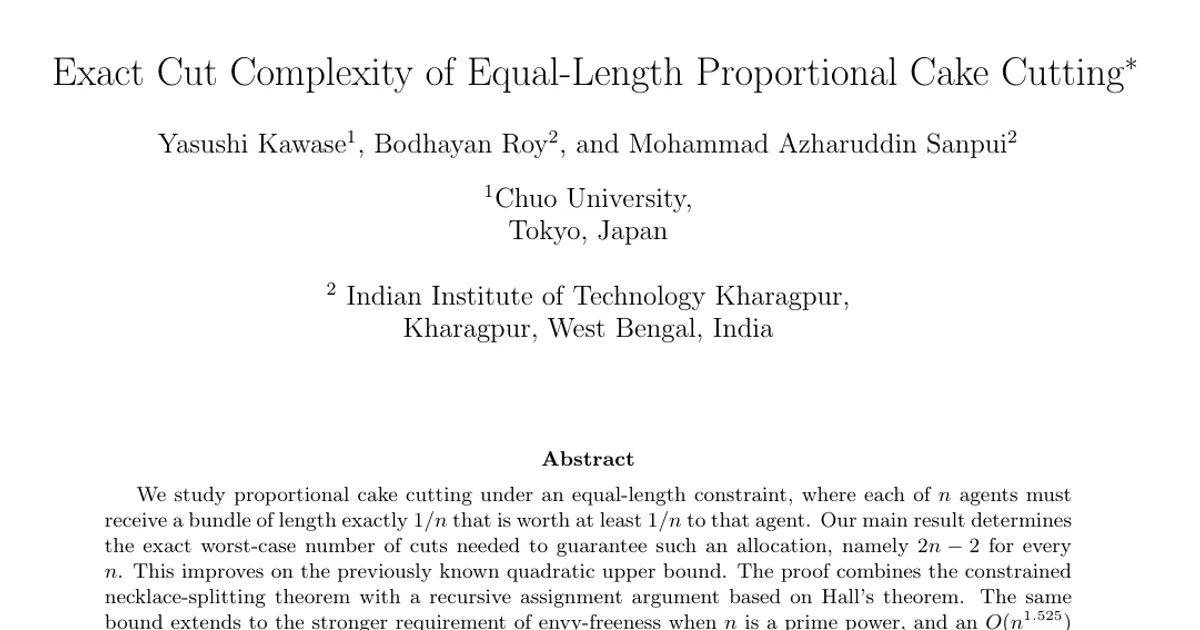
Authors’ abstract
We study proportional cake cutting under an equal-length constraint, where each of $n$ agents must receive a bundle of length exactly $1/n$ that is worth at least $1/n$ to that agent. Our main result determines the exact worst-case number of cuts needed to guarantee such an allocation, namely $2n-2$ for every $n$. This improves on the previously known quadratic upper bound. The proof combines the constrained necklace-splitting theorem with a recursive assignment argument based on Hall's theorem. The same bound extends to the stronger requirement of envy-freeness when $n$ is a prime power, and an $O(n^{1.525})$ upper bound holds for arbitrary $n$. We then ask whether such allocations can be computed. We first show that no deterministic protocol in the Robertson--Webb model terminates after finitely many queries on every instance and always returns an exact equal-length proportional allocation, even for two agents with identical valuations. For every $\varepsilon>0$, however, $O(n^2/\varepsilon)$ queries suffice to produce an allocation in which every agent receives a bundle of length exactly $1/n$ and value at least $1/n-\varepsilon$, again using at most $2n-2$ cuts. Finally, we augment the Robertson--Webb model with two-knife queries. We show that recursive balanced halving attains the optimal bound of $2n-2$ cuts when $n$ is a power of two. For arbitrary $n$, we give a procedure using $O(n\log n)$ cuts.