Research
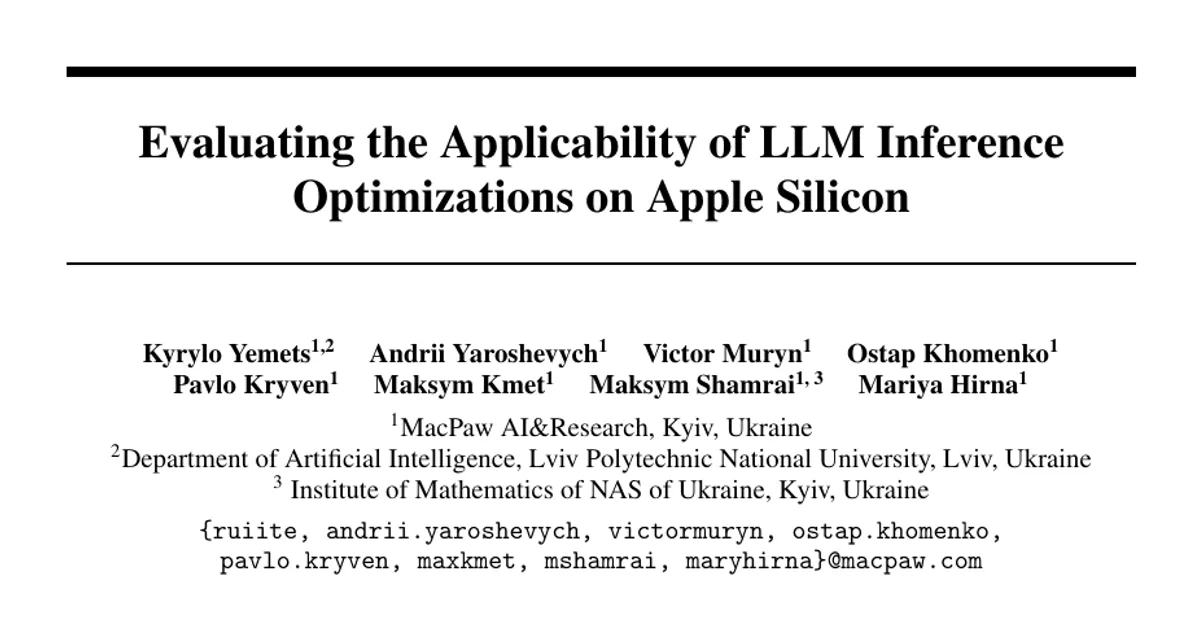
Evaluating the Applicability of LLM Inference Optimizations on Apple Silicon
Overview Research area: Efficient LLM inference (systems and performance engineering), specifically the portability of inference optimizations across hardware platforms — Apple Silicon versus NVIDIA G
- arXiv
- 2610.31479
- Published
- 2026-10-22
- Authors
- Kyrylo Yemets, Andrii Yaroshevych, Victor Muryn, Ostap Khomenko, Pavlo Kryven, Maksym Kmet, Maksym Shamrai, Mariya Hirna
AI summary
Overview
Research area: Efficient LLM inference (systems and performance engineering), specifically the portability of inference optimizations across hardware platforms — Apple Silicon versus NVIDIA GPUs.
Technical level: Intermediate. The paper assumes familiarity with terms like KV cache, speculative decoding, GPU kernels, and quantization, but its central argument — that a speedup is not a property of a technique alone — is accessible to anyone who follows LLM systems work.
Scope: A measurement study of four inference optimization families (KV-cache pruning, speculative decoding, ported GPU kernels, post-training quantization) across four Apple Silicon machines under a common single-request decode workload, with matched RTX 4090 comparisons where possible.
What This Paper Is About
Nearly all LLM inference optimizations are designed and benchmarked on server-class NVIDIA GPUs running batched serving workloads, even though Apple Silicon is one of the most common platforms for running models locally. This paper asks a simple but largely unexamined question: when those optimizations are moved to a Mac, which ones still help, and what actually determines whether they do? The goal is to characterize applicability as a function of the technique, the runtime, the hardware's capabilities, and the workload — rather than assuming published speedups carry over.
Key Contributions
- A cross-platform evaluation of four optimization families — KV-cache pruning, speculative decoding, ported GPU kernels, and post-training quantization — tested on Apple Silicon with matched RTX 4090 comparisons where feasible.
- A controlled experimental setup spanning four Apple machines under one common single-request decode workload, isolating hardware from workload effects.
- Evidence that individual techniques can reverse sign across platforms, most sharply for KV-cache pruning (helpful on Apple, sometimes harmful on desktop NVIDIA) and speculative decoding (uniformly harmful on Apple despite large reported server gains).
- A reframing of reported speedups as a joint function of technique, runtime, hardware contract, and workload regime, rather than a portable property of the technique itself.
Main Findings
-
KV-cache pruning is genuinely useful on Apple Silicon: it reaches up to 1.75× end-to-end throughput — but the same family can reduce throughput on desktop NVIDIA GPUs, so the direction of the effect is platform-dependent.
-
Speculative decoding did not pay off on Apple: every evaluated speculative decoding method lowered throughput on Apple Silicon, in contrast to the 2–6× gains reported for server GPUs.
-
CUDA kernel designs transfer only partially: the public Metal API lacks asynchronous copy, and batch-one decode renders several serving-oriented mechanisms inapplicable. The components that do transfer still yield up to 1.20× decode throughput.
-
Quantization is machine-dependent: gains vary from one Apple machine to another, with no single uniform benefit described in the abstract.
-
The headline conclusion is about portability of claims: across all four families, a reported speedup is not a portable property of a technique alone, but a joint function of technique, runtime, hardware contract, and workload regime.
Methodology in Plain English
The authors take optimizations that are normally built and validated on server GPUs and run them on Macs instead. They keep conditions deliberately narrow and shared: the same kind of workload — generating one response at a time, token by token — on four different Apple machines, so that differences in results can be attributed to the hardware and the technique rather than to wildly different usage patterns. Where the hardware allows, they also run the same tests on an RTX 4090 as a reference point for how the technique behaves on the platform it was designed for. They then group results by optimization family and ask, for each one, whether the benefit survives the move — and if not, what about the Mac's hardware or runtime explains the gap.
Why This Matters
Impact on research: The paper challenges a common assumption in LLM systems work — that a benchmark result on a datacenter GPU generalizes. If pruning helps on one platform and hurts on another, and speculative decoding helps enormously on servers but hurts on laptops, then papers reporting a single speedup number are reporting something narrower than readers usually assume. This argues for describing the hardware contract and workload regime alongside any claimed gain.
Real-world applications:
- Local and on-device assistants: developers running models on Macs get direct guidance on which optimizations to trust and which to skip.
- Consumer and creative professional tooling: apps embedding local models on Apple hardware can avoid adopting techniques that look good in papers but slow users down.
- Porting and runtime engineering: teams moving inference stacks between CUDA and Metal learn which kernel features are the real blockers.
- Deployment tuning and model selection: practitioners choosing quantization settings per machine rather than assuming a uniform win.
Industry relevance: Apple Silicon is a mainstream local inference target, not a niche one. As more inference moves to personal machines and edge devices, understanding which serving-oriented optimizations are misaligned with a single-request, latency-sensitive regime matters for anyone shipping local AI products — and for hardware and runtime vendors deciding which capabilities to expose.
Future Directions
- Close the API gap: determine how much of the missing CUDA-to-Metal performance is attributable to features absent from public Metal, such as asynchronous copy, and what would change if they were available.
- Design for the batch-one regime: develop optimizations built for single-request, latency-bound decode rather than adapting batched-serving mechanisms that the workload renders inapplicable.
- Explain and exploit machine-level variation: investigate why quantization gains differ across Apple machines, and whether settings can be selected per device rather than chosen once.
- Broaden the evaluation envelope: extend beyond the single-request decode workload and four machines to other workloads (prefill, longer contexts, concurrent requests) and other chips, to see whether the reported patterns hold.
Target Audience
Systems and performance engineers working on local or on-device LLM inference; developers deploying models on Apple Silicon; researchers who benchmark inference optimizations and want to understand the boundary conditions of published speedups; and runtime, compiler, and framework maintainers deciding where cross-platform porting effort is worthwhile. Readers new to the area will follow the high-level argument, though the findings assume some familiarity with inference internals.
Authors’ abstract
Apple Silicon is among the most widely used platforms for local LLM inference, yet nearly all inference optimizations are designed and validated on server-class NVIDIA GPUs under batched serving workloads. Which optimizations retain their benefits when moved to Apple Silicon, and what determines their applicability? We evaluate four optimization families: KV-cache pruning, speculative decoding, ported GPU kernels, and post-training quantization. Experiments span four Apple machines under a common single-request decode workload, with matched RTX 4090 comparisons where possible. KV-cache pruning can reach up to 1.75 times end-to-end throughput on Apple but can reduce throughput on desktop NVIDIA GPUs. Under the common benchmark, all evaluated speculative decoding methods reduce throughput on Apple, despite reported 2-6 times gains on server GPUs. CUDA kernel designs transfer only partially: public Metal lacks asynchronous copy, and batch-one decode makes several serving-oriented mechanisms inapplicable, although transferable components yield up to 1.20 times decode throughput. Quantization gains vary by machine. Across four families, a reported speedup is not a portable property of a technique alone but a joint function of technique, runtime, hardware contract, and workload regime.