Research
Estimation and Optimization of Ship Fuel Consumption in Maritime: Review, Challenges and Future Directions
Estimation and Optimization of Ship Fuel Consumption in Maritime: Review, Challenges and Future Directions Overview Research area: Maritime transport / shipping decarbonization, sitting at the interse
- arXiv
- 2602.21959
- Published
- 2026-02-25
- Authors
- Dusica Marijan, Hamza Haruna Mohammed, Bakht Zaman
AI summary
Estimation and Optimization of Ship Fuel Consumption in Maritime: Review, Challenges and Future DirectionsOverview
Research area: Maritime transport / shipping decarbonization, sitting at the intersection of naval architecture, ship operations, and machine learning (fuel oil consumption estimation and optimization).
Technical level: Intermediate. The paper is a review, so it assumes familiarity with concepts such as AIS, MRV reporting, resistance models, and common regression/neural-network methods, but it explains them in accessible terms.
Scope (1 sentence): A comprehensive review of data sources, estimation models (physics-based, data-driven, and hybrid) and optimization approaches for ship fuel oil consumption, with an emphasis on data fusion, Explainable AI, and open research gaps.
Note on completeness: the provided paper content ends mid-discussion in Section 3.3.1 (hybrid models). Sections 4–6 (detailed model categories for prediction, challenges, conclusions) are referenced but their full content is not included, so details such as specific optimization algorithm categories are only reported at the level promised in the abstract and introduction.
What This Paper Is About
Maritime shipping carries over 75% of goods transported by sea, but it is a significant source of greenhouse gas emissions, and fuel is the single largest operating cost for a vessel. The core problem is that fuel oil consumption (FOC) is hard to estimate accurately and hard to minimize, and the literature addressing these two problems is fragmented across physics-based, machine-learning, and hybrid approaches. The goal of this review is to bring those strands together, categorize the methods, compare the data sources they rely on, and identify where the field is falling short.
Key Contributions
-
A three-way taxonomy of FOC estimation models distinguishing physics-based (white-box) models, data-driven (black-box) models, and hybrid (grey-box) models, with a discussion of the strengths and limitations of each. The physics-based branch is further split into added-resistance estimation, speed-loss estimation, and statistical fuel-curve approaches; the data-driven branch into classical machine learning, neural networks, and ensemble models; and the hybrid branch into Serial (S-GBM), Constraint-based (C-GBM), and Embedding-based (E-GBM) grey-box models.
-
A detailed review of FOC data sources and their fusion. The paper reviews navigation data (AIS, noon reports), engine data (onboard sensors), meteorological data (ECMWF, NOAA, CMEMS), and regulatory data (EU MRV, IMO DCS), and is described by the authors as unique in reviewing and tabulating data fusion across these sources for FOC estimation.
-
Categorization of modeling algorithms by their batch versus online (streaming) capability, examining whether FOC models can process streaming data or must be retrained offline.
-
The first attempt to discuss Explainable AI (XAI) in the context of maritime fuel consumption, plus a structured listing of limitations, challenges, and future directions. A comparison table (Table 1) positions this work against prior reviews by Fan et al. (2022b), Wang et al. (2022), Barreiro et al. (2022), Mylonopoulos et al. (2023), and Yan et al. (2021b); the authors claim their review is the only one covering FOC estimation, FOC optimization, FOC-specific XAI, feature discussion, challenges, and data fusion together.
Main Findings
The literature search protocol. Searches on Scopus, ACM, IEEEXplore, and Google Scholar using terms such as "fuel consumption", "fuel optimization", "machine learning models in maritime", "physics-based models in maritime", "hybrid models in maritime", "maritime data fusion", and "maritime explainable AI" returned 1305 articles initially, filtered down to 115 papers, and expanded to 140 papers after reference analysis.
Fuel cost is the dominant operational expense. FOC accounts for approximately two-thirds of the cruising expenses of a vessel and more than 25% of total operating expenses.
Regulatory pressure is explicit and quantified. Under the 2023 IMO GHG strategy, carbon emissions per vessel transport work are targeted to fall by at least 40% by 2030 compared to 2008, with a mid-term target of at least 70% reduction by 2040 and net-zero GHG emissions by or around 2050.
Data sources differ sharply in resolution and access. AIS is public, standardized, and global but has a recorded frequency of minutes on average (messages transmit every few seconds for a fast-moving ship) and lacks direct engine or fuel data, with risks of signal gaps and spoofing. Noon reports are daily, internal, manually entered, contain direct daily FOC, but are too coarse for short-term or real-time analysis. Onboard sensors record at intervals of several seconds, are high fidelity and suitable for real-time modeling, but are proprietary with sensor drift and calibration concerns. Online meteorological sources (ECMWF, NOAA, CMEMS) are open but require interpolation and co-location with vessel tracks. MRV data (EU, since 2018, accessible via EMSA) is regulatory-grade and standardized but annual, limiting operational analytics.
Physics-based models require ship-specific parameters. These models compute total resistance as the sum of calm-water, wind, wave, marine fouling, and shallow-water resistance, then derive brake power and FOC from power and specific fuel oil consumption (SFOC). They do not need extensive historical data but often need component information that is not publicly available.
The "cubic law" for speed and FOC has limits. According to Adland et al. (2020), the cubic relationship between speed and FOC or main engine power is not relevant after the ship has been in service for a specific time, such as one year.
Classical machine learning is widely applied. Random forests, decision trees, support vector machine regression, multiple linear regression, XGBoost, Lasso, elastic nets, and adaptive boosting are all used for FOC prediction.
Deep learning, especially bidirectional LSTM, is prominent. Zhang et al. (2024) uses a Bi-LSTM with attention over SOG, draft, trim, main engine shaft power, ME temperature, and wind/wave/current speed and direction. Chen et al. (2024) combines Ensemble Empirical Mode Decomposition (EEMD) with BiLSTM for short-term prediction without other features. Ilias et al. (2023) uses BiLSTMs to predict main and auxiliary engines simultaneously.
Reported accuracy varies widely by study. Sample results include: Hajli et al. (2024) with multiple linear regression, MAE 5.49 × 10⁻³ and RMSE 7.36 × 10⁻³ (metric tons per nautical mile); Du et al. (2019) with an ANN, RMSE of less than 9.5 MT/day; Papandreou and Ziakopoulos (2022) with XGBoost, prediction error within 5%; Yan et al. (2024) with an ANN, MAE of 7.5%; Fan et al. (2024) with random forest, R² = 0.9747 and MAE = 1.72; Yuksel et al. (2023) with an M5 decision tree, R² = 0.9666; and Uyanık et al. (2020) reporting RMSE = 0.0001 with R² = 99.999% for Bayesian ridge, multiple linear regression/ridge, and kernel ridge models.
Most data-driven algorithms are batch, not online. Only a small set of works process streaming data or retrain online; examples cited are Kaklis et al. (2022) for online training, Yuan et al. (2021) for real-time FOC prediction, and Chi et al. (2018) and Chi et al. (2015) for real-time energy-efficiency monitoring frameworks.
Noon reports fused with metocean data is the most common fusion approach. Table 6 shows that the dominant data-fusion pattern for FOC is combining noon reports with publicly available metocean data, which suits long voyages lasting several days; when real-time prediction is needed, onboard sensor data is fused with other sources.
Derived features matter. Examples include slip (the difference between actual and theoretical vessel speed, or between the theoretical and actual distance traveled by the propeller) and computed speed loss due to wind, waves, and currents. Engine temperature and time since hull/propeller cleaning during dry docking are also noted as affecting FOC.
Grey-box models come in three interaction patterns. Serial grey-box models run the physics model first and feed its output into a machine-learning model; constraint-based grey-box models embed physics as mathematical constraints or regularization during training; embedding-based grey-box models place physics relationships directly inside the ML architecture, enabling real-time estimation at a possible cost to interpretability.
Standard evaluation metrics. Reviewed studies typically use MAE, MSE, RMSE, MAPE, and the coefficient of determination (R²), with formulas given in the paper.
Methodology in Plain English
This is a review article, not an experimental study, so the "method" is a structured literature search and synthesis. The authors defined a set of search terms tied to fuel consumption estimation and optimization, ran them across four databases (Scopus, ACM, IEEEXplore, Google Scholar), screened the 1305 results by reading titles and abstracts, and read full papers when relevance was unclear. They kept both review articles and empirical technical papers, reducing to 115 papers, then followed the references of those papers to find additional work, arriving at 140 papers. They then organized the field along several axes: which data sources feed FOC models, what type of model is used (physics-based, data-driven, or hybrid), whether the algorithm is batch or online, how different data sources are fused, and how model performance is measured. From this organization they drew out limitations, challenges, and future research directions.
Why This Matters
Impact on research. The paper gives the field a shared vocabulary for hybrid models (S-GBM, C-GBM, E-GBM) and a side-by-side comparison of data sources and their weaknesses, which makes it easier to compare new work against existing approaches and to see where evidence is thin. It also flags that no comprehensive review existed covering both FOC estimation and FOC optimization plus XAI and data fusion, and that the closest prior review (Yan et al., 2021a) does not cover work up to 2025.
Real-world applications:
- Weather routing and route optimization — choosing routes with the lowest fuel consumption using meteorological and sea-state data from sources such as ECMWF, NOAA, and CMEMS.
- Speed and trim optimization — adjusting vessel speed and trim, and understanding where the cubic speed–FOC relation breaks down for an in-service ship.
- Real-time operational decision support — using high-frequency onboard sensor data fused with other sources for short-term prediction and live energy-efficiency monitoring.
- Regulatory compliance and benchmarking — using MRV and IMO DCS data for emissions reporting and compliance metrics, and as a validation benchmark for estimation models.
Industry relevance. Because fuel accounts for roughly two-thirds of cruising expenses and more than a quarter of total operating expenses, even modest estimation and optimization improvements translate into direct cost savings while also serving the IMO targets of at least 40% carbon reduction by 2030 (versus 2008), at least 70% by 2040, and net zero by or around 2050. The paper also highlights a practical industry tension: the most precise data (onboard sensors) is proprietary, while the most accessible data (AIS, MRV, public metocean) is coarse or indirect.
Future Directions
- Hybrid (grey-box) modeling as a research priority. The authors identify hybrid methodologies that effectively combine physics-based and data-driven paradigms as under-explored relative to work that treats them separately.
- Real-time optimization. Current strategies for optimization in dynamic maritime environments remain underexplored, and most data-driven algorithms are batch rather than streaming-capable, which limits operational deployment.
- Standardized, open benchmarking datasets. The heterogeneity of maritime data sources is described as creating a need for standardized, open benchmarking datasets in maritime analytics; the paper notes that fusion of AIS, onboard sensor, and meteorological data for improved accuracy has not been thoroughly investigated.
- Explainable AI for fuel consumption. XAI's application in maritime fuel consumption remains limited, which the authors say makes it difficult for stakeholders to trust AI-driven decision-making; the paper frames its own XAI discussion as a first attempt in this context.
Target Audience
This review is most useful to maritime and shipping researchers, machine-learning practitioners applying models to vessel data, naval architects and marine engineers working on resistance and power models, ship operators and fleet performance analysts interested in fuel-saving measures, and regulators or policy analysts working with IMO and EU MRV frameworks. Graduate students entering the field would also benefit, since the paper provides the data-source landscape, a model taxonomy, and an entry point into the literature.
Authors’ abstract
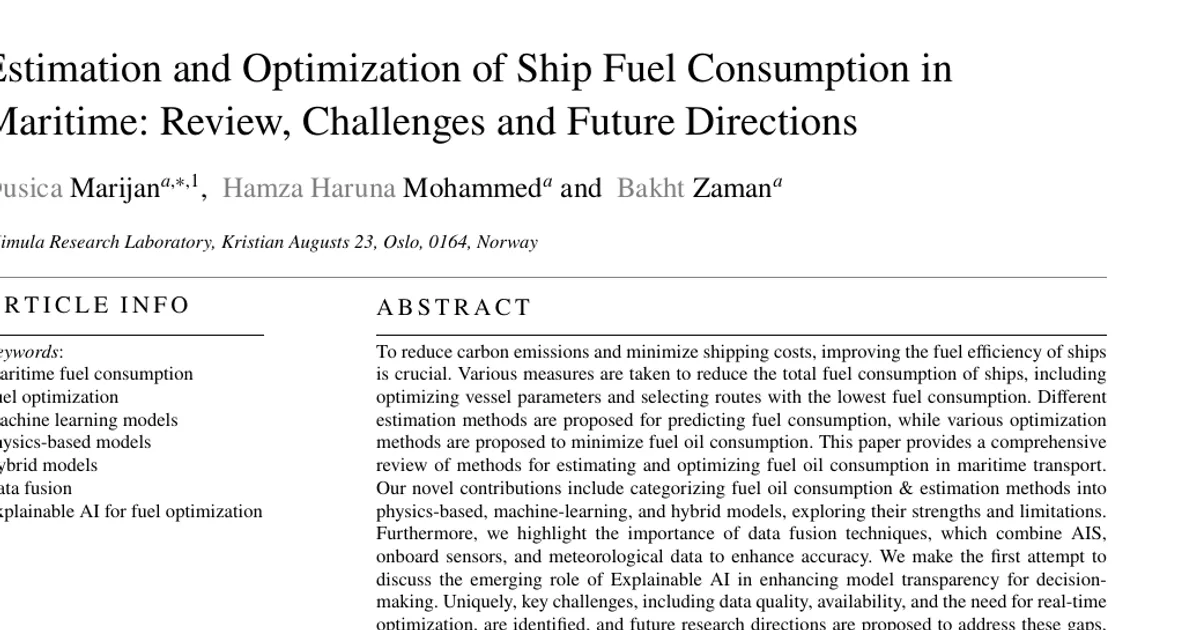
To reduce carbon emissions and minimize shipping costs, improving the fuel efficiency of ships is crucial. Various measures are taken to reduce the total fuel consumption of ships, including optimizing vessel parameters and selecting routes with the lowest fuel consumption. Different estimation methods are proposed for predicting fuel consumption, while various optimization methods are proposed to minimize fuel oil consumption. This paper provides a comprehensive review of methods for estimating and optimizing fuel oil consumption in maritime transport. Our novel contributions include categorizing fuel oil consumption \& estimation methods into physics-based, machine-learning, and hybrid models, exploring their strengths and limitations. Furthermore, we highlight the importance of data fusion techniques, which combine AIS, onboard sensors, and meteorological data to enhance accuracy. We make the first attempt to discuss the emerging role of Explainable AI in enhancing model transparency for decision-making. Uniquely, key challenges, including data quality, availability, and the need for real-time optimization, are identified, and future research directions are proposed to address these gaps, with a focus on hybrid models, real-time optimization, and the standardization of datasets.