Research
Entertain, then Cancel: How Thinking Makes Reasoning Models Read Some and Or Literally
Overview Research area: Computational pragmatics and reasoning-model interpretability — specifically, how extended chain-of-thought "thinking" changes the way language models interpret logical words s
- arXiv
- 2610.21204
- Published
- 2026-10-15
- Authors
- Zhizhuo Kou, Jian Yang, Pengfei Hao, Junyu Luo, Jingshu Peng, Sirui Han, Yike Guo
AI summary
Overview
Research area: Computational pragmatics and reasoning-model interpretability — specifically, how extended chain-of-thought "thinking" changes the way language models interpret logical words such as some and or.
Technical level: Intermediate. The core experimental design (hold weights fixed, vary only thinking budget) is easy to grasp, but the statistics (cluster-bootstrap intervals, logistic dose–response models, Holm correction) and the trace-prefix intervention assume some familiarity with LLM evaluation.
Scope (one sentence): The paper treats "how long a model thinks" as a controllable dial on fixed weights and measures which reading — pragmatic or literal — the model endorses, across 40 open and seven closed reasoning models, and locates the moment of change inside the model's own reasoning trace.
What This Paper Is About
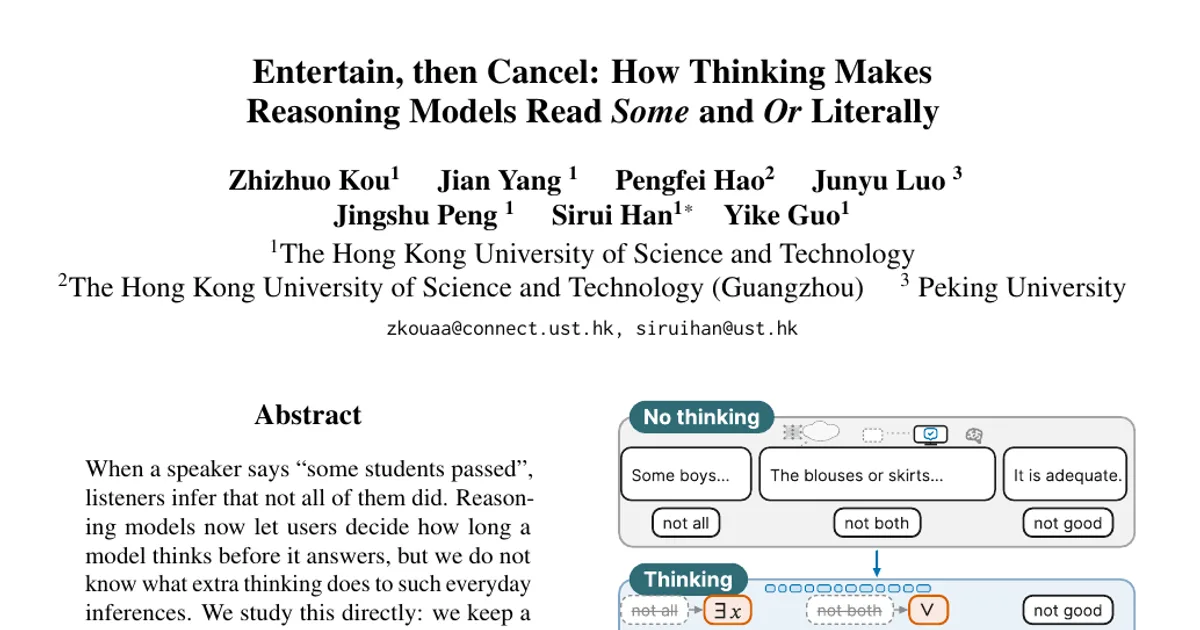
When someone says "some students passed," listeners normally infer that not all of them did — a textbook scalar implicature. Reasoning models now let users control how much a model deliberates before answering, but it was unknown whether extra deliberation makes a model more sensitive to what a speaker meant or more strictly literal. The authors keep model weights fixed, turn only the thinking dial, and record which reading the model chooses; they then cut the model's reasoning trace at successive points to see where the reading flips.
Key Contributions
- Thinking cancels implicature. Extended reasoning lowers the pragmatic reading of some ("not all") and or ("not both") in 30 of 40 open reasoning models and in GPT-5, and in label-free three-way choices in 21 of 24 models.
- A diagnostic protocol. A fixed-weight framework that combines dose–response profiling (thinking off vs. capped budgets vs. natural stopping) with a trace-prefix diagnostic that forces an answer after the first t tokens of the model's own reasoning, while controlling for yes-bias.
- The "entertain, then cancel" pattern. Models typically endorse the pragmatic reading early in the trace (in smaller models, at a higher rate than with no thinking at all) and abandon it by the final answer.
- An exploratory inference-time remedy plus released resources. Answering from the first 128 trace tokens improves accuracy on scalar-felicity items in two 8B models without hurting literal accuracy; the authors also release new Bott–Noveck sentences with expert-checked speaker-knowledge scenarios, expanded IMPPRES test sets, full trace logs, and machine-translated German/Chinese slices.
Main Findings
- Large, consistent literal shift for logical words. In Qwen3-8B, natural thinking changes the pragmatic reading of some by −28.2 pp (95% CI −41.0 to −16.7) and of or by −36.4 pp; in Qwen3-32B the changes are −51.3 and −46.5 pp.
- The effect spans model families and vendors. High reasoning effort in gpt-oss-20b produces −30.8 pp (some) and −24.7 pp (or) versus low effort; OLMo-3-32B-Think shifts some by −11.5 pp; R1-Distill-Llama-8B and R1-Distill-Llama-70B each shift by −50.0 pp against a forced-empty thinking block; DeepSeek-R1-0528-Qwen3-8B by −24.4 pp; GPT-5 by −20.6 pp (some) and −18.8 pp (or) at high versus minimal effort.
- Robust to analysis choices. On the held-out half of the full IMPPRES sets (300 items per word), Qwen3-8B shows −37.7 pp for some and −37.7 pp for or; the shift persists under a forced-empty baseline, both stopping procedures, and a three-way choice without Yes/No labels. On the full held-out sets, 47 of 48 some and or shifts survive Holm correction within their model family.
- Modals behave less consistently. The modal shift is −13.6 pp in Qwen3-32B but only 1.2 pp in Qwen3-14B, and EXAONE-Deep and OLMo-3-32B-Think read modals more pragmatically with thinking (10.2 and 29.7 pp). The authors conclude the robust effect is on some and or.
- Context-driven inferences improve. Presupposition accuracy rises 22.2 pp in Qwen3-8B; Fig-QA accuracy rises 10.7 pp and six PUB tasks 10.1 pp (significant at every Qwen3 size from 4B to 32B); Circa rises 17.5 pp, NOPE 9.9 pp, and LUDWIG indirect answers 6.5 pp.
- Lexical scales split by model size. From 8B up, Qwen3 reads lexical scales slightly more pragmatically (5.5 pp at 8B, 4.0 pp at 32B), but 4B loses them (−7.7 pp), so the effect changes sign between Qwen3-4B and Qwen3-8B. Equivalence within ±3 pp holds in only 2 of 42 models.
- A dose–response arc. In Qwen3-8B the some reading first rises with a 128-token budget (+37.2 pp), falls to 5.1 pp at 512 tokens, and drops below the no-thinking level only beyond 512 tokens (−21.8 pp at 1024).
- Entertain, then cancel inside the trace. In Qwen3-8B, forcing an answer after successive trace prefixes raises the pragmatic reading of some from 35.8% (empty trace) to 52.0% after 128 tokens (+16.2 pp, CI 12.8 to 19.8), then down to 1.1% at the end of the trace; or follows the same arc (+16.9 pp after 128 tokens). The empty-trace reading matches the no-thinking baseline (35.8% vs 38.8%).
- Trajectory counts. 67.4% of Qwen3-8B some traces are pragmatic-early, literal-final, versus 31.4% literal throughout; across Qwen3 models and words the pragmatic-to-literal rate ranges from 41.4% to 68.1%. Phi-4-reasoning shows 75.3% such trajectories; Qwen3.8-27B cancels or from 38.4% to 0.0% (55.0% pragmatic-then-literal); Qwen3.5-9B shows some at 35.9% empty, 57.1% after 32 tokens, 0.0% at the end.
- Not every model or format agrees. Claude Sonnet 4.6 moves the other way (+21.2 pp for some, +26.2 pp for modals, +20.8 pp for lexical scales) and reverses in the three-way choice; DeepSeek-V4 also rises (+8.9 pp for some in V4-Pro, +16.9 pp in V4-Flash, +41.7 pp for lexical scales in V4-Pro); Granite-3.3 and Llama-3.1-Nemotron-Nano-8B read some more pragmatically in the Yes/No format.
- Post-training moves the default reading. In OLMo-3, the no-thinking pragmatic default on some falls from 75.6% (base) to 39.7% after thinking SFT, while RL-Zero on math from the same base leaves it at 78.2%; in Tülu-3 it falls from 46.2% (SFT) to 14.1% (DPO). R1-Distill-Qwen-7B reads some pragmatically in 85.9% of items against 41.0% for its base.
- The exploratory remedy works narrowly. Reading the answer after the first 128 trace tokens raises pooled equal-family score by 1.4 pp (95% CI 1.2 to 1.6) and lifts IMPPRES some/or felicity accuracy from 1.2% to 20.5% in Qwen3-8B and from 2.2% to 8.1% in DeepSeek-R1-0528-Qwen3-8B, with literal-gold accuracy unchanged. A task-aware instruction raises the overall score more (2.3 pp) but barely moves the felicity items (3.5% and 2.6%).
Methodology in Plain English
The authors exploit the fact that "thinking" is a setting rather than a change to the model itself. Because weights stay frozen, turning thinking on or off is like a dose in a medical trial: any change in answers must come from the deliberation, not from different training.
Each test item is a short sentence containing a trigger word plus a question about what the speaker meant (e.g., speaker says "Some boys play" — would you conclude the speaker believes "Not all boys play"?). Saying yes is the pragmatic reading; no is the literal one. Items come from established pragmatics benchmarks (IMPPRES, LUDWIG, PragMega, Fig-QA, PUB, Circa, NOPE) plus scalar-diversity sets with human enrichment rates.
Models answer in three conditions: thinking off, thinking capped at a token budget B, and natural stopping under an 8,192-token safety cap. The authors compute the share of committed answers taking the pragmatic reading, and a second readout that skips answer parsing by comparing the log-probabilities the model assigns to the two options after the trace.
For the trace diagnostic, they cut the model's own reasoning text after t tokens (t ∈ {0, 32, …, 2048}), close it, and force an answer. Averaged over items, this traces out how the endorsed reading evolves. A trajectory is labelled "entertain-then-cancel" when an early prefix yields the pragmatic answer and the final answer is literal, and "literal-throughout" when no prefix does. Statistics use three decoding seeds, 95% cluster-bootstrap intervals over items paired across conditions, and a pre-registered logistic model of the pragmatic reading on log thinking budget, phenomenon class and their interaction — several pre-registered predictions did not hold and are reported in the appendix.
Why This Matters
Research impact. The paper argues that accuracy alone cannot distinguish "the model changed its interpretation" from "the model got worse," because both readings of some and or are licensed. It proposes that evaluations of reasoning models report the reading chosen alongside accuracy, and it supplies a protocol for doing so. The trace results also fit the linguistic default-and-cancel account better than the effort account of implicature, since enrichment falls rather than rises on logical words.
Real-world applications:
- Conversational assistants with thinking on by default — a model may treat "some of the tests failed" as compatible with "all failed," producing technically correct but misleading answers.
- Requirements and specification review, where some, or and modals carry precise legal/technical scope.
- Clinical or safety-adjacent triage dialogue, where hedged and indirect user statements must be interpreted as intended rather than literally.
- Evaluation and QA tooling for model vendors, using the dose–response and trace-prefix probes as a diagnostic suite for interpretation drift.
Industry relevance. Thinking budgets and effort levels are now user-facing product settings. The finding that a setting marketed as "more reasoning" can systematically shift interpretation — and that the intended reading is present in the first ~128 trace tokens — gives deployers both a risk to monitor and a cheap routing heuristic.
Future Directions
- Establish causality and mechanism. The training-stage comparisons are correlational, and the trace probe intervenes on text rather than reading internal state, so neither identifies why cancellation happens.
- Test the remedy beyond two 8B models. The exploratory fix was validated on Qwen3-8B and DeepSeek-R1-0528-Qwen3-8B, which share a base model; generality across lineages, scales and larger models is untested.
- Resolve format sensitivity and non-English behaviour. The direction for Claude models reverses between formats, and all headline items are English; the machine-translated German and Chinese slice shows the same drop but is not human-verified.
- Find training-time fixes. Four pre-registered remedies that intervene in or train the thinking itself failed their development gates, leaving open how to preserve intended readings where context warrants them.
Target Audience
Researchers in computational pragmatics and LLM evaluation, reasoning-model developers who tune thinking budgets and effort levels, and alignment/safety practitioners interested in interpretation rather than accuracy. It is also useful for linguists wanting a clean, weight-controlled testbed for competing theories of implicature, and for product teams deciding whether to enable extended thinking by default in conversational deployments.
Authors’ abstract
When a speaker says ``some students passed'', listeners infer that not all of them did. Reasoning models now let users decide how long a model thinks before it answers, but we do not know what extra thinking does to such everyday inferences. We study this directly: we keep a model's weights fixed, change only how much it thinks, and record which reading it chooses. A second tool cuts the model's own reasoning at successive points and asks for an answer, showing where the reading changes. Thinking makes models read logical words as logic: it cancels the implicatures of \emph{some} (\emph{not all}) and \emph{or} (\emph{not both}) in most tested open reasoning models and in GPT-5, while context-driven inferences such as indirect answers improve. The trace shows why: models first entertain the enriched reading and cancel it later. Answering from that early reading, an exploratory inference-time remedy, recovers these implicatures without losing literal accuracy. Evaluations of reasoning models should measure how they interpret, not only how accurate they are.