Research
Enhancing Navigation Efficiency of Quadruped Robots via Leveraging Personal Transportation Platforms
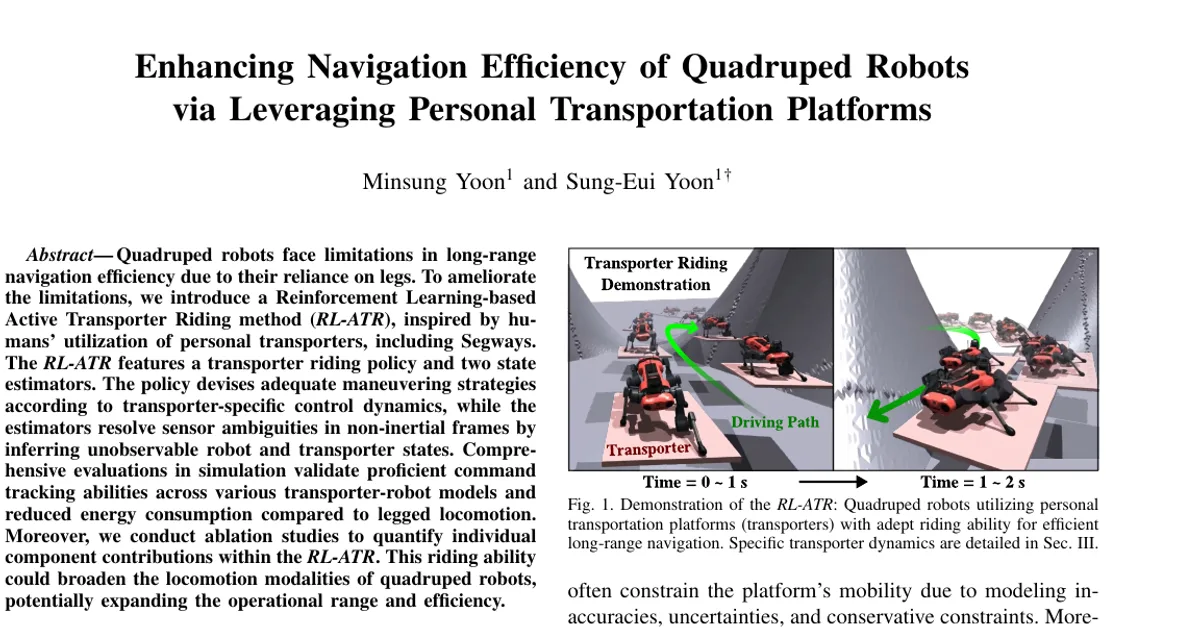
Quadruped robots face limitations in long-range navigation efficiency due to their reliance on legs. To ameliorate the limitations, we introduce a Reinforcement Learning-based Active Transporter Ridin
- arXiv
- 2602.03397
- Published
- 2026-02-03
- Authors
- Minsung Yoon, Sung-Eui Yoon
Authors’ abstract
Quadruped robots face limitations in long-range navigation efficiency due to their reliance on legs. To ameliorate the limitations, we introduce a Reinforcement Learning-based Active Transporter Riding method (\textit{RL-ATR}), inspired by humans' utilization of personal transporters, including Segways. The \textit{RL-ATR} features a transporter riding policy and two state estimators. The policy devises adequate maneuvering strategies according to transporter-specific control dynamics, while the estimators resolve sensor ambiguities in non-inertial frames by inferring unobservable robot and transporter states. Comprehensive evaluations in simulation validate proficient command tracking abilities across various transporter-robot models and reduced energy consumption compared to legged locomotion. Moreover, we conduct ablation studies to quantify individual component contributions within the \textit{RL-ATR}. This riding ability could broaden the locomotion modalities of quadruped robots, potentially expanding the operational range and efficiency.