Research
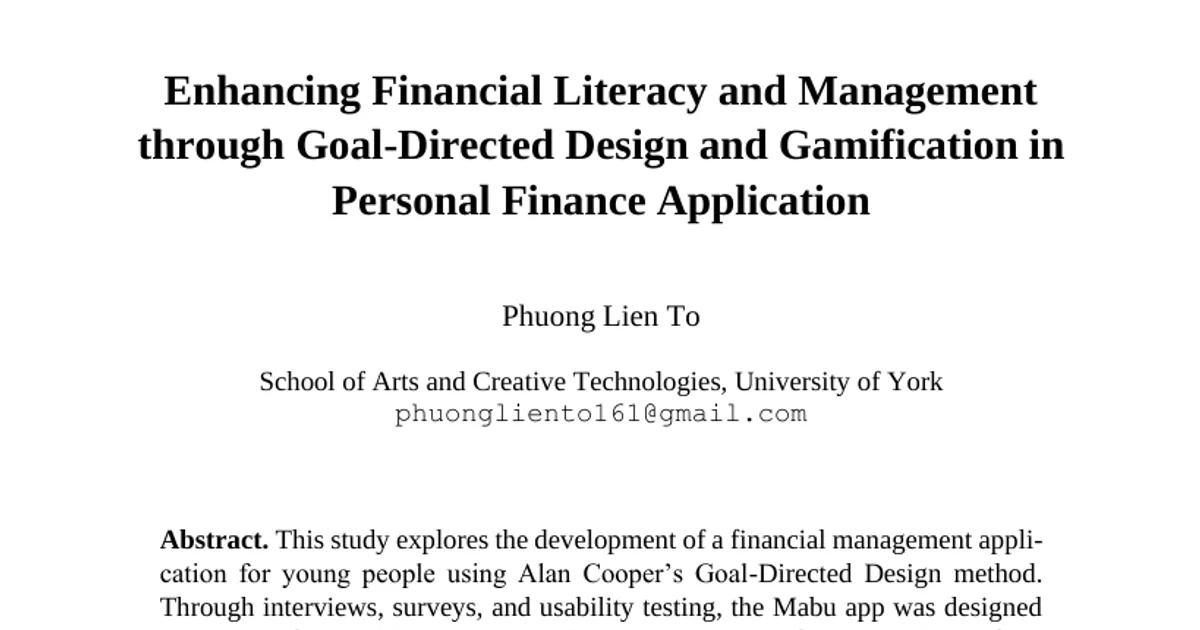
Enhancing Financial Literacy and Management through Goal-Directed Design and Gamification in Personal Finance Application
Overview Research area: Human-Computer Interaction, specifically interaction and user-experience design for personal finance tools, with connections to financial literacy education and gamification. T
- arXiv
- 2601.08640
- Published
- 2026-01-13
- Authors
- Phuong Lien To
AI summary
Overview
Research area: Human-Computer Interaction, specifically interaction and user-experience design for personal finance tools, with connections to financial literacy education and gamification.
Technical level: Beginner-Friendly. The abstract describes a design-methodology study — interviews, surveys, and usability testing — rather than a technically specialised engineering or machine-learning contribution.
Scope (one sentence): The paper reports on designing a personal finance management application for young people using Alan Cooper's Goal-Directed Design method, combining personalised features and gamification to support financial literacy and better financial behaviour.
What This Paper Is About
Young people often manage money without much formal grounding in personal finance, and generic budgeting apps may not fit how they actually think about their goals. This paper addresses that gap by applying a structured, goal-focused design method to build a finance management application tailored to young users. The goal is to see whether combining personalised features with gamified learning can improve financial literacy and encourage better day-to-day financial habits.
Key Contributions
-
Application of Goal-Directed Design to personal finance. The study adapts Alan Cooper's Goal-Directed Design method — a user-research-driven approach that starts from users' underlying goals rather than feature lists — to the domain of personal finance management for young people.
-
A designed application targeting financial literacy in young users. The output is a personal finance application whose stated purpose is improving financial literacy, not merely tracking spending.
-
Integration of gamification with personalised features. The design combines game-like elements for learning with customisation to the individual user, positioning these as complementary rather than separate features.
-
Empirical grounding through mixed user research. The design is informed by interviews and surveys, and evaluated through usability testing, giving the work a user-study basis rather than a purely conceptual proposal.
Main Findings
-
Gamified learning was found effective: The abstract reports that gamified learning was effective in the context studied, supporting its use as a mechanism for financial education within the application.
-
Tailored experiences were found effective: Personalised, user-specific experiences are reported as effective alongside gamification, suggesting the two work together in encouraging engagement.
-
Positive behavioural signal: Findings indicate that these features encouraged better financial behaviour among young users, according to the study's interviews, surveys, and usability testing.
-
Details are not given in the abstract: The abstract states these findings at a general level only. It does not report sample sizes, participant demographics, quantitative measures, effect sizes, comparison baselines, or the specific gamification mechanics used. Those details would be in the full paper, which was not available for this summary.
Methodology in Plain English
The researcher followed Alan Cooper's Goal-Directed Design process, which puts understanding users' actual goals ahead of designing screens and features. In practice, this meant gathering information directly from young people through interviews (open-ended conversations to understand motivations and money habits) and surveys (structured questions to reach more people). Those inputs shaped the design of a personal finance application that pairs personalised features with gamification — game-like elements intended to make learning about money more engaging. The design was then checked with usability testing, where users interact with the application while the researcher observes how well it works for them. The abstract presents this as a design-and-evaluation study rather than a controlled experiment comparing conditions.
Why This Matters
Impact on research: The paper is a case study in applying an established HCI design method (Goal-Directed Design) to financial literacy technology, and in treating gamification and personalisation as a combined design strategy. It contributes to the ongoing conversation in HCI about whether motivational design techniques genuinely translate into behaviour change rather than short-lived engagement.
Real-world applications:
- Consumer budgeting apps can borrow the goal-first design approach instead of shipping generic category-based trackers.
- Financial literacy programmes in schools, universities, or community organisations could use gamified, personalised tools as a supplement to classroom teaching.
- Banks and fintech products aimed at younger customers can apply the personalisation-plus-motivation pattern to onboarding and habit-building features.
- Youth financial inclusion initiatives can use the interview-and-survey framing to understand goals before designing interventions for young, first-time money managers.
Industry relevance: Product and UX teams in fintech, neobanking, and personal finance software face the problem of engagement dropping off after sign-up. This work speaks directly to that problem by framing design around user goals and motivational mechanics, and by validating the design with real users. It reinforces that financial apps compete not only on features and data but on how well they fit users' underlying intentions.
Future Directions
-
Longer-term behaviour tracking. The abstract describes improvement in financial behaviour but does not say over what period or how it was measured. A natural next step is longitudinal study to see whether gains persist once novelty fades.
-
Comparative evaluation. Testing the goal-directed, gamified design against a conventional budgeting app would clarify how much of the benefit comes from the specific method versus from simply being a new, well-designed tool.
-
Generalisation beyond the studied users. The abstract specifies "young people" without defining the range or context. Extending the approach to different age groups, income levels, or cultural settings is an open question.
-
Separating gamification from personalisation. Because the abstract reports both features together, it remains unclear which contributes more, and whether gamification can backfire for users motivated by different things.
Target Audience
This paper is most useful to UX and product designers working on consumer finance tools, HCI researchers interested in design methodology and gamification, and fintech practitioners building products for younger audiences. It is also accessible to educators and financial literacy programme designers who want to understand how goal-directed design and game mechanics can be applied to teaching money management. Readers looking for quantitative evidence of learning outcomes or detailed experimental results will not find them in the abstract, which reports findings at a high level.
Authors’ abstract
This study explores the development of a financial management application for young people using Alan Cooper's Goal-Directed Design method. Through interviews, surveys, and usability testing, the application was designed to improve financial literacy by combining personalised features and gamification. Findings highlight the effectiveness of gamified learning and tailored experiences in encouraging better financial behaviour among young users.