Research
Enhanced Diffusion Sampling: Efficient Rare Event Sampling and Free Energy Calculation with Diffusion Models
Overview Research area: Statistical machine learning (stat.ML) applied to molecular simulation — specifically combining enhanced sampling methodology from computational chemistry with diffusion-model-
- arXiv
- 2602.16634
- Published
- 2026-02-18
- Authors
- Yu Xie, Ludwig Winkler, Lixin Sun, Sarah Lewis, Adam E. Foster, José Jiménez Luna, Tim Hempel, Michael Gastegger, Yaoyi Chen, Iryna Zaporozhets, Cecilia Clementi, Christopher M. Bishop, Frank Noé
AI summary
Overview
- Research area: Statistical machine learning (stat.ML) applied to molecular simulation — specifically combining enhanced sampling methodology from computational chemistry with diffusion-model-based equilibrium samplers.
- Technical level: Intermediate to Advanced. The paper assumes familiarity with stochastic differential equations, diffusion/score-based generative models, importance sampling and free-energy estimators (MBAR/WHAM); the concepts are explained carefully enough for an informed non-specialist to follow the motivation.
- Scope: The paper introduces a framework for steering pretrained diffusion models to sample rare regions of molecular equilibrium distributions while retaining exact reweighting, and instantiates it in three algorithms (UmbrellaDiff, MetaDiff, and ΔG-Diff) demonstrated on toy potentials and protein folding systems.
What This Paper Is About
Molecular dynamics suffers from two distinct problems: slow mixing (correlated trajectories trapped in long-lived states) and the rare-state problem (states with small equilibrium probability are almost never visited, even with independent samples). Diffusion-model equilibrium samplers such as BioEmu solve slow mixing by generating approximately independent configurations, but they cannot cheaply estimate observables dominated by rare states — estimating a folding free energy of ΔG_fold = −10 kcal/mol this way would require sampling roughly 1 in 1.9 × 10⁷ unfolded configurations, on the order of one GPU year. The paper's goal is to close this remaining gap by adding quantitatively accurate biasing and exact unbiasing on top of a pretrained diffusion sampler.
Key Contributions
- An enhanced diffusion sampling framework. A steering algorithm that applies arbitrary bias potentials to a pretrained diffusion model at inference time, producing samples from biased (tilted) ensembles that can subsequently be reweighted back to the unbiased equilibrium distribution.
- Exact unbiasing machinery for weighted diffusion samples. A weighted variant of MBAR that combines samples from K biased ensembles with their steering importance weights, using per-sample effective masses α_{k,i} = ESS_k · w_{k,i} / Σ_j w_{k,j}, and returning minimum-variance, asymptotically unbiased estimates without needing to evaluate log p(x).
- Three enhanced sampling algorithms instantiated in the diffusion framework. UmbrellaDiff (umbrella sampling along a reaction coordinate ξ), MetaDiff (a batchwise analogue of metadynamics that updates the bias from a batch of samples, adding a mixture-of-Gaussians kernel rather than a single hill), and ΔG-Diff (free-energy differences via tilted ensembles).
- Demonstrations on toy landscapes and protein folding. Validation on analytic double-well potentials with ΔG from −2 to −14 k_BT, and on protein folding landscapes and folding free energies using the BioEmu model for proteins between 50 and 200 amino acids, reported as achievable within GPU-minutes to hours per system.
Main Findings
- Rare-state sampling improved dramatically in an idealized setting. On double-well potentials where the high-energy state has equilibrium probability between 10⁻¹ and 10⁻⁶, unbiased diffusion sampling required a number of samples that grew approximately exponentially with ΔG, whereas enhanced diffusion sampling required only between 10 and 100 samples for all ΔG values inspected (range −2 to −14 k_BT) using a single linear tilt that equalizes the two minima.
- The authors flag this as a best case. The toy demonstration assumes a single biasing potential and that the perfect bias is known in advance; realistic use requires trying different biasing potentials and combining them with MBAR, which increases the sample count needed for convergence and complicates the relationship between free-energy differences and sample requirements.
- UmbrellaDiff avoids the kinetic trapping that afflicts umbrella sampling with MD. In a two-dimensional test with 8 umbrellas biasing ξ = x, traditional Langevin umbrella sampling (orange in Fig. 2) fails to sample a third high-probability state that lies off the umbrella path, yielding a wrong free energy, while UmbrellaDiff samples the equilibrium distribution conditioned on the umbrella potential and recovers the correct free energy.
- Steered diffusion samples are iid, unlike MD trajectories. Because each steered sample is generated independently from the noisy state, UmbrellaDiff does not require preparing and equilibrating initial configurations per window, and it is not subject to hysteresis in directions orthogonal to the reaction coordinate.
- MetaDiff makes MBAR applicable to metadynamics-style sampling. Because each steering invocation targets the equilibrium distribution of the current bias condition and returns iid (weighted) samples, each bias update defines a well-posed thermodynamic state, so MBAR can be applied online — unlike standard metadynamics, where the fill-up period is a nonequilibrium process and multistate estimators such as MBAR are not directly applicable.
- A practical recipe for window design and diagnostics. For UmbrellaDiff, the paper recommends estimating the biased width as σ_k ≈ 1/√κ_k, spacing neighboring centers within one or two σ for roughly 10–30% overlap, optionally preconditioning with κ_k = 1/(c_k − c_{k−1})² followed by updating κ_k ← 1/Var[ξ], and monitoring per-window ESS, correlation-corrected effective counts N_k^eff ≈ N_k/g_k, overlap coefficients O_{k,k+1} = ∫√(q_k(ξ)q_{k+1}(ξ))dξ (recommended range 0.1 to 0.3), MBAR/WHAM uncertainty estimates, and optionally EMUS error analysis.
- Resampling controls weight degeneracy. Stratified resampling is applied periodically or when the Kish effective sample size (ESS = (Σw_i)²/Σw_i²) falls below a threshold such as n/2, after which weights are reset to uniform weights of 1.
- Reported speed-up for folding free energies. The abstract states the methods achieve fast, accurate, and scalable estimation of equilibrium properties within GPU-minutes to hours per system, "closing the rare-event sampling gap that remained after the advent of diffusion-model equilibrium samplers." Detailed benchmark tables for the 50–200 residue proteins are not contained in the provided excerpt of the paper.
Methodology in Plain English
The approach mirrors classical enhanced sampling but replaces the dynamics engine. Start with a pretrained diffusion model whose output distribution p(x) is treated as the unbiased equilibrium distribution (written as p(x) = e^{−u(x)} with a dimensionless energy u). Instead of running molecular dynamics, run the reverse diffusion process and add a control drift σ̃_t²/2 ∇b_t derived from a chosen bias potential b(x); this is the Driftlite/Feynman-Kac-corrector formulation, a generalization of the reward-tilted SDE that yields weighted particles rather than unweighted samples. Along the trajectory, particles accumulate importance weights via d log w_t = F_t(x_t)dt − E_{x~q_t}[F_t(x)], and are periodically resampled when the effective sample size drops too low. The result is a batch of weighted samples from a biased marginal q(x) ∝ p(x)e^{−b(x)}.
To remove the bias, one known quantity (the bias potential) is used to reweight back to p. With a single bias, reweighting is trivial: W_n = w_n e^{b(x_n)}. With multiple biases, the paper uses a weighted MBAR variant that treats the unbiased state as a target ensemble, solves for reduced free energies f̂_k of the sampled biased states, and produces per-sample target weights W_n^(a). Any equilibrium observable is then a weighted average, with folding free energy obtained as ΔG_fold = −k_BT ln(Ê_p[χ]/(1 − Ê_p[χ])) using a folded/unfolded membership function χ(x) (for example based on native contacts), and potentials of mean force obtained by weighted histogram or kernel density estimation. Uncertainties come from MBAR covariance expressions or a cluster bootstrap over independent denoising trajectories.
Three protocols reuse this machinery: UmbrellaDiff places harmonic biases ½κ_k‖ξ(x) − c_k‖² at chosen centers along a reaction coordinate; MetaDiff treats each batch of steered samples as a well-defined thermodynamic state and deposits a batchwise mixture-of-Gaussians bias in collective-variable space, reducing to standard metadynamics on steered diffusion sampling when the batch size is 1; and ΔG-Diff computes free-energy differences from tilted ensembles.
Why This Matters
The paper targets a problem that has been the central limiting factor in molecular dynamics for decades and that survives even after diffusion samplers removed the slow-mixing bottleneck. If rare-event estimates can be obtained in GPU-minutes to hours rather than the roughly one GPU year implied for a ΔG_fold = −10 kcal/mol protein by direct BioEmu sampling, quantitative free-energy calculations become a routine capability rather than a specialized, compute-intensive undertaking.
Potential applications (drawn from problems the paper discusses, with the caveat that the provided excerpt documents detailed results mainly for toy potentials and protein folding):
- Protein folding stability prediction — computing ΔG_fold for proteins of 50–200 amino acids, filling in a regime where direct equilibrium sampling is intractable.
- Protein–ligand binding free energies — the paper situates its framework relative to alchemical free energy perturbation (FEP) methods, which become impractical when alchemical changes induce large-scale slow conformational rearrangements.
- Conformational change and mechanism studies — the paper cites metadynamics, string methods with umbrella sampling, and brute-force simulations resolving GPCR activation/binding mechanisms; MetaDiff and UmbrellaDiff map directly onto those PMF-of-conformational-change workflows.
- Materials science — the paper notes that Boltzmann emulator concepts are emerging in materials applications, implying the framework is not restricted to biomolecules.
Industry relevance: all authors are affiliated with Microsoft Research AI for Science, and the framework is designed to be layered on top of a pretrained model such as BioEmu rather than trained from scratch. That makes it a low-marginal-cost capability for organizations already holding diffusion-based equilibrium samplers — relevant to pharmaceutical and biotech R&D groups performing stability and binding calculations, and to cloud/AI platform providers offering molecular simulation services.
Future Directions
- From best case to realistic protocols. The toy demonstration assumes a single, perfect, a priori known bias; extending the demonstrated efficiency to automatically designed, adaptive multi-window bias sets combined with MBAR remains an open practical question, as the authors themselves note.
- Multidimensional umbrella sampling and collective-variable discovery. The paper states the extension of UmbrellaDiff to multidimensional coordinates is straightforward, but notes that for high-dimensional biomolecular transitions suitable low-dimensional bias coordinates are often unknown a priori and may only become apparent after substantial sampling — which motivates adaptive discovery of reaction coordinates.
- Scaling to harder rare events. The authors explicitly frame the protein folding free-energy calculations as a problem "extremely difficult or currently impossible with all-atom MD simulations"; whether the GPU-minutes-to-hours claim holds for larger proteins, explicit-solvent systems, and non-folding observables is not established in the provided excerpt.
- Combination and comparison with related steering methods. The paper positions itself relative to adjoint sampling (Nam et al.), the umbrella-sampling-like steering of Richman and Dror (which it describes as a special case of the present approach), and steering that makes ensembles consistent with experimental data (Lam et al.), leaving open how these alternatives compare in accuracy and cost, and how experimental-observable steering could be integrated.
Target Audience
Computational chemists and biophysicists who already use umbrella sampling, metadynamics, or alchemical free-energy methods and want to replace or accelerate the sampling engine; machine learning researchers working on diffusion models who want a rigorous reweighting-based way to steer pretrained generators toward low-probability regions; and methods developers in AI-for-science groups building free-energy estimation pipelines on top of Boltzmann emulators such as BioEmu. Readers without background in importance sampling or stochastic differential equations will find Sections III–IV accessible at a conceptual level, but the algorithmic details in Section II require intermediate preparation.
Authors’ abstract
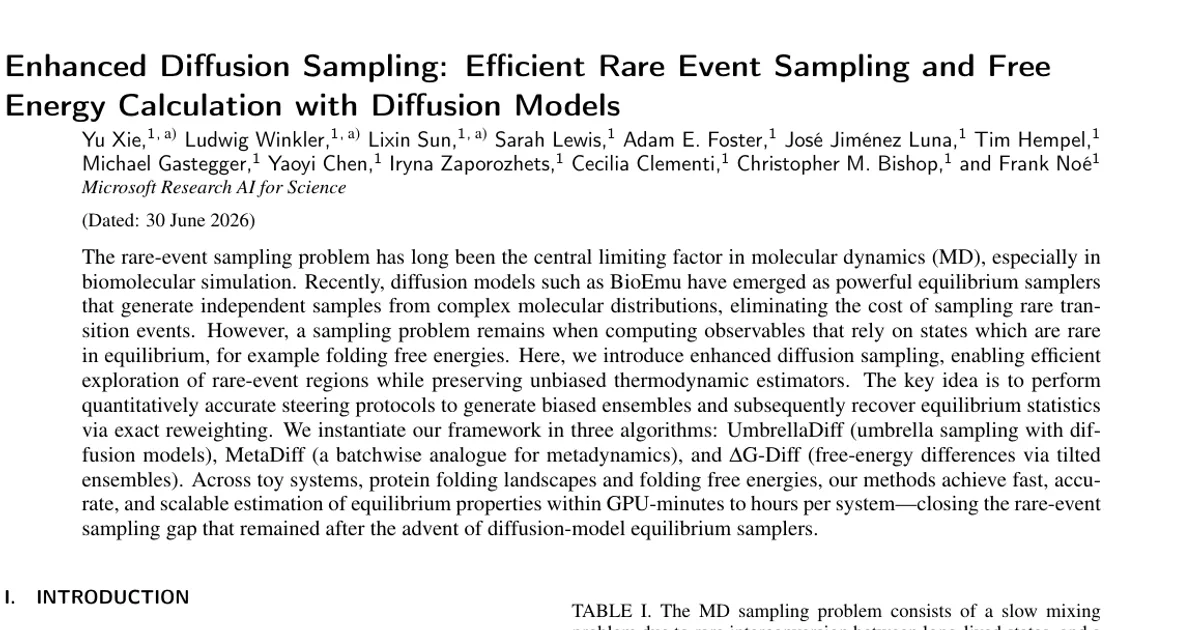
The rare-event sampling problem has long been the central limiting factor in molecular dynamics (MD), especially in biomolecular simulation. Recently, diffusion models such as BioEmu have emerged as powerful equilibrium samplers that generate independent samples from complex molecular distributions, eliminating the cost of sampling rare transition events. However, a sampling problem remains when computing observables that rely on states which are rare in equilibrium, for example folding free energies. Here, we introduce enhanced diffusion sampling, enabling efficient exploration of rare-event regions while preserving unbiased thermodynamic estimators. The key idea is to perform quantitatively accurate steering protocols to generate biased ensembles and subsequently recover equilibrium statistics via exact reweighting. We instantiate our framework in three algorithms: UmbrellaDiff (umbrella sampling with diffusion models), $Δ$G-Diff (free-energy differences via tilted ensembles), and MetaDiff (a batchwise analogue for metadynamics). Across toy systems, protein folding landscapes and folding free energies, our methods achieve fast, accurate, and scalable estimation of equilibrium properties within GPU-minutes to hours per system -- closing the rare-event sampling gap that remained after the advent of diffusion-model equilibrium samplers.