Research
End-to-End Motion Capture from Rigid Body Markers with Geodesic Loss
Overview Research area: Marker-based optical motion capture (MoCap), human pose estimation, computer vision, and 3D human body modeling. Technical level: Advanced. The paper assumes familiarity with t
- arXiv
- 2511.16418
- Published
- 2025-11-20
- Authors
- Hai Lan, Zongyan Li, Jianmin Hu, Jialing Yang, Houde Dai
AI summary
Overview
Research area: Marker-based optical motion capture (MoCap), human pose estimation, computer vision, and 3D human body modeling.
Technical level: Advanced. The paper assumes familiarity with the SMPL parametric body model, axis-angle and quaternion rotation representations, the SO(3) rotation manifold, deep temporal networks, and inverse kinematics.
Scope: The paper introduces a new hardware unit for optical MoCap (the Rigid Body Marker, or RBM) and a deep-learning regression framework with a geodesic loss that maps 6-DoF RBM measurements directly to SMPL body parameters.
What This Paper Is About
Traditional marker-based optical MoCap is accurate but requires a dense set of single-point reflective markers affixed to bare skin, which makes setup slow and leaves markers unlabeled, so an occluded marker that reappears may be assigned a new index and scramble the input sequence. The authors replace the single-point marker with a rigid plate carrying multiple reflectors that reports an unambiguous 6-DoF (position and orientation) pose, and they train a network to regress SMPL parameters directly from these sparse 6-DoF measurements. The goal is to keep the accuracy of gold-standard optical MoCap while making setup faster and inference far cheaper than optimization-based fitting.
Key Contributions
-
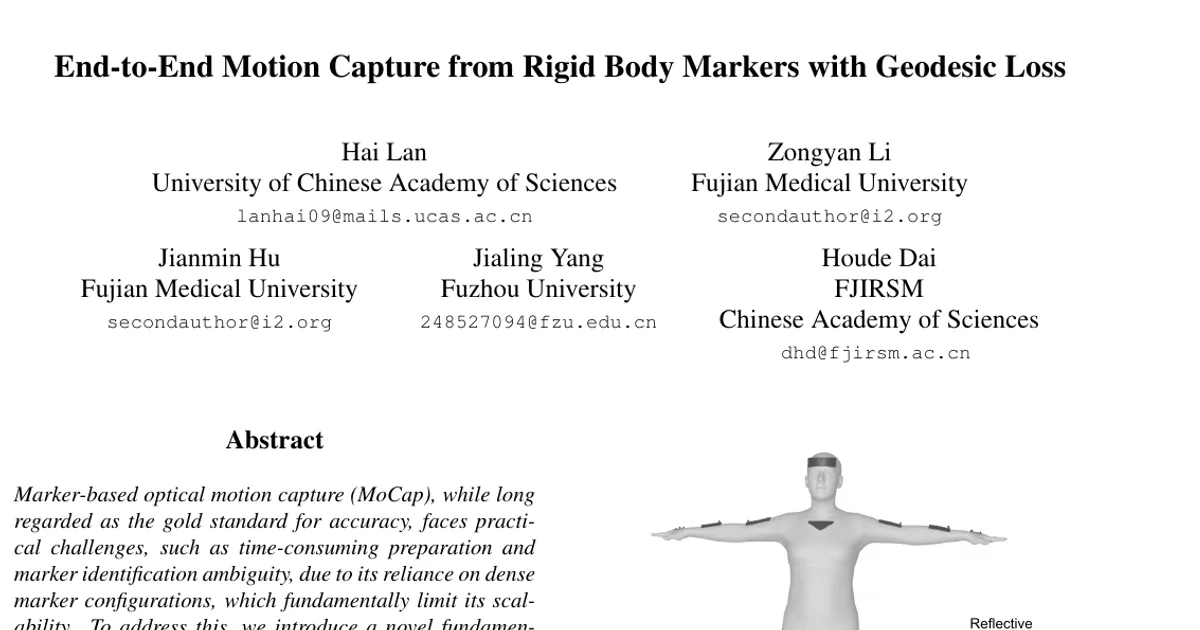
The Rigid Body Marker (RBM) as a new fundamental unit for MoCap. Fourteen wearable RBMs are fabricated via high-precision 3D printing, each integrating at least three reflective markers in a distinct spatial pattern, mounted on ergonomically shaped rigid plates fixed with adjustable nylon straps. Each RBM is individually configured so the optical system can unambiguously identify it and capture full 6-DoF motion, eliminating marker labeling ambiguity and reducing preparation effort.
-
A manifold-aware geodesic loss for direct SMPL parameter regression. Instead of switching to the continuous 6D rotation representation, the authors supervise SMPL pose parameters (in axis-angle form) with a loss derived from the geodesic distance on SO(3), formulated as 4 sin²(Δθ/2), which avoids the singularity of an arccos-based distance and provides well-behaved gradients.
-
An end-to-end temporal regression framework that needs no optimization refinement. A temporal encoder plus regression head maps normalized 6-DoF RBM sequences directly to SMPL shape (β), pose (θ), and global translation (γ), with a composite loss consisting of the geodesic pose loss plus MSE losses on shape and translation.
-
Systematic evaluation of sparsity and placement. The paper compares seven RBM configurations, ranging from all 14 rigid bodies down to 6, against a standard 53-marker dense baseline, and derives practical guidance on which body segments matter most.
Main Findings
-
RBM-All outperforms the dense-marker baseline on all metrics. The full 14-RBM setup achieves the lowest MPJPE (46.7 mm), PA-MPJPE (33.4 mm), and MPJAE (4.7°) among the compared configurations, against a horizontal dashed baseline representing the standard 53-marker AMASS configuration.
-
Sparse RBMs remain competitive. Even the sparsest configurations (RBM-D and RBM-F), each containing only 6 RBMs, exhibit performance comparable to the dense marker baseline.
-
Placement asymmetry matters. Removing distal RBMs (hands, feet; RBM-C) produces lower MPJPE, whereas removing proximal RBMs (arms, thighs; RBM-A) produces better MPJAE. The authors explain this by noting proximal limb segments are more stable and their pose can be inferred from child segments, while distal segments undergo larger, more complex motion.
-
With one RBM per limb, the intermediate segment wins. Preserving the intermediate segment RBM (forearm or shin, RBM-F) shows a slight advantage over the most distal placement (hand or foot, RBM-D), and both beat preserving the proximal one (RBM-E).
-
Geodesic loss beats the 6D continuous representation in the same network. Under identical architecture and training protocol, the geodesic loss gives 46.725 mm MPJPE, 33.364 mm PA-MPJPE, and 4.652° MPJAE, versus ORTH6D at 78.116 mm, 57.440 mm, and 8.921°, with FLOPs of 176.9 M versus 178 M (for a 120-frame input sequence).
-
EM-POSE wins on position, the proposed method wins on orientation, at far lower cost. EM-POSE reaches 24.729 mm MPJPE, 18.097 mm PA-MPJPE, and 5.325° MPJAE at 3045 M FLOPs, attributed to its Learned Gradient Descent refinement giving more accurate global translation γ; the proposed approach consistently achieves superior MPJAE across backbones at a computational cost up to 50 times lower.
-
Results hold across temporal backbones. With the geodesic loss, RNN gives 51.798 mm / 30.354 mm / 4.189°, LSTM gives 51.842 mm / 35.784 mm / 4.802°, GRU gives 48.554 mm / 32.955 mm / 4.545°, and the two-layer Transformer gives 46.725 mm / 33.364 mm / 4.652°, with FLOPs of 60.6 M, 164 M, 129.5 M, and 176.9 M respectively.
-
Both proposed components contribute, per the ablation. With neither pose normalization nor geodesic loss: 143.756 mm MPJPE and 9.356° MPJAE. Pose normalization alone: 126.612 mm and 6.034°. Geodesic loss alone: 67.115 mm and 7.227°. Both together: 46.725 mm and 4.652°.
-
Real-world feasibility. Qualitative results on data captured with a Vicon optical tracking system, with five distinct actions, show the method reconstructing SMPL bodies that closely match the original subjects; recordings were made with informed consent and IRB approval.
-
Known weaknesses. The network has limited ability to regress body shape β, because RBM orientation data provides fewer cues about body morphology than dense positional data; the regression approach lacks an explicit marker-fitting constraint, reducing global translation accuracy; and the absence of a smoothness constraint causes minor frame-wise jitter.
Methodology in Plain English
The researchers first synthesize training data. They use the AMASS dataset, which contains SMPL body parameters for many shapes and motions, and virtually attach RBMs to the body mesh. For each RBM, they build a local coordinate frame at a chosen vertex on the mesh (using the vertex normal, a reference direction to an adjacent face centroid, and cross products to complete a right-handed frame), then place the virtual RBM at a fixed offset from that frame. Running SMPL forward kinematics poses the mesh, and concatenating the transforms yields the virtual RBM's global 6-DoF pose.
At inference, real RBMs are attached to a person, and a T-pose calibration establishes the fixed transform between each RBM's frame and its body vertex frame, so real measurements line up with the virtual training data.
The network input is normalized rather than raw. Positions are centered by subtracting the centroid of all RBM positions, and the centroid itself is concatenated back in so global context is retained. Orientations are converted to a kinematic tree with the chest RBM as root; each node's rotation is expressed relative to its parent by multiplying by the parent's inverse quaternion, then mapped from the Lie algebra to a 3D axis-angle vector. This mirrors how SMPL's own pose parameters are defined, which makes learning easier.
A temporal encoder (tested with RNN, LSTM, GRU, and a two-layer Transformer with relative position embedding) processes the sequence, and an MLP head plus linear layers output SMPL β, θ, and γ. Training uses a weighted sum of three losses: the geodesic loss for pose, and MSE for shape and translation.
The geodesic loss is the key design choice. The true geodesic distance between two rotations is 2·arccos(|⟨q₁, q₂⟩|), but its gradient blows up when the rotations are close, producing NaN values during training. The authors replace it with 4·sin²(Δθ/2), which equals 4(1 − ⟨q₁, q₂⟩²) and can be computed directly from the quaternion inner product. It approximates the squared geodesic distance for small angles and stays monotonic with respect to Δθ on [0, π], so the gradient always points toward reducing the true angular error.
Experiments use CMU (96 subjects, 1,853 sequences) for training and BMLrub (111 subjects, 2,893 sequences) for evaluation, both resampled to 60 Hz and trimmed to exclude sequences shorter than two seconds (120 frames). Training runs for 1000 epochs with Adam, an initial learning rate of 5×10⁻⁴, decayed by a factor of 0.8 every 100 epochs, on an NVIDIA RTX 3090 GPU.
Why This Matters
Impact on research. The paper argues that when a network has sufficient representational capacity, the loss function's inductive bias can matter more than the choice of rotation representation, which reframes a long-running discussion in pose estimation research. It also shows that sparse 6-DoF sensing combined with principled geometric design can exceed dense marker systems and rival hybrid optimization methods, suggesting the regression-versus-optimization trade-off is not as fixed as commonly assumed.
Real-world applications:
- Clinical rehabilitation and large cohort studies, where multiple participants must perform the same standardized tasks and dense marker setup is impractical; the paper specifically cites this setting as motivation.
- Biomechanics and kinematic analysis, where marker-based optical MoCap remains the accepted reference standard and reduced soft tissue artifact from mid-limb RBM placement is valuable.
- Film production and computer graphics / digital human modeling, where high-fidelity motion is needed and setup time is a cost.
- Virtual reality and embodied intelligence, where the paper's stated goal of practical real-time MoCap applies directly.
Industry relevance. Commercial marker-based systems from vendors such as Vicon and OptiTrack rely on proprietary solutions aligned with anatomical protocols and require significant anatomical expertise to place markers. The RBM design reduces that dependency, and the reported computation figures (176.9 M FLOPs for the Transformer model versus 3045 M for the EM-POSE variant tested) point toward real-time deployment on modest hardware. A concrete example cited in the paper is clinical cohort studies requiring many participants to perform the same standardized tasks.
Future Directions
- Combine regression with optimization. The authors suggest integrating their efficient regression model as a high-quality initializer inside optimization-based frameworks, combining fast inference with the translation accuracy of iterative refinement, since EM-POSE's advantage was concentrated in global translation γ.
- Improve body shape estimation. The limited accuracy in regressing β remains open, given that RBM orientation provides fewer morphological cues than dense positional markers.
- Add explicit constraints. Because the method lacks a marker-fitting constraint and a smoothness constraint, adding these could improve global translation accuracy and remove the frame-wise jitter the authors report.
- Refine minimal RBM configurations. The counter-intuitive finding that intermediate-segment RBMs (forearm, shin) slightly outperform the most distal placement invites further study into how few rigid bodies suffice for a given accuracy target, and which mounting locations to choose in practice.
Target Audience
Researchers and practitioners in computer vision and human pose estimation who work on regression-based methods and rotation-aware loss functions; graphics and digital human researchers building high-fidelity motion pipelines; biomechanics and clinical researchers who depend on optical MoCap and face the setup and labeling burdens the paper targets; and engineers evaluating hardware-plus-algorithm designs for real-time MoCap in VR and embodied intelligence. The SMPL, SO(3), and Lie algebra content makes it most accessible to readers with prior exposure to 3D human body models and deep sequence modeling.
Authors’ abstract
Marker-based optical motion capture (MoCap), while long regarded as the gold standard for accuracy, faces practical challenges, such as time-consuming preparation and marker identification ambiguity, due to its reliance on dense marker configurations, which fundamentally limit its scalability. To address this, we introduce a novel fundamental unit for MoCap, the Rigid Body Marker (RBM), which provides unambiguous 6-DoF data and drastically simplifies setup. Leveraging this new data modality, we develop a deep-learning-based regression model that directly estimates SMPL parameters under a geodesic loss. This end-to-end approach matches the performance of optimization-based methods while requiring over an order of magnitude less computation. Trained on synthesized data from the AMASS dataset, our end-to-end model achieves state-of-the-art accuracy in body pose estimation. Real-world data captured using a Vicon optical tracking system further demonstrates the practical viability of our approach. Overall, the results show that combining sparse 6-DoF RBM with a manifold-aware geodesic loss yields a practical and high-fidelity solution for real-time MoCap in graphics, virtual reality, and biomechanics.