Research
Enabling Creative Exploration for Vibe Design Agents
Overview Research area: Artificial intelligence / human-AI interaction, specifically generative UI ("vibe design") agents that turn natural-language briefs into rendered interfaces and frontend code.
- arXiv
- 2609.15078
- Published
- 2026-09-14
- Authors
- Yifan Zhang, Nghi D. Q. Bui, Georgios Evangelopoulos, Arnaud Benard
AI summary
Overview
Research area: Artificial intelligence / human-AI interaction, specifically generative UI ("vibe design") agents that turn natural-language briefs into rendered interfaces and frontend code.
Technical level: Advanced. The paper assumes familiarity with inference-time decoding controls, temperature-scaled sampling, LLM-as-judge evaluation, and online A/B testing, though the central mechanism is described in accessible terms.
Scope: The paper proposes an inference architecture that inserts an explicit, selectable "design direction" between a user's request and a fixed downstream generator, then evaluates it offline across 168 prompts and online across more than 300,000 user tasks.
Authors as listed: Yifan Zhang, Nghi D. Q. Bui, Georgios Evangelopoulos, Arnaud Benard. The paper lists a Google affiliation for Bui, Evangelopoulos, and Benard.
What This Paper Is About
Vibe design agents can already produce a valid interface from a conversational brief, but they tend to return similar, conventional-looking results when asked repeatedly. The obvious fix, raising token-level temperature, is described in the paper as a "blunt solution" because it varies aesthetic choices and syntax-sensitive code at the same time. The paper's goal is to make design direction an explicit, separately controllable decision — one that changes which design concept the system pursues without perturbing the downstream generation settings that keep code valid.
Key Contributions
- An inference architecture for controllable design exploration. A proposal stage elicits structured design specifications with typicality scores, an external selector samples one specification under a temperature-scaled policy, and the downstream generator realizes the selected specification together with the original request under fixed decoding settings. Design direction becomes an intermediate decision rather than a side effect of decoding temperature.
- Two independent instantiations of that architecture. One conditions UI theme generation (seed color, light/dark mode, headline and body fonts, corner roundness as a bundle); the other conditions visual-asset image prompts (subject, composition, visual style). The experiments enable these separately to separate the two sources of variation.
- An offline empirical study across 168 prompts. The Standard UI Benchmark (83 prompts) and Complex UI Benchmark (85 prompts) together yield 1,255 paired comparisons per temperature for each intervention, measuring selection coverage, screenshot-embedding similarity, compiled DOM similarity, and LLM-judge preferences.
- An online A/B evaluation in a deployed commercial design assistant, covering 309,870 created tasks and 505,940 generated screens, reporting latency, task success, monitored error signals, exports, feedback, and correction interactions.
Main Findings
- Theme sampling broadens observed selection coverage. Baseline runs report 1.00 selected theme option across five runs for each of 83 prompts. Candidate selection raises the reported mean to 2.10–2.94 options; at τ ≥ 1.5 every prompt has more than one observed option. The paper cautions that option identity is not documented well enough to treat this as a count of distinct rendered designs.
- Theme sampling separates screenshots in embedding space. Report-level screenshot similarity falls from a baseline of 0.6765 to 0.6560 at τ = 0.5 and 0.5438 at τ = 2.0, with a difference of −0.1327 at τ = 2.0 (0.5437 at τ = 5.0).
- Theme judge preference peaks and then reverses. At τ = 2.0 the theme intervention shows the strongest observed preference, a 1.10 win/loss ratio (38.8% VS wins vs. 35.3% baseline wins, 25.4% ties). At τ = 5.0 the judge preference reverses (0.90 ratio) despite nearly identical screenshot similarity — evidence that measured variation and judged quality do not move together monotonically. Unrated pairs account for 0.5–1.1% and stay in the denominators.
- Asset sampling changes judge preference with much smaller visual shifts. With theme sampling disabled, τ = 1.0 produces the highest observed asset win/loss ratio, 1.32 (42.8% vs. 32.3%, 24.9% ties), while whole-screen similarity moves only from 0.6765 to 0.6616. Higher asset temperatures do not consistently improve either measure (τ = 1.5: 0.85; τ = 2.0: 0.96; τ = 5.0: 0.88). Unrated pairs are 0.0–0.2%.
- Optimal settings do not transfer across prompt suites. On standard prompts the best observed ratios occur at τ = 2.0 for themes and τ = 1.0 for assets; the complex asset benchmark instead peaks at τ = 1.5 (1.19). The paper states the reported defaults of 1.5 for themes and 2.0 for assets are distinct from the best observed offline settings and should not be treated as universal recommendations.
- Viewport results are suite-dependent. On the standard asset benchmark at τ = 1.0, desktop gives 42.9% vs. 31.1% (ratio 1.38) and mobile 42.7% vs. 33.5% (ratio 1.27). The complex asset benchmark reports a desktop ratio of 2.43 (56.7% vs. 23.3%) at the same temperature, but the paper notes this uses a different suite and cannot establish a viewport effect by comparison.
- Structural change is partial, not wholesale. Mean compiled HTML similarity is 0.8779 for baseline outputs and 0.7935–0.8339 for intervention outputs on the standard theme study, indicating shared structural patterns alongside change rather than equivalent DOMs.
- Online latency and completion show modest costs. The share of completed tasks finishing within 30 seconds moves from 28.2% to 27.5%; within 60 seconds from 49.9% to 48.2% (−3.47% relative, 95% CI [−5.83%, −1.11%]). Task success moves from 97.95% to 97.80% (−0.15% relative, 95% CI [−0.30%, −0.01%]).
- Code-export improvement is statistically uncertain. Code exports per generated screen rise from 1.06% to 1.15%, an observed +8.23% relative change whose 95% interval [−13.03%, +29.48%] includes zero. Figma exports show +0.94% relative (95% CI [−11.77%, +13.66%]), also inconclusive.
- Negative feedback falls while corrections rise. Negative feedback events drop from 73 to 50 (−31.51% relative, 95% CI [−62.02%, −1.00%]); positive-to-negative counts move from 278:73 to 285:50, roughly 3.8:1 to 5.7:1, out of 351 and 335 total ratings. Meanwhile the conversation evaluator flags corrections in 1,407 of 3,624 control conversations (38.8%) versus 1,492 of 3,589 treatment conversations (41.6%), a +7.08% relative change (95% CI [+1.38%, +12.77%]) on the evaluated conversation subset only.
- Monitored error signals are sparse. Recorded invalid-HTML and JSON-decode error rates are 0.00% in both groups; screens with console errors number four in control and seven in treatment, rates below 0.003%. The paper does not treat this as evidence of unchanged overall reliability.
- The qualitative case study shows joint variation. On one meal-planning-dashboard prompt across five runs per condition, primary colors go from 2 values (80% #2D6A4F) to 5 (100% unique), headline fonts from 1 (100% Plus Jakarta) to 3 unique (adding Epilogue and Lexend), body fonts from 2 (80% Be Vietnam) to 3 unique (adding Inter and Manrope pairings), and corner radius from 1 to 3 unique. Tail archetypes appear in 60% of sampled runs (3 of 5 sampled a p ≤ 0.40 direction) versus 0% baseline. The paper explicitly does not use this single prompt as quantitative evidence.
Methodology in Plain English
The system splits interface creation into three steps instead of one. First, a proposal stage asks the model to list distinct, prompt-compatible design directions — each with structured attributes (for themes: seed color, light/dark mode, headline and body fonts, corner roundness; for assets: an image prompt describing subject, composition, and style), a brief rationale, and a self-assessed typicality score, inspired by Verbalized Sampling. Second, a selection stage normalizes those scores into weights and samples one candidate using a temperature-scaled policy, q_k(τ) = p̂_k^(1/τ) / Σ_j p̂_j^(1/τ). At τ = 1 selection follows the elicited weights; values below one favor higher-weight directions more strongly, values above one raise the odds of lower-weight directions. Invalid, missing, negative, or all-zero scores trigger a re-prompt, and if a valid set still cannot be obtained the system falls back to the baseline path. Third, generation receives the original request plus the selected specification, with downstream decoding settings and the existing pipeline held fixed.
The evaluated configuration uses K = 3 candidate directions labeled Safe, Premium, and Experimental (labels that guide elicitation, not measured quality or risk levels). Gemini 3 Flash performs proposal, design-system generation, and code generation; Nano Banana 2 generates in-page images; Gemini 3.1 Pro with specialized UI rubrics serves as the pairwise judge. Tested temperatures are τ ∈ {0.5, 1, 1.5, 2, 5}.
Evaluation proceeds on separate tracks. Offline, two prompt suites — Standard UI Benchmark (short, open-ended requests, 83 prompts, evaluated at mobile and desktop with five repeats each, 415 pairs per viewport and 830 pairs per temperature per intervention) and Complex UI Benchmark (85 detailed, constraint-heavy prompts, 43 mobile and 42 desktop, five repeats each, 425 pairs per temperature per intervention) — supply 1,255 paired comparisons per temperature for each intervention, each pair comparing a baseline output against an intervention output for the same prompt and viewport. Measurements include reported option coverage, within-prompt cosine similarity between screenshot embeddings (lower means more separation), compiled HTML DOM similarity, and LLM-judge wins/losses/ties. Online, an archived A/B snapshot of a commercial design assistant (produced August 26, 2026, with a reported query window of July 28–August 26) compares 155,338 control and 154,532 treatment tasks, and 253,070 and 252,870 generated screens respectively.
Why This Matters
Impact on research. The paper reframes exploration breadth, output preference, and real-world behavior as three distinct outcomes that need separate measurement, rather than collapsing them into one quality score. It also provides a concrete alternative to token-level temperature for controlling creative variation in systems that must simultaneously emit valid, syntax-sensitive code — and reports cases where the two metrics disagree, such as the theme reversal at τ = 5.0 and the asset gains at τ = 1.0 with near-baseline screenshot similarity. The limitations section is unusually candid that the study does not isolate the contribution of the typicality weights from that of simply proposing multiple candidates.
Real-world applications:
- Conversational UI and web-app builders (the paper cites Lovable, v0, Bolt, Replit Agent, Figma Make, Claude Design, and Google Stitch as context) that want to offer users several coherent design directions before committing to one.
- Brand-aware theming: packaging palette, typography, display mode, and shape as a single selectable specification makes it easier to keep chosen directions consistent when generating a design system.
- Marketing and content asset variation, using the visual-asset instantiation to propose distinct image prompts for in-page imagery.
- Product experimentation, where a sampling parameter becomes a tunable knob whose effects on latency, completion, exports, feedback, and corrections can be observed in production.
Industry relevance. The largest piece of evidence is a deployed A/B experiment covering more than 300,000 tasks in a commercial assistant, which is rare in this literature. The observed combination — fewer negative feedback events alongside more correction interactions and modest latency and completion costs, with the export increase statistically uncertain — gives teams a realistic picture of what to expect when shipping exploration features.
Future Directions
- Isolate the mechanism. The paper states that comparisons with unweighted candidate elicitation, exact uniform selection, source-faithful Verbalized Sampling, and token-temperature changes are needed to separate the contribution of typicality weighting from that of proposing multiple candidates. It also notes the archived records do not establish whether identical candidate sets were reused across temperatures and repeats.
- Clarify what coverage counts. The meaning of option identity across repeated runs needs clarification before coverage can be read as a count of distinct design specifications; repeated pre-passes and prompt-paraphrase tests would establish the stability of candidate support.
- Strengthen evaluation rigor. A confirmatory study should freeze the prompt manifest, candidate sets, model versions, seeds, renderer, and exclusion rules; retain invalid and unrated outputs in denominators; and report prompt-clustered uncertainty, which the offline aggregates currently lack. Following the Human Creativity Benchmark, it should separate adherence and execution from aesthetic direction and preserve disagreement among blinded professional designers, complemented by browser-based task tests and accessibility checks.
- Test portability and adaptivity. The experiments use one generation-model configuration and one UI pipeline; replication is needed across model families, prompt domains, languages, and accessibility-constrained tasks. The authors also call for adaptive policies that account for explicit design constraints and user steering, which this study does not evaluate.
Target Audience
Researchers and practitioners working on generative UI, frontend code synthesis, and creative AI systems will get the most from this paper, particularly those interested in inference-time control of diversity and in LLM-judge plus online evaluation methodology. Product and engineering teams shipping conversational design tools will find the online metrics and the honest framing of trade-offs directly useful. Readers should note that the proprietary prompt set, generations, evaluator records, renderer state, and analysis code are not released, and that the results are presented as preliminary.
Authors’ abstract
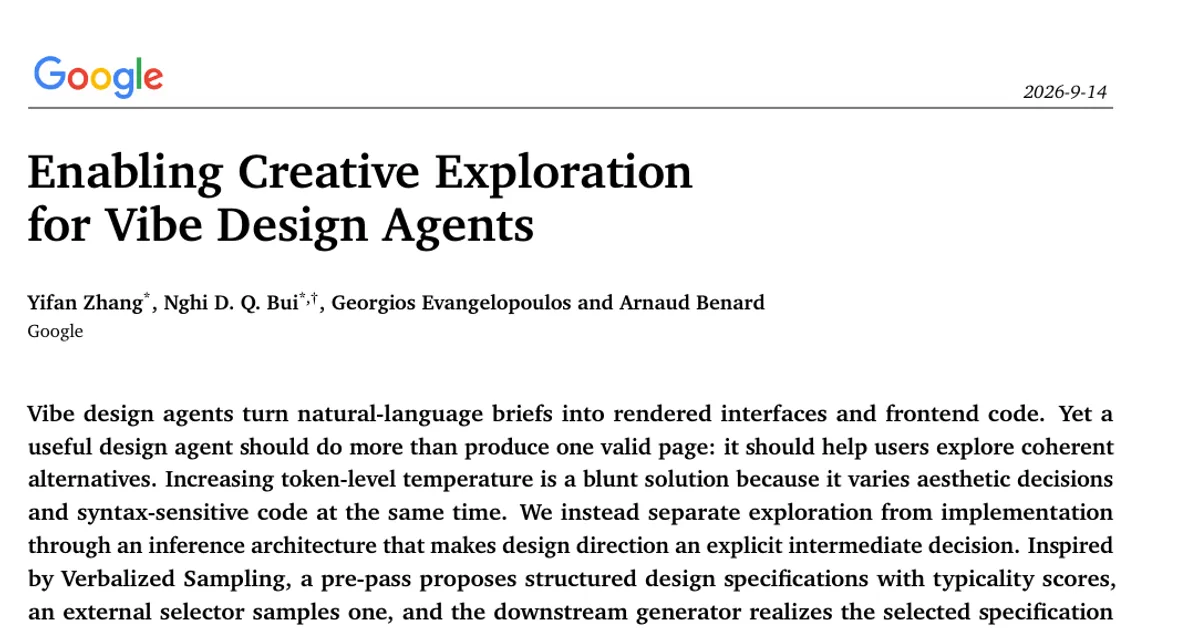
Vibe design agents turn natural-language briefs into rendered interfaces and frontend code. Yet a useful design agent should do more than produce one valid page: it should help users explore coherent alternatives. Increasing token-level temperature is a blunt solution because it varies aesthetic decisions and syntax-sensitive code at the same time. We instead separate exploration from implementation through an inference architecture that makes design direction an explicit intermediate decision. Inspired by Verbalized Sampling, a pre-pass proposes structured design specifications with typicality scores, an external selector samples one, and the downstream generator realizes the selected specification together with the original request under fixed settings. We apply this approach to UI themes and visual-asset prompts. Across 168 prompts, with 1,255 paired comparisons per temperature for each intervention, theme sampling broadens observed selection coverage and screenshot variation, while LLM-judge preferences vary across interventions, prompt complexity, and viewport. In an online experiment with more than 300,000 tasks, the observed code-export increase remains statistically uncertain, while fewer negative feedback events coexist with more correction interactions and modest operational costs. Together, these findings identify structured design specifications as a practical control point for exploring alternative UI concepts while keeping downstream generation settings fixed.