Research
Empirical Variational Autoencoder
Overview Research area: Generative modeling for continuous-valued sequences (images and audio), variational autoencoders, and autoregressive generation. Technical level: Intermediate (requires familia
- arXiv
- 2610.06545
- Published
- 2026-10-05
- Authors
- Kaede Shiohara
AI summary
Overview
- Research area: Generative modeling for continuous-valued sequences (images and audio), variational autoencoders, and autoregressive generation.
- Technical level: Intermediate (requires familiarity with VAEs, ELBO, and autoregressive modeling).
- Scope: The paper introduces Empirical Variational Autoencoder (EVA), a VAE-based generative framework that replaces the fixed standard-Gaussian latent prior with an empirically learned autoregressive prior, and evaluates it on ImageNet 256×256 image synthesis and VGGSound audio synthesis.
What This Paper Is About
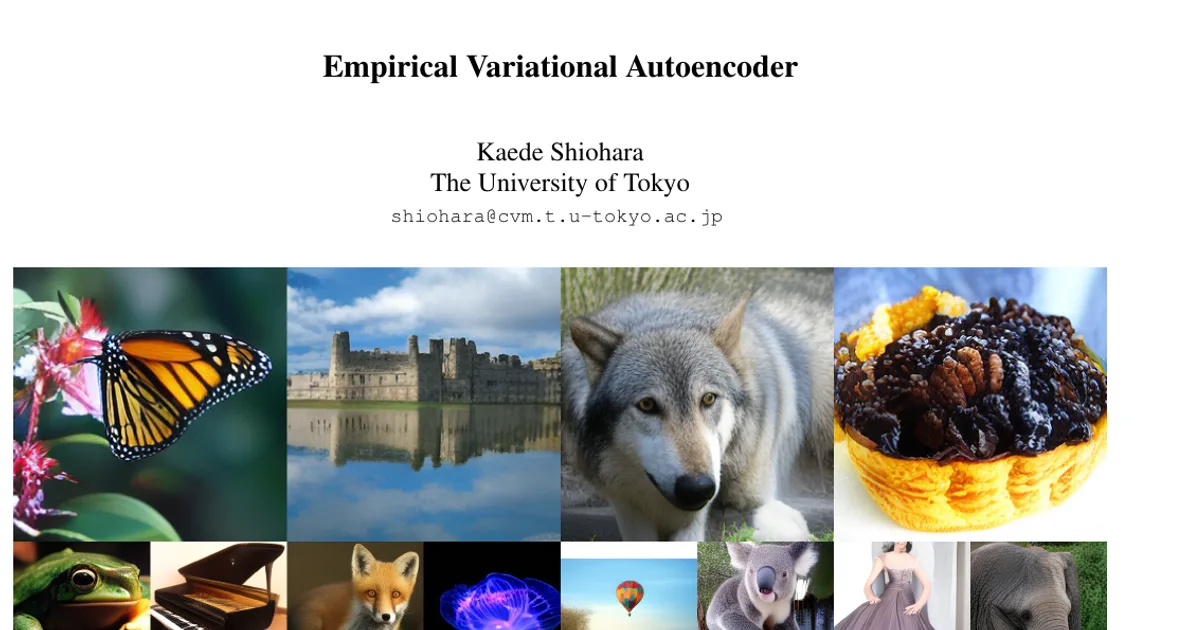
Variational autoencoders can in principle generate continuous-valued sequences, but the standard-Gaussian prior they use for sampling rarely matches the structured posterior learned from data, which hurts sample quality. Standard VAE-style models have therefore drifted toward being used mainly as latent compressors or tokenizers rather than standalone generators. EVA's goal is to close that prior–posterior gap by learning an autoregressive latent prior directly from training data, so that ancestral sampling produces high-fidelity sequences without the cost of diffusion-based decoding.
Key Contributions
- An empirical autoregressive latent prior for VAEs. EVA keeps the VAE evidence lower bound (ELBO) formulation but replaces the fixed standard-Gaussian constraint with a prior predicted autoregressively from preceding latents, parameterized as a Gaussian with mean and variance predicted by a "predictor" network.
- Minimal implementation overhead. The new prior can be implemented by adding a single linear layer on top of a VAE; the predictor can share its backbone with the causal decoder, with one linear head predicting latents and another predicting observations.
- A theoretical and empirical toy analysis of multimodality. The paper compares AR with MSE loss, AR with a Gaussian mixture head (K=3), causal VAE, and EVA on a synthetic two-step sequence task where latent branching and observation-level offsets control multimodality, showing why only the latent-marginalization family with a learned autoregressive prior recovers multimodal structure.
- Competitive generation quality with fast ancestral inference. Experiments on ImageNet and VGGSound show EVA reaching competitive FID against autoregressive diffusion baselines while using fewer inference parameters and substantially faster inference.
Main Findings
- Direct MSE regression fails on multimodal continuous sequences: The vanilla AR model trained with MSE loss obtained an FID of 200.50 and IS of 3.60 on ImageNet, and FID 4.51 / IS 4.45 on VGGSound, consistent with the toy study showing that squared-error training collapses to the conditional mean.
- GMM heads help but are capacity-limited: AR-GMM reached FID 21.71 / IS 124.23 on ImageNet and FID 3.05 / IS 6.30 on VGGSound. In the toy experiment, the GMM with K=3 handled (M_lat, M_obs) = (1,3) but failed on (2,2) and (2,3), where the visible modes exceed the fixed mixture capacity.
- A causal decoder alone is not enough: Causal VAE performed poorly, with FID 100.27 / IS 13.13 on ImageNet and FID 1.84 / IS 7.45 on VGGSound.
- EVA achieves strong fidelity at low inference cost: EVA reached FID 7.68 / IS 178.60 on ImageNet and FID 0.64 / IS 25.26 on VGGSound, with 171.8M training and 86.4M inference parameters and a normalized inference time of 1.00.
- EVA is much faster than the strongest baseline: AR-Diffusion with 24 blocks (321.3M training and inference parameters) achieved the best metrics (FID 5.44, IS 262.80 on ImageNet; FID 0.54, IS 26.96 on VGGSound) but had a normalized inference time of 24.76 — roughly 10 times slower than EVA at comparable FID.
- Depth-matched comparison favors EVA: AR-Diffusion with 12 blocks (236.2M parameters), matching EVA's number of Transformer blocks at inference, remained at much worse FID (29.96 on ImageNet).
- Normalizing-flow prior is less effective: Causal VAE w/ NF reached FID 12.43 / IS 215.04 on ImageNet and FID 0.65 / IS 28.95 on VGGSound, with 259.9M training and 174.6M inference parameters.
- Generation improves without hurting reconstruction: In the generation-versus-reconstruction comparison, EVA (ImageNet FID 7.68, rFID 2.42; VGGSound FID 0.64, rFID 0.64) improved generation FID over Causal VAE (FID 100.27, rFID 2.49; FID 1.84, rFID 0.63) while keeping reconstruction fidelity comparable.
- Latent structure is semantically organized: Bi-directional KL divergence visualization showed that semantically similar patches in EVA's latent space tend to have similar latent distributions, while Causal VAE still exhibited spatially structured variations in its posterior latents.
- Latent size matters: Varying latent size from 16 to 256 showed that too small a bottleneck degrades FID, quality improves up to 128 dimensions (best ImageNet FID of 7.68 at CFG scale 7), and further increases give no additional gains or can hurt.
- Larger backbones help: With a latent size of 64, EVA-B achieved an FID of 8.41 at CFG scale 7 while EVA-L achieved an FID of 6.04 at CFG scale 7.
- System-level comparison: On ImageNet-256, EVA-B (124.6M parameters) achieved FID 7.68 / IS 178.60, compared with VAR-B (197.9M, FID 12.82, IS 126.34), SiT-B (179.9M, FID 5.88, IS 215.03), JiT-B (131.3M, FID 3.72, IS 267.87), and LlamaGen-B (153.4M, FID 8.68, IS 120.37). The paper notes VAR and SiT are bi-directional while LlamaGen and EVA are causal.
Methodology in Plain English
The authors start from the standard VAE setup, where an encoder maps data to latents and a decoder reconstructs data from them, and the training objective balances reconstruction against a KL penalty pulling the latents toward a fixed standard Gaussian. They change two things. First, they treat both the data and the latents as sequences and use a causal decoder, so each output token depends only on latents up to that position. Second, and most importantly, instead of forcing all latents toward one shared standard Gaussian, they learn a predictor network that outputs a Gaussian distribution for each latent given all preceding latents. Training then minimizes the negative ELBO of this new formulation, which is called the EVA loss.
In practice the predictor is cheap: it can share a Transformer backbone with the decoder, with one linear head predicting the latent and another predicting the observation. Generation at inference is purely ancestral — sample the first latent from the learned prior, then sample each next latent conditioned on the previous ones, decoding each token causally. The framework extends to conditional generation by conditioning the encoder, decoder, and predictor on a condition vector, and classifier-free guidance is applied to the mean of the predicted latent distribution with a scale of 7 unless stated otherwise.
Experiments use ImageNet at 256×256, tokenized into 16×16 tokens with 16 channels by a pre-trained VAE, and VGGSound, with 309 classes, waveforms trimmed to nine seconds and tokenized into 215 tokens with 32 channels by a pre-trained VAE. All compared models share a 170M-parameter Transformer backbone of 24 blocks with hidden width 768, and are trained for 400 epochs with AdamW at a learning rate of 1.0e-4 and betas (0.9, 0.95). Latent size is 128 for Causal VAE, Causal VAE w/ NF, and EVA. FID and IS are reported, using 50k generated ImageNet samples and 15446 VGGSound samples (up to 50 per class).
Why This Matters
The work argues for revisiting VAEs as standalone generative models rather than only as latent compressors or tokenizers. It shows that the prior–posterior mismatch that has long limited VAE sampling can be addressed with a single additional linear layer, and that competitive fidelity does not require iterative denoising at inference.
Real-world applications:
- Image synthesis, including class-conditional ImageNet-scale generation at 256×256.
- Audio and sound generation, demonstrated on VGGSound's 309 sound classes.
- Image completion / inpainting, where given posterior latents from a prefix are used to generate subsequent latents, including switching the class condition (as shown from "vacuum" to "pot" and from "wreck" to "liner").
- Efficient generative pipelines, where fast ancestral sampling matters more than squeezing out the last increment of FID.
Industry relevance centers on inference economics: EVA has roughly 2× fewer inference parameters than the AR baselines because its encoder is dispensable, and its normalized inference time of 1.00 is far below AR-Diffusion's 23.46 and 24.76. This makes latent-autoregressive generation attractive for settings where per-sample latency and compute cost are binding constraints.
Future Directions
- Exploit 2D spatial structure: EVA currently linearizes spatial latent maps into a 1D causal sequence, so designing autoregressive priors specialized for spatial data is identified as a way to further improve image generation.
- Scale beyond closed-set benchmarks: The paper focuses on ImageNet and VGGSound at moderate model scales; validating on larger-scale and more diverse tasks is left open.
- Broader modality coverage: The authors propose text-to-image, text-to-speech, and multimodal data generation as natural next steps.
- Open questions on capacity trade-offs: The results showing that latent sizes above 128 do not improve and can hurt FID, and that excessively large latent spaces make prior modeling and sampling harder, raise the question of how to size latents and priors jointly at larger scales.
Target Audience
Researchers and practitioners in generative modeling who work with VAEs, autoregressive models, or diffusion heads for continuous data such as images and audio. It is also relevant to engineers optimizing inference cost in generative pipelines, and to students who want a compact example of how a single architectural change to the VAE prior can shift sampling quality. Readers should be comfortable with the ELBO, KL divergence, and autoregressive factorization; the toy analysis is accessible to a broader audience.
Authors’ abstract
We present Empirical Variational Autoencoder, a general generative framework for continuous-valued (i.e., non-vector-quantized) sequences. EVA is based on the evidence lower bound of the Variational Autoencoder (VAE) but learns autoregressive latent priors empirically from training data, which can be implemented only by an additional single linear layer on top of VAEs. By replacing the conventional standard-Gaussian constraint with the self-predicted priors, EVA significantly alleviates the latent distribution gap between prior and posterior which is typically observed in conventional VAEs, and leads to high-fidelity ancestral sampling for sequential data generation. Extensive experiments on image and sound synthesis demonstrate that EVA achieves competitive generation quality with autoregressive diffusion baselines despite its much faster inference time.