Research
Empathy Applicability Modeling for General Health Queries
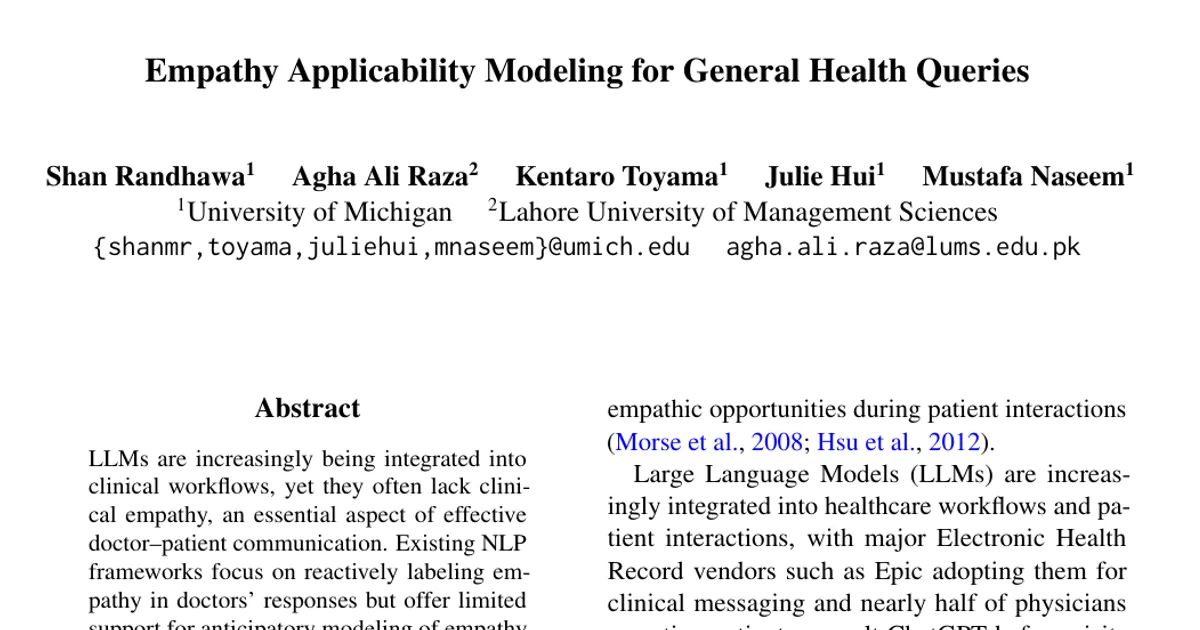
Empathy Applicability Modeling for General Health Queries Overview Research area: Natural Language Processing for clinical communication and empathetic language technologies, specifically anticipatory
- arXiv
- 2601.09696
- Published
- 2026-01-14
- Authors
- Shan Randhawa, Agha Ali Raza, Kentaro Toyama, Julie Hui, Mustafa Naseem
AI summary
Empathy Applicability Modeling for General Health QueriesOverview
Research area: Natural Language Processing for clinical communication and empathetic language technologies, specifically anticipatory modeling of when clinical empathy is warranted in patient-written health queries.
Technical level: Intermediate. The paper combines qualitative clinical-communication theory building with standard text-classification experiments (RoBERTa-base fine-tuning, TF–IDF linear baselines, Cohen's kappa agreement analysis). Readers should be comfortable with classification metrics, inter-annotator agreement, and LLM annotation pipelines.
Scope in one sentence: The paper introduces and empirically validates the Empathy Applicability Framework (EAF), a cue-based scheme that labels single-turn general health queries as Applicable or Not Applicable along two empathy dimensions (Emotional Reactions and Interpretations), releasing a 1,296-query dual-annotated benchmark and showing that these labels are learnable by classifiers.
What This Paper Is About
Large language models are being pulled into clinical workflows, but they lack clinical empathy — and existing NLP work only labels empathy after a response exists, or presumes empathy is always appropriate. The authors argue that the missing step is an antecedent decision: before generating a reply, a system should determine whether emotional acknowledgement or interpretive understanding is even warranted for a given patient query. They build the Empathy Applicability Framework (EAF) to make that decision explicit, annotate real patient queries with it using both human annotators and GPT-4o, and test whether the resulting labels encode consistent, machine-learnable patterns.
Key Contributions
-
Framework design: The Empathy Applicability Framework (EAF), a theory-driven, cue-based scheme grounded in clinical empathy literature and Patient-Centered Communication (PCC) functions (Epstein and Street Jr, 2007; McCormack et al., 2011). It classifies queries along two dimensions — Emotional Reactions (EA) and Interpretations (IA) — as Applicable or Not Applicable, explicitly shifting the task from reactive labeling of responses to anticipatory applicability judgment.
-
Annotated and analyzed benchmark: A dataset of 1,296 real patient queries annotated by two human annotators and GPT-4o, released publicly (de-identified) along with annotation scripts, training code, and model outputs, demonstrating EAF's reliability and interpretability.
-
Operationalization challenges characterized: A systematic analysis of where human and LLM annotations diverge — implicit distress, clinical-severity ambiguity, and contextual hardship — with the argument that these point toward multi-annotator modeling, clinician-in-the-loop calibration, and culturally diverse annotation.
-
Predictive validity evidence: Classifiers trained on human-labeled and GPT-only annotations predict empathy applicability with strong performance, outperforming heuristic and zero-shot LLM baselines.
Main Findings
-
Human agreement is moderate, and in line with the field: Across 1,296 independently labeled queries, overall Cohen's κ was 0.46. Dimension-level: EA κ = 0.521 (981 agreements / 315 disagreements) and IA κ = 0.404 (898 / 398). The authors compare this to reported mean expert κ_w values of 0.41 (EmpatheticDialogues), 0.46 (EPITOME), 0.55 (Lend an Ear), and 0.60 (Perceived Empathy) from Kumar et al. (2026), and to Sibyl's reported 0.4–0.6 range. Agreements outnumbered disagreements by a factor of two to three.
-
GPT-4o aligns well with human consensus on clearer cases: On the human-consensus subset (820 queries), GPT-4o reached κ = 0.614 for EA (667 / 153) and κ = 0.659 for IA (681 / 139), with raw agreement around 80% for both dimensions. The authors stress this reflects agreement on human-aligned cases, excluding more ambiguous queries.
-
GPT annotation is internally stable: For the 1,296 human-annotated queries, GPT-4o produced five annotation passes per query with majority voting; more than 94% of queries received the same label on the first pass as on the majority vote for both dimensions.
-
EAF labels are machine-learnable: On the human-consensus test set, a RoBERTa-base transformer reached 0.92 accuracy, 0.92 macro-F1, and 0.92 weighted F1 for EA, and 0.87 / 0.87 / 0.87 for IA. Classical baselines were lower but still strong: Logistic Regression 0.84 / 0.84 / 0.84 (EA) and 0.80 / 0.80 / 0.80 (IA); Linear SVM 0.83 / 0.83 / 0.83 (EA) and 0.77 / 0.77 / 0.77 (IA).
-
Models trained only on GPT labels approximate human consensus: The Autonomous-set transformer, trained on 8,000 GPT-labeled queries and tested on the same human-consensus test set, scored 0.85 / 0.85 / 0.85 for EA and 0.78 / 0.77 / 0.77 for IA.
-
Baselines were substantially weaker: o1 Zero-Shot reached 0.55 / 0.40 / 0.41 for EA and 0.62 / 0.53 / 0.54 for IA; Random Guessing 0.47 for EA and 0.44 for IA accuracy; Always Applicable 0.52 (EA) and 0.53 (IA); Always Not Applicable 0.48 (EA) and 0.47 (IA). McNemar's test confirmed the transformer's superiority over trivial baselines (max p < 10⁻⁴) and over the classical baselines (max p ≤ 0.02).
-
Humans and GPT reason similarly at the subcategory level: UpSet plot analysis showed strong conceptual alignment. When the two human annotators picked different subcategories for the same label, GPT often cited both. No-match cases were rare, and Appendix G.4 reports match rates above 80% for most subcategories.
-
Challenge 1 — Subjective inference of implied distress: Inferred Negative State (EA) and Distressing Uncertainty (IA) showed the most divergence. In a qualitative review of 50 randomly selected cases (25 each) by the first author as adjudicator, in more than 50% of queries one could reasonably infer implied emotional distress or judge the query as factually motivated. The paper gives the example of a pain-and-menstrual-cycle query labeled Distressing Uncertainty by the female annotator but treated as a factual diagnostic request by the male annotator.
-
Challenge 2 — Clinical-severity ambiguity: Within Serious Symptoms (EA), GPT labeled 100 queries as requiring emotional reactions when humans did not. Qualitative analysis of 25 randomly selected cases where only GPT marked empathy applicable found: 40% where GPT appropriately flagged chronic or life-threatening conditions (e.g., post-liver transplant complications) that non-clinician annotators overlooked; 16% borderline cases (e.g., prolonged low-grade fever after kidney stones); and 44% where GPT overgeneralized vivid but non-serious symptoms (e.g., lip numbness after dental problems) that did not meet EAF's chronic-or-life-threatening criterion.
-
Challenge 3 — Contextual hardship: GPT over-applied Symptoms Emotional Impact (SEI) and Context Sharing (CS) relative to humans. Analysis of 25 randomly selected SEI mismatches and all 20 CS mismatches found GPT correctly identified complex distress humans missed in 20–25% of cases, but more often (75–80%) equated physical discomfort with emotional distress — a pattern the authors suggest may reflect Western-centric training biases.
Methodology in Plain English
Building the framework. The authors read 300 randomly selected patient queries drawn from the publicly released HealthCareMagic and iCliniq datasets (Li et al., 2023) and did inductive thematic coding to identify recurring themes, which they grouped into cue subcategories. They then anchored those cues to Patient-Centered Communication functions so that each cue corresponds to a clinically recognized expression of empathy. The result is a two-dimension scheme: Emotional Reactions (does the query call for warmth, compassion, concern?) and Interpretations (does it call for acknowledgement of feelings, experiences, or uncertainty?). Each dimension is labeled Applicable or Not Applicable based on listed cues — for instance, Severe Negative Emotion, Inferred Negative State, Seriousness of Symptoms, and Concern for Relations push Emotional Reactions toward Applicable, while Purely Factual Medical Queries, Routine Health Management, Neutral Symptom Descriptions, and Hypothetical Queries push it toward Not Applicable. EPITOME's third dimension, Explorations, was deliberately excluded because follow-up probing belongs to multi-turn dialogue, not a single-turn asynchronous reply.
Data and annotation. They sampled 9,500 patient queries — 4,750 each from HealthCareMagic (≈100k dialogues) and iCliniq (≈10k) — to maximize linguistic and contextual diversity. Their IRB determined the study exempt from human subjects review. Of these, 1,500 were earmarked for dual annotation by humans and GPT-4o; the remaining 8,000 were annotated only by GPT-4o for predictive validity testing. Two annotators from Pakistan with high English proficiency were recruited and paid US$360 (equivalent to a local monthly research salary): HA1, a male with a BS in Computer Science, and HA2, a female with an MS in Linguistics. Neither had clinical training — a deliberate choice, since empathy is "in the eye of the beholder" and lay perspectives reflect the patient's experience. They completed three-stage training on 200 queries (50 + 50 + 100) with convergence meetings, then independently labeled the remaining 1,296 queries (four were dropped for missing content). GPT-4o was prompted as an expert annotator using contrastive prompting, returning all relevant subcategories; for the 1,296 human-annotated queries, five passes were majority-voted, while the 8,000-query pool used a single pass due to cost.
Modeling. Empathy applicability prediction is framed as two independent binary classification tasks. A separate RoBERTa-base classifier (≈125M parameters) is fine-tuned for EA and for IA. Two training sets were used: the Human Set (only queries where both human annotators agreed, split 75% train / 5% validation / 20% test) and the Autonomous Set (GPT-labeled data from the 8,000-query pool, tested on the same human-consensus test set). Training ran on a single NVIDIA A40 GPU per run — roughly 15 minutes for a Human-Set run and 40 minutes for an Autonomous-Set run, so under 1 GPU-hour per dimension — for 10 epochs at a learning rate of 2 × 10⁻⁵ and batch size 8. Evaluation reports accuracy, weighted F1, and macro-F1, benchmarked against Random Guessing, Always Applicable, Always Not Applicable, o1 Zero-Shot, and TF–IDF Logistic Regression and Linear SVM classifiers (1–3 grams).
Analysis of disagreement. Rather than treating mismatches as plain errors, the authors decompose them with three-way divergence bars into Annotator Spread (one human Applicable, the other Not), LLM-Adds (GPT Applicable, humans Not), and LLM-Omits (GPT Not, humans Applicable), supplemented by qualitative review of randomly sampled mismatched queries.
Why This Matters
Impact on research. The paper relocates empathy modeling from a response-generation problem to an upstream decision problem. Prior frameworks such as EPITOME, empathy direction detection, and empathy intent classification label empathy in existing responses; cause-aware and anticipatory generation methods (Gao et al., 2021; Sabour et al., 2022; Chen et al., 2024; Lee et al., 2025; Wang et al., 2025) optimize how to empathize once empathy is assumed warranted. EAF asks whether it is warranted at all, and on which dimension — a decision the authors position as complementary to, not a replacement for, those methods. The paper also contributes a concrete benchmark and a candid account of where the construct resists clean annotation, which is useful for anyone designing annotation schemes for subjective clinical constructs.
Real-world applications
- Asynchronous patient messaging: flagging incoming patient messages that carry empathic needs before a clinician or drafting system composes a reply.
- EHR-integrated clinical messaging: the paper notes that vendors such as Epic are adopting LLMs for clinical messaging, exactly the single-turn asynchronous setting EAF targets.
- Pre-visit patient portals and chatbots: nearly half of physicians report patients consult ChatGPT before visits, so applicability signals could route high-need queries to human review.
- Clinician training and feedback: since clinicians miss 70–90% of empathic opportunities during interactions, applicability cues could surface missed opportunities.
- Culturally sensitive deployment: the observed tendency of GPT-4o to treat minor inconvenience as empathy-worthy where South Asian annotators did not is a directly actionable warning for systems deployed across cultural contexts.
Industry relevance. The commercial pull is already present: LLMs are entering clinical workflows via major EHR vendors, and patients are arriving at appointments having consulted consumer chatbots. A lightweight, learnable applicability classifier — the human-supervised model reaches 0.92 macro-F1 for EA and 0.87 for IA — is the kind of component that could sit in front of a response generator to decide whether to produce factual or empathetic text. The paper's insistence on a human-in-the-loop pipeline, with clinicians retaining final authority, also frames the deployment boundary that regulated healthcare products will need to respect.
Future Directions
-
Diversify and expand the annotator pool. The authors call for larger annotator pools with clinical expertise and cultural diversity, arguing that two non-clinician annotators cannot represent population-level variability and may lack the expertise to resolve severity judgments.
-
Move toward diversity-aware, multi-annotator modeling. Instead of collapsing disagreement into a single consensus label, they advocate annotator-aware and disagreement-aware representations that preserve interpretive pluralism, citing multi-annotator models, annotator-aware representations, and jury learning as precedents.
-
Evaluate across model families and annotation protocols. All automatic annotations came from GPT-4o, so generalization to Gemini, Claude, reasoning models, or open-source alternatives is untested. The paper also flags a procedural mismatch — humans selected one best-fit subcategory per dimension while GPT returned multiple — that standardized guidelines could fix.
-
Add graded empathy tiers and uncertainty calibration. The binary Applicable / Not Applicable framing captures the antecedent decision but not the intensity of empathic need; graded tiers (low, moderate, high) or uncertainty-based calibration could handle borderline cases, though the authors note this would require substantially more annotated data.
-
Explore stronger classifiers. The RoBERTa-base setup was chosen to establish learnability rather than maximize performance; larger pre-trained models such as ModernBERT, larger LLMs, and prompting-based approaches are named as natural extensions.
Target Audience
This paper is most useful to NLP researchers working on empathetic language technologies, clinical NLP, and annotation methodology for subjective constructs; to healthcare AI product teams building or evaluating patient-facing messaging and triage systems; and to clinical informatics and medical communication researchers interested in operationalizing patient-centered communication. The explicit treatment of annotator disagreement and cultural bias also makes it valuable to researchers studying pluralistic and culturally grounded annotation, and to ethicists and policy-oriented readers weighing the risks of artificial empathy in care settings.
Authors’ abstract
LLMs are increasingly being integrated into clinical workflows, yet they often lack clinical empathy, an essential aspect of effective doctor-patient communication. Existing NLP frameworks focus on reactively labeling empathy in doctors' responses but offer limited support for anticipatory modeling of empathy needs, especially in general health queries. We introduce the Empathy Applicability Framework (EAF), a theory-driven approach that classifies patient queries in terms of the applicability of emotional reactions and interpretations, based on clinical, contextual, and linguistic cues. We release a benchmark of real patient queries, dual-annotated by human annotators and GPT-4o. In the subset with human consensus, we also observe substantial human-GPT alignment. To validate EAF, we train classifiers on human-labeled and GPT-only annotations to predict empathy applicability, achieving strong performance and outperforming the heuristic and zero-shot LLM baselines. Error analysis highlights persistent challenges: implicit distress, clinical-severity ambiguity, and contextual hardship, underscoring the need for multi-annotator modeling, clinician-in-the-loop calibration, and culturally diverse annotation. EAF provides a framework for identifying empathy needs before response generation, establishes a benchmark for anticipatory empathy modeling, and enables supporting empathetic communication in asynchronous healthcare.