Research
Emergent Specialization in Learner Populations: Competition as the Source of Diversity
Overview Research area: Multi-agent machine learning / emergent coordination in populations of learners, drawing on ecological niche theory (competitive exclusion) and game theory. Technical level: In
- arXiv
- 2601.19943
- Published
- 2026-01-16
- Authors
- Yuhao Li
AI summary
Overview
Research area: Multi-agent machine learning / emergent coordination in populations of learners, drawing on ecological niche theory (competitive exclusion) and game theory.
Technical level: Intermediate. The paper is written accessibly and rests on simple, interpretable mechanisms, but it assumes familiarity with multi-agent reinforcement learning (QMIX, MAPPO, IQL), Thompson sampling, Beta-Bernoulli style Bayesian updates, and Shannon entropy-based diversity metrics.
Scope: The paper argues and empirically tests that competition alone—without explicit communication, centralized training, or handcrafted diversity incentives—is sufficient to make a population of learners spontaneously split into specialists for different environmental regimes.
What This Paper Is About
When many learners share an environment, they face the problem of how to divide labor and specialize without talking to each other. Existing solutions rely on explicit communication channels, centralized training with shared rewards, or handcrafted diversity bonuses, all of which add complexity and may not scale.
The authors hypothesize that competitive pressure alone can do the job: when learners with identical behavior compete for the same limited reward, deviating to a less-contested niche becomes profitable, which drives differentiation. They introduce an algorithm called NichePopulation and test this hypothesis across six real-world prediction domains.
Key Contributions
-
The NichePopulation algorithm, combining competitive exclusion (only the highest-reward learner per iteration receives positive updates) with niche affinity tracking (a learned probability distribution over regimes) and an optional niche bonus controlled by the parameter λ ≥ 0. It achieves a mean Specialization Index (SI) of 0.747 across six real-world domains, with an average Cohen's d of 22.84.
-
The core theoretical claim that competition alone induces specialization. At λ = 0 (no niche bonus), mean SI = 0.329, which the authors report as 2.5× higher than the random baseline (mean 0.127).
-
Demonstration of method-level division of labor. Populations use 87% of available prediction methods on average (threshold τ = 0.3), with mean Method Specialization Index 0.364, yielding a +26.5% average improvement over homogeneous (single-best-method) baselines.
-
Outperformance of MARL baselines (QMIX, MAPPO, IQL) by 4.3× in specialization, while being reported as 4× faster (0.9s vs. 3.7s per 500 iterations) and using 99% less memory (1 MB vs. 384–512 MB).
-
Three theoretical propositions with proofs: competitive exclusion (homogeneous strategies are not Nash equilibria when N > R), a lower bound on expected SI as a function of λ, and a mono-regime collapse result (SI → 0 as the effective regime count k_eff → 1).
Main Findings
-
Specialization emerges consistently across all six domains. Per-domain SI (NichePopulation): Crypto 0.786 ± 0.055, Commodities 0.773 ± 0.055, Weather 0.758 ± 0.046, Solar 0.764 ± 0.042, Traffic 0.573 ± 0.051, Air Quality 0.826 ± 0.036. The table's average is 0.747; the abstract states a mean SI of 0.75.
-
Effect sizes are extremely large. Cohen's d per domain: Crypto 20.05, Commodities 19.89, Weather 23.44, Solar 25.71, Traffic 15.86, Air Quality 32.06, averaging 22.84. The abstract summarizes these as d > 20. All NichePopulation vs. Homogeneous comparisons are reported as significant at p < 0.001 after Bonferroni correction (α = 0.05/6 = 0.0083).
-
Competition alone is sufficient. In the λ ablation, mean SI at λ = 0.0 is 0.329, rising through 0.423 (λ = 0.1), 0.596 (λ = 0.2), 0.747 (λ = 0.3), 0.814 (λ = 0.4), and 0.834 (λ = 0.5). The authors argue the niche bonus is an accelerant, not the cause, because the λ = 0 result already exceeds random (0.127).
-
Air Quality specializes most at λ = 0 (SI = 0.501), which the authors attribute to particularly distinct regime-method affinities.
-
Traffic specializes least (SI = 0.573). The authors frame this as a successful prediction of Proposition 2: Traffic has 6 regimes versus 4 elsewhere, and the SI bound scales as (1 − 1/R). They also note temporal correlation between Traffic regimes (morning rush → midday → evening rush) violates the i.i.d. regime assumption, and that the "transition" regime overlaps other regimes.
-
Division of labor improves performance. Normalized performance, NichePopulation vs. Homogeneous: Crypto 0.886 vs. 0.626 (+41.6%), Commodities 0.890 vs. 0.648 (+37.2%), Weather 0.868 vs. 0.675 (+28.6%), Solar 0.925 vs. 0.786 (+17.6%), Traffic 0.917 vs. 0.740 (+23.8%), Air Quality 0.916 vs. 0.834 (+9.9%). Average gain: +26.5%.
-
Method coverage varies by domain. Weather and Traffic reach 100% coverage (all 5 methods used by specialists), Solar 97%, Crypto 79%, and Commodities and Air Quality 73%.
-
MARL baselines do not specialize. Across Crypto, Commodities, Weather, and Solar, NichePopulation's SI values are 0.758, 0.763, 0.716, and 0.788 (mean 0.756), compared with MARL's mean of 0.167. Weather is MARL's strongest domain at 0.332. The authors state that MARL methods were run with published hyperparameters, N = 8 learners, T = 500 iterations, and identical seeds, without additional tuning.
-
Over-specialization at high λ. Air Quality's SI dips slightly to 0.800 at λ = 0.5, which the authors interpret as learners becoming too focused on their primary niche to explore.
Methodology in Plain English
The setup is a population of N = 8 learners choosing among M = 5 prediction methods per domain, over T = 500 iterations, with 30 independent trials per condition, learning rate η = 0.1, and random seed base 42.
-
Regime-switching environment. At each step the environment is in one of R regimes drawn from a stationary distribution π(r). Regimes are labeled qualitatively—bull/bear/sideways/volatile for crypto, clear/cloudy/rainy/extreme for weather, good/moderate/unhealthy-sensitive/unhealthy for air quality, and so on. Different methods perform better in different regimes.
-
Learners pick methods by Thompson sampling. Each learner keeps Beta-distributed beliefs about how well each method performs in each regime, samples from them, and greedily picks the highest sampled value. This balances exploration of uncertain methods with exploitation of known good ones.
-
Competition decides who learns. All learners run their chosen method and get a reward. Only the single highest-reward learner (the "winner") gets a positive update to its method belief and its niche affinity. This winner-take-all rule is the core mechanism. The authors show this directly parallels the ecological principle of competitive exclusion.
-
Optional niche bonus. The adjusted reward multiplies the raw reward by (1 + λ · 1[preferred regime = current regime] · affinity). With λ = 0 there is no bonus, isolating the effect of competition alone.
-
Measurement. Specialization is measured as 1 − H(α)/log R, where H is Shannon entropy over the niche affinity distribution. SI = 1 means perfect specialization on one regime; SI = 0 means uniform. Method specialization uses the same entropy formula over method usage, and coverage is the fraction of methods used by at least one specialist above threshold τ = 0.3.
-
Baselines. Homogeneous (all learners use the oracle single best method), Random (uniform method choice), and three MARL methods (IQL, QMIX, MAPPO) with equivalent learner counts and training budgets.
Data comes from public sources: Bybit Exchange (8,766 daily OHLCV bars for BTC/ETH/SOL), FRED (5,630 daily oil, copper, natural gas prices), Open-Meteo (9,105 daily observations across 5 US cities; 116,834 hourly solar measurements; 2,880 hourly PM2.5 readings for NYC), and NYC TLC (2,879 hourly taxi trip counts). The conclusion cites 145,294 total records.
Why This Matters
Impact on research. The paper offers empirical support for the idea that specialization is not just a constraint imposed by finite resources but an emergent property of competing bounded systems—directly engaging the debate triggered by LeCun's argument that human intelligence is "ridiculously specialized." It also reframes diversity: instead of being engineered via quality-diversity archives or handcrafted behavior descriptors, it can arise endogenously. If validated further, this suggests competition can substitute for communication as a coordination mechanism.
Real-world applications (as described in the paper):
- Algorithmic trading: Homogeneous strategies can amplify market volatility; the paper cites the 2010 Flash Crash, when the Dow Jones dropped 1,000 points in minutes, as an example of the consequences of correlated, homogeneous behavior. Specialized learners could reduce correlated risk.
- Autonomous driving: Vehicles must implicitly coordinate traffic flow to avoid congestion and collisions without explicit communication.
- Distributed sensing networks: Sensors must specialize to different environmental conditions to maximize information gain.
- Forecasting under regime change: The six evaluated domains—cryptocurrency, commodity prices, weather, solar irradiance, urban traffic, and air quality—are direct examples of practical deployment settings.
Industry relevance. The appeal is operational: NichePopulation is reported as 4× faster and using 99% less memory than the MARL baselines, with interpretable specialist assignments (each learner has a clear primary niche and a human-readable affinity distribution). The authors highlight settings where communication is costly (bandwidth-limited networks), impossible (adversarial environments), or undesirable (privacy-preserving systems) as the strongest fits for a competition-based design principle.
Future Directions
-
Better regime detection. The current work uses simple classifiers (moving average crossover, volatility thresholds). Hidden Markov models or changepoint detection might reveal finer-grained niches or reduce regime ambiguity. The paper also notes regimes are hand-specified from domain knowledge, so unsupervised regime discovery would be needed in novel domains.
-
Non-stationary environments. The theory assumes stationary regime distributions; regime drift or concept shift would likely require mechanisms that re-partition niches over time.
-
Alternative competition rules. The work uses single-winner updates. Proportional rewards or top-k winners may produce different specialization patterns and are left to future work.
-
Automatic method discovery. Method inventories are hand-designed per domain. Meta-learning or program synthesis could remove this dependence on domain expertise.
-
Additional baselines. The authors note the absence of an Oracle that perfectly switches methods per regime (which would upper-bound achievable performance) and of ensembles without competitive exclusion (which would separate the value of competition from simply having multiple learners).
Target Audience
Researchers in multi-agent reinforcement learning and emergent coordination will find the direct comparison to QMIX, MAPPO, and IQL most relevant. Practitioners building decentralized or distributed forecasting systems—especially in finance, sensing, and traffic—benefit from the practical tradeoffs reported (speed, memory, interpretability) and from the failure analysis of the 6-regime Traffic domain. Readers interested in the general-versus-specialized intelligence debate will find the ecological framing and the λ = 0 ablation the most novel parts. The paper is accessible to graduate students and advanced undergraduates comfortable with entropy-based metrics and Bayesian updating, though some familiarity with MARL terminology helps.
Authors’ abstract
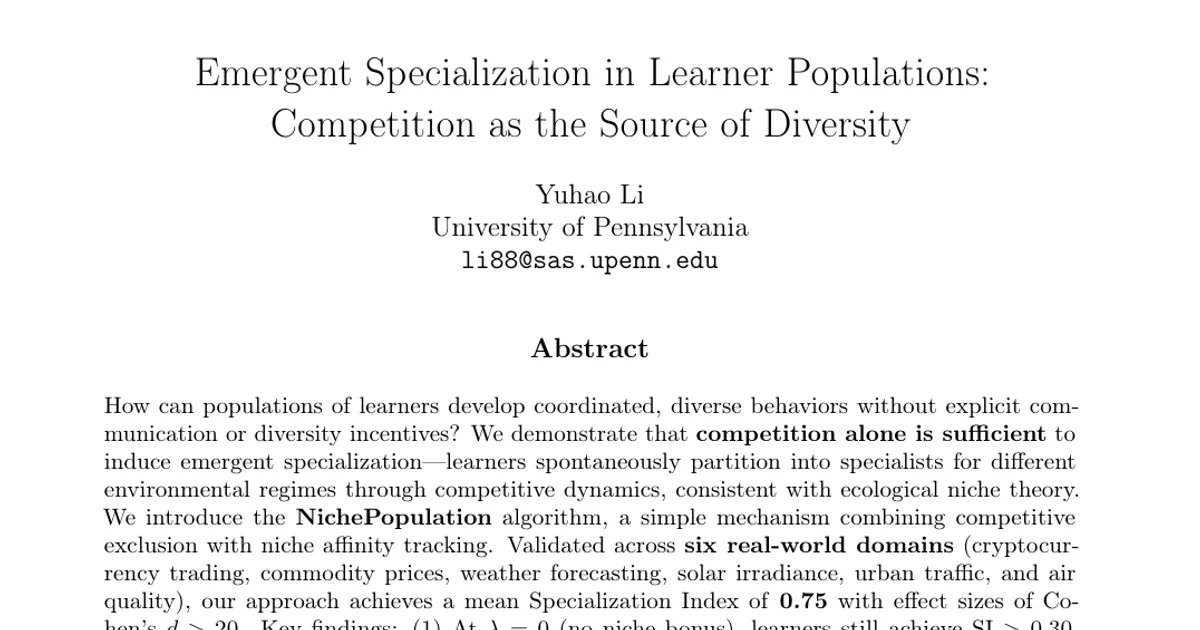
How can populations of learners develop coordinated, diverse behaviors without explicit communication or diversity incentives? We demonstrate that competition alone is sufficient to induce emergent specialization -- learners spontaneously partition into specialists for different environmental regimes through competitive dynamics, consistent with ecological niche theory. We introduce the NichePopulation algorithm, a simple mechanism combining competitive exclusion with niche affinity tracking. Validated across six real-world domains (cryptocurrency trading, commodity prices, weather forecasting, solar irradiance, urban traffic, and air quality), our approach achieves a mean Specialization Index of 0.75 with effect sizes of Cohen's d > 20. Key findings: (1) At lambda=0 (no niche bonus), learners still achieve SI > 0.30, proving specialization is genuinely emergent; (2) Diverse populations outperform homogeneous baselines by +26.5% through method-level division of labor; (3) Our approach outperforms MARL baselines (QMIX, MAPPO, IQL) by 4.3x while being 4x faster.