Research
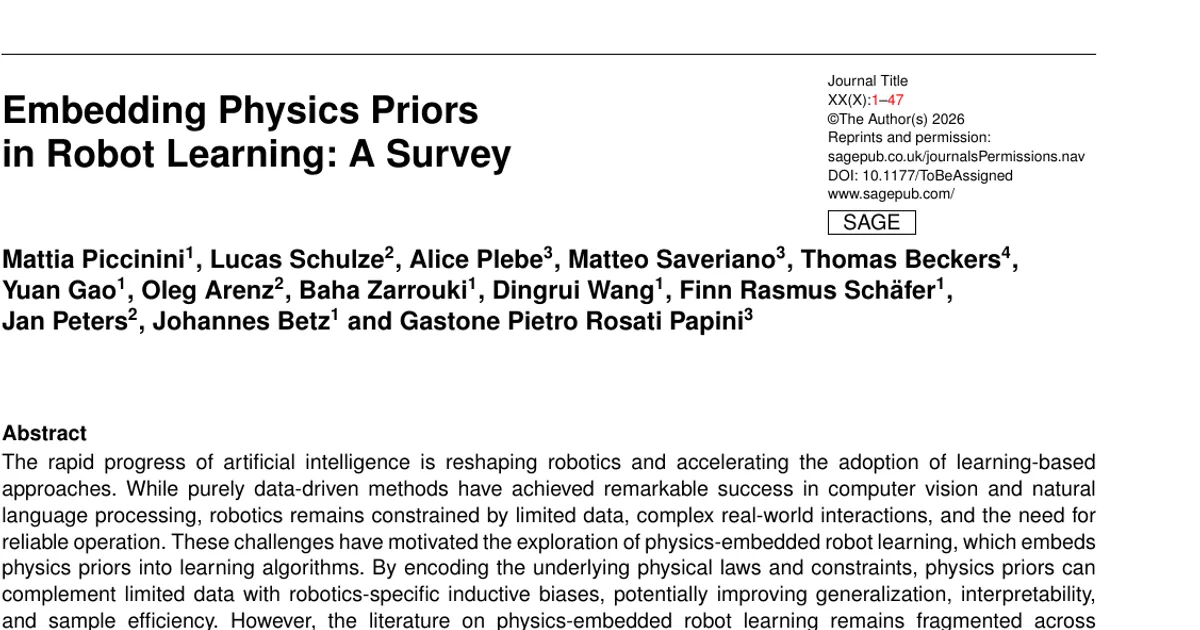
Embedding Physics Priors in Robot Learning: A Survey
Overview Research area: Robot learning, physics-informed/embedded machine learning, and model-based robotics. Technical level: Advanced. The survey assumes familiarity with robot dynamics (Lagrangian
- arXiv
- 2609.22319
- Published
- 2026-09-15
- Authors
- Mattia Piccinini, Lucas Schulze, Alice Plebe, Matteo Saveriano, Thomas Beckers, Yuan Gao, Oleg Arenz, Baha Zarrouki, Dingrui Wang, Finn Rasmus Schäfer, Jan Peters, Johannes Betz, Gastone Pietro Rosati Papini
AI summary
Overview
Research area: Robot learning, physics-informed/embedded machine learning, and model-based robotics.
Technical level: Advanced. The survey assumes familiarity with robot dynamics (Lagrangian and Hamiltonian mechanics, Euler-Lagrange equations, inertia matrices), machine learning architectures, and control/estimation terminology, although its taxonomy is explained conceptually before the formal details.
Scope (one sentence): A structured review of methods that embed physical knowledge into robot learning, organized by where the physics enters the learning pipeline — inputs/data/representations, model architectures, or training losses.
What This Paper Is About
Robot learning struggles because real-world robot data is expensive to collect, robots are high-dimensional systems with nonlinear dynamics and contact, and safe generalization matters. Physics-embedded robot learning addresses this by encoding known physical laws as inductive biases that complement (rather than replace) data-driven learning. The problem this survey tackles is that the existing literature is fragmented across terminology, methods, and application domains, making it hard to see the whole field — so the authors build a unified taxonomy and map the work into it.
Key Contributions
-
A structured review of physics-embedded robot learning covering a wide range of ML models — from single-layer perceptrons to generative models — and a broad spectrum of physics priors, from Newton-Euler and Lagrangian dynamics to conservation laws, symmetries, and invariances.
-
A three-way taxonomy based on where physics is embedded: physics-guided (inputs, data, and representations), physics-encoded (internal model architectures), and physics-informed (loss functions). The categories are explicitly non-mutually-exclusive.
-
An application-level categorization into robot dynamics learning, trajectory planning and prediction, control, and estimation, plus an overview of the open-source software ecosystem supporting this work.
-
An identification of key open challenges and proposed future research directions, supported by a continuously updated public repository containing all reviewed papers, classification and search methods, tables, and software (https://github.com/TUM-AVS/survey-physics-embedded-robot-learning).
Main Findings
-
Physics-encoded architectures dominate the field: they account for 71% of the surveyed methods, with most applications in manipulators and vehicles. Their development spans the last decade and accelerated markedly since 2020.
-
This survey's coverage is far broader than prior reviews: the authors report 232 of 329 references that embed physics priors in robot learning methods, compared with 21/359 for Watson et al. (2025), 16/112 for Sivtsov et al. (2025), 16/108 for Geist and Trimpe (2021), and 6/262 for Li et al. (2026). The survey states it is the first to cover physics-guided inputs/data, physics-encoded architectures, and physics-informed losses together in the context of robot learning.
-
Five non-mutually-exclusive families of physics priors are defined: (i) governing equations (Newton-Euler, Euler-Lagrange, Hamiltonian, and port-Hamiltonian formulations, plus ODEs and PDEs); (ii) conservation laws, symmetries, and invariances (energy, momentum, power; SE(3), SO(3), morphological symmetries); (iii) geometric and kinematic structure (manifolds, Lie groups, kinematic trees, subsystem decompositions, holonomic and nonholonomic constraints); (iv) constitutive and interaction models (friction, contact, impact, stiffness, damping, actuator and drivetrain dynamics); and (v) physical consistency and admissibility (positive definiteness of inertia matrices, positive semi-definiteness of damping matrices, passivity, dissipativity, stability, actuator limits, boundary conditions). Generic mathematical structure alone is not counted as a physics prior.
-
Physics priors act at different stages of the learning lifecycle. Physics-guided components operate during data curation or as pre-processing modules that stay active at training and inference (with learnable quantities pre-trained or frozen). Physics-encoded priors live in the architecture and are active during both training and inference. Physics-informed priors enter only through the training loss and persist at inference only through learned parameters.
-
There is an inherent trade-off. Stronger physics priors can improve interpretability and generalization but may also constrain model expressiveness, limiting the representation of behaviors that deviate from the assumed physical laws.
-
Six non-mutually-exclusive classes of physics-encoded architectures are reviewed: Lagrangian and Hamiltonian learning models, model-structured architectures, neural ODEs and variational integrator networks, hybrid physics-neural architectures, physics-encoded topology learning, and physics-encoded neural operators, with additional approaches discussed separately.
-
Lagrangian methods illustrate the design pattern. Deep Lagrangian Networks (DeLaN) parameterize the inertia matrix and potential energy with neural networks, enforcing positive definiteness through a Cholesky factorization M(q) = L(q)L(q)^T with positive diagonal entries. Because the networks take only generalized coordinates as input, dependence on velocities and accelerations is determined analytically by the Lagrangian formulation rather than learned. Extensions encode branch-induced sparsity using the reordered Cholesky factorization M(q) = L(q)^T L(q) from Featherstone (2005), leading to the Floating-Base Deep Lagrangian Network (FeLaN); other extensions add friction models (Coulomb, viscous, Stribeck), actuator input matrices, dissipative terms, and residual black-box torque models.
-
Lagrangian Neural Networks (LNNs) take a different route. Introduced by Cranmer et al. (2020), they learn the Lagrangian directly as an unstructured neural network function of generalized coordinates and velocities rather than imposing the kinetic-minus-potential decomposition, which allows representing more general Lagrangians.
-
Joint use of the three embedding routes remains underexplored. Most existing works focus on only one of the levels, and the authors argue that combining complementary routes may enable richer exploitation of prior physical knowledge, but systematic comparisons remain limited.
-
Scope exclusions are explicit. Reinforcement learning approaches where physics enters only through RL-specific mechanisms (state/action space design, exploration, safety constraints, simulator augmentation) are excluded, as those were reviewed by Banerjee et al. (2025); RL methods are included only when physics is embedded through one of the survey's taxonomy mechanisms.
Methodology in Plain English
The authors performed a literature review rather than an experimental study. They searched Google Scholar across multiple categories of physics embedding using a set of keywords listed in their online repository, covering peer-reviewed journal and conference papers published until August 2026, plus a few arXiv preprints judged to contribute significantly to the state of the art.
They adapted a taxonomy from Faroughi et al. (2024) to sort methods into three labels based on where physics priors are embedded, and they define a decision flow for assigning those labels: does the method embed physics priors expressing specific physical knowledge of a robotic system rather than generic mathematical structure? Are priors used to transform, enrich, curate, select, or correct inputs, data, or representations? Are priors encoded in the architecture and active at inference? Are priors incorporated into the training loss only? Because a method can satisfy several of these, labels can be combined. The same decision flow is implemented in the public repository so newly published papers can be classified continuously.
They defined scope along three axes: types of physics priors (five families), ML models and methods (neural networks, Gaussian Process Regression, kernel methods, sparse identification and symbolic regression, equation learning, Koopman models, neural operators, variational integrator networks, and generative models including diffusion models, Vision-Language-Action Models, and Video World Models), and robotics applications (dynamics learning; trajectory planning and prediction; control; estimation).
Why This Matters
Impact on research. The field lacks shared terminology, so papers using the same physical principle can look unrelated, and comparisons across methods are hard. A unified taxonomy, an explicit classification flow, and a continuously updated repository give researchers a common reference frame. The survey also makes the central design tension explicit: physics priors are useful inductive biases — analogous to how architectures like CNNs and LSTMs encode structural assumptions — but they can also restrict what a model can express. Quantifying that trade-off is framed as an open problem.
Real-world applications. The reviewed literature spans:
- Manipulators and parallel robots — inverse-dynamics control, trajectory tracking, and system identification, including a 6-DoF parallel robot validated experimentally.
- Legged and floating-base robots — quadrupeds and humanoids, including ground reaction force estimation and sparsity-aware floating-base dynamics models.
- Vehicles and mobile robots — wheeled robots, quadrotors, underwater vehicles, and excavators, where learned dynamics are combined with estimators such as Kalman filters for disturbance and contact force estimation.
- Wearable and assistive robotics — lower-limb motion-intention perception on a hip-knee powered exoskeleton, using predicted future joint states as references for computed-torque control.
Industry relevance. Robots must operate in safety-critical, real-time settings where large-scale open datasets are scarce. Embedding available physical knowledge into learned models is a route to models that need less data, behave more predictably outside the training distribution, and yield interpretable physical quantities such as inertia matrices and energy functions — properties that matter for qualification, certification, and maintenance of deployed robotic systems. Notably, the survey reports that a dexterous robot hand may have more than 20 degrees of freedom, illustrating why purely data-driven dynamics learning is hard at industrial scale.
Future Directions
-
Systematically combining the three embedding routes. Most works use only one level (guided, encoded, or informed); the authors state that joint use of complementary routes may exploit prior physical knowledge more richly, but that systematic comparisons remain limited.
-
Quantifying the expressiveness cost of stronger priors. A central open question is how much representational capacity is lost when hard physical constraints are imposed, and how to trade interpretability and generalization against the ability to model behaviors that deviate from assumed physics.
-
Extending physics-encoded architectures to newer, less-covered model classes. The survey highlights generative models, Vision-Language-Action Models, Video World Models, neural operators, and Koopman models as areas where physics embedding is still developing relative to classical Lagrangian and Hamiltonian approaches.
-
Broadening and continuously updating coverage. The paper points to an online repository with a decision flow for classifying new publications, inviting the community to extend beyond the scope of the survey. The specific future research directions the authors outline in their Section 8 are not included in the truncated content provided here.
Target Audience
Robotics and machine learning researchers who want an organized entry point into physics-embedded learning; PhD students and practitioners selecting an embedding strategy for a dynamics-learning, planning, control, or estimation problem; and engineers evaluating whether structural priors can reduce data requirements for a deployed robotic platform. Readers focused narrowly on Reinforcement Learning methods that handle physics solely through reward design, exploration, or environment augmentation will find those approaches outside the survey's scope by design.
Authors’ abstract
The rapid progress of artificial intelligence is reshaping robotics and accelerating the adoption of learning-based approaches. While purely data-driven methods have achieved remarkable success in computer vision and natural language processing, robotics remains constrained by limited data, complex real-world interactions, and the need for reliable operation. These challenges have motivated the exploration of physics-embedded robot learning, which embeds physics priors into learning algorithms. By encoding the underlying physical laws and constraints, physics priors can complement limited data with robotics-specific inductive biases, potentially improving generalization, interpretability, and sample efficiency. However, the literature on physics-embedded robot learning remains fragmented across terminology, methodologies, and application domains, making it difficult to assess this growing body of work. This survey reviews physics-embedded robot learning across a broad range of physics priors, robotics applications, and machine learning models, from single-layer perceptrons to generative foundation models. We adopt a unified taxonomy that classifies existing approaches according to their physics embedding: physics-guided inputs, data, and representations; physics-encoded model architectures; and physics-informed training loss functions. Building on this taxonomy, we review methods for robot dynamics learning, trajectory planning, prediction, control, and estimation, together with the corresponding open-source software ecosystem. We identify key open challenges, and outline promising future research directions. Overall, we argue that physics priors provide a particularly relevant robotics-specific inductive bias, complementing rather than replacing data-driven learning, and paving the way toward more generalizable, data-efficient, and trustworthy robotic systems.