Research
Eliciting Weak-to-Strong Generalization with On-Policy Reverse Distillation
Overview Research area: Machine learning, specifically large language model post-training — weak-to-strong generalization, on-policy knowledge distillation, and reinforcement learning with verifiable
- arXiv
- 2609.08798
- Published
- 2026-09-08
- Authors
- Youngrok Park, Sangmin Bae, Hojung Jung, Jongwoo Ko, Yunseon Choi, Young Jin Kim, Pashmina Cameron, Aaron Courville, Se-Young Yun
AI summary
Overview
- Research area: Machine learning, specifically large language model post-training — weak-to-strong generalization, on-policy knowledge distillation, and reinforcement learning with verifiable rewards (RLVR).
- Technical level: Advanced. The paper assumes familiarity with policy-gradient methods (GRPO), KL-divergence-based distillation objectives, and gradient decomposition.
- Scope: The paper proposes a single training method, On-Policy Reverse Distillation (OPRD), and evaluates it across successive model transfer, multi-teacher distillation, and conventional strong-to-weak distillation on math and logical reasoning benchmarks.
What This Paper Is About
Conventional distillation makes a student model imitate its teacher's output distribution, which means a weak teacher's capacity limit becomes the student's ceiling. This paper asks how a large model can absorb the gains a smaller model acquired during reinforcement-learning post-training without being constrained to reproduce that smaller model. OPRD answers by using the weak teacher only to rescale the direction of the strong student's own reward-driven gradient, never as an independent objective to optimize toward.
Key Contributions
-
Framing weak-to-strong generalization as an optimization problem. The authors identify the central difficulty as exploiting post-training gains from weaker models without making either the weak policy or its policy shift a separate optimization target — a failure mode that affects standard on-policy distillation and hybrid distillation-plus-RL methods alike.
-
The OPRD algorithm. On student-generated rollouts, OPRD computes the weak teacher's policy shift relative to its own pre-RL reference (a mean-centered logit difference), normalizes it to a unit direction, and amplifies only the component of the student's verifier-driven policy gradient that lies along that direction — leaving the orthogonal component untouched.
-
A preservation guarantee. Because the transformation is a positive rescaling of a gradient component already present, it is a linear map (I + λ d dᵀ) with λ ≥ 0 that is invertible and leaves the stationary points of the verifier objective unchanged, while adding a nonnegative first-order alignment gain.
-
Empirical validation across three regimes. OPRD is tested on successive model transfer (4B → 8B), multi-teacher consolidation (four 4B specialists → one 8B student), and conventional strong-to-weak distillation (8B → 1.7B, 8B → 0.6B), with ablations on guidance direction, amplification strength, and alignment dynamics.
Main Findings
-
Faster and higher in successive transfer: With a post-trained Qwen3-4B teacher and Qwen3-8B student, OPRD averages 51.91 on math versus 43.99 for the strongest baseline (KDRL) and 38.66 for the teacher itself; on Reasoning Gym it averages 55.18 versus 44.38 (KDRL) and 44.65 (teacher). The authors report reaching teacher-level performance with 33–67% fewer updates than GRPO.
-
Distillation plateaus, OPRD does not: Standard on-policy distillation (OPD) accelerates early but saturates near the teacher's performance, while GRPO is slower but keeps improving. OPRD matches OPD's early speed, surpasses the teacher, and reaches GRPO's end-of-training performance much sooner.
-
Multi-teacher consolidation without cross-task tradeoffs: Consolidating four Reasoning Gym specialists into one 8B student, OPRD averages 58.77 against 47.68 for Mix-RL and 44.65 for the specialist average. OPRD beats each corresponding specialist on all four tasks, suggesting joint improvement rather than a tradeoff. The authors attribute this to projecting each task's gradient onto its own teacher direction, an effect resembling PCGrad applied between gradients and teacher directions rather than between conflicting task gradients.
-
Independence from capacity ordering: In strong-to-weak distillation, OPRD reaches 33.58 on AIME'24 (8B → 1.7B) versus 29.79 for OPD, and 49.40 on Knights & Knaves (8B-Base → 0.6B) versus 20.20 for OPD and 33.70 for KDRL. This confirms the method is not specific to the weak-teacher-strong-student regime.
-
The weak policy delta is the best guidance direction: Comparing three candidate directions — the normalized weak policy delta, the OPD teacher-matching gradient, and the OPSD self-distillation gradient — the policy delta yields the fastest and most sustained gains.
-
Better teachers help but do not set the ceiling: Later GRPO checkpoints of the 4B teacher generally produce faster 8B student learning. A teacher checkpoint scoring only 29.0% Pass@1 on Knights & Knaves still produced an OPRD student reaching roughly 88%.
-
Amplification strength matters, but not precisely: Every λ > 0 beats GRPO (λ = 0), and values up to 0.5 improve early learning speed; returns flatten beyond 0.5, so the authors default to λ = 0.5.
-
Teacher guidance fades over training: Tracking the angle between the teacher direction and the student gradient, the two are strongly aligned (or strongly opposed) early on, then converge toward orthogonality. As the student increasingly follows verifier-supported directions the teacher shift does not capture, the guidance becomes less influential.
-
Comparison with related weak-to-strong methods: OPRD averages 60.81 versus 54.21 for S2L-PO, 49.22 for W2S-OPD, 48.64 for W2SR-P, 37.81 for Direct-OPD, and 21.69 for the authors' OPSD variant. The two closest concurrent methods (Direct-OPD, W2S-OPD) optimize the policy shift directly; OPRD instead retains verifier supervision through the untouched orthogonal component.
Methodology in Plain English
Start with a student model and a smaller teacher that has already been trained with reinforcement learning on verifiable rewards. For each training batch, the student generates its own answers — nothing is taken from the teacher's own output. At every prefix the student visits, the method asks two questions.
First, how did the teacher change during its post-training? The answer is the difference between the teacher's next-token logits and those of its pre-RL reference model, with a constant offset removed so only relative token preferences remain. This difference is then normalized to a unit vector, so only its direction matters, not its size. In practice the computation is truncated to the student's top-10 candidate tokens.
Second, which way does the student's own reward-driven gradient point? The gradient is split into two pieces: one pointing along the teacher's direction, one perpendicular to it. OPRD multiplies the along-teacher piece by (1 + λ) and leaves the perpendicular piece exactly as it was.
The intuition: when the reward signal and the teacher agree, the shared direction gets reinforced and learning speeds up. When they disagree — the student finds a reward-supported answer the teacher would not have produced — the disagreement is amplified rather than suppressed, which is what lets the student pass the teacher. Because only an existing component is scaled, the set of points where the gradient is zero does not change, so the student is still optimizing the same reward objective, just faster.
One refinement: the amplification is asymmetric. Positive alignment (student agrees with teacher) is scaled at full strength immediately, while negative alignment is ramped up gradually via a warm-up schedule. The reason is that both signals contain reward-irrelevant noise, and scaling only one sign would systematically accumulate that noise.
Why This Matters
Impact on research. The paper reframes weak-to-strong generalization from a question about what to imitate to a question about how to steer an existing optimization. It is also a negative result for a natural alternative: two concurrent methods that optimize the weak policy delta directly perform substantially worse than rescaling the verifier gradient along that delta, suggesting the shift is more useful as a direction than as a target.
- Reusing post-training across model generations: When a lab scales up a model, the post-training work invested in the previous generation could transfer to the successor without having to redo frontier-scale RL from scratch.
- Domain consolidation: Specialists in math, code, or logic can be iterated cheaply at small scale — where reward functions and environments are fast to experiment with — and then merged into one general model.
- Reduced compute for reasoning post-training: The reported 33–67% reduction in updates to reach teacher parity translates into real GPU-hour savings for reasoning training pipelines.
- Distillation when the teacher is not strictly better: OPRD works in both capacity orderings, which matters for distillation pipelines where a nominally stronger teacher is nonetheless a poor imitation target.
Industry relevance. The two motivating scenarios — successive model transfer and multi-teacher consolidation — map directly onto how frontier labs build model generations and how they combine domain-specialized policies. The method requires no new reward model, reuses the same rollout budget as baselines, and adds only a logit-difference computation against a frozen reference, making it relatively cheap to bolt onto an existing GRPO pipeline.
Future Directions
- Handling vanishing gradients. The paper notes that OPRD requires a nonzero verifier-driven policy gradient, which limits the correction when the student's rollouts produce no learning signal (for example, when all responses in a group receive identical rewards). Mitigations are discussed but the constraint remains.
- Extending the warm-up schedule. In the multi-teacher experiments, the authors retain the single-teacher coefficient schedules rather than extending them for the longer 300-update run, leaving open whether a schedule tuned to the run length would help further.
- Beyond reasoning tasks. All evaluations are mathematical and logical reasoning with programmatically verifiable answers. Whether the approach transfers to open-ended generation, where the verifier signal is weaker or learned rather than exact, is untested.
- Scaling the setting. Experiments span 0.6B to 8B parameters. Whether the alignment dynamics, the plateau behavior of OPD, and the orthogonality convergence observed mid-training hold at frontier scale is an open question.
Target Audience
Researchers and engineers working on LLM post-training, reinforcement learning from verifiable rewards, and knowledge distillation. It will be most valuable to practitioners building multi-generation training pipelines or consolidating domain-specialist models, and to readers interested in gradient-level interventions that preserve an optimization objective's stationary points. Readers without a background in policy gradients will find the method section dense, though the motivation and empirical results are accessible.
Authors’ abstract
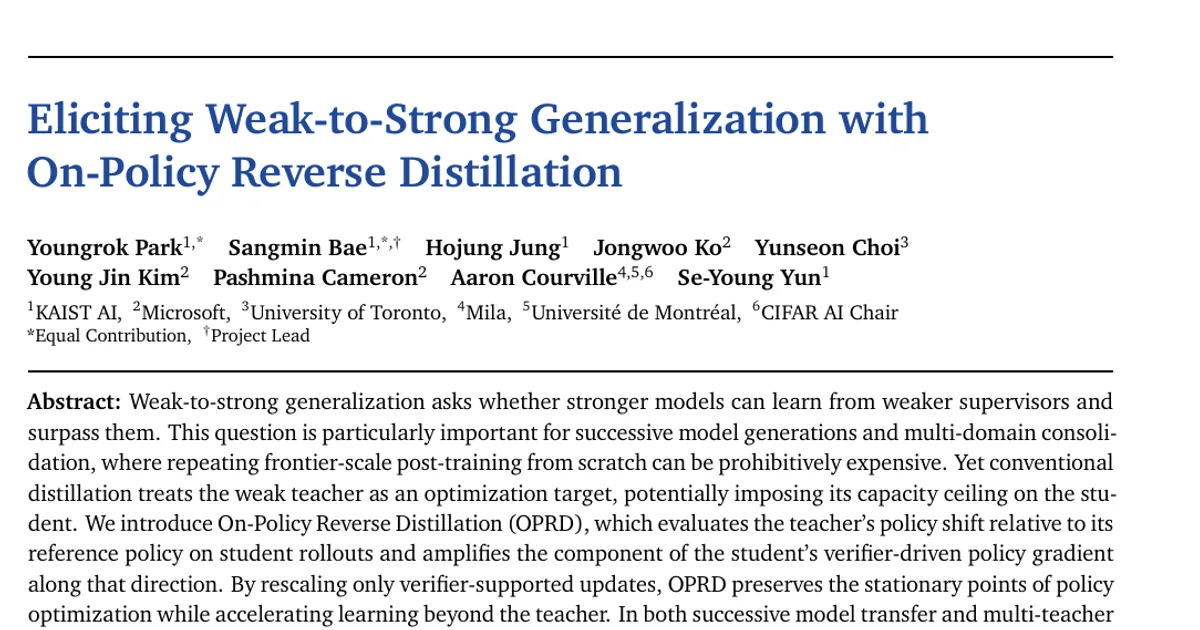
Weak-to-strong generalization asks whether stronger models can learn from weaker supervisors and surpass them. This question is particularly important for successive model generations and multi-domain consolidation, where repeating frontier-scale post-training from scratch can be prohibitively expensive. Yet conventional distillation treats the weak teacher as an optimization target, potentially imposing its capacity ceiling on the student. We introduce On-Policy Reverse Distillation (OPRD), which evaluates the teacher's policy shift relative to its reference policy on student rollouts and amplifies the component of the student's verifier-driven policy gradient along that direction. By rescaling only verifier-supported updates, OPRD preserves the stationary points of policy optimization while accelerating learning beyond the teacher. In both successive model transfer and multi-teacher distillation, OPRD achieves higher performance with fewer student updates than existing RL and distillation approaches. Response-style analysis shows that OPRD students remain closer to models trained with verifier-based RL alone than to their weak teachers, suggesting that teacher guidance accelerates rather than redirects the student's own optimization. Results in conventional strong-to-weak distillation further demonstrate that OPRD effectively combines verifier-driven policy optimization with teacher guidance regardless of capacity ordering.