Research
Efficiently Learning To Reason or Not to Reason: Root-token Policy Optimization for Adaptive Thinking
Overview Research area: Natural language processing, specifically efficient inference and reinforcement-learning post-training for large reasoning models (LRMs). The work sits at the intersection of a
- arXiv
- 2610.17767
- Published
- 2026-10-13
- Authors
- Taehyeon Kim, Hyunsoo Lee, Youngsoo Jang, Moontae Lee
AI summary
Overview
- Research area: Natural language processing, specifically efficient inference and reinforcement-learning post-training for large reasoning models (LRMs). The work sits at the intersection of adaptive/conditional computation and policy optimization.
- Technical level: Advanced. The paper assumes familiarity with GRPO-style policy gradients, advantage normalization, KL regularization, LoRA, KV-cache and activation memory accounting, and Pass@1 evaluation for math models.
- Scope: One sentence: the paper proposes and evaluates RPO, a training method that teaches a reasoning model when to think by updating only the single root token that decides whether the model opens a
<think>reasoning block, and reports accuracy, token usage, thinking rate, memory, and FLOPs across several model families and scales.
What This Paper Is About
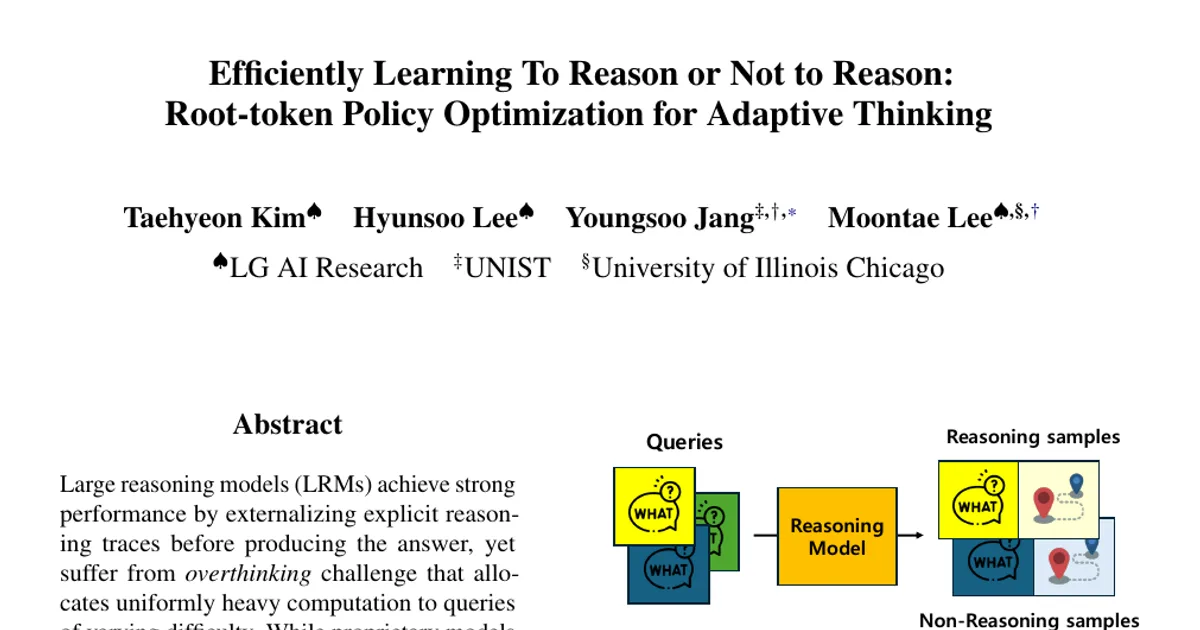
Large reasoning models spend long explicit reasoning traces on every query, including trivial ones, which the paper calls the "overthinking" problem. Proprietary services hide a routing mechanism that decides when heavy reasoning is needed, but open-source models lack an efficient, openly documented way to learn that decision, because training over full reasoning trajectories is expensive and prior recipes depend on curated data or teacher models. The goal of this paper is to make the routing decision itself the only thing the model is trained on, so that adaptive thinking can be learned cheaply and without degrading the model's original ability.
Key Contributions
- RPO (Root-token Policy Optimization): A framework that restricts gradient updates to the single initial gating token — the first newline token(s) after
<think>, which chooses between the Long (explicit reasoning) and Short (direct answer) mode — while treating the rest of each rollout as environment output. - A two-stage pipeline: Offline synthesis of paired reasoning and non-reasoning samples via forced chat templates and self-distillation, followed by RPO on a compact prompt set, with a model-specific difficulty signal derived from contrasting mode-conditioned correctness rather than external difficulty labels.
- Empirical evidence across model families and scales: Results for Qwen3-1.7B, Qwen3-8B, Qwen3-32B, Exaone4-1.2B, and R1-1.5B on MATH500, AIME24, AIME25, GPQA-Diamond, and LiveCodeBench, plus analysis of calibration for an explicit reasoning knob (target Think% or routing threshold on root-token probability).
- A compute and memory accounting: Demonstrated that a difficulty-aware policy learned in the math domain transfers to scientific and code domains, and that root-only updates reduce training compute to about 0.02x that of AdaptThink and cut peak VRAM relative to full-trajectory GRPO.
Main Findings
- Training compute drops to about 0.02x: Under PFLOPs accounting for an 8B dense Transformer, RPO totals 10,241 PFLOPs (6,144 forward, 4,097 backward) versus 522,240 for AdaptThink (1.00x) and 393,984 for ThinkLess (0.75x), because RPO updates T_upd = 1 token while AdaptThink has T_upd about 16K and ThinkLess about 24K. The abstract states RPO learns difficulty-aware adaptive thinking at approximately 2% of the training compute of prior adaptive-reasoning methods.
- VRAM falls sharply at batch size 8 and context 13K: For 1.5B, peak VRAM is 146.86 GiB for original GRPO, 41.40 GiB for RPO (0.28x), and 19.12 GiB for RPO with LoRA (0.13x). For 7B, it is 436.34 GiB for original GRPO, 155.11 GiB for RPO (0.36x), and 51.01 GiB for RPO with LoRA (0.17x). The backward activation term per rollout falls from 13.18 GiB to 1.10 x 10^-3 GiB at 1.5B and from 35.16 GiB to 2.93 x 10^-3 GiB at 7B.
- Better accuracy-routing trade-off on larger backbones: On Qwen3-8B, average Think% falls from 57.3% to 44.8% while average Pass@1 moves only from 63.8% to 62.0%, improving RAR from 0.90 to 0.72. On Exaone4-1.2B, Think% drops from 43.4% to 23.6% and RAR improves from 0.85 to 0.49.
- On a small backbone, RPO refines rather than compresses: On Qwen3-1.7B, the post-SFT point is already Think% = 72.8 with RAR = 1.45; RPO lands at Think% = 74.0 and RAR = 1.43, recovering accuracy through routing refinement rather than further Think% reduction.
- SFT already does much of the routing work: SFT alone substantially reduces Think% and tokens, showing mode-following is largely learned at the template level; RPO then fine-tunes the root decision. The direction of that refinement is configuration-dependent.
- Against published hybrid-reasoning baselines on R1-1.5B: RPO reaches 20.5% Think% on MATH500 and a two-task average Pass@1 of 51.3 with RAR = 0.96, versus AdaptThink at average Pass@1 = 56.5 and RAR = 0.74 but a far larger training budget. The paper frames this as two points on a budget-accuracy frontier, not a head-to-head ranking.
- Transfer beyond math: On LiveCodeBench and GPQA-Diamond, RPO lowers average RAR on Exaone4-1.2B (2.15 to 1.26) and Qwen3-8B (1.85 to 1.34), but on Qwen3-32B, where SFT already gives average Think% = 94.6 and RAR = 1.52, RPO yields a comparable but not strictly better RAR of 1.55.
- Threshold routing yields a smooth knob: On MATH500 with R1-1.5B, the original model scores 83.6 (500 routed to Long); a threshold of 0.75 routes 62 to Short and 438 to Long for 83.8 overall; a threshold of 0.70 routes 155 to Short and 345 to Long for 82.2 overall.
- Root confidence is only weakly calibrated: Reliability diagrams with Qwen3-1.7B over 10 uniform confidence bins show that Short-root confidence correlates with correctness, but the signal is weak and dataset dependent — on AIME25 mass concentrates at low confidence, while MATH500 shows a broader spread.
- Not reported: The paper does not report results on agentic or tool-use benchmarks, does not optimize intra-mode behavior such as how long to think or when to stop, and states that a more exhaustive ablation of RL training dynamics and a fully controlled comparison against alternative GRPO variants using their exact recipes were not provided due to limited compute.
Methodology in Plain English
The method treats "should I think?" as a single branching decision at the very start of generation. With a <think> prefix in place, the first newline token acts as the switch: one form continues into a long reasoning block, the other immediately closes the block and answers directly.
First, the authors build training data offline. They take math queries, sample many outputs from the model in each of the two forced modes, keep only outputs that follow the template and get the right answer, and then fine-tune the model on a balanced mix (20K instances per mode, 40K total) until it can produce either style on demand without losing accuracy under the default chat template. This stage gives a model that knows how to answer both ways; it does not yet know when.
Second, they run RPO. For each training query they deliberately collect a balanced set of rollouts — 8 Short and 8 Long out of 16 total — so neither mode collapses. Each rollout gets a reward equal to how many rollouts in its own mode group answered correctly, with a mild bonus for Short (alpha_S = 1 + 1/n) to reflect the goal of saving compute. Advantages are then standardized per mode across the batch, which is necessary because rewards are constant within a prompt's mode group and only cross-prompt variation supplies usable variance. Despite generating full trajectories to check correctness, the gradient is applied only to the probability of the root token; every other token is masked out. A KL term keeps the root distribution close to the post-SFT reference.
The training set for RPO is small — roughly 1K queries drawn from s1k and a compression dataset — filtered to exclude items where Long is rarely correct (accuracy below 0.25) and stratified 1:1 into easy (Short already scores at least 0.75) and hard (Short worse than Long, with Long at most 0.5) regimes. Runs use three H100 GPUs, batch size 128, learning rate 10^-6, 16 rollouts per prompt, maximum context 16K, temperature 0.6, top-p 0.95, and fewer than 60 update steps for all model sizes. Because only one token position is backpropagated, the activation memory term no longer scales with chain-of-thought length.
Why This Matters
Impact on research. The paper pushes the idea of token-selective RL to its extreme, showing that a large fraction of the benefit of adaptive reasoning can come from a single decision token. It provides an open, reproducible alternative to opaque commercial routing, and reframes the accuracy-versus-compute trade-off as an operating point to be selected rather than a single number to be maximized. The honest reporting that RPO sometimes traces a comparable rather than strictly dominating frontier against SFT is itself useful for the field.
Real-world applications:
- Serving assistants that must answer a mix of easy and hard user queries, where routing trivial questions away from long reasoning directly cuts latency and per-request cost.
- Coding assistants, motivated by the LiveCodeBench evaluation (sliced from March 25 to April 15, 2025), where the optimal amount of deliberation varies widely across tasks.
- Scientific question answering, motivated by the GPQA-Diamond evaluation, where a model can avoid over-deliberating on questions it already handles.
- Deployment planning on fixed hardware, since the reported VRAM and PFLOPs figures let teams decide whether root-only RL or LoRA-based root-only RL fits their accelerators.
Industry relevance. The headline efficiency numbers — training compute at about 0.02x AdaptThink in the PFLOPs accounting, peak VRAM at 0.28x to 0.36x of full-trajectory GRPO, and LeBron-free of full chain-of-thought backpropagation — matter to teams whose constraint is GPU hours and memory rather than algorithmic novelty. The existence of a routing threshold and of intermediate checkpoints with different Think% values gives operators a deployment knob comparable to a budget setting, without retraining the whole model.
Future Directions
- Evaluation on agentic and tool-use benchmarks, which the limitations section names as necessary broader evaluation before claims about adaptive reasoning generalize.
- Improving root-confidence calibration, since the paper finds the Short-root confidence signal weak and dataset dependent, and sensitive to the composition of easy and hard queries in the RPO bucket.
- Extending beyond binary routing to intra-mode decisions such as how long to think or when to stop reasoning, which could improve compute allocation further.
- Deeper analysis of training dynamics, including how root-token choice should be designed and a fully controlled comparison against alternative GRPO variants run on their publicly released checkpoints and exact training recipes, which the authors did not perform due to limited compute.
Target Audience
Researchers and engineers working on efficient inference, reasoning-model post-training, or reinforcement learning for language models, especially those who already understand GRPO-style objectives and want a lower-cost method for conditional reasoning. It is also useful for practitioners deciding how to deploy reasoning models under tight GPU memory or latency budgets, and for readers interested in how a model's own mode-conditioned accuracy can serve as a difficulty signal without external labels. Readers without background in policy optimization will find the methodology sections demanding, though the high-level framing and the efficiency tables remain readable.
Authors’ abstract
Large reasoning models (LRMs) achieve strong performance by externalizing explicit reasoning traces before producing the answer, yet suffer from overthinking challenge that allocates uniformly heavy computation to queries of varying difficulty. While proprietary models mitigate this via opaque routing, open-source LRMs still lack an efficient mechanism to internalize adaptive reasoning due to both expensive training cost and limited disclosure of training recipes. In response, we introduce RPO (Root-token Policy Optimization), a framework that enables LRMs to self-determine when to reason by training only the initial root token (e.g., whether to invoke the <think> tag) via group relative reward and group-wise advantages. By focusing on this pivotal branching point, RPO drastically reduces training overhead and VRAM usage. Across multiple model families and scales, RPO learns difficulty-aware adaptive thinking at just ~2% of the training compute of prior adaptive-reasoning methods.