Research
Efficient Multi-Agent Reasoning via Confidence-Guided Adaptive Debate
Overview Research area: Multi-agent reasoning with large language models, specifically test-time debate protocols and inference-time compute allocation. Technical level: Advanced. The paper builds on
- arXiv
- 2610.16343
- Published
- 2026-10-12
- Authors
- Seungdong Yoa, Ye Seul Sim, Suhee Yoon, Sanghyu Yoon, Dongmin Kim, Soonyoung Lee, Bumsoo Kim, Junhyun Lee
AI summary
Overview
Research area: Multi-agent reasoning with large language models, specifically test-time debate protocols and inference-time compute allocation.
Technical level: Advanced. The paper builds on Bayesian latent-concept models, Dirichlet-multinomial belief updates, martingale arguments, and Pareto/accuracy-cost tradeoff analysis, so readers need some background in probabilistic modeling and LLM inference economics.
Scope: The paper proposes LASE (Leader-Adaptive Structured Engagement), a confidence-gated leader–supporter debate framework, and evaluates it against single-agent, majority-vote, and multi-agent-debate baselines on six reasoning and knowledge benchmarks using two LLM backbones.
What This Paper Is About
Multi-agent debate is expensive because existing frameworks apply interaction uniformly to every query, even when interaction cannot help. The authors argue that debate only pays off in a "corrective regime" (when an informative or correct response exists to amplify) and is neutral in expectation in a symmetric "neutral regime," so the real question is when to invoke debate and how to structure it. LASE answers this by letting a single leader agent attempt the problem first, checking its own token-level confidence, and escalating to peers only when that confidence is low.
Key Contributions
-
A reconciliation of two conflicting debate theories. The paper connects Hu et al. (2025), who show debate can amplify a correct seed and beat majority vote (Theorems 2.4–2.5), with Choi et al. (2025), who show symmetric debate is a martingale with no positive expected drift (Theorem 2.7), and argues the difference is a matter of timing and structure rather than of the agents themselves.
-
The LASE framework. A leader-centric architecture with a directed star topology in which a leader agent interacts with at most one peer at a time, using staged escalation: an adversarial check, then a peer support interaction, and optionally an expert escalation, with early stopping whenever the uncertainty event clears.
-
A confidence-gating mechanism. Two confidence proxies computed on the leader's answer span — minimum token log-probability (LP_min) and maximum token entropy (H_max) — thresholded by τ_lp and τ_h to define an uncertainty event U that decides whether any interaction happens at all.
-
Theoretical guarantees for the accuracy-cost tradeoff. Theorem 3.7 gives an accuracy lower bound of Acc(π_solo) + P(U=1)·ρδ; Equation 20 gives Cost(π_LASE) = C_L + P(U=1)·C_peer ≤ Cost(π_full) with strict inequality when P(U=1) < 1; Proposition 3.8 shows all-to-all debate scales as Θ(Tn²) cross-agent context inclusions versus O(T) for the leader-centric scheme, an Ω(n²) reduction; Corollary 3.9 states a Pareto frontier improvement over static debate.
-
Empirical validation across six benchmarks and two models, including a calibration analysis, a majority-vote compatibility experiment, and an agent-permutation robustness check.
Main Findings
-
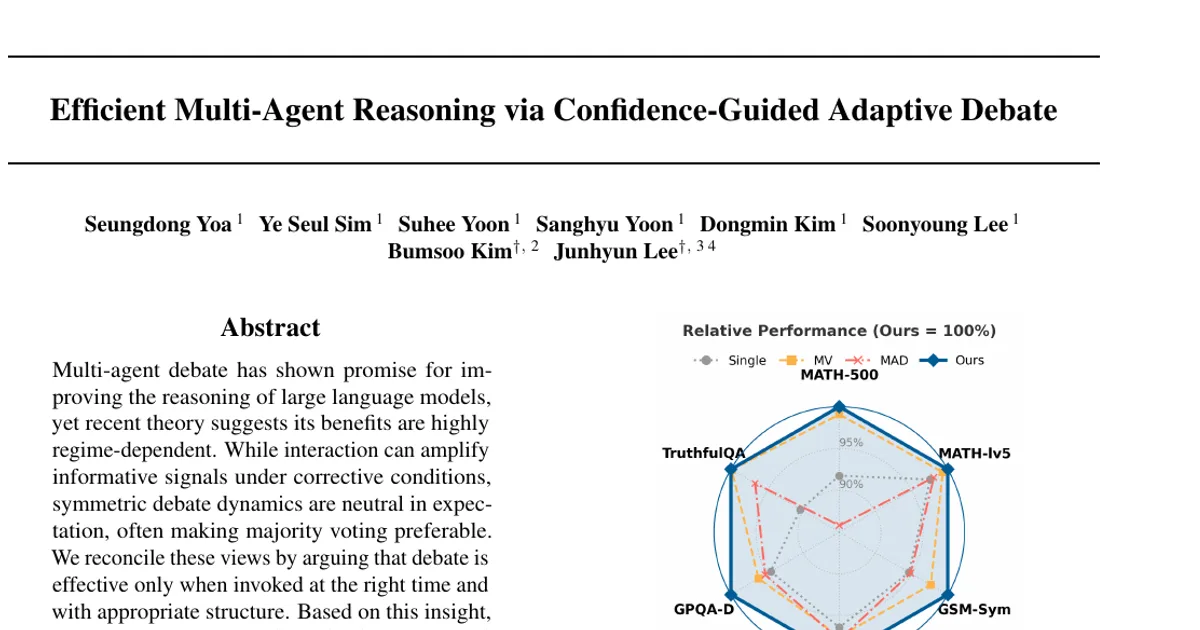
Consistent accuracy wins: On Gemini-2.0-Flash, LASE (labeled "Ours") reaches 87.2 on MATH-500 versus Single 80.0, MV 86.4, and MAD 74.8; 57.1 on MATH-lv5 versus 55.7 / 56.7 / 56.0; 93.4 on GSM-Symbolic versus 88.4 / 91.2 / 88.6; 81.3 on MMLU-Pro versus 78.4 / 79.3 / 79.6; 65.2 on GPQA-Diamond versus 61.6 / 62.7 / 62.1; and 80.3 on TruthfulQA versus 72.6 / 80.2 / 77.6.
-
GPT-4.1-mini results: LASE records 74.2 on MATH-500 (versus 73.0 singles, 73.8 MV, 73.8 MAD), 86.6 on MATH-lv5 (79.8 / 84.7 / 86.4), 94.8 on GSM-Symbolic (94.4 / 94.8 / 93.2), 81.8 on MMLU-Pro (79.4 / 81.5 / 81.7), 72.9 on GPQA-Diamond (67.7 / 71.2 / 72.7), and 81.1 on TruthfulQA (79.9 / 80.9 / 80.8).
-
Order-of-magnitude token savings: The paper states LASE reduces average token usage by over 10× compared to MAD. On GSM-Symbolic with Gemini-2.0-Flash, LASE uses 0.4k tokens versus MAD's 5.6k, which the paper describes as a 14× reduction. On MATH-500 with Gemini-2.0-Flash, LASE costs 1.1k tokens versus MAD's 11.8k and MV's 5.2k.
-
LASE as a "better voter": In Table 2 on MATH-500, Ours (Single, N=1) scores 87.2 with 1.1k tokens (+0.8 over MV), and Ours-Majority Vote (N=5) scores 88.0 with 5.4k tokens (+1.6), while standard MV (N=7) scores 86.4 with 5.2k tokens.
-
Confidence proxies are calibrated: Aggregating two independent runs across both models on MATH-500 gave 2,000 sample points. Minimum log-probability ≥ 0.99 corresponds to 85.5% accuracy, while values below 0.50 drop to 50.9%. Entropy above 1.0 corresponds to 30.4% accuracy. The paper presents this as empirical validation of Assumption 3.3.
-
Permutation invariance: On MATH-500, three runs with randomly shuffled supporter order scored 86.8, 87.2, and 86.6, averaging 86.9 (±0.31) at roughly 1.1k tokens, versus the main reported 87.2 at 1.1k tokens — a gap the authors call minimal.
Methodology in Plain English
The framework is a gated escalation ladder rather than an open debate. A single leader agent first answers the question alone (z_L^(0)). The system then measures how confident the leader was on the tokens that make up its final answer, using two cheap signals: the lowest log-probability among those tokens, and the highest entropy among those tokens.
If both signals look reassuring relative to the thresholds τ_lp and τ_h, the uncertainty flag U is 0 and the process stops immediately — no debate, no extra tokens. If U is 1, the leader escalates one peer at a time. First a peer performs a low-cost adversarial check, and the leader revises (z_L^(1)). Then a peer provides support, and the leader revises again (z_L^(2)). If a further step is needed, the leader can escalate to an expert peer. At any point, if the leader's confidence clears the threshold, the process halts and its current answer is extracted.
This produces a directed star interaction graph centered on the leader instead of the all-to-all mesh used by canonical multi-agent debate. The asymmetric topology is the mechanism the authors use to break the symmetry condition that makes debate a martingale, so that peer feedback functions as a corrective bias rather than a redundant exchange.
For evaluation, the authors used Gemini-2.0-Flash and GPT-4.1-mini as backbones and compared against zero-shot single-agent generation, majority vote over N=7 independent samples, and multi-agent debate with N=3 agents debating for 2 rounds followed by majority voting. The benchmarks were MATH-500, a custom MATH-lv5 subset of N=1,324 highest-difficulty problems, GSM-Symbolic (N=500), MMLU-Pro (N=504), GPQA-Diamond (N=198), and TruthfulQA-MC (N=817).
Why This Matters
Impact on research: The paper offers a practical bridge between two theoretical camps that appeared to contradict each other. Instead of asking whether debate helps in general, it frames the problem as a resource allocation question — when to interact and how to structure the interaction — and supplies both a lower bound on accuracy gain and a cost identity to back that framing.
Real-world applications:
- Deploying reasoning assistants where per-query API cost and latency matter more than squeezing out the last fraction of accuracy.
- High-stakes verification workflows (science, medicine, law) where the "expert escalation" stage could route hard cases to a stronger or more expensive model only when needed.
- Production systems that already use majority voting and want a drop-in enhancement that improves each sampled reasoning path before aggregation.
- Robustness-sensitive deployments, since GSM-Symbolic tests against memorization and TruthfulQA tests factuality/safety behavior.
Industry relevance: The work comes from LG AI Research with academic co-authors at Chung-Ang University and Hankuk University of Foreign Studies. The paper's impact statement frames the token reduction as a contribution to Green AI by lowering the energy footprint of large-scale model deployment. The cost model in the paper explicitly includes a per-token cost c_i per agent, which captures latency, price, and model size — the exact levers a serving team would optimize.
Future Directions
- Tuning the gating thresholds. The paper defines τ_lp and τ_h but the truncated content does not report how they were selected or how sensitive results are to them.
- Scaling the supporter set. The paper's remark on compatibility with voting suggests replacing the single peer in the support stage with a small set of peers aggregated by majority vote, which would raise the conditional seed probability ρ in Assumption 3.4 while preserving the uncertainty-gated structure.
- Extending the staged escalation. LASE currently uses an adversarial check, a support interaction, and optional expert escalation; the natural question is whether more stages, or learned selection of which peer to query (A, S, E), improves the tradeoff.
- Testing the theoretical assumptions more broadly. Assumptions 3.3 through 3.6 are validated on MATH-500 calibration data and the reported benchmarks; the truncated Appendix A.3 does not include the full conservativeness argument, so the degree to which these hold on other model families and task types remains open.
Target Audience
Researchers working on multi-agent LLM systems and inference-time compute scaling will get the most from this paper, particularly those interested in the theory of debate dynamics and in gating mechanisms. Practitioners building cost-sensitive reasoning pipelines — where token spend, latency, and reliability all matter — will find the empirical cost-accuracy tables directly actionable. Readers without a probabilistic modeling background can still follow the framework and results, but the theoretical sections on martingale neutrality, Dirichlet conjugacy, and the Pareto argument assume familiarity with Bayesian inference.
Authors’ abstract
Multi-agent debate has shown promise for improving the reasoning of large language models, yet recent theory suggests its benefits are highly regime-dependent. While interaction can amplify informative signals under corrective conditions, symmetric debate dynamics are neutral in expectation, often making majority voting preferable. We reconcile these views by arguing that debate is effective only when invoked at the right time and with appropriate structure. Based on this insight, we propose LASE: Leader-Adaptive Structured Engagement, a leader-centric multi-agent debate framework that selectively engages interaction only in non-neutral regimes. LASE introduces an asymmetric leader-supporter architecture that enables directed information flow and selective signal amplification, while defaulting to simple aggregation otherwise. Experiments across diverse reasoning benchmarks show that LASE achieves multi-agent-level performance with near single-agent token cost, substantially improving efficiency over static debate and voting baselines.