Research
EditYourself: Audio-Driven Generation and Manipulation of Talking Head Videos with Diffusion Transformers
Overview Research area: Computer vision, specifically generative video models for audio-driven talking-head synthesis and transcript-based video-to-video (V2V) editing. Technical level: Advanced. The
- arXiv
- 2601.22127
- Published
- 2026-01-29
- Authors
- John Flynn, Wolfgang Paier, Dimitar Dinev, Sam Nhut Nguyen, Hayk Poghosyan, Manuel Toribio, Sandipan Banerjee, Guy Gafni
AI summary
Overview
- Research area: Computer vision, specifically generative video models for audio-driven talking-head synthesis and transcript-based video-to-video (V2V) editing.
- Technical level: Advanced. The paper assumes familiarity with diffusion transformers (DiTs), flow matching, 3D VAEs, and Rotary Positional Embeddings (RoPE).
- Scope: The paper introduces EditYourself, a DiT-based framework built on LTX-Video that turns a general-purpose video diffusion model into an audio-driven editor capable of adding, removing, re-rendering, and retiming spoken segments in existing talking-head videos while preserving identity and lip sync.
What This Paper Is About
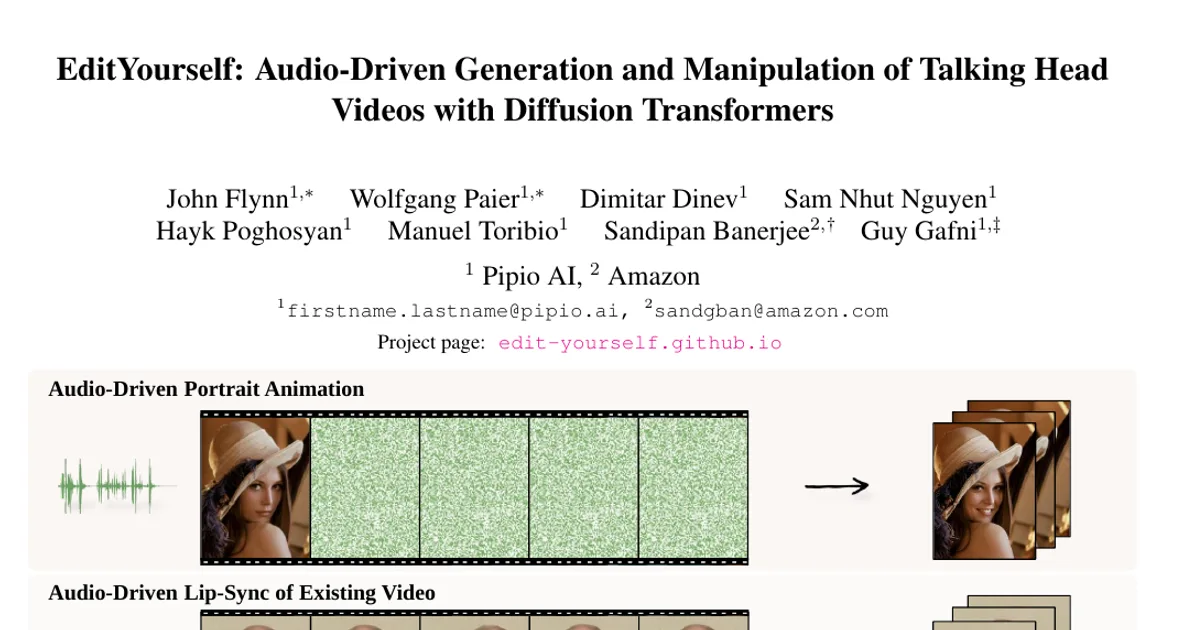
Existing generative video models are good at creating new content from text or image prompts, but they are weak at editing videos that already exist, where changing a few words of the spoken script must preserve motion, timing, speaker identity, and lip synchronization. The authors reframe talking-head synthesis as "visual dialog editing": a video-to-video task driven by changes to the transcript, so a creator can shoot once and refine the spoken content later. EditYourself adapts a pretrained video diffusion model into an audio-conditioned V2V editor that handles the addition, removal, and retiming of spoken segments.
Key Contributions
- Lip-sync on a pretrained video diffusion model: A two-stage training scheme that enables inference on speech audio across varying text, image, and video inputs while maintaining accurate lip synchronization, plus a windowed audio conditioning strategy that avoids audio feature downsampling and remains robust across varying video frame rates.
- Latent-space visual dialog editing: Formulating transcript-driven video editing directly in latent space, supporting seamless addition, removal, and retiming of spoken segments (with a re-render operation also defined).
- Identity-preserving long video generation: A reference-based identity conditioning mechanism called Forward–Backward RoPE Conditioning, together with TeaCache-aware inference, to stabilize appearance and temporal coherence over long videos.
- A practical editing interface: A transcript-diff workflow that maps word-level edits to Addition, Removal, and Retime operations on the latent video sequence, shifting video production toward a "shoot once, refine later" model.
Main Findings
- Two-stage training: Training proceeds in two stages; in stage 1 the new audio projection module and cross-attention layers are optimized with all other weights frozen. The provided content is truncated mid-sentence during this description, so the remaining schedule is not reported here.
- Audio conditioning design: One audio cross-attention layer is inserted into each DiT block between the text cross-attention and the FFN. Keys and values come from pre-extracted Whisper-small features. The Audio Projection module and associated cross-attention layers introduce approximately 2B additional learnable parameters on top of the 14B-parameter backbone.
- Stable initialization: Audio Projection convolution layers are initialized as average pooling operators and audio cross-attention output projections are set to zero to minimize disruption to the pretrained DiT at the start of training.
- Phase-shifted audio sampling: Rather than interpolating audio features down to the video frame rate, the method samples audio features on a phase-shifted grid using linear interpolation, preserving the original audio feature rate while aligning audio windows to video frames. A learned fixed-size positional embedding tensor encodes position within the window.
- Spatiotemporal mouth inpainting: For V2V lip sync, MediaPipe is used to detect lower-face bounding boxes, and an enclosing box over groups of eight consecutive frames yields a binary mask per latent frame. Noise is applied only inside the masked region, and audio cross-attention output is masked to face tokens.
- Noise timestep bias is required: Noise levels are biased toward the high-noise region using a shifted log-normal distribution with shift μ = 2.05, which places 90% of timesteps in the range [0.60, 0.98]. Without this, the pretrained DiT could infer the mouth without audio, trivializing the cross-attention layers and collapsing lip-sync on novel audio.
- Mask-controlled synchronization modes: At inference, adjusting the mask allows Lip (mouth-only), Face (expressions), or Head (synthesizing new head dynamics matched to audio prosody) behavior.
- Latent-space timeline editing: Latent frame n maps to input video frames 8(n−1)+1 to 8n+1 exclusive, with latent frame 0 mapped to video frame 0, giving an 8-frame-resolution proxy for temporal editing. Additions insert fully noised latent frames; removals delete latent frames and add noise to adjacent latents to re-render smooth transitions; RoPE is recomputed on the edited sequence.
- Long inference with caching: The Time-aware position shift fusion (TAPSF) strategy from Sonic is adapted with a block width of 17 latent frames (136 video frames). Shifting is disabled during the middle steps of denoising, with a shift of 5 latent frames during early and late steps, allowing adaptive caching during the middle 75% of denoising steps and a speedup of approximately 1.6×.
- Identity conditioning: During training, 6 latent frames (corresponding to 64 video frames) are sampled from a temporal window of ±5 s around the target clip, and only lower-face tokens are retained as un-noised reference tokens. Distinct sentinel temporal indices (t = −1, −2, …) are assigned to reference tokens from different frames to avoid aggregation bias, in contrast to zeroing the temporal component of 3D RoPE.
- Forward–Backward RoPE Conditioning: For fully synthetic blocks, full-frame reference tokens from the last-seen and first-available future clean latent frames are assigned "fake" temporal indices, capped so the temporal distance between reference frames and the block is not greater than 3.
- Reported performance claim: The introduction states that evaluations against recent I2V and V2V lip-sync benchmarks demonstrate state-of-the-art visual quality and synchronization accuracy. The specific benchmark names and numeric results are not present in the provided (truncated) content.
- Dataset: 1,070 hours of talking-head footage collected, comprising 70 hours of proprietary high-quality frontal recordings plus 1,000 hours of YouTube user-generated content. After filtering (no scene cuts, SyncC ≥ 3, temporal offset ≤ 40 ms, bit-rate ≥ 2000 Kbps, frame rate in [24, 60], at least 121 frames, and removal of corrupted videos), 475 hours remained, cut into 121-frame clips. Captions were generated with CogVLM2. Source videos span 0.25 to 2.0 MP, aspect ratios from 2:1 through 1:1 to 0.5:1, and 24–60 fps.
- Backbone: The model is based on LTX-0.9.7 / LTX-Video, a 14B-parameter DiT with a separately pretrained Video-VAE using a 32×32×8 compression rate, trained with a flow-matching objective and sampled with a first-order Euler solver over 40 steps.
Methodology in Plain English
The team started from an existing open-weight video diffusion model that already knew how to generate and inpaint video from text, images, and video. They grafted on a new "hearing" pathway: audio is converted into Whisper-small features, projected into the model's latent frame rate, and injected through new cross-attention layers in every transformer block, with roughly 2B extra parameters. To align audio with video without degrading the audio features, they slide a fixed-size window of audio features over each video frame using fractional indices and linear interpolation, rather than resampling audio to the video frame rate.
For editing, they treat the video's latent sequence as something they can cut and splice. New lines become newly inserted, fully noised latent frames; deleted lines become removed latent frames with extra noise applied to neighbors so the model re-renders a smooth transition instead of a jump cut; timing changes become distributed additions or removals. The user's edited transcript is diff-checked against the original to find changed spans, which are mapped to word-level timestamps and converted into these operations. Voice is handled by commercial zero-shot voice cloning tools, so the paper focuses on the visual side.
Because denoising the whole video at once is limited by GPU memory, they process the latents in blocks and loop over blocks inside each denoising step, shifting the block boundaries between steps so context propagates across the whole video. They stop shifting during the middle denoising steps so a caching accelerator can be reused, gaining about 1.6× speed. To stop faces from drifting over long videos, they feed un-noised reference tokens from the subject's own video into the sequence and give those tokens their own fake temporal positions, keeping identity cues distinct without forcing the model to copy those exact frames.
Why This Matters
- Research impact: The paper reframes talking-head synthesis from generation to editing, introducing visual dialog editing as a task and showing that a general-purpose video diffusion model can be specialized for it with audio conditioning, latent timeline manipulation, and long-horizon identity conditioning. It offers a concrete alternative to both identity-drifting image-to-video models and rigid video-to-video lip-sync models.
- Real-world applications:
- Fixing fumbled lines, updating outdated facts, or removing filler words in recorded corporate communications, courses, and interviews without re-shooting.
- Language localization and dubbing, where translated speech changes segment duration (the paper's example shows an English phrase expanding by approximately +1.1 s in German), requiring retiming rather than word-level edits.
- Selective re-rendering of an awkward facial expression or a hand gesture within an otherwise acceptable take.
- Producing personalized variants of a single recording for different audiences, or extending a clip with newly generated segments that match the original speaker.
- Industry relevance: The work targets professional post-production workflows, where selective re-rendering currently demands extensive manual intervention. A transcript-centric interface also plugs naturally into LLM-based automated editing agents, and pipeline-level details such as data filtering thresholds, caching speedups, and GPU-memory-driven block inference signal a production-oriented design rather than a purely academic demo.
Future Directions
- Quantitative benchmarking: The provided content does not report the specific I2V and V2V lip-sync benchmark names or numeric results, so the full evaluation protocol and per-benchmark scores remain to be examined in the complete paper.
- Edit-quality evaluation: Beyond lip sync, it is an open question how to measure and improve the perceptual quality of boundary transitions in removal and retiming operations, where jump-cut artifacts are the key failure mode.
- Training scale and data dependence: The two-stage training recipe is described only up to the start of stage 1 in the provided text, leaving open how much of the 475 filtered hours are needed and how the proprietary 70 hours compare with the 1,000 hours of in-the-wild content.
- Integration with higher-level control: The paper positions transcript editing as an interface for LLM-based agents and other control systems; how such systems would plan multi-operation edits and validate generated results automatically is not addressed.
- Extending beyond speech-driven edits: The same latent-space editing machinery could plausibly apply to non-dialog edits, but the paper scopes the problem to changes in spoken dialog.
Target Audience
Researchers and engineers working on video diffusion models, audio-driven talking-head generation, and generative video editing will benefit most, particularly those interested in adapting pretrained DiTs to new conditioning modalities. It is also relevant to practitioners building post-production tools for dubbing, localization, and video personalization, and to readers tracking how generative video models are moving from content creation toward content repair and restructuring.
Authors’ abstract
Current generative video models excel at producing novel content from text and image prompts, but leave a critical gap in editing existing pre-recorded videos, where minor alterations to the spoken script require preserving motion, temporal coherence, speaker identity, and accurate lip synchronization. We introduce EditYourself, a DiT-based framework for audio-driven video-to-video (V2V) editing that enables transcript-based modification of talking head videos, including the seamless addition, removal, and retiming of visually spoken content. Building on a general-purpose video diffusion model, EditYourself augments its V2V capabilities with audio conditioning and region-aware, edit-focused training extensions. This enables precise lip synchronization and temporally coherent restructuring of existing performances via spatiotemporal inpainting, including the synthesis of realistic human motion in newly added segments, while maintaining visual fidelity and identity consistency over long durations. This work represents a foundational step toward generative video models as practical tools for professional video post-production.