Research
Dynamics-Aware Sparse Attention for Efficient Autoregressive Video Diffusion
Overview Research area: Computer Vision — specifically generative video models, and within that, autoregressive Diffusion Transformers for long video generation and the inference-efficiency techniques
- arXiv
- 2610.26262
- Published
- 2026-10-19
- Authors
- Yuanyu He, Zhuokun Chen, Yefei He, Zhiwei Tang, Jiasheng Tang, Yinghao Yu, Jianfei Cai, Bohan Zhuang
AI summary
Overview
Research area: Computer Vision — specifically generative video models, and within that, autoregressive Diffusion Transformers for long video generation and the inference-efficiency techniques (sparse attention, KV-cache compression, distillation) used to make them practical.
Technical level: Advanced. The paper assumes familiarity with transformer attention, KV caching in autoregressive decoding, diffusion-based generative models, and knowledge distillation.
Scope: A framework that exploits the observation that motion in video is spatially sparse, in order to cut both memory and computation in autoregressive video diffusion while maintaining visual quality.
What This Paper Is About
Autoregressive Diffusion Transformers can generate long videos, but they are expensive: they apply the same dense computation to every region of every frame, and they keep a growing cache of past key/value features in memory. Video, however, is highly redundant — most of what persists from frame to frame is static, and only a small portion of the scene actually moves. The paper's goal is to stop spending uniform resources everywhere and instead direct storage and computation toward the regions that are actually changing, thereby making long-video generation faster and lighter without visibly degrading output.
Key Contributions
-
A unified sparse, motion-driven framework (DASA) that replaces dense processing in autoregressive video diffusion with processing targeted at regions where motion occurs, aiming to remove both storage and computational redundancy at once rather than addressing only one of the two.
-
Dynamics-aware KV-cache compression: instead of retaining the full historical key/value cache, the method keeps only the dynamic features from the generated chunk, which the authors frame as the remedy for the memory bottleneck in long-sequence autoregressive generation.
-
Region-level computation allocation: computational effort is assigned according to localized motion, so static regions receive less processing than moving ones, reducing overall FLOPs.
-
Dynamics-guided distillation: a lightweight distillation training procedure is introduced to recover or maintain generation quality under the sparsified computation.
Main Findings
-
Reported speedup: On VBench, the approach accelerates autoregressive video generation by 2.16x relative to the dense baseline, according to the abstract.
-
Quality retention: The abstract states that high visual fidelity is preserved alongside the speedup, i.e., the acceleration is claimed not to come at a large cost in visual quality. No per-metric quality numbers are given in the abstract.
-
Memory reduction via selective caching: The abstract attributes memory savings to retaining only dynamic features in the historical KV cache. The magnitude of the memory reduction is not stated in the abstract.
-
Motion sparsity as the exploitable structure: The central empirical premise is that video motion is confined to sparse areas, making uniform dense computation wasteful — this is the assumption the method is built on and, per the abstract, the source of the efficiency gains.
-
Not specified in the abstract: baseline comparisons, ablation results, dataset details, model sizes, memory-savings figures, and per-metric VBench scores are all absent and would need the full paper.
Methodology in Plain English
The authors take inspiration from video codecs, which do not store every frame in full but instead separate what stays the same from what changes. They apply the same idea inside the generative model: the video content being produced is explicitly split into dynamic (moving) and static regions.
That split then drives two savings. First, when the model carries forward its memory of previously generated content, it does not keep everything — it keeps only the features associated with the dynamic parts, which shrinks the memory footprint. Second, when it computes the next chunk, it does not spend equal effort across the whole frame; regions with little motion get cheaper treatment while dynamic regions get the full computation. To keep quality up despite this selective processing, they add a lightweight distillation step that trains the sparse model against a fuller reference, so the approximation does not drift too far from dense behavior.
The result is a generation loop that is cheaper to run and lighter in memory because it follows the motion in the video rather than ignoring it.
Why This Matters
Impact on research: The work reframes efficiency in video diffusion as a content-adaptive problem rather than a purely architectural one — the observation that sparsity should follow motion links the efficiency literature to classical video-coding ideas, and offers a template for jointly tackling memory (KV cache) and compute (attention sparsity) instead of treating them as separate problems. It also suggests that temporal redundancy, long treated as a nuisance in generative modeling, is a resource to be exploited.
Real-world applications:
- Long-form AI video generation for advertising, short films, and social media content, where runtime and GPU memory are the binding constraints.
- Interactive or real-time generative video tools (storyboarding, previz, game asset prototyping) that need low-latency iteration.
- Deployment of video generation on memory-constrained hardware, where a smaller KV cache makes longer clips feasible.
- Streaming/edge scenarios where generating video on-device or on modest accelerators is otherwise impractical.
Industry relevance: Inference cost is the main barrier between video diffusion demos and products. A 2.16x generation speedup with preserved fidelity, plus reduced memory pressure, translates directly into lower serving cost per clip, longer clips per GPU, and higher throughput — the metrics that determine whether a video-generation service is economically viable. The codec-inspired framing is also legible to teams from the video-compression world, easing adoption.
Future Directions
-
How far can sparsity go? The abstract reports a single speedup point; the natural next question is the accuracy/efficiency trade-off curve — how much sparsity can be imposed before visual fidelity noticeably degrades, and where that knee lies.
-
Robustness of the static/dynamic split: Cheaply and reliably separating motion from stillness is the load-bearing assumption. How the method behaves on scenes with global motion, camera panning, heavy occlusion, or rapidly changing content is an open question the abstract does not address.
-
Removing or simplifying the distillation stage: The distillation step is described as lightweight, but whether the sparse model could be trained or adapted without any auxiliary distillation, or with an even cheaper signal, is a natural follow-up.
-
Extension beyond autoregressive video diffusion: The dynamics-aware, cache-selective idea is not inherently tied to this architecture — applying it to other long-sequence generative settings (e.g., other temporal or streaming models) is an obvious direction, as is validating it beyond VBench on longer clips and other domains.
Target Audience
Researchers and engineers working on efficient generative models — particularly those building or serving autoregressive video diffusion systems and wrestling with KV-cache memory and attention cost. It will also interest practitioners of sparse attention and model compression looking for a content-adaptive application domain, and applied teams evaluating whether long-video generation is deployable at their compute budget. Readers without grounding in transformer attention, diffusion models, and KV caching will find the mechanism hard to follow, since the abstract presupposes that background.
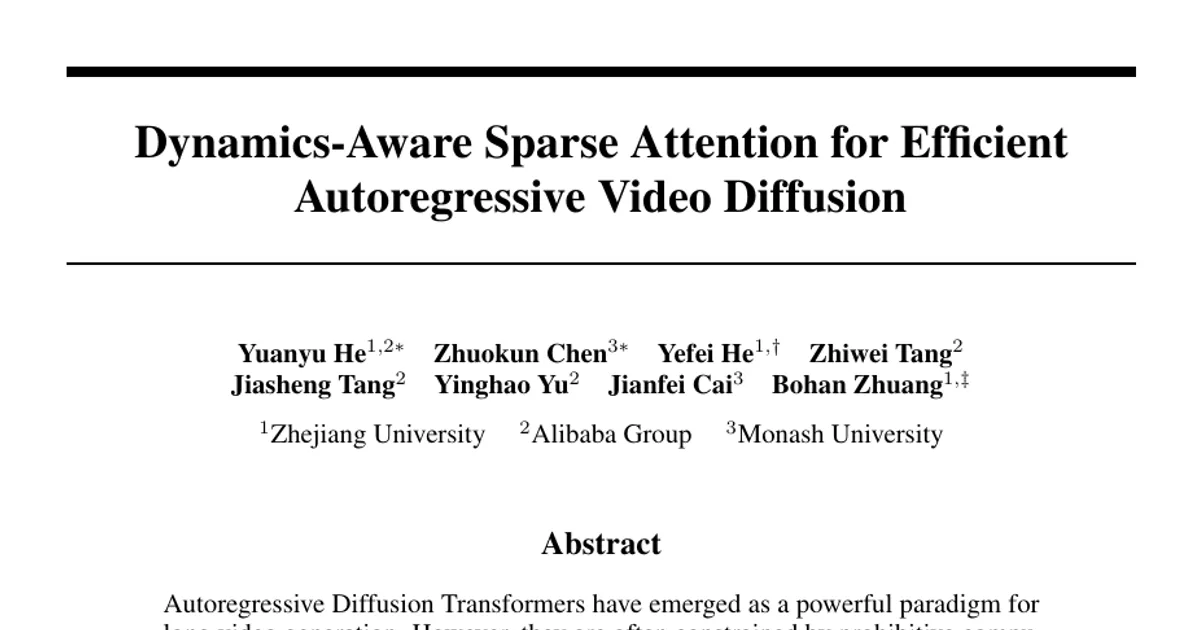
Authors’ abstract
Autoregressive Diffusion Transformers have emerged as a powerful paradigm for long video generation. However, they are often constrained by prohibitive computational overhead and substantial memory footprints. This inefficiency arises from dense computation mechanisms that allocate uniform processing resources across all spatiotemporal regions, failing to leverage the inherent temporal redundancy of video where motion is typically confined to sparse areas. In this paper, we propose Dynamics-Aware Sparse Attention (DASA), a unified framework that shifts from dense computation to sparse, motion-driven generation to eliminate both storage and computational redundancies. Inspired by video codec principles, our approach explicitly decouples video content into dynamic and static regions. To mitigate memory bottlenecks, we selectively compress the historical KV cache by retaining only dynamic features within the generated chunk. Furthermore, to reduce computational overhead, we employ a region-level computation allocation strategy based on localized dynamics. Additionally, a dynamics-guided distillation method is introduced to enhance performance via a lightweight distillation training process. Experiments on VBench demonstrate that our approach accelerates autoregressive video generation by 2.16x, while preserving high visual fidelity.