Research
DuoTouch: Passive Two-Footprint Attachments Using Binary Sequences to Extend Touch Interaction
Overview Research area: Human-Computer Interaction (HCI) — capacitive touch sensing, passive hardware attachments, and interaction techniques for commodity touch devices. Technical level: Intermediate
- arXiv
- 2602.17961
- Published
- 2026-02-20
- Authors
- Kaori Ikematsu, Kunihiro Kato
AI summary
Overview
Research area: Human-Computer Interaction (HCI) — capacitive touch sensing, passive hardware attachments, and interaction techniques for commodity touch devices.
Technical level: Intermediate. The paper combines a physical/electrical design (conductive traces and footprints on a PCB) with signal-processing-style decoding and an empirical characterization study, but the underlying concepts — binary on/off sequences, majority voting, and quadrature-style timing — are explained from first principles.
Scope in one sentence: DuoTouch is a passive, two-footprint attachment with two conductive traces that encodes user motion as binary touch sequences so that unmodified capacitive touch panels can support both discrete commands and continuous control with minimal screen occlusion.
What This Paper Is About
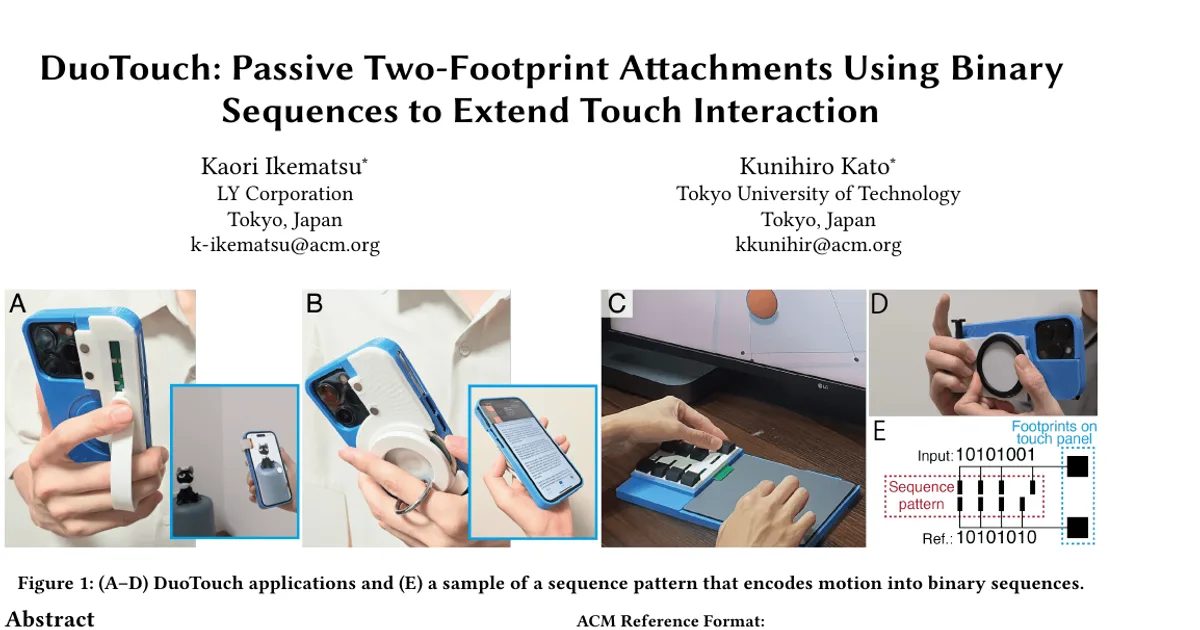
Passive attachments made of conductive materials can extend what a touchscreen can do, but existing designs typically need one on-screen footprint per input (or many footprints), which blocks the display, complicates wiring, and makes precise finger input harder. DuoTouch reduces this to just two fixed on-screen footprints and two conductive traces, called a sequence pattern, that produce temporal patterns of touches and releases as the user actuates a knob, slider, or button. From these binary sequences, the system either recognizes a discrete command or measures direction and distance of motion, using only standard touch APIs on unmodified devices.
Key Contributions
- DuoTouch itself: a passive two-footprint attachment that encodes motion as binary touch sequences on unmodified capacitive touch panels, using two footprints regardless of the number of inputs (O(1) wiring scaling).
- Two configurations with paired decoders: an aligned configuration with a code classifier for discrete commands, and a phase-shifted configuration with a geometric estimator for continuous control.
- A technical evaluation on a smartphone and a touchpad across four electrode widths and a range of speeds (20–200 mm/s in 20 mm/s increments), yielding 1600 total trials and revealing accuracy trends and boundary conditions.
- An analytical characterization and design workflow: a sampling-limited bound linking input speed, electrode width, and sampling rate, distilled into design guidelines (G1–G4 parameter-selection rules, G4–G6 deployment practices) and a design-support tool that exports verified patterns in CAD-ready vector formats.
The paper also notes that Ikematsu et al. (Ikematsu and Kato, 2025b) introduced the initial concept of DuoTouch without reporting accuracy validation, user study, or a design-support tool, and that this work addresses those gaps.
Main Findings
-
Sampling-limited bound governs reliability: The paper derives the bound v ≤ w·f_s (actuation speed must not exceed electrode width times sampling rate), which appears as a diagonal boundary in the accuracy heatmaps. It arises because each reference-bit interval must contain at least one sampling frame, and the required interval count is N ≈ w·f_s / v.
-
Aligned configuration accuracy (within the bound, smartphone at 60 Hz): 75.0% (1.5 mm width), 85.0% (2.0 mm), 90.0% (2.5 mm), and 93.3% (3.0 mm). A trial counted as correct only when every bit position was classified correctly.
-
Aligned configuration accuracy (touchpad at 90 Hz): 92.9% (1.5 mm), 86.7% (2.0 mm), 94.0% (2.5 mm), and 98.0% (3.0 mm).
-
Aligned bound exceeds tested speeds on the 90 Hz device: Once w ≥ 2.5 mm, the sampling-limited bound is above the maximum tested speed of 200 mm/s (225 mm/s at 2.5 mm; 270 mm/s at 3.0 mm).
-
Phase-shifted configuration accuracy (within the bound, smartphone at 60 Hz): mean per-cycle accuracy was 78.3% (1.5 mm), 90.3% (2.0 mm), 96.3% (2.5 mm), and 94.4% (3.0 mm). Accuracy was computed per cycle, with three cycles per trial; a cycle was correct when the detected order of input touch-down and touch-up events relative to the corresponding reference transitions matched the expected direction.
-
Phase-shifted configuration accuracy (touchpad at 90 Hz): 57.1% (1.5 mm), 77.9% (2.0 mm), 87.6% (2.5 mm), and 97.7% (3.0 mm).
-
Accuracy falls with speed and narrow electrodes: Across both devices and both decoding methods, accuracy decreased as speed v increased, with a decline for narrower widths w and lower sampling rates f_s. Two factors explain this: sampling limits temporal resolution near the feasibility bound, and capacitive charging limits usable signal because faster motion shortens electrode dwell and smaller width reduces per-frame capacitance change.
-
Phase-shifted is less robust near the boundary: Compared with the aligned configuration, phase-shifted decoding shows lower mean accuracy and higher variance near the boundary, because it requires two same-sign offsets per interval and a single neutral offset causes rejection.
-
Direction cannot be resolved for palindromic codes: A binary pattern identical to its reverse (a palindrome such as 0110) produces the same bit pattern for leftward and rightward swipes, so it cannot distinguish swipe direction. A binary sequence of length L ≥ 2 has 2^L possible bit patterns.
-
Discrete accuracy thresholds define the design rules: The 90% accuracy contour lies at normalized speed s ≈ 0.73 (aligned) and s ≈ 0.72 (phase-shifted), where normalized speed is s = v / (w·f_s).
-
Recommended widths: For typical finger speeds of v_max = 100–130 mm/s, at 60 Hz use w ≥ 3.0 mm for aligned and w ≥ 3.0 mm for phase-shifted; at 90 Hz use w ≥ 2.0 mm for aligned and w ≥ 2.5 mm for phase-shifted.
Methodology in Plain English
The design starts with two conductive footprints placed over the active area of a touch panel, each connected to a narrow trace running along the path a user-actuated component travels. Each trace alternates conductive and insulating segments. When a conductive part of the knob or button bridges a trace segment and the user's body, the touch controller registers a touch at the corresponding footprint; crossing an insulating gap registers a release. The two traces act as a reference trace (a fixed-pitch periodic pattern producing a timing signal such as 1010…) and an input trace that either carries a fixed binary code (aligned) or is offset relative to the reference (phase-shifted).
For aligned decoding, the timeline is divided into reference-bit intervals. Each input bit is decided by a majority vote of the frames overlapping that interval; if the vote ties, a duration-weighted tie-break is used, and bits that remain equal are marked ambiguous and treated as wildcards when matching against predefined codes. A command is issued only when exactly one code matches. For phase-shifted decoding, the system measures the time offset between an input transition and the corresponding reference edge in each interval. A negative offset means the input leads the reference and a positive offset means it lags; direction is identified when both offsets share the same sign. Distance is accumulated as a signed sum of transition counts, with spatial resolution Δd = L_seq/2 under an interleaved geometry.
To test reliability, the researchers mounted an iPhone 16 (60 Hz) and a Magic Trackpad 2 (90 Hz) on the build platform of a Bambu Lab A1 mini 3D printer. The printer's printhead moved a grounded slider knob at constant speeds (the printer supports 1 mm/s to 500 mm/s in 1-mm/s increments), with a copper-tape lead connecting the slider to ground to simulate user grounding. Electrodes were square with 8 mm side length and 8 mm height; the gap between adjacent reference electrodes was set to 3w so the off interval matched the 2w geometric overlap per contact. The aligned test used the 6-bit code 100011; the phase-shifted test used 6-bit alternation on both traces with the input trace offset by w. Conditions covered 2 trace configurations, 2 device types, 4 widths (1.5, 2.0, 2.5, 3.0 mm) and 10 speeds, with 10 repetitions each, for 1600 total trials. Touch events were logged using standard APIs at each device's default sensing rate.
The findings were then turned into a parameter-selection workflow. The α values were estimated by linearly interpolating along the speed axis for each combination of width and sampling rate to find the normalized speed at which accuracy first crosses 0.90 from above, denoted s_90(w, f_s); these were aggregated over widths w ≥ 2.0 mm and over 60 Hz and 90 Hz, excluding w = 1.5 mm, with the median taken per configuration.
Why This Matters
Impact on research. The paper reframes passive touch attachments around binary sequence encoding rather than footprint proliferation, showing that two fixed footprints can support both discrete and continuous interaction. The sampling-limited bound v ≤ w·f_s gives a testable, device-independent relationship between geometry, motion speed, and touch sampling rate, and the normalized speed measure s = v / (w·f_s) lets results transfer across devices with different frame rates.
Real-world applications.
- Phone hand straps and ring holders that add physical buttons, toggles, or cross-key navigation without covering the display.
- Touchpad add-ons that provide tangible dials or sliders for scrolling, zooming, or volume and brightness adjustment.
- Bounded sliders for scalar adjustment (scroll, zoom, volume, brightness) and unbounded rotary dials for cyclic adjustment (rotate, adjust hue).
- Multiple mechanisms sharing the same two contact footprints, so several controls can be added with minimal footprint and wiring overhead, assuming only one mechanism is actuated at a time.
Industry relevance. DuoTouch works through standard, off-the-shelf OS touch APIs without kernel or firmware changes, works across smartphones, tablets, smartwatches, and touchpads, and has constant O(1) wiring scaling relative to footprint count. Compared to approaches that read raw capacitive data or modulate impedance, it avoids non-public capacitive images and driver modifications. It requires manual assembly of PCBs into a 3D-printed housing, but ships with a design-support tool and a library of STL files for 3D-printed parts.
Future Directions
- Broaden device coverage beyond the two tested devices. The evaluation covered one smartphone (60 Hz class, representative of tablets and smartwatches) and one touchpad (90 Hz class); other panels, electrode sizes, and sampling rates are not reported.
- Improve phase-shifted robustness near the sampling boundary. The phase-shifted configuration showed lower mean accuracy and higher variance than aligned near the bound because a single neutral offset causes rejection; how to recover from or tolerate neutral offsets is an open question.
- Extend the design-support tool and guidelines. The paper describes G1–G4 parameter rules and G4–G6 deployment practices, but the truncated content does not report the full detail of the deployment practices (G5 and G6), nor a formal user study of the tool.
- Report the preliminary user feedback in depth. The paper states that preliminary user feedback was gathered to inform design choices, but the truncated content does not report its results, leaving the user-facing evaluation of the form factors (hand strap, phone ring holder, touchpad add-ons) an area for further study.
Target Audience
This paper is most useful to HCI researchers and interaction designers working on touch input, passive tangible interfaces, and touchscreen augmentation; hardware and embedded engineers interested in retrofitting physical controls onto commodity devices without firmware changes; and practitioners building accessories such as phone straps, ring holders, and touchpad add-ons who need concrete guidance on electrode width, code length, and speed limits. Readers comfortable with basic electronics timing concepts (bit intervals, majority voting, quadrature-like phase relations) will get the most from the decoding and design-rule sections.
Authors’ abstract
DuoTouch is a passive attachment for capacitive touch panels that adds tangible input while minimizing content occlusion and loss of input area. It uses two contact footprints and two traces to encode motion as binary sequences and runs on unmodified devices through standard touch APIs. We present two configurations with paired decoders: an aligned configuration that maps fixed-length codes to discrete commands and a phase-shifted configuration that estimates direction and distance from relative timing. To characterize the system's reliability, we derive a sampling-limited bound that links actuation speed, internal trace width, and device touch sampling rate. Through technical evaluations on a smartphone and a touchpad, we report performance metrics that describe the relationship between these parameters and decoding accuracy. Finally, we demonstrate the versatility of DuoTouch by embedding the mechanism into various form factors, including a hand strap, a phone ring holder, and touchpad add-ons.