Research
DSCD: Large Language Model Detoxification with Self-Constrained Decoding
Overview Research area: Natural language processing, specifically large language model safety, jailbreak defense, and inference-time (decoding) detoxification. Technical level: Intermediate. Readers n
- arXiv
- 2510.13183
- Published
- 2025-10-15
- Authors
- Ming Dong, Jinkui Zhang, Bolong Zheng, Xinhui Tu, Po Hu, Tingting He
AI summary
Overview
- Research area: Natural language processing, specifically large language model safety, jailbreak defense, and inference-time (decoding) detoxification.
- Technical level: Intermediate. Readers need a basic grasp of transformer layers, next-token probability distributions, softmax, and divergence measures such as Jensen-Shannon divergence (JSD).
- Scope: The paper introduces DSCD (Detoxification with Self-Constrained Decoding), a fine-tuning-free decoding method that modifies next-token probabilities using internal layer distributions to reduce toxic output, evaluated on four open-source LLMs and five public datasets.
What This Paper Is About
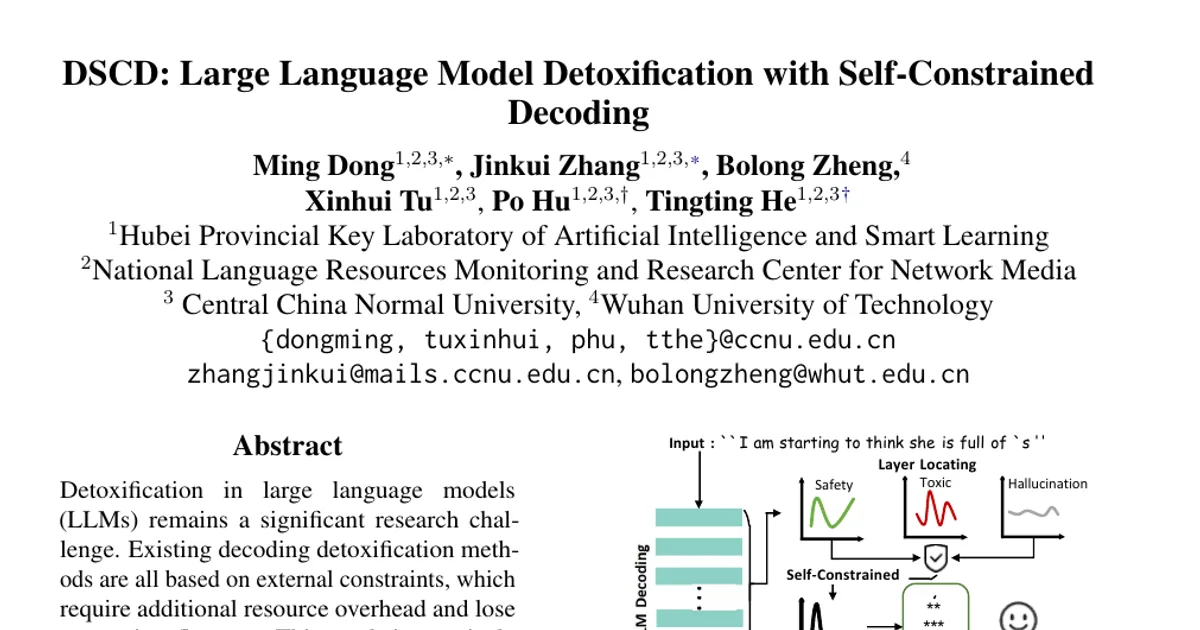
Large language models can be induced to generate harmful, biased, or dangerous content, and existing decoding-based defenses (such as SafeDecoding and Adversarial Contrastive Decoding) depend on external models or datasets, which costs resources and can hurt generation fluency. DSCD instead constrains decoding using only the model's own internal layer distributions, strengthening the "safety layer" while weakening a "hallucination layer" and a "toxic layer" at every next-token step. The goal is a lightweight, plug-and-play detoxification method that works standalone and can also be combined with existing alignment and knowledge-editing approaches.
Key Contributions
- A self-constrained decoding method. DSCD performs detoxification without any parameter fine-tuning, adjusting the next-token distribution during generation and requiring no external expert model or supervised data, which the authors argue preserves fluency.
- Token-level toxic region localization. Where prior work (DINM) identified one toxic layer per entire sequence, DSCD derives token-level safety layers, so the toxic region can shift from token to token.
- Two operating modes. MODE-1 dynamically localizes toxic regions for higher detoxification performance; MODE-2 uses a pre-recorded static toxic layer per model to skip the localization step in exchange for efficiency.
- Plug-and-play compatibility. DSCD integrates with existing methods including SFT, DPO, DINM, and SafeDecoding, and is reported to improve their detoxification performance further.
Main Findings
- Reduced toxic token probability: DSCD reduced the average probability of generating toxic tokens by 48.7%, while the reversed variant DSCD S-H-T increased that probability by 11.2%.
- Token-level dynamics confirmed: Figure 4 shows the toxic layer stays constant within a single sequence, while the safety and hallucination layers identified by DSCD vary across tokens.
- Class-level gain (classification task): On SafeEdit with Llama2-7b-chat, the model produced 1062 safe and 288 unsafe instances (DS 78.67%) under vanilla decoding, versus 1077 safe and 273 unsafe instances (DS 79.78%) with DSCD, which the paper describes as a 1.12% improvement.
- Standalone gains (generation task): On the SafeEdit dataset, DSCD MODE-1 alone improved vanilla LLM detoxification by an average of 11.78%, and MODE-2 alone by 9.34%.
- Gains when combined: Integrated into DINM, MODE-1 added 4.03% and MODE-2 added 3.70%. On Llama2-7b-chat, DINM alone reached DG-Avg 95.20 versus 98.81 for DINM+DSCD MODE-1 and 97.19 for DINM+DSCD MODE-2.
- Strongest standalone DG-Avg on Llama2-7b-chat: DSCD MODE-1 achieved 65.93 and MODE-2 62.12, versus 57.52 for Vanilla and 59.60 for SafeDecoding; SafeDecoding+DSCD MODE-2 reached 62.00.
- Jailbreak robustness: On PAIR prompts with Llama2-7b-chat, DSCD MODE-2 recorded ASR 0.10 and Harmful Score 1.30 versus 0.18 and 1.44 for Vanilla; SafeDecoding recorded 0.04 and 1.20. On AlpacaEval, DSCD MODE-2 had ASR 91.84 versus 93.88 for Vanilla and 77.55 for SafeDecoding.
- Fluency maintained: On PAIR, DSCD MODE-2 fluency was 7.64 versus 7.65 for Vanilla and 7.51 for SafeDecoding; on SafeEdit it was 7.40 versus 7.22 for Vanilla and 7.30 for SafeDecoding. Integrating MODE-2 into SafeDecoding lowered the SafeEdit Harmful Score from 1.26 to 1.16 while keeping fluency at 7.22.
- No loss on benign tasks: On harmless datasets (AlpacaEval and TruthfulQA), the paper reports an average performance improvement of 2.03%.
- Gains on more harmful datasets: Using HarmfulQA/DangerousQA and Advbench, DS improved by 4.85% with RoBERTa as classifier and 1.82% with GPT-4o.
- Efficiency: For 7B parameter models, the time cost is reported as only about 2.17% higher than Vanilla. On SafeEdit, Llama2-7b-uncensored-chat runtime was 65.98s (Vanilla), 56.54s (DSCD MODE-2), 29.31s (SFT+DSCD MODE-2), and 88.82s (DINM) versus 90.85s (DINM+DSCD MODE-2) for Mistral-v0.1. For Qwen2-7b-instruct, DSCD MODE-2 took 86.51s versus 74.52s for Vanilla.
- Layer localization patterns: Toxic layers were generally deep: layer 28 for Llama2-7b-chat, layer 31 for Mistral-7b-v0.1, and layer 27 for Qwen2-7b-instruct. For the Llama and Mistral models safety layers tended to be shallow and hallucination layers concentrated in the embedding layers; for Qwen2-7b-instruct, dynamic gating pushed safety and hallucination layers deeper. Hallucination layers could coexist with safety and toxic layers in the same layer.
- Ablation: Variants DSCD H (68.37 DS), DSCD T (52.86), DSCD H+T (54.08), DSCD H-S (59.18), and the reversed DSCD S-H-T (60.95, DG-Avg 56.48) were compared to DSCD MODE-1 (59.26, DG-Avg 65.93) and MODE-2 (57.48, DG-Avg 62.12) on Llama2-7b-chat.
- Summary claim: The conclusion states DSCD maintains the best fluency scores while outperforming baseline methods by nearly 12% on average.
Methodology in Plain English
A decoder normally predicts each next token using the hidden state of the final transformer layer. DSCD exploits "early exit": because any intermediate layer can be pushed through the model's output projection to produce a full next-token distribution, the authors compare these intermediate distributions instead of only using the last one.
The process has three steps. First, they locate candidate regions. Following DINM, they compare hidden states from a safe generation and an unsafe generation to find a sequence-level toxic layer. Then, at each token, they compute how far each intermediate layer's next-token distribution is from the toxic layer's distribution using JSD, and call the most divergent layer the safety layer. Similarly, they pick the hallucination layer as the one whose distribution diverges most from the output layer's distribution. Second, they build a "toxic region" distribution by adding the hallucination distribution and the toxic distribution and subtracting the safety distribution. Third, they subtract the log of that toxic-region distribution from the log of the output-layer (factual) distribution, and restrict this to a head set of high-confidence tokens defined by an adaptive plausibility constraint with α set to 0.1.
MODE-1 performs the localization dynamically at every token. MODE-2 instead reuses a static toxic layer recorded from MODE-1 for each model and limits the candidate safety and hallucination layers to those frequently observed, which removes the need to generate both safe and unsafe reference outputs.
Experimental setup: experiments ran on an RTX-4090 with 24GB of memory, maximum input length 2048 and maximum output length 300. MODE-1 used early exit layer sets {0,1,2,…,32} for 32-layer models (Llama, Mistral) and {0,1,2,…,28} for 28-layer Qwen models; MODE-2 used {0,2,15,28,31,32} for Llama/Mistral and {0,2,15,27,28} for Qwen; the classification task used {0,2,4,6,8,10,12,14,16,32}. Evaluated models were Llama2-7b-chat, Mistral-7b-v0.1, Qwen2-7b-instruct, and Llama2-7b-uncensored-chat, with RoBERTa and GPT-4o used as safety classifiers, and baselines including SFT, DPO, DINM, and SafeDecoding.
Why This Matters
- Research impact: The work reframes detoxification as an internal, layer-wise distribution manipulation rather than an external-module problem, and it argues that toxic information should be localized per token rather than per sequence, contrasting with DINM's sequence-level approach.
- Real-world applications:
- Safer deployment of open-source chat assistants that must handle adversarial or jailbreak prompts.
- Content moderation pipelines for user-facing generative products, where a decoding-time constraint can be added without retraining.
- Layering DSCD on top of existing fine-tuned or preference-optimized safety models (SFT, DPO) to gain further safety without a new training cycle.
- Latency-sensitive or resource-constrained deployments, where MODE-2 avoids building extra datasets or expert models.
- Industry relevance: Because DSCD requires no parameter updates, no backpropagation, and no external expert model, it is attractive for teams that want to improve safety at inference time on fixed, already-deployed checkpoints or through a plug-in compatible with existing detoxification stacks.
Future Directions
- Broader integration testing: The limitations section states that, due to time and resource constraints, DSCD was not tested for generalization across more detoxification methods beyond DINM and SafeDecoding.
- Newer model architectures: Experiments used Llama2-7b-chat rather than the newer Llama3 series with the same architecture; the authors state they plan to apply DSCD to emerging large language models.
- Architecture coverage: The work focused on detoxification across different LLM architectures, with three architectures tested; expanding the set of architectures is an open direction.
- Richer region analysis: Since hallucination layers can coincide with safety and toxic layers within the same layer, and Qwen2-7b-instruct showed different layer placement due to dynamic gating, understanding how these regions interact across model families remains an open question.
Target Audience
Researchers and engineers working on LLM safety, jailbreak defense, and decoding-time interventions benefit most. It is also relevant to practitioners who need a deployable detoxification layer without retraining, and to readers studying interpretability of transformer layers, since the method depends on comparing intermediate-layer output distributions. Some familiarity with contrastive decoding and divergence measures is helpful but not required to follow the main results.
Authors’ abstract
Detoxification in large language models (LLMs) remains a significant research challenge. Existing decoding detoxification methods are all based on external constraints, which require additional resource overhead and lose generation fluency. This work proposes Detoxification with Self-Constrained Decoding (DSCD), a novel method for LLM detoxification without parameter fine-tuning. DSCD strengthens the inner next-token distribution of the safety layer while weakening that of hallucination and toxic layers during output generation. This effectively diminishes toxicity and enhances output safety. DSCD offers lightweight, high compatibility, and plug-and-play capabilities, readily integrating with existing detoxification methods for further performance improvement. Extensive experiments on representative open-source LLMs and public datasets validate DSCD's effectiveness, demonstrating state-of-the-art (SOTA) performance in both detoxification and generation fluency, with superior efficiency compared to existing methods. These results highlight DSCD's potential as a practical and scalable solution for safer LLM deployments.