Research
DragonMoCap: Monocular Video-based Motion Capture for Diverse Dragon Topologies
Overview Research area: Computer vision and character animation — monocular (single-camera) motion capture for non-human, fantasy creatures, specifically dragons. Technical level: Advanced. The paper
- arXiv
- 2610.25437
- Published
- 2026-10-18
- Authors
- Zhongfei Qing, Xiaoxiang Zhao, Ling-Hao Chen, Zhongang Cai, Wenjia Wang, Yifan Wu, Qianying Liu, Wei Zeng, Bo Hu, Songnan Li
AI summary
Overview
Research area: Computer vision and character animation — monocular (single-camera) motion capture for non-human, fantasy creatures, specifically dragons.
Technical level: Advanced. The paper assumes familiarity with transformer decoders, CLIP/DINOv2 backbones, 6D rotation representations, kinematic trees, and standard human-mesh-recovery metrics (MPJPE, PA-MPJPE).
Scope (one sentence): The paper presents DragonMoCap, a rig-conditioned framework that recovers per-joint dragon motion from a monocular video and generalizes to unseen dragon skeletons without retraining, by representing each joint as a language-grounded query token.
What This Paper Is About
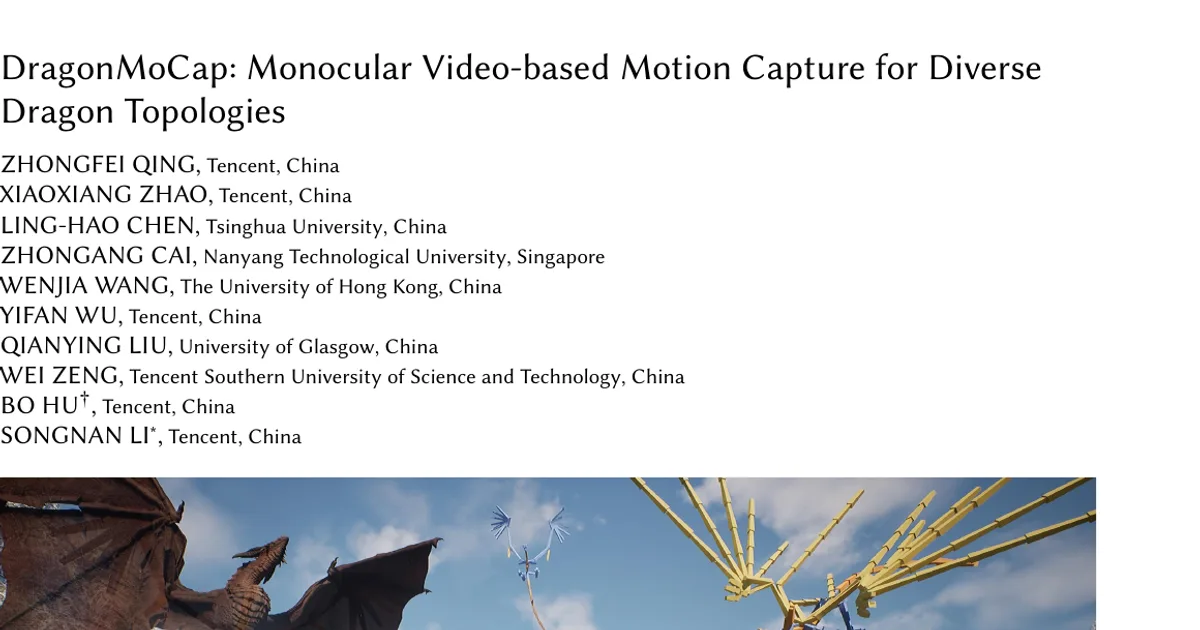
Dragon animation in games and films is still largely hand-keyframed, because the datasets and parametric body models that made human motion capture routine (SMPL, SMPL-X) do not exist for dragons, and production dragon rigs vary wildly — the paper reports joint counts ranging from 20 to over 60, with inconsistent bone naming and differing wing or leg structures. Standard regressors output a fixed-size vector tied to one skeleton, so they cannot be pointed at a new rig. The goal is a single video-based system that takes a user-supplied rig (bone names plus hierarchy) and predicts that rig's motion, including for characters it has never seen.
Key Contributions
- DragonMoCap system: A real-time, video-based motion capture framework for dragon-type characters that predicts per-joint rotations and root translation, integrated as an Unreal Engine 5 add-on for production animation workflows.
- Language-grounded joint query tokens: Each joint is represented by a query that fuses a CLIP text embedding of its (LLM-rewritten) bone name with topological and hierarchical-relation descriptors, giving tokens that are discriminative within a rig but similar across rigs.
- Query-token retrieval: A non-parametric mechanism that gives zero-shot generalization to unseen rigs by scoring training bones against a new joint using semantic and topological similarity, then interpolating their learned residuals — with no retraining and no per-case optimization.
- Scoped topology coverage and evaluation: The framework is deliberately limited to the three most common production topologies — winged quadrupeds, wingless quadrupeds, and winged bipeds (wyverns) — and validated with a UE5-rendered dataset of 8 training and 7 held-out rigs.
Main Findings
- Best accuracy on seen rigs: DragonMoCap reaches 9.46 MPJPE and 6.01 PA-MPJPE (cm), versus 10.57 / 6.53 for the strongest retrained baseline, SMPLest-X, and 11.20 / 7.12 for OSX — a 10.5% MPJPE reduction relative to SMPLest-X. OSX and SMPLest-X cannot be evaluated on unseen rigs because their output heads are defined over training-rig joints.
- Best accuracy on unseen rigs: 12.11 MPJPE and 8.74 PA-MPJPE, against 14.62 / 9.32 for a learned-embedding variant, 15.32 / 9.59 for CLIP-only, and 14.82 / 9.63 for topology-only. All variants share the same retrieval step, so the gap is attributed to query construction.
- Neither descriptor alone is enough: CLIP-only queries show strong cross-rig similarity for corresponding bones but confuse bones sharing the same prefix at different depths; topology-only queries resolve structural ambiguity but miss semantic distinctions. The combined design wins.
- Query-design cross-rig retrieval test: Across 8 dragon rigs, 1,252 queries, and an average of 47.9 candidate bones, combined semantic and structural queries gave the most reliable cross-rig bone retrieval.
- Residuals organize by function, not character: Grouped by semantic category (spine, limb, wing, tail, head, extremity), residuals from different rigs average above 0.85 cosine similarity for spine, limb, and tail bones, while cross-category similarity falls below 0.2.
- Retrieval quality: In a leave-one-rig-out experiment, retrieval achieves 78.3% top-1 and 94.6% top-5 semantic-role match.
- User preference on AI-generated inputs: With 40 participants × 30 clips = 1,200 paired trials per criterion, mean 5-point Likert scores favored DragonMoCap — motion fidelity 4.4 vs 3.7 (72.5% win rate), anatomical plausibility 4.5 vs 3.2 (83.6% win rate, +1.3), overall visual quality 4.6 vs 4.1 (74.8% win rate), all with p < 0.001 by Wilcoxon signed-rank test.
- Interpretable attention: Cross-attention visualizations show queries such as "Head" activating the dragon's head across poses and rigs, and "Wrist_L"/"Wrist_R" attending to the correct respective wing joints.
- Speed: The full per-frame pipeline runs at approximately 30 FPS on a single NVIDIA L20 GPU; rig-level quantities are cached, and when driving multiple rigs from one video only the lightweight decoder is re-run per rig.
Methodology in Plain English
The system works frame by frame. A frozen DINOv2 ViT-L/14 image encoder turns each video frame into a grid of visual feature tokens. Separately, the target rig is described to the network in words and structure: each bone's name is first rewritten by an LLM into a more consistent, descriptive form, then encoded by a frozen CLIP text encoder; this is combined with hand-built topological features (depth in the tree, child count, chain position, leaf status, subtree size, ordering cues, plus laterality and role indicators parsed from the name) and with a descriptor of each joint's directed ancestor/descendant relations and path lengths.
These three embeddings are concatenated, projected, and refined by a skeleton encoder whose attention carries a hierarchy bias — a joint attends more to its ancestors, less to its descendants, scaled by tree distance, within a limited hop neighborhood. The result is a shared query per joint. During training each joint of each training character also gets a small learnable residual added to its query, capturing the motion habits of that specific bone.
A transformer decoder then takes the translation token plus all adapted joint queries, lets them self-attend, cross-attend to the image tokens, and outputs a root translation and a 6D rotation per joint through two small prediction heads. Because the output is just one prediction per input query, the network handles any joint count; because the rotation head is shared, no joint identity is baked into the weights. Training uses a per-frame L1 loss on 6D rotations (averaged over joints, so bigger rigs don't dominate) plus an L1 term on root translation; image and text encoders stay frozen.
For a new, unseen rig, the network cannot look up residuals it never learned. Instead, every training bone is stored in a bank with its semantic descriptor, topological descriptor, and residual. Each new joint is scored against all bank entries by a weighted sum of semantic and topological cosine similarity; the top matches have their residuals blended by temperature-scaled softmax and added to the new rig's own shared query. That is the whole adaptation — no gradient steps, no new parameters.
Why This Matters
Impact on research: The paper reframes rig diversity as a conditioning problem rather than an architectural constraint, showing that a single decoder can be driven by a variable-length set of joint queries. The dual-property requirement it articulates — intra-rig discriminability plus cross-rig similarity — is a reusable design principle for any capture system aimed at heterogeneous skeletons, and the residual-space analysis gives evidence for why retrieval-based transfer works at all.
Real-world applications:
- Previs and animation blocking for film and AAA games, where dragon motion is currently keyframed by hand.
- Game production pipelines via the Unreal Engine 5 plugin, which lets artists pick a video, assign a mesh, select a subset of bones to capture (filtering out auxiliary gameplay bones), set an output directory, and receive a native UE5 animation asset.
- Sketch-to-motion authoring: a few expressive key-frame sketches are each lifted to a 3D pose and then used as constraints for interpolation (e.g., GenMM) to produce dense sequences on the target rig.
- Motion reassembly: hybrid rigs built by attaching dragon A's wings to dragon B's body still produce plausible motion, supporting asset reuse across a character library.
Industry relevance: The reported ~30 FPS, the cached per-rig computation, the shared image encoder across multiple simultaneously driven rigs, and the shipped UE5 editor integration all target production constraints rather than benchmark-only settings. The authors are largely at Tencent, and the framing is explicitly industrial.
Future Directions
- Extending beyond three topologies. The method is deliberately scoped to winged quadrupeds, wingless quadrupeds, and winged bipeds. How it degrades on serpents, multi-headed rigs, or other fantasy morphologies, and whether the query design scales to them, is untested.
- Closing the unseen-rig gap. There is still a measurable drop from 9.46 MPJPE on seen rigs to 12.11 on unseen rigs; improving transfer (better retrieval scoring, larger bone banks, or hybrid retrieval-plus-finetuning) is an open engineering question.
- Direct comparison with arbitrary-skeleton capture methods. MoCapAnything (V1 and V2) targets non-humanoid capture but was not compared because official code and weights were unavailable; a head-to-head with those and with CAST, which adds a geometric correction stage the authors deliberately omit, would sharpen the claims.
- Evaluation beyond rendered data. All quantitative results come from UE5-rendered held-out data, with AI-generated inputs assessed only by user study because they lack ground truth. Validation on real filmed footage and on animator-authored production rigs would test the pipeline under distribution shift.
Target Audience
Researchers in monocular motion capture and character animation who work on non-humanoid or arbitrary-skeleton problems; technical artists and R&D engineers in games and VFX who need to drive many heterogeneous rigs from video; and readers interested in how language-grounded representations (CLIP semantics plus LLM-normalized names) can substitute for a canonical parametric model when no such model exists. Readers without background in transformer decoders or mesh-recovery metrics will find the method sections dense, though the problem framing and results tables are accessible.
Authors’ abstract
This work explores monocular motion capture for dragon-type characters, which currently relies on manual keyframing due to the lack of high-quality datasets and parametric models. The primary obstacle lies in the extreme topological diversity across dragon rigs, where varying joint counts and naming conventions render traditional fixed-template regressors inapplicable. To address this, we introduce DragonMoCap, a novel framework that treats the target rig as a dynamic input rather than a fixed prior. By deliberately scoping the framework to the most prevalent production topologies, we ensure high-fidelity results across diverse morphologies. The core of our approach is the design of language-grounded joint query tokens, which establish a dual-property representation: ensuring intra-rig discriminability while maintaining cross-rig similarity. We further propose a non-parametric query-token retrieval mechanism to enable zero-shot adaptation to unseen rigs without retraining. Extensive evaluations demonstrate that DragonMoCap consistently outperforms HMR-style baselines across diverse dragon topologies. The practical utility of our framework is further evidenced by its integration into professional animation workflows, highlighting its potential for real-time industrial applications.