Research
Distill3R: A Pipeline for Democratizing 3D Foundation Models on Commodity Hardware
Overview Research area: Computer vision, specifically multi-view 3D reconstruction, knowledge distillation, and efficient AI. Technical level: Advanced. The paper assumes familiarity with vision trans
- arXiv
- 2602.00865
- Published
- 2026-01-31
- Authors
- Brandon Leblanc, Charalambos Poullis
AI summary
Overview
Research area: Computer vision, specifically multi-view 3D reconstruction, knowledge distillation, and efficient AI.
Technical level: Advanced. The paper assumes familiarity with vision transformers, point-map regression, attention mechanisms, and knowledge distillation objectives.
Scope (one sentence): The paper presents a distillation pipeline (Distill3R) that compresses a 650M-parameter 3D foundation model (Fast3R) into a 72M-parameter student trainable on a single workstation, trading fine-grained regression precision for accessible training, structural consistency, and better metric scale adherence.
What This Paper Is About
State-of-the-art multi-view 3D reconstruction models such as Fast3R (650M parameters, trained on 128 A100 GPUs for 6.13 days) and VGGT (approximately 1B parameters, trained on 64 A100 GPUs for 9 days) produce globally consistent geometry in a single forward pass, but their training requires infrastructure most academic labs do not have. The authors' goal is to lower that barrier by distilling the geometric reasoning of a large teacher into a compact student that can be trained on commodity hardware, targeting a reproducible research baseline rather than competing with state-of-the-art foundation models.
Key Contributions
-
Distill3R distillation framework with an offline teacher cache. A two-stage pipeline (manifest generation, then cache generation and export) that pre-computes teacher supervision so heavy teacher inference is decoupled from the student training loop, making distillation feasible on a single workstation.
-
A confidence-aware distillation loss. The geometric loss is weighted by the cached teacher confidence rather than the student's own predicted confidence, which the authors state prevents degenerate solutions (predicted confidence collapsing toward zero to attenuate loss) and provides a stable optimization landscape for short training cycles. Teacher confidence maps are also directly supervised with a mean L1 loss.
-
A democratized research baseline with characterized trade-offs. A 72M-parameter student achieving a 9x parameter reduction and 5x inference speedup relative to its 650M-parameter teacher, fully trainable in under 3 days on a single workstation versus up to a week on massive GPU clusters for the teacher.
-
Evidence that distillation regularizes metric scale. The student adheres more closely to absolute metric scale than the teacher on both indoor (7-Scenes) and extreme OOD object-centric (DTU) scenes, despite lower fine-grained accuracy and completeness.
Main Findings
- Inference efficiency. At N = 128 views, Distill3R runs in 2.69 s with 31.90 GB peak memory versus Fast3R at 10.11 s and 44.36 GB, which the authors describe as nearly 5x faster than the teacher. Against VGGT, Distill3R is described as nearly 6x faster by N = 64 views, where VGGT takes 6.40 s and 38.41 GB while Distill3R takes 1.02 s and 21.80 GB; VGGT runs out of memory at N = 96 and N = 128.
- Full latency and memory scaling. Distill3R: 0.13 s / 4.05 GB (N = 12), 0.41 s / 9.97 GB (N = 32), 1.02 s / 21.80 GB (N = 64), 1.78 s / 28.69 GB (N = 96), 2.69 s / 31.90 GB (N = 128). Fast3R: 0.32 s / 6.86 GB, 1.14 s / 12.11 GB, 3.26 s / 21.11 GB, 6.35 s / 32.36 GB, 10.11 s / 44.36 GB at the same view counts.
- Reconstruction accuracy gap. On 7-Scenes (OOD), the teacher achieves Acc 2.45 and Comp 2.97 versus the student's 8.76 and 8.88 (median distance scaled by 100x). On DTU (OOD), the teacher achieves Acc 0.31 and Comp 0.41 versus the student's 1.16 and 1.77. The authors attribute the gap to subtle geometric warping and scale ambiguities that affect regression metrics but do not preclude functional utility.
- Superior metric scale adherence. On 7-Scenes, the student achieves an average scale factor of 1.62 versus the teacher's 3.54, where 1.0 is perfect metric scale. On DTU, the student achieves 394.59 versus the teacher's 942.49 (DTU ground truth is in millimeters, 7-Scenes in meters).
- Loss ablation on DTU (OOD). Full Distill3R: Acc 1.25, Comp 1.54, Scale 380.30. Without weighting: Acc 1.42, Comp 1.88, Scale 467.85. Labels-only (no weighting, no confidence): Acc 1.37, Comp 2.09, Scale 409.05.
- Distillation matters. The authors report that removing the distillation signals results in a 9.6% reduction in accuracy and a 35.7% degradation in completion quality.
- Encoder ablation. DUNE ViT-S (21M parameters) was chosen as the backbone; preliminary ablations showed DINOv3 ViT-S yielded significantly poorer 3D reconstruction quality, and CroCo-B lacked a publicly available ViT-Small variant compatible with the student's d = 384 design.
- Training behavior over time. Quantitative metrics saturate early, with qualitative analysis showing improvements in structural coherence and surface smoothness as training progresses to 60 epochs. During extended training, accuracy and metric scale continue to improve while the completeness metric degrades slightly.
- Known limitation. The student achieves accurate translation in the global reference frame but exhibits rotational drift in global pose estimation, which the authors identify as a primary structural limitation of this iteration.
Methodology in Plain English
The authors take a large pretrained 3D reconstruction model as a teacher and train a much smaller student to imitate it, but they restructure the process so that the expensive part happens once, offline.
Step 1 — Build a manifest. Raw data from six datasets (CO3D-v2, ScanNet++, Habitat, MegaDepth, BlendedMVS, ARKitScenes) are standardized into a common image format and indexed in an image manifest recording dataset ID, scene ID, sample ID, image dimensions, and absolute paths. A dynamic sub-sampling strategy varies the sampling stride by scene type, overlap, and image count, using N = 20 contiguous frames, distilling a multi-terabyte corpus down to approximately 450k images (150 GB).
Step 2 — Cache the teacher's answers. Each sample is passed as a joint batch through the teacher in a single forward pass to produce four supervision maps: a global 3D point map, a local 3D point map, and their two confidence maps. These are down-sampled to 224 x 518 (divisible by the student encoder's 14 x 14 patch size), filtered by a confidence threshold of tau = 0.3 on the local confidence map to create a binary validity mask, quantized from float32 to float16, and stored with run-length-encoded masks, reducing storage expansion from 7x to 4x. The N maps per sample are stacked and saved into single consolidated archives to avoid file-handle limits and CPU overload. Cache generation takes 11.3 hours on a single RTX 6000 Ada.
Step 3 — Train a small student. The 72M-parameter student keeps the teacher's overall shape but swaps in lightweight parts: a DUNE ViT-S encoder (21M parameters, weights shared across all views), learned positional embeddings with a fixed embedding for the reference frame and randomized view ID embeddings for the rest, a compressed global fusion transformer (6 layers, 6 heads, 384 embedding dimension, initialized from scratch), and two lightweight DPT heads that regress the global/local coordinates and confidences.
Step 4 — Use a confidence-aware loss. Training now looks like ordinary supervised learning, since the teacher's outputs are already cached. The loss has two parts. The geometric part is a weighted mean squared error on global and local point maps, where the per-pixel weight is the cached teacher confidence, not the student's. A hyperparameter alpha_g = 2.0 up-weights the global geometry loss, alpha_l = 1.0 weights the local loss, and gamma = 0.001 down-weights the confidence loss. The confidence part is a mean L1 loss between the student's confidence maps and the teacher's. Losses are computed only on valid pixels. Global and local coordinates are normalized differently—one shared scale factor across the whole batch for the global loss, and a per-view scale factor for the local loss—so the model generalizes across view combinations.
Training setup. AdamW with weight decay 0.01, cosine annealing with linear warmup over the first 3,500 steps, peaking at 1e-4 and decaying to 5e-5, bf16 mixed precision, and FlashAttention to scale to N = 20 views. Training runs for 60 epochs over 2.875 days at a 224 x 518 resolution, using a per-GPU batch size of 4 with 2 gradient accumulation steps for an effective batch size of 16, on a workstation with two NVIDIA RTX 6000 Ada (48 GB) GPUs. The pipeline is verified to run on a single GPU without modification.
Why This Matters
Impact on research. The paper argues that progress in 3D vision has concentrated in a small number of frontier labs with large GPU clusters, and that the community has responded by gravitating toward inference-only optimizations (post-training quantization of VGGT to 4 bits, removing global attention in early decoder layers, block sparse attention, token pruning) rather than addressing training cost. Distill3R shifts the target from inference-only deployment toward an accessible training pipeline, so labs can modify and specialize models on their own data without industrial-scale infrastructure.
Real-world applications:
- Robotics: navigation initialization and reactive obstacle avoidance, where high update rates and qualitative scene understanding are argued to outweigh millimetric precision.
- Local occupancy mapping and spatial awareness on mobile robots and embedded systems, enabled by the 5x inference speedup and lower memory footprint.
- Edge deployment in medical applications and autonomous navigation, where 3D reconstruction is described as most valuable but current model sizes are impractical.
- Domain-specific specialization, such as medical imaging or specific industrial environments, where a general-purpose foundation model may be too costly to deploy.
Industry relevance. The 9x parameter reduction, lower peak VRAM (31.90 GB versus 44.36 GB for the teacher at N = 128, and far below VGGT which runs out of memory beyond N = 64), and 5x speedup make compact 3D reconstruction more viable for products that need on-device or low-latency geometry inference. The authors frame the work as an exploratory baseline rather than a state-of-the-art competitor, and note that the student's superior metric scale adherence (1.62 versus 3.54 on 7-Scenes) may matter more than textural precision for robotics-style consumers.
Future Directions
- Addressing rotational drift. The student gets accurate translation but fails to capture the rotation needed to align views, because the Fast3R teacher relies on ICP-based alignment during its own training and supplies geometry already anchored to a reference frame. The authors propose that permutation-equivariant models such as pi^3, which infer camera parameters without a fixed reference frame, are a promising direction—while noting this would require a non-trivial expansion of the training pipeline and evaluation scope.
- Data augmentation. Adding aspect-ratio and scale-invariant augmentations with matching logic in the teacher cache to improve robustness to varying sensor characteristics.
- Geometric priors. Integrating a planar loss (Manhattan-world prior) to improve metrics on indoor benchmarks like 7-Scenes where warping is present.
- Functional scaling. For robotics applications where raw RMSE is secondary to navigation utility, exploring more aggressive compression of the fusion transformer to target ultra-low-power edge devices.
An open question the paper raises is whether the quantitative gap to the teacher can be closed without sacrificing the single-workstation training constraint, and whether the accessibility goal is fundamentally in tension with absolute precision.
Target Audience
Academic laboratories and researchers without access to large-scale GPU clusters who want to train, modify, or specialize 3D reconstruction models on their own domain-specific data; engineering teams targeting edge or embedded deployment of 3D vision; and researchers studying knowledge distillation for dense regression tasks who want a reproducible baseline and a characterized set of trade-offs between model size and reconstruction fidelity. Readers primarily interested in state-of-the-art reconstruction accuracy will find that this work explicitly does not compete on that axis.
Authors’ abstract
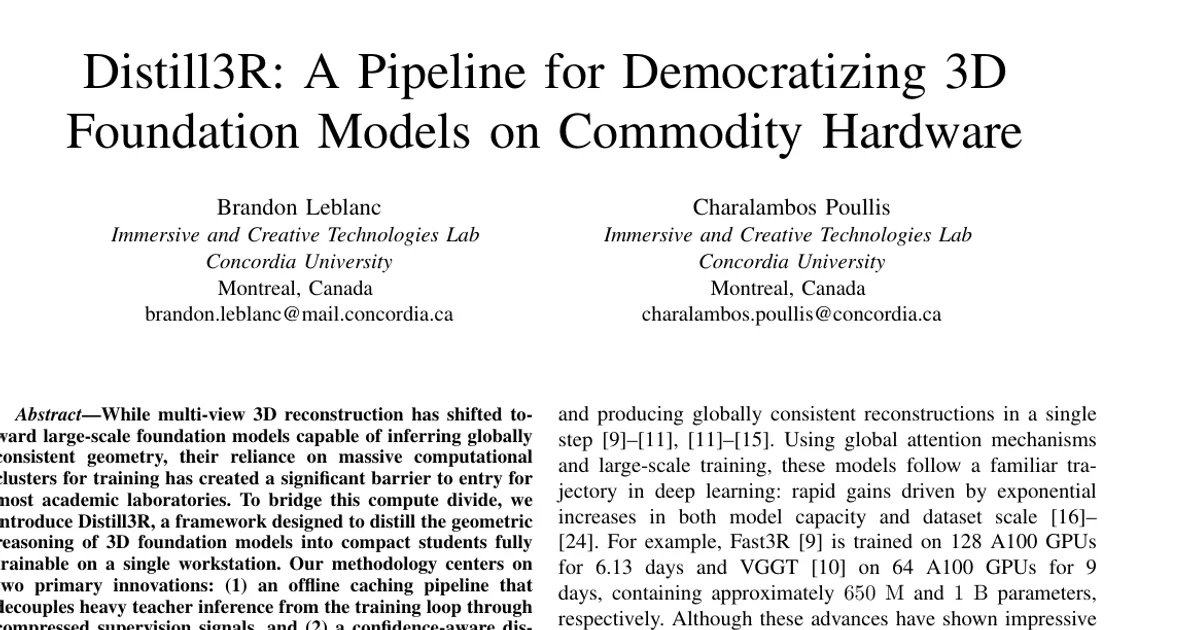
While multi-view 3D reconstruction has shifted toward large-scale foundation models capable of inferring globally consistent geometry, their reliance on massive computational clusters for training has created a significant barrier to entry for most academic laboratories. To bridge this compute divide, we introduce Distill3R, a framework designed to distill the geometric reasoning of 3D foundation models into compact students fully trainable on a single workstation. Our methodology centers on two primary innovations: (1) an offline caching pipeline that decouples heavy teacher inference from the training loop through compressed supervision signals, and (2) a confidence-aware distillation loss that leverages teacher uncertainty to enable training on commodity hardware. We propose a 72M-parameter student model which achieves a 9x reduction in parameters and a 5x inference speedup compared to its 650M-parameter teacher. The student is fully trainable in under 3 days on a single workstation, whereas its teacher requires massive GPU clusters for up to a week. We demonstrate that the student preserves the structural consistency and qualitative geometric understanding required for functional 3D awareness. By providing a reproducible, single-workstation training recipe, Distill3R serves as an exploratory entry point for democratized 3D vision research and efficient edge deployment. This work is not intended to compete with state-of-the-art foundation models, but to provide an accessible research baseline for laboratories without access to large-scale compute to train and specialize models on their own domain-specific data at minimal cost.