Research
Discriminative classification with generative features: bridging Naive Bayes and logistic regression
Overview Research area: Statistical machine learning / classification methodology, at the intersection of generative and discriminative modeling (stat.ML). Technical level: Intermediate. The paper bui
- arXiv
- 2512.01097
- Published
- 2025-11-30
- Authors
- Zachary Terner, Alexander Petersen, Yuedong Wang
AI summary
Overview
Research area: Statistical machine learning / classification methodology, at the intersection of generative and discriminative modeling (stat.ML).
Technical level: Intermediate. The paper builds on familiar concepts (Naive Bayes, logistic regression) but introduces spline-based density-ratio estimation within a reproducing kernel Hilbert space framework, which requires some statistical background.
Scope: The paper proposes "Smart Bayes," a classifier that replaces raw covariates in a logistic regression with estimated marginal log-density ratios, and evaluates it against Naive Bayes and logistic regression on simulated and real data.
What This Paper Is About
Naive Bayes and logistic regression are two classic classifiers with a well-known trade-off: Naive Bayes is generative, assumes features are independent given the class, and tends to do well with small samples, while logistic regression is discriminative and tends to have a lower asymptotic error rate but needs more data. The paper asks whether the two can be combined so that the useful structure Naive Bayes exploits is retained while the flexibility of logistic regression is preserved. The answer is a hybrid method that feeds Naive Bayes-style log-density-ratio features into a logistic regression, letting the data decide how much weight each feature deserves rather than fixing all weights at one.
Key Contributions
-
Introduces Smart Bayes (SB), a classification framework that fits a logistic regression on generative features defined as marginal log-density ratios, z_k = log{g_1k(x_k)/g_0k(x_k)}. Naive Bayes emerges as the special case where all coefficients α_k are fixed to one.
-
Develops a spline-based estimator for univariate log-density ratios. The method minimizes a penalized likelihood over a reproducing kernel Hilbert space with a smoothing parameter λ, generalizing Silverman's (1978) approach to a broader class of model spaces and penalties.
-
Provides interpretability results. Coefficients exp(α_k) act as hazard ratios for a one-unit increase in the log likelihood ratio z_k, and for exponential family distributions (Gaussian, Bernoulli, Poisson) the log density ratio is shown to be a linear transformation γx + δ with an explicit scaling factor γ.
-
Demonstrates empirical performance. Simulations across multivariate t (df = 5, 10, 30) and multivariate Gaussian data, plus experiments on seven UCI datasets, show Smart Bayes often outperforming both Naive Bayes and logistic regression, particularly at larger training sizes.
Main Findings
-
Smart Bayes generalizes both parent methods. From the generative side it relaxes Naive Bayes's fixed unit weights; from the discriminative side it swaps raw covariates for arguably more informative density-ratio features. The authors note coefficients can legitimately be negative, not just differ from one.
-
Simulation results favor Smart Bayes at large samples. Across multivariate t with 5, 10, and 30 degrees of freedom and a multivariate Gaussian, Smart Bayes always outperformed logistic regression and outperformed Naive Bayes at large sample sizes. With heavier tails (fewer degrees of freedom), Smart Bayes overtook Naive Bayes even at smaller sample sizes.
-
Naive Bayes showed a lower asymptotic error rate than logistic regression as degrees of freedom increased in these simulations — consistent with the pattern discussed by Ng and Jordan (2002) and by Xue and Titterington (2008).
-
Real-data gains on specific datasets. On the adult, ionosphere, and sonar datasets, Smart Bayes achieved lower misclassification rates than both alternatives, with differences generally appearing at larger training sizes. The general shapes of the plots matched those in Ng and Jordan (2002), with minor differences attributed to variable selection and implementation choices.
-
Smart Bayes needs sufficient training data. Because it must estimate density ratios (like Naive Bayes) while also learning weights (like logistic regression), it requires enough observations to realize its advantage.
-
Optimal Bayes recovery in special cases. When both classes are Gaussian, Smart Bayes can recover the optimal Bayes classifier when the classes differ in means but share a covariance, and when they differ in means and covariances but share variances. More generally this holds when the marginal density ratios z_k are linear in x.
-
No numerical error rates are reported in the text. The average misclassification rates are presented only in figures; the provided content does not list specific numeric values for any dataset.
Methodology in Plain English
The authors start from the observation that the logistic regression classifier, when class-conditional distributions are known, equals the log prior odds plus the log density ratio. Naive Bayes approximates that ratio by summing marginal log-density ratios with all weights equal to one. Smart Bayes instead treats those marginal ratios as new inputs and fits a weighted combination of them by logistic regression.
Because real data do not come with known density ratios, the second piece is estimation. For each variable separately, the authors model the log-odds η(x) = log r + log d(x) and fit it by minimizing a penalized negative log-likelihood, where the function lives in an RKHS and the penalty J(η) controls smoothness. For univariate continuous variables with bounded support they suggest a Sobolev space; for variables supported on the real line, a thin-plate spline space. The smoothing parameter λ can be chosen by generalized cross-validation or generalized maximum likelihood.
The estimated log density ratio is then d̂(x) = η̂(x) − log r̂, with r̂ estimated simply as the ratio of class counts. Once each marginal log-density ratio is estimated, these become the features z_k in a standard logistic regression. In practice the authors used R's gam function with family = "binomial" from the mgcv package for the density-ratio step, glm for the logistic regressions, and naive_bayes from the naivebayes package for the Naive Bayes baseline. Computation ran on an AWS EC2 t2.xlarge instance using the clustermq package in R version 4.3.2.
For simulation, they generated data from multivariate t distributions with 5, 10, and 30 degrees of freedom and a multivariate Gaussian, with p = 32 covariates whose means and covariances were taken from the two classes of the ionosphere dataset. They used m training observations per class, split the rest to test, and averaged misclassification over 100 replications, computing error rates every 30 observations. For real data they used seven UCI datasets — abalone, adult, Boston housing, ionosphere, liver, Pima, and sonar — all except abalone drawn from Ng and Jordan (2002). At each training size m they ran 200 replications and reported average out-of-sample misclassification.
Why This Matters
Impact on research. The work adds a concrete, implementable bridge between the generative and discriminative families, showing that the classical "generative vs. discriminative" trade-off need not be a strict either/or. It also contributes a general spline-based density-ratio estimator that the authors note can be applied beyond marginal ratios to joint log density ratios of features.
Real-world applications:
- Medical diagnosis or screening, where small labeled datasets and many biomarkers make the generative/discriminative trade-off practically important.
- Spam or fraud detection, where class-conditional feature distributions carry signal and interpretable coefficients are valuable.
- Remote sensing and geoscience classification (the ionosphere and sonar datasets are canonical examples of this kind of signal classification).
- Propensity score estimation in causal inference, which the authors explicitly flag as a promising application area since better approximation of the Bayes rule may produce better propensity scores than logistic regression.
Industry relevance. Practitioners already choose between Naive Bayes and logistic regression on an ad hoc basis. Smart Bayes gives a principled default that degrades gracefully toward Naive Bayes and retains logistic regression's learnable, interpretable coefficients — an appealing property for regulated or audit-sensitive settings. The reliance on existing R packages keeps the barrier to adoption low.
Future Directions
- Adding structure to the model. Higher-order interactions between generative features and regularization methods to select among them.
- Moving beyond univariate marginals. Extending to multivariate marginal densities guided by prior knowledge or graphical structure, which the authors suggest could yield classifiers closer to the optimal Bayes rule.
- Theoretical characterization. The paper explicitly states it does not provide a theoretical explanation for when Smart Bayes outperforms the alternatives; establishing such conditions is listed as worthwhile future work.
- Embedding generative features in other models. Applying the density-ratio features inside support vector machines, transformers, and other deep learning architectures, and assessing whether the gains transfer.
Target Audience
Statisticians and machine learning researchers working on classification methodology, particularly those interested in the generative–discriminative distinction and in density-ratio estimation. Applied researchers who routinely compare Naive Bayes against logistic regression — in biostatistics, signal classification, or causal inference — will find the framework directly usable given its reliance on standard R packages. Readers should be comfortable with logistic regression, Bayes' rule, and basic smoothing/spline ideas to follow the estimation section.
Authors’ abstract
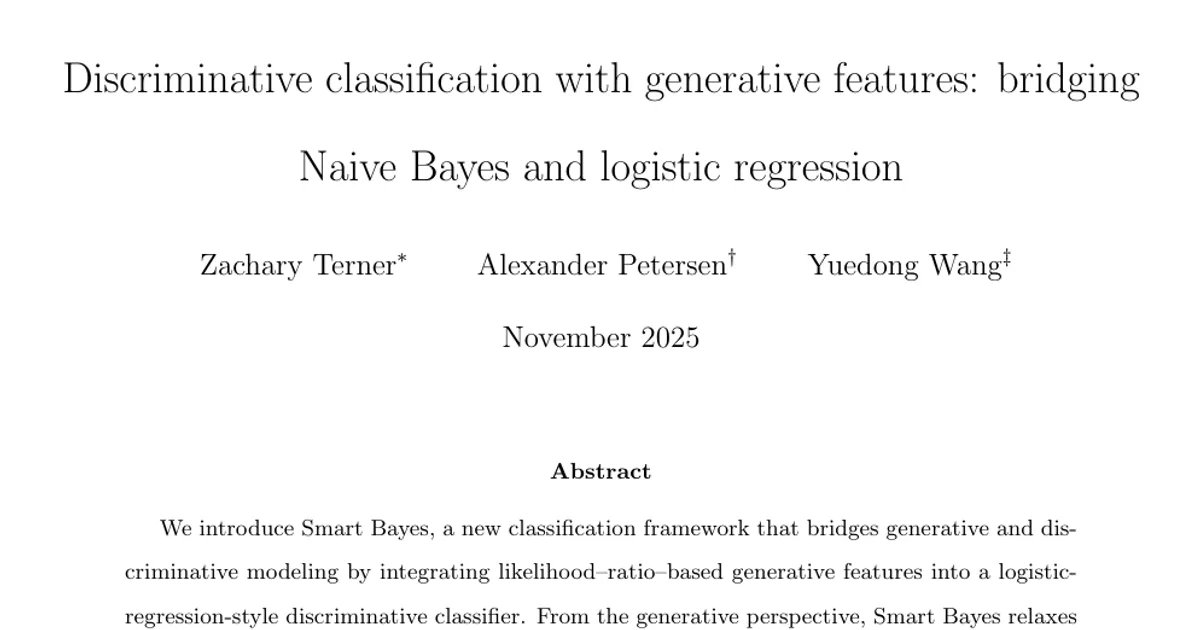
We introduce Smart Bayes, a new classification framework that bridges generative and discriminative modeling by integrating likelihood-ratio-based generative features into a logistic-regression-style discriminative classifier. From the generative perspective, Smart Bayes relaxes the fixed unit weights of Naive Bayes by allowing data-driven coefficients on density-ratio features. From a discriminative perspective, it constructs transformed inputs as marginal log-density ratios that explicitly quantify how much more likely each feature value is under one class than another, thereby providing predictors with stronger class separation than the raw covariates. To support this framework, we develop a spline-based estimator for univariate log-density ratios that is flexible, robust, and computationally efficient. Through extensive simulations and real-data studies, Smart Bayes often outperforms both logistic regression and Naive Bayes. Our results highlight the potential of hybrid approaches that exploit generative structure to enhance discriminative performance.