Research
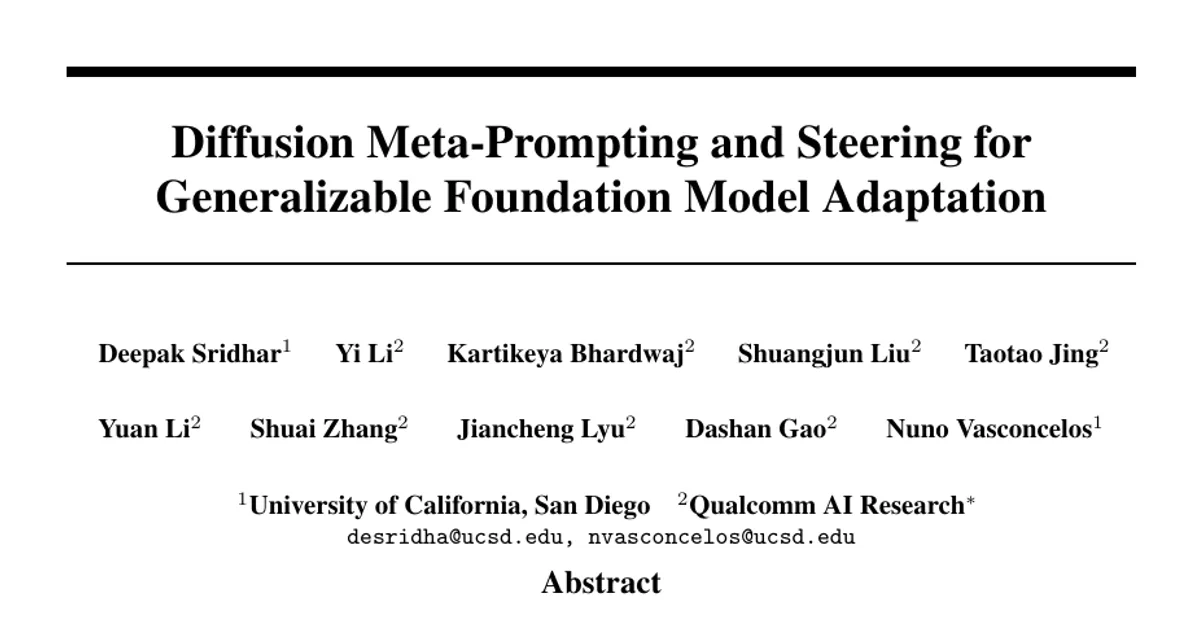
Diffusion Meta-Prompting and Steering for Generalizable Foundation Model Adaptation
Diffusion Meta-Prompting and Steering for Generalizable Foundation Model Adaptation Overview Research area: Computer vision and foundation-model adaptation, specifically prompt learning, meta-learning
- arXiv
- 2610.11067
- Published
- 2026-10-08
- Authors
- Deepak Sridhar, Yi Li, Kartikeya Bhardwaj, Shuangjun Liu, Taotao Jing, Yuan Li, Shuai Zhang, Jiancheng Lyu, Dashan Gao, Nuno Vasconcelos
AI summary
Diffusion Meta-Prompting and Steering for Generalizable Foundation Model AdaptationOverview
Research area: Computer vision and foundation-model adaptation, specifically prompt learning, meta-learning, and diffusion models. Technical level: Advanced (requires familiarity with diffusion models, prompt tuning, CLIP-style vision-language models, and meta-learning). Scope: This paper introduces Diffusion Meta-Prompting (DMP), a framework that learns a diffusion model over a repository of already-learned prompts so that new prompts can be synthesized from natural-language task descriptions, plus a test-time steering strategy that stabilizes sampling.
What This Paper Is About
Prompt learning adapts foundation models to new tasks, but each learned prompt is task-specific: it fails to transfer to new classes, new domains, or combinations of tasks, so practical systems end up storing and searching large repositories of prompts. This paper asks whether prompts can instead be treated as samples from a shared structured distribution, and whether a generative model can be trained over an existing prompt repository to synthesize new prompts on demand without ever revisiting the original task data or task losses.
Key Contributions
- Diffusion Meta-Prompting (DMP). A meta-learning framework that treats learned prompts as samples from a shared distribution modeled by a diffusion model. DMP is trained once on a repository of previously learned prompts and synthesizes task-specific prompts at inference without revisiting original task data, task losses, or performing additional prompt optimization.
- Test-time steering. A training-free inference mechanism that uses the best training-selected prompt in the repository as a latent anchor during DDIM sampling, interpolating the predicted clean prompt with this anchor at each denoising step. It yields up to 2.0% improvement over standard sampling and does not access test classes or target-task examples.
- A theoretical guarantee. Proposition 1 bounds the expected task loss of prompts sampled from a DMP in terms of the empirical loss over the prompt repository (denoising loss ≤ τ) and the denoising error of the diffusion model, with probability at least 1 − δ, up to an o(1) term.
- Broad empirical validation. DMP improves generalization in cross-task and composite classification, text-to-image personalization, and sparse multi-view retrieval, while reducing storage and inference costs by over 90% compared to prompt retrieval approaches, and is shown to be representation-agnostic.
Main Findings
- Composite classification over all classes: On combined dataset classes, DMP reaches 73.6 All / 76.0 Base / 78.8 New accuracy, versus CoOp at 69.6 / 73.6 / 76.7, BPL at 72.0 / 77.5 / 78.4, and ProMetaR at 71.2 / 75.8 / 77.6. DMP improves over CoOp by 4% on All classes and outperforms the best meta-prompting baseline (BPL) by 1.6%.
- Specific dataset pairs: On the EuroSAT and Flowers pair, DMP (zero-shot) reaches 61.1 / 74.5 / 77.8 for All / Base / New, exceeding BPL's zero-shot baseline by +8.5/+4.4% and CoOp by +25.6/+18.4% on All/New classes. DMP also outperforms BPL trained on the entire dataset pair by +2.7% on New classes, and the paper notes BPL requires approximately 10 hours on a 40GB GPU even for a single dataset pair.
- Across 55 composite dataset-pairs: DMP with steering reaches 63.1 All / 69.4 Base / 70.8 New (average 67.8), against CoOp at 58.7 / 65.1 / 65.1 (average 63.0), BPL at 60.8 / 66.3 / 68.7 (average 65.3), and ProMetaR at 61.2 / 67.4 / 68.9 (average 65.8). Reported gains over ProMetaR are +2.0% Base, +1.9% New, +1.9% All; over CoOp, +4.3% Base, +5.7% New, +4.4% All.
- Test-time steering effect: Isolated on the 55 composite pairs, steering adds +1.7 points on All, +2.1 on Base, +2.2 on New, for an average gain of +2.0 points over DMP without steering.
- Hierarchical (taxonomic) classification: Measured as Mean Treecut Accuracy (MTA) over 25 treecuts on ImageNet, SUN, and OOD variants of ImageNet, DMP prompts gain between 2.4 and 9.4% over BPL and between 5.8 and 11.7% over CoOp, despite no prompts ever being trained for hierarchical classification. The abstract summarizes this as roughly 2-9% improvement for hierarchical classification.
- Storage and inference cost: Against the Stylus retrieval method, DMP reduces memory from 1.30 GB to 0.12 GB (91% reduction) and runtime from 12.1 s to 1 s (92% reduction), matching the paper's claim of over 90% reduction in storage and inference cost.
- Text-to-image personalization (DMPVariation): Compared to Textual Inversion (TI), DMPVariation has lower Face-ID (0.299 vs 0.428, a −0.13 difference), indicating diverse yet semantically similar prompts, while improving CLIP-Text similarity to 28.4 (from 27.0, +1.4) and the CSD style metric to 61.8 (from 50.4, +11.4).
- Sparse multi-view retrieval: On MVImgNet with 5,447 gallery objects having only one to four available views each, DMP improves over direct DINOv2 retrieval on every metric: NDCG 93.47 vs 91.64 (+1.83), MRR 94.42 vs 94.36 (+0.06), Top-1 91.74 vs 91.44 (+0.30), and mAP 89.64 vs 86.20 (+3.44).
- Diffusion beats autoregressive alternatives: The paper states diffusion offers better generalization than autoregressive methods, with the supporting comparison placed in Table 19, Appendix A.6.1.
- Operations learned without explicit training: DMPs perform concept composition, guided sampling, novel subject generation, editing, and negative prompting without being trained for these operations, and a single model can serve multiple tasks (subject personalization and slider attributes). The truncated text does not report the full set of retrieval conclusions.
Methodology in Plain English
The starting point is a repository of prompts that other users have already learned for their own tasks, each stored alongside a natural-language description of that task (for example, "SDXL prompt for tattoo synthesis," or a personalization prompt for a named subject). Rather than optimizing prompts one task at a time, the researchers train a diffusion model whose samples are prompts. The diffusion model adds noise to a stored prompt and learns to denoise it back, conditioned through cross-attention on the text description of the task. Because the repository prompts were themselves produced by standard prompt learning under a downstream task loss, minimizing the ordinary denoising MSE is argued to be enough to produce prompts of low downstream risk.
The implementation is a 1D variant of Stable Diffusion, replacing 2D operations with 1D counterparts. Prompts usually live directly in prompt space; for unusually long prompts (d ≥ 2048), a variational autoencoder with fewer than 1M parameters and a latent dimension of 128 is trained to compress them first. Training uses classifier-free guidance, dropping the text conditioning 20% of the time.
At inference, a user specifies only the task text, and the diffusion model samples a prompt, which is then handed to the downstream foundation model. To stabilize sampling, the authors add test-time steering: for each dataset they take the M prompt initializations, pick the one with the highest training accuracy as an anchor, and at every denoising step interpolate the predicted clean prompt with this anchor using a constant λ (they use λ = 0.2). For composite tasks covering K datasets, the anchors are averaged. The anchor is chosen purely from source-task training performance, so no test classes or target examples are used.
Composition and negation follow from treating the diffusion model as an energy-based model: noise predictions for multiple task conditions are combined with per-task temperature weights, allowing a single prompt to be synthesized that reflects several tasks at once, rather than running the downstream model repeatedly. Beyond prompts, the same idea is applied to foundation-model representations for the sparse multi-view retrieval experiment, where DMP is trained on objects disjoint from the gallery and synthesizes embeddings for missing views.
Why This Matters
Impact on research. The paper reframes prompt learning output as data rather than an endpoint, showing that structure exists in prompt space that can be learned and reused. It offers a scalable alternative to double-loop meta-learning, which requires joint training with the downstream model, and it provides a theoretical bound linking diffusion denoising quality to downstream task risk. It also extends the same machinery from prompt embeddings to representation embeddings, suggesting the idea is not specific to prompting.
Real-world applications:
- Personalizing text-to-image models to a specific person, pet, or object and then generating that subject across many contexts, an area currently served by large prompt or embedding repositories such as HuggingFace or Civitai.
- Attribute or style control, where concepts like age, hair, or smiling are adjusted through prompts, merged with subject personalization in a single model.
- Classification systems that must handle mixed or open label sets, for example when a model needs to recognize classes drawn from several unrelated taxonomies at once.
- Product or object retrieval from sparse, incomplete galleries, where each item is captured from only one to four viewpoints and missing viewpoints must be filled in.
Industry relevance. The over 90% reduction in storage and inference cost relative to prompt retrieval, the roughly one-second prompt sampling with 50 DDIM timesteps, and the ability to train on a repository without the original task data all matter for deployment at scale, where storing and searching many task-specific prompt sets is expensive. The paper is a Qualcomm AI Research collaboration with UC San Diego, and training is done on 24GB NVIDIA-A10 or 3090-RTX GPUs, indicating the approach targets commodity accelerators.
Future Directions
- Extending DMP beyond CoOp prompts. The paper notes DMP is agnostic to the prompt repository and can be applied to other prompting methods, but that other methods use additional weights and projection matrices requiring much larger diffusion models; Appendix A.3 reports consistent but smaller gains there. Scaling DMP to those parameter spaces is open.
- Broadening the repository and task count. The classification repository is built from ImageNet and the 10 fine-grained datasets commonly used in prompt-learning literature, with M = 40 initializations each. Whether the learned prompt distribution keeps improving as the repository grows in tasks, domains, and prompting methods is an empirical question the paper leaves open.
- Representation-level generalization. The retrieval experiment shows gains of +3.44 mAP on MVImgNet, suggesting DMP could model structured distributions of other foundation-model representations; how far this transfers to other representation spaces and objectives than sparse multi-view retrieval is unresolved.
- Practical sampling efficiency and steering design. The paper samples with 50 DDIM timesteps at about one second per prompt and points to faster sampling methods as a way to speed this up, and it uses a constant steering weight λ = 0.2 with an ablation in Appendix A.3, leaving the choice of steering schedules or adaptive anchors as further work.
Target Audience
This paper is most useful to researchers and practitioners working on foundation-model adaptation, especially those already familiar with prompt learning methods such as CoOp and CoCoOp, meta-learning approaches such as BPL and ProMetaR, and diffusion model training. It will particularly interest engineers who maintain large libraries of learned prompts or personalized embeddings and want to consolidate them, and researchers studying generalization to unseen classes, composition of tasks, and the theory connecting generative modeling of prompts to downstream task performance. Readers without a background in diffusion models or vision-language models will find the technical sections demanding.
Authors’ abstract
Prompt learning is a popular method for adapting foundation models, but learned prompts are typically task-specific and fail to generalize to new classes, domains, or compositions of tasks. In this paper, we introduce a Diffusion Meta-Prompt (DMP) model , a framework that models the distribution of learned prompts using diffusion models. Given a repository of previously learned prompts, DMP is trained and sampled without access to the original task examples or task losses, and synthesizes new prompts conditioned on natural language task descriptions. To improve the sampling stability, we introduce a test-time steering strategy for DMP, which uses the best training-selected prompt in the repository as a latent anchor during diffusion sampling, without retraining the DMP or accessing test classes. DMP improves generalization across classification, retrieval and text-to-image generation tasks, supports concept composition and negative prompting without explicit training. It reduces storage and inference costs by over 90% compared to prompt retrieval methods. For composite classification, DMP achieves upto 2.0% average gain over prior meta-learning methods across 55 pairs of datasets with gains as high as 8.5% on specific pairs such as Eurosat and Flowers. DMP also enhances cross-task generalization with ~2-9% improvement for hierarchical classification task. We further provide a theoretical guarantee bounding the expected task loss of prompts sampled from a DMP. Code is available: https://github.com/DeepakSridhar/dmp