Research
DiffResearch: Accelerating Deep Research with Diffusion Language Models
Overview Research area: AI systems for automated "deep research" (multi-step web/academic search plus long-form report writing), with a focus on diffusion language models (dLLMs) as an alternative to
- arXiv
- 2610.28909
- Published
- 2026-10-20
- Authors
- Alan-Barsag Gazzaev, Alexey Gavrilov, Mikhail Mozikov, Sergey Muravyov
AI summary
Overview
- Research area: AI systems for automated "deep research" (multi-step web/academic search plus long-form report writing), with a focus on diffusion language models (dLLMs) as an alternative to autoregressive (AR) decoding inside agentic pipelines.
- Technical level: Intermediate. Readers should be comfortable with the basic distinction between autoregressive and diffusion-based text generation, and with the idea of a multi-agent pipeline.
- Scope: A controlled, single-variable comparison of a diffusion backbone against a comparable autoregressive backbone inside an otherwise identical open deep-research framework, measured on latency and report quality over 100 Deep Research Bench tasks.
What This Paper Is About
Deep research systems plan, retrieve evidence, write, and revise in a loop, so end-to-end latency is a real barrier to interactive use. Nearly all production systems rely on autoregressive language models, which generate one token at a time from left to right, making planning and long-form writing inherently sequential. The authors build DiffResearch, an open multi-agent framework where every agent uses a diffusion language model, and they hold prompts, retrieval code, the agentic scaffold, and evaluation fixed while swapping only the backbone, so that any measured difference can be attributed to the decoding paradigm.
Key Contributions
- An open diffusion-native deep research framework released under an Apache-2.0 license, with two operating modes (full and fast), nine agents built on a single interchangeable backbone abstraction, and a deliberately explicit pipeline rather than heavy orchestration layers.
- A controlled latency comparison between diffusion and autoregressive backbones in an otherwise identical pipeline on Deep Research Bench, showing roughly 6× end-to-end speedup concentrated in planning and writing.
- A fast decomposition mode ("dFast") that reads intermediate denoising states and extracts the subquery set before generation finishes, giving a 1.99× median speedup on decomposition in isolation (100-query probe) while preserving downstream report quality.
- A public leaderboard snapshot showing that a version of the same framework built on a stronger diffusion model (Mercury) scores 48.03 overall on the Deep Research Bench RACE rubric (0–100 scale), ranking above several commercial systems, explicitly framed as a system-level rather than a causal-decoding claim.
Main Findings
- End-to-end latency: Over all 100 tasks, AR averaged 71.45 s versus 11.89 s for dFull and 11.97 s for dFast, both about 6.0× faster. The gap holds at the median (48.78 s AR vs. 11.87 s / 12.07 s) and the tail (p90 111.87 s vs. 16.13 s / 16.33 s).
- Where the time goes: The two model-bound stages dominate the AR cost. Planning falls from 39.32 s to ~3.6–3.7 s (10.7×), and writing from 59.78 s to ~5.1–5.3 s (11.7×). Retrieval is essentially unchanged (3.94 s AR vs. 4.83 s / 4.59 s) because it is a shared deterministic Semantic Scholar call, not a model call.
- dFast does not help end-to-end: Its mean and p90 are slightly higher than dFull, so its benefit is confined to the decomposition stage, which is small relative to planning, retrieval, and writing.
- Isolated decomposition probe: On 100 queries asking for exactly six subqueries as JSON, a valid exact-count object appeared during denoising for all 100 queries, with a mean of 8.99 draft steps (median 9, range 6–17). Taking the first exact-count draft was 1.99× faster at the median than full generation (243.4 ms vs. 484.9 ms).
- Stability tradeoff: Requiring a "stable" object (same exact-count JSON in two consecutive states) was only 1.04× faster at the median (468.4 ms) but reproduced the final answer exactly in 91 of 100 cases, versus 1 of 100 for the first draft. The benchmark therefore uses the first draft, since retrieval tolerates wording noise.
- Report quality holds: On RACE (0–1 scale in the controlled runs, Gemini 2.5 Pro evaluator, with cleaning), dFast scored best overall at 0.3969, ahead of AR at 0.3904 by 0.0065 and dFull at 0.3895 by 0.0074. Paired common-success analysis showed every overall-RACE mean-difference interval including zero in both languages.
- Length does not explain the speedup: Diffusion reports were about 10–17% shorter than AR reports in language-specific means (e.g., English 5014 and 4853 characters vs. 5847; Chinese 2147 and 2176 vs. 2410), whereas the writer was 11–12× faster.
- Language diagnostics: dFast scored 0.3909 on English and 0.4016 on Chinese; dFull 0.3925 / 0.3858; AR 0.3925 / 0.3885. AR produced more inline citation groups (10.05 English, 8.52 Chinese) than the diffusion modes (6.67–7.14 English, 3.25–3.83 Chinese).
- Source-grounding audit: Across 10 blinded reports, only 14 of 50 sampled material claims (28%) were fully supported by retrieved evidence, 10 (20%) partially supported, and 26 (52%) not established. Of 76 inline citation mentions, 41 (53.9%) fully entailed the adjacent claim, 21 (27.6%) partially, and 14 (18.4%) did not. Prompt-facet coverage was 87.4% overall (English 92.7%, Chinese 82.2%). The authors identify retrieval grounding as a shared bottleneck rather than a decoding-specific effect.
- Leaderboard snapshot: DiffResearch (Mercury) scored 48.03 overall with 48.20 insight and 47.40 readability, above OpenAI Deep Research (46.45), Dr. Tulu (45.49), and Claude Research (45.00), among others listed.
Methodology in Plain English
The team built a small, explicit multi-agent pipeline in which nine agents handle query formatting, planning, plan-checking, relevance filtering, information extraction, summarization, complexity assessment, query decomposition, and judging. The core flow is intent classification, query reformulation, planning, retrieval, and writing, with judging as an optional sixth stage. Every agent is a Python class inheriting from a common backbone and implementing a single generate method, so the entire generator can be swapped by changing one setting.
For the controlled experiment they used two open models of comparable size: a diffusion model (google/diffusiongemma-26B-A4B-it) and an autoregressive model (google/gemma-4-26B-A4B-it), both served through Hugging Face runtimes on an H200 pod. Everything else stayed identical: the same prompts, the same retrieval configuration (Semantic Scholar only, four subqueries, two results per query, one request per second), and the same RACE evaluation. That yields three configurations: diffusion full, diffusion fast, and autoregressive.
Fast mode is the clever part. Instead of waiting for the diffusion model to finish denoising, a custom streamer inspects each intermediate state, strips thinking-channel artifacts, scans for a JSON object with a subqueries list of exactly the requested length, and stops as soon as one appears. Both modes use the same acceptance criterion — parseable JSON with exactly the right number of non-empty subqueries — so the comparison is fair. The authors stress this is not speculative decoding: no draft model is involved, only the model's own partial denoised states.
They then ran a separate 100-query probe of decomposition alone (timing from the start of generation, model loading excluded) to characterize the mechanism, and a configuration-blinded manual audit of 10 stored reports to check whether claims were actually supported by the retrieved sources.
Why This Matters
Impact on research. This is one of the first controlled measurements of what changes when you replace an autoregressive backbone with a diffusion backbone inside a complete agentic pipeline, rather than in a standalone chat or coding setting. It separates two claims that are easy to conflate: a causal decoding-paradigm claim (latency and quality under a fixed scaffold) and a system-competitiveness claim (leaderboard rank). It also demonstrates a reusable idea — that intermediate denoising states are usable intermediate outputs for downstream agents, not just noise to be discarded.
Real-world applications:
- Interactive research assistants, where a 6× reduction in end-to-end latency turns a minute-long wait into a roughly ten-second one, making conversational back-and-forth with a research agent practical.
- Literature review and evidence synthesis tools used by scientists and analysts, where planning and drafting dominate the wall-clock cost and are exactly the stages that accelerate.
- Enterprise document and competitive-intelligence pipelines that need to fan out many parallel research jobs, so per-job latency directly sets throughput and cost.
- Agentic orchestration generally: reading partial structured outputs mid-generation could apply to query fan-out, tool-call planning, and routing decisions beyond deep research.
Industry relevance. The paper comes from an industry track (EMNLP 2026 Industry Track) and ships under Apache-2.0 with public code. Its findings are directly actionable for teams already running retrieval-augmented agent pipelines: the deployment change is a backbone swap, not a rewrite. The audit results are equally actionable in the other direction — they show that citation faithfulness and evidence sufficiency remain unsolved regardless of decoder, which is where engineering effort should go next.
Future Directions
- Parallel retrieval dispatch. Because fast mode makes all subqueries available in a single denoising pass, their retrieval calls could in principle be issued together. The present runs were rate-limited to one request per second, so this was not evaluated; quantifying it under a higher-throughput retrieval backend is left to future work.
- Broader backbone sweeps. The controlled comparison is a single pair of comparable-size open models. Testing across more model families and sizes would strengthen the attribution to the decoding paradigm.
- Fixing retrieval grounding. The source audit found that 52% of sampled material claims were not established by the stored source packet, and 18.4% of citation mentions did not support the adjacent claim. Re-enabling the arXiv and web channels (both disabled in these runs) and improving source quality are obvious next steps.
- Consumer-grade latency budgets. All speedups were measured on an H200 pod with local retrieval. Behavior on hardware where local diffusion inference becomes the bottleneck, or under tight consumer latency constraints, is not benchmarked.
Target Audience
AI engineers and researchers building agentic retrieval-and-writing pipelines who want to know whether a diffusion backbone is a viable drop-in for autoregressive generation. It also suits practitioners evaluating deep research systems, benchmarking teams interested in how to design a clean single-variable backbone comparison, and anyone working on efficient long-form generation or on citation-faithfulness in retrieval-augmented systems. Readers need only a working familiarity with LLM decoding and multi-agent orchestration; the paper is explicit about what its measurements do and do not establish, which makes it useful for decision-makers as well as implementers.
Authors’ abstract
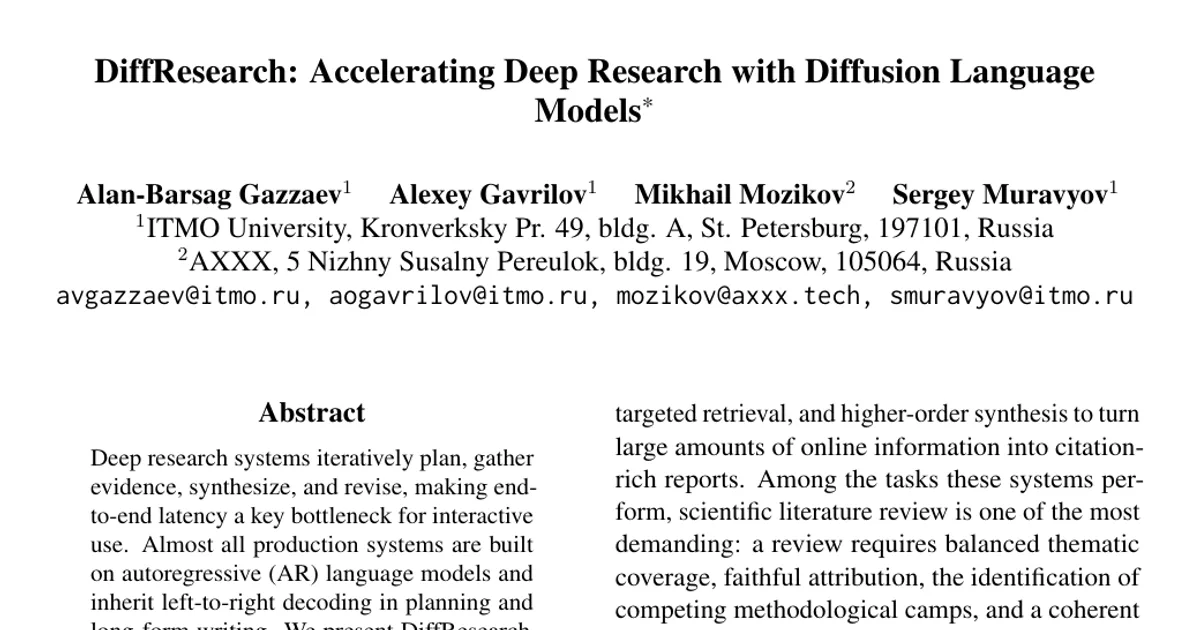
Deep research systems iteratively plan, gather evidence, synthesize, and revise, making end-to-end latency a key bottleneck for interactive use. Almost all production systems are built on autoregressive (AR) language models and inherit left-to-right decoding in planning and long-form writing. We present DiffResearch, an open multi-agent deep research framework that places a diffusion language model (dLLM) at the core of every stage, and measure how a diffusion backbone changes latency and report quality. Holding the agentic scaffold, retrieval code, prompts, and evaluation fixed, we swap the backbone between an open diffusion model and a comparable AR model. Across 100 Deep Research Bench tasks, the diffusion backbone is roughly 6 times faster end-to-end, driven by order-of-magnitude reductions in planning and writing. We further introduce dFast, a decomposition mode that reads intermediate denoising states and extracts subqueries before generation finishes, providing a 1.99 times median speedup for decomposition in isolation with no loss of report quality. On the benchmark's RACE rubric, dFast obtains the best overall score among the three configurations. Finally, in a public system-level leaderboard snapshot, an instance built on a stronger diffusion model ranks above several commercial systems. We release DiffResearch under an Apache-2.0 license.