Research
Difficulty-Aware Label-Guided Denoising for Monocular 3D Object Detection
Difficulty-Aware Label-Guided Denoising for Monocular 3D Object Detection Authors: Soyul Lee, Seungmin Baek, Dongbo Min (corresponding author), School of AI and Software, Ewha Womans University, South
- arXiv
- 2511.13195
- Published
- 2025-11-17
- Authors
- Soyul Lee, Seungmin Baek, Dongbo Min
AI summary
Difficulty-Aware Label-Guided Denoising for Monocular 3D Object DetectionAuthors: Soyul Lee, Seungmin Baek, Dongbo Min (corresponding author), School of AI and Software, Ewha Womans University, South Korea arXiv: 2511.13195v1 [cs.CV], 17 Nov 2025 Code: https://github.com/lsy010857/MonoDLGD
Overview
Research area: Computer vision, specifically monocular 3D object detection with DETR-style (Detection Transformer) architectures, denoising-based training, and aleatoric uncertainty estimation.
Technical level: Advanced. The paper assumes familiarity with transformer decoders, Hungarian matching, query-based detection, anchor-box parameterization, and aleatoric uncertainty losses.
Scope in one sentence: The paper proposes MonoDLGD, a training-time framework that perturbs 3D ground-truth labels with difficulty-dependent strength and trains the detector to reconstruct them, reporting state-of-the-art results on the KITTI benchmark.
What This Paper Is About
Monocular 3D object detection estimates an object's 3D location, size, and orientation from a single RGB image, but this is fundamentally ill-posed because a single image provides no reliable depth cue. Existing transformer-based detectors address this with global attention and auxiliary depth prediction heads, yet they still produce inaccurate depth estimates and treat every object as equally difficult, ignoring instance-level factors such as occlusion, distance, truncation, and scale. MonoDLGD's goal is to inject explicit geometric supervision into training by deliberately corrupting ground-truth labels and forcing the model to rebuild them, with the amount of corruption scaled to how easy or hard each individual instance is.
Key Contributions
-
Difficulty-Aware Label-Guided Denoising (MonoDLGD). A framework that perturbs and then reconstructs ground-truth 3D labels — projected bounding boxes, depths, and classes — guided by predicted detection uncertainty, supplying explicit geometric supervision during training.
-
Evidence that modeling instance-level uncertainty alone improves accuracy. The authors report that incorporating uncertainty into the denoising process produces gains independent of the perturbation strategy, arguing that uncertainty-aware denoising is an important component in monocular 3D detection.
-
3D Dynamic Anchor Box (3D-DAB) queries. Queries are initialized with explicit spatial priors — a projected 2D bounding box, a depth, and a class embedding — rather than arbitrary learnable embeddings, constraining the decoder's search to geometrically meaningful regions.
-
State-of-the-art KITTI performance without extra training data and without additional inference overhead. Perturbation and reconstruction occur only in training, so the authors claim the difficulty-aware denoising adds no inference cost.
Main Findings
-
State-of-the-art on the KITTI test set (Car category). With no extra training data, MonoDLGD reaches 36.63 / 25.3 / 23.13 AP_BEV|R40 and 29.11 / 19.87 / 17.74 AP_3D|R40 for Easy / Moderate / Hard respectively, compared with the MonoDGP baseline at 35.24 / 25.23 / 22.02 AP_BEV|R40 and 26.35 / 18.72 / 15.97 AP_3D|R40.
-
Improvement over the MonoDGP baseline on the test set. +1.39 (Easy), +0.07 (Moderate), and +1.11 (Hard) on AP_BEV|R40; +2.76 (Easy), +1.15 (Moderate), and +1.77 (Hard) on AP_3D|R40.
-
Improvement over the second-best method on the test set. +1.39, +0.07, +1.11 on AP_BEV|R40 and +2.76, +1.03, +0.96 on AP_3D|R40 for Easy, Moderate, Hard.
-
KITTI validation results. 41.68 / 30.53 / 27.76 AP_BEV|R40 and 34.89 / 25.19 / 21.78 AP_3D|R40, versus the MonoDGP baseline at 39.40 / 28.20 / 24.42 and 30.76 / 22.34 / 19.02. Gains over the baseline are +2.28, +2.33, +3.34 on AP_BEV|R40 and +4.13, +2.85, +2.76 on AP_3D|R40.
-
Consistent gains on a second backbone. Applied on top of MonoDETR, the method raises validation AP_BEV|R40 from 36.38 / 26.19 / 22.29 to 38.59 / 27.65 / 23.62 and AP_3D|R40 from 27.34 / 19.33 / 16.04 to 29.79 / 21.63 / 18.17.
-
Minimal inference cost. On KITTI validation, MonoDGP goes from 69.0 to 69.3 GFLOPs and from 42.4 ms to 42.7 ms; MonoDETR goes from 59.7 to 59.8 GFLOPs and from 35.2 ms to 35.5 ms. The paper describes the additional overhead as negligible and states that perturbation and reconstruction are confined to the training phase.
-
Ablation on core components (KITTI val, Car). Baseline (a) 39.40 / 28.20 / 24.42 AP_BEV|R40 and 30.76 / 22.34 / 19.02 AP_3D|R40; replacing anchors with 3D-DAB alone (b) degrades performance to 36.85 / 26.72 / 23.21 and 27.82 / 20.64 / 17.78; adding uniform noise perturbation with an L1 reconstruction loss (c) recovers and surpasses the baseline at 40.32 / 30.13 / 26.53 and 31.99 / 23.82 / 20.65; switching to a Laplacian uncertainty reconstruction loss (d) gives 41.16 / 30.31 / 26.54 and 33.82 / 24.7 / 21.19; the full method with Difficulty-Aware Perturbation (e) reaches 41.68 / 30.53 / 27.76 and 34.89 / 25.19 / 21.78.
-
Uncertainty-aware loss is valuable in denoising. The paper attributes a notable improvement to extending aleatoric uncertainty into bounding-box denoising, reporting this as the (c) versus (d) comparison, and states elsewhere that further gains come from DAP as the (d) versus (e) comparison.
-
Depth supervision drives the largest single gain. Applying denoising only to projected bounding boxes plus class raises Moderate AP_3D|R40 from 22.34% to 23.36%; adding depth to the denoising process raises it to 25.19%.
-
Difficulty-adaptive perturbation beats uniform noise. The authors contrast DAP with DN-DETR-style uniform noise, arguing DAP adaptively regularizes easy instances while preserving the geometry of hard ones.
-
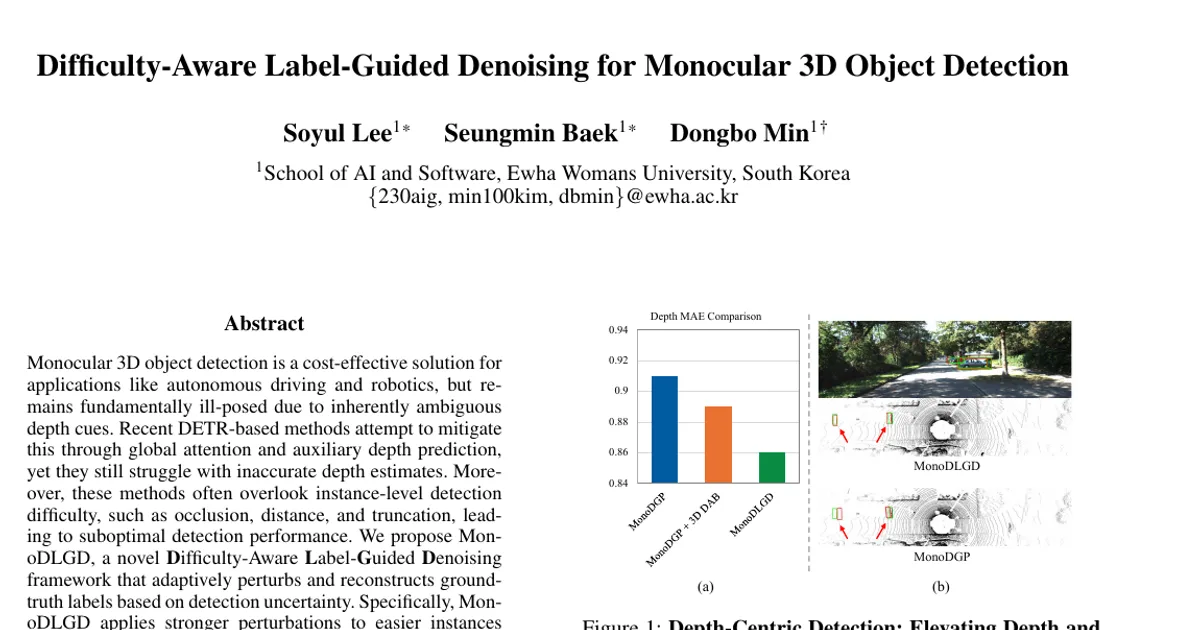
Depth estimation accuracy. Figure 1(a) reports depth mean absolute error (MAE) on the KITTI validation set for MonoDGP, MonoDGP with 3D-DAB, and MonoDLGD, and Figure 1(b) shows BEV visualizations, but the paper content provided does not list the numeric MAE values.
Methodology in Plain English
The detector builds on MonoDGP with a ResNet-50 backbone and a transformer encoder–decoder. Queries in the decoder are initialized as 3D Dynamic Anchor Boxes: each query encodes a 2D bounding box projected onto the image, a depth value, and a class embedding, so the model starts from geometrically plausible positions instead of random learned vectors.
Training runs in two stages through the shared 3D detection decoder. In Stage 1, ground-truth label queries are passed through the decoder and two prediction heads that estimate uncertainty (log-variance) for depth and for the reparameterized projected bounding box coordinates (top-left and bottom-right corners). Uncertainty is converted into a certainty value by exponentiating the negative log-variance, then min–max normalized using running minimum and maximum values updated with an exponential moving average, producing a difficulty score in [0, 1] per attribute.
In Stage 2, the labels are deliberately corrupted. For bounding boxes, each coordinate is shifted by the boundary distance multiplied by the difficulty score, a randomly sampled sign, and a bounding box perturbation scaling factor, then clipped to [0, 1] so the box stays valid (left edge before right edge, top before bottom). Depth is perturbed by a similar formula using the depth difficulty score and a depth scaling factor. Class labels are flipped to another class at equal probability, uniformly across all instances and independent of difficulty. The key inversion is that easier instances get stronger perturbations while harder instances get weaker ones, preserving geometric structure where it matters most. The perturbed queries and the 3D-DAB queries are fed together into the decoder, which simultaneously reconstructs the original labels and predicts objects.
Because each perturbed query has a known matching ground truth, no Hungarian matching is needed for the reconstruction loss, which uses a Laplacian aleatoric uncertainty loss for depth and box coordinates plus cross-entropy for class. Detection queries still use Hungarian matching and the MonoDGP detection loss. The total objective is the reconstruction loss plus the detection loss.
Implementation details: 250 epochs, Mixup3D strategy, batch size 8, initial learning rate 2×10⁻⁴ with the AdamW optimizer, weight decay 10⁻⁴, learning rate decayed by a factor of 0.5 at epochs 85, 125, 165, and 225. Training used an NVIDIA RTX A6000. At inference, queries with category confidence below 0.2 are discarded. Evaluation uses the KITTI benchmark (7,481 training and 7,518 testing images; the 7,481 training images split into 3,712 for training and 3,769 for validation), with AP_3D and AP_BEV computed over 40 recall positions and methods ranked by Moderate AP_3D for the Car category.
Why This Matters
Impact on research. The paper reframes monocular 3D detection as a supervision problem rather than purely an architecture problem: instead of adding more modules at inference, it extracts more signal out of existing 3D ground-truth labels through controlled corruption and reconstruction. It also argues against the uniform-perturbation assumption inherited from DN-DETR and DINO, showing that perturbation strength should depend on instance difficulty. The demonstrated transfer to MonoDETR suggests the training scheme is architecture-agnostic.
Real-world applications (as positioned by the paper).
- Autonomous driving, where single-camera 3D perception is far cheaper than LiDAR rigs.
- Robotics, where lightweight depth-aware perception is needed on constrained platforms.
- Augmented reality, where the paper notes compatibility with high-resolution imagery.
- Deployment scenarios where low cost and ease of installation matter more than sensor fidelity.
Industry relevance. Because the extra computation is confined to training — 69.0 to 69.3 GFLOPs and 42.4 to 42.7 ms on the MonoDGP configuration — the method can be retrofitted onto existing production mono-camera detectors without changing the inference budget. The paper also reports operating without any additional training data, which avoids the cost of LiDAR-equipped data collection.
Future Directions
-
Reconciling the difficulty signal with multi-factor complexity. The paper criticizes MonoMAE for modeling only occlusion or depth range, yet its own difficulty score is derived from depth and box uncertainty alone. Whether explicit scale, truncation, and occlusion terms would improve the score is left open.
-
Extending beyond the Car category. All reported metrics are for the Car category on KITTI, even though KITTI annotates Car, Pedestrian, and Cyclist. Behavior on small, highly truncated Pedestrian and Cyclist instances is not reported.
-
Understanding when 3D-DAB alone hurts. The ablation shows that swapping in 3D-DAB without accompanying denoising supervision degrades performance relative to the baseline, dropping from 39.40 to 36.85 AP_BEV|R40 on Easy. The conditions under which the anchor design becomes beneficial — the paper attributes it to the supervision that accompanies it — warrant further study.
-
Training cost. The paper states that training time increases slightly because Stage 1 adds perturbation and reconstruction, and references the supplementary material for a detailed analysis; the appendix text provided is cut off mid-sentence, so the quantitative training-cost figures are not available in the content reviewed.
Target Audience
Researchers and graduate students working on monocular 3D object detection, DETR-based detection, and denoising or uncertainty-aware training objectives. It is also relevant to applied engineers evaluating whether a training-only modification can improve an existing deployment without increasing inference cost. Readers need prior familiarity with transformer detection pipelines, query-based decoding, and uncertainty loss formulations to follow the method and the ablation design.
Authors’ abstract
Monocular 3D object detection is a cost-effective solution for applications like autonomous driving and robotics, but remains fundamentally ill-posed due to inherently ambiguous depth cues. Recent DETR-based methods attempt to mitigate this through global attention and auxiliary depth prediction, yet they still struggle with inaccurate depth estimates. Moreover, these methods often overlook instance-level detection difficulty, such as occlusion, distance, and truncation, leading to suboptimal detection performance. We propose MonoDLGD, a novel Difficulty-Aware Label-Guided Denoising framework that adaptively perturbs and reconstructs ground-truth labels based on detection uncertainty. Specifically, MonoDLGD applies stronger perturbations to easier instances and weaker ones into harder cases, and then reconstructs them to effectively provide explicit geometric supervision. By jointly optimizing label reconstruction and 3D object detection, MonoDLGD encourages geometry-aware representation learning and improves robustness to varying levels of object complexity. Extensive experiments on the KITTI benchmark demonstrate that MonoDLGD achieves state-of-the-art performance across all difficulty levels.