Research
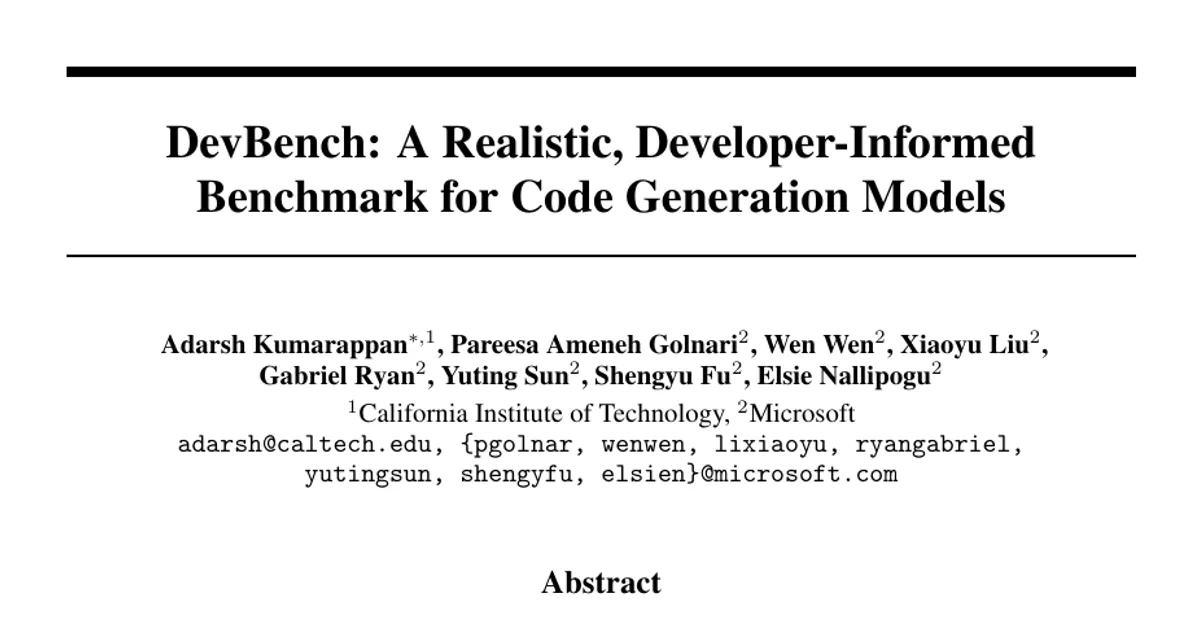
DevBench: A Realistic, Developer-Informed Benchmark for Code Generation Models
Overview Research area: Machine learning / code generation — evaluation benchmarks for large language models (LLMs) used in developer code-completion tools. Technical level: Intermediate. The core ide
- arXiv
- 2601.11895
- Published
- 2026-01-17
- Authors
- Adarsh Kumarappan, Pareesa Ameneh Golnari, Wen Wen, Xiaoyu Liu, Gabriel Ryan, Yuting Sun, Shengyu Fu, Elsie Nallipogu
AI summary
Overview
- Research area: Machine learning / code generation — evaluation benchmarks for large language models (LLMs) used in developer code-completion tools.
- Technical level: Intermediate. The core ideas are accessible, but the paper uses psychometric and statistical machinery (Spearman correlations, Fleiss' and Cohen's kappa, PCA, logistic regression with fixed effects) to justify its design choices.
- Scope: The paper introduces DevBench, a telemetry-derived, synthetic benchmark of 1,800 code-completion instances across six programming languages and six task categories, and uses it to evaluate 9 state-of-the-art models with functional, similarity-based, and LLM-judge metrics.
What This Paper Is About
Existing code-generation benchmarks are built from open-source repositories or coding-challenge sites, and their target completions are filled in by static rules rather than by how developers actually use code-completion tools. That makes them unrepresentative, hard to diagnose from (they report aggregate scores only), and vulnerable to training-data contamination. DevBench instead derives its task categories from internal telemetry of over one billion real developer code-completion interactions, then synthesizes 1,800 privacy-preserving, contamination-resistant evaluation instances that mirror those real-world scenarios.
Key Contributions
-
A telemetry-grounded benchmark taxonomy. Six task categories (API Usage, Code Purpose Understanding, Code2NL/NL2Code, Low Context, Pattern Matching, Syntax Completion) were derived from a stratified, difficulty-enriched sample of 50,000 completions, 3,000 human-annotated examples (500 per language, Fleiss' κ = 0.74), and clustering — then retained only if they met prevalence (≥5% of low-acceptance completions across at least four languages) and actionability criteria.
-
A 1,800-instance, six-language benchmark released open source. It covers Python, JavaScript, TypeScript, Java, C++, and C# at 300 instances per language and 50 per language–category cell, with instances averaging 57.6 LOC, 117.9 prefix tokens, and 108.2 completion tokens. Code and benchmark are at https://github.com/microsoft/devbench under CC BY 4.0.
-
Multi-generator synthesis with validated fairness. Instances were produced by three earlier-generation models from different provider families (GPT-4o, Claude 3.5 Sonnet, DeepSeek-V3), 684 candidates each, yielding 2,052 candidates. A same-family logistic-regression coefficient was small and not statistically significant, and model rankings on each generator's subset correlated at minimum pairwise Spearman ρ = 0.91.
-
A three-metric evaluation framework. Functional correctness (Pass@1 with n = 5), similarity metrics (average cosine similarity and Line 0 Exact Match Rate), and a blinded Gemini 2.5 Flash LLM judge scoring relevance and helpfulness on a 0–10 scale, which was validated against 450 human-scored completions (ICC(3,1) = 0.76; Spearman ρ = 0.81 with human scores, p < 0.001).
Main Findings
- The benchmark remains hard. Of 9 evaluated models, the strongest (GPT-5.5) reached only 43.5% Pass@1, followed by DeepSeek V4 Pro at 43.3% and Claude Opus 4.7 at 40.5%. No model exceeded 44%.
- Clear capability gradient. Mid-tier open and closed models clustered at 32–36% (Llama 4 Maverick 35.8%, Claude Sonnet 4.6 32.6%, Mistral Medium 3.5 32.1%), compact models at 27–28% (GPT-5.4 Mini 28.2%, GPT-5.4 Nano 27.1%), and the smallest open model at 18.0% (Qwen3.6-27B) — roughly a 25-point gap from strongest to weakest.
- Low Context is easiest; Code2NL/NL2Code is hardest. Top performers reached 46–54% on Low Context, while leading models managed only 29–32% on Code2NL/NL2Code, with most below 26%.
- Pattern Matching differentiates models most. DeepSeek V4 Pro scored 60.4% versus Qwen3.6-27B at 22.7%. API Usage was uniform among frontier models (33–38%) but fell to 18.1% for Qwen3.6-27B.
- Categories are related but not redundant. Mean pairwise Spearman correlation of Pass@1 across 54 model–language combinations was ρ̄ = 0.44, with low-correlation pairs such as API Usage vs. Code Purpose Understanding (ρ = 0.16) and API Usage vs. Pattern Matching (ρ = 0.17), and a higher pair for Pattern Matching vs. Code Purpose Understanding (ρ = 0.74). PCA showed the first two components explain roughly 77% of variance and three explain roughly 87%.
- Similarity and correctness diverge. DeepSeek V4 Pro tied GPT-5.5 on Pass@1 (43.3% vs. 43.5%) while achieving the highest similarity scores, and led Line 0 Exact Match in Python (60.67%) and JavaScript (62.67%).
- A language-specific failure was confirmed, not an artifact. Claude Opus 4.7's C# cosine similarity collapsed to 0.12, aligning with 9.9% Pass@1 in that language; Claude Sonnet 4.6 also scored low in C# (0.21 cosine). C# was particularly challenging for Anthropic models.
- The LLM judge ranks models differently from Pass@1. Llama 4 Maverick (9.13) and Mistral Medium 3.5 (9.22) received the highest judge scores despite lower Pass@1, while among frontier models DeepSeek V4 Pro led at 7.71, ahead of GPT-5.5 (6.11) and Claude Opus 4.7 (6.07). This reflects that the judge scores relevance and helpfulness, not executable correctness.
- Diagnostic case study: DeepSeek V4 Pro. It excelled at Syntax Completion similarity (cosine 0.71 vs. GPT-5.5's 0.67; Line 0 54.33% vs. 53.33%) yet underperformed on functional correctness in that same category (32.4% vs. 51.4% Pass@1), suggesting heavier reliance on pattern memorization. It was the most balanced model across languages (9.4-percentage-point spread) but weakest in TypeScript (36.1%), with judge scores ranging from 9.70 in C++ to 5.42 in JavaScript.
- Contamination and bias controls held up. Near-duplicate filtering (token 4-gram Jaccard and AST structural similarity) removed 41 of 2,052 candidates (2.0%); the validation funnel also removed 89 candidates for failed syntax/execution checks and 122 during blinded human review. Within-prompt TF-IDF cosine similarity averaged 0.094, indicating high instance diversity.
Methodology in Plain English
The researchers started from a large internal corpus of anonymized, real code-completion interactions — over one billion — containing prefix/suffix context, generated and accepted completions, and user actions (accept, reject, edit). Because raw user code could not be released for privacy and compliance reasons, the team used that corpus only to discover what developers struggle with, not to publish any of it.
They drew a sample of 50,000 completions weighted toward difficult cases (low acceptance rates, high post-acceptance edit distance), then had three researchers annotate 3,000 of them. Clustering those annotations produced candidate scenarios, which were consolidated into six categories using two filters: the scenario must be prevalent enough and must be isolable into a self-contained prefix/suffix completion task.
For each of the 36 language–category cells, they asked three models from different providers to generate candidate instances from the same structured prompts, producing 2,052 candidates. Those were run through automatic syntax and execution checks, filtered for near-duplicates against public benchmarks, and reviewed blind by two of three senior annotators on usefulness, realism, category alignment, and complexity authenticity. Just over half the candidate review rejections came from submissions that were too textbook-perfect (32%) or insufficiently complex (28%), with unrealistic edge-case handling (23%) and category misalignment (17%) accounting for the rest. Rejected items were regenerated until they met the bar, leaving 1,800 instances.
Evaluation used zero-shot prompting with a code-only template, a maximum output length of 800 tokens, temperature 0.2 where supported, top-p = 1.0, and 5 samples per task. Each instance has a prefix, a golden completion, an optional suffix for fill-in-the-middle settings, and hidden assertions the model never sees. Scores came from three angles: whether generated code passes hidden tests, how similar it is to the golden completion, and how a blinded separate-family judge rates it.
Why This Matters
Impact on research. DevBench shifts code-generation evaluation away from scraped repositories and interview-style problems toward behavior observed in real developer sessions. Its synthetic, filtered construction addresses contamination at the instance level, and its category structure supports diagnosis — which capabilities a model lacks — rather than a single leaderboard number. Its public release (CC BY 4.0, code and benchmark at github.com/microsoft/devbench) gives other researchers a reusable, contamination-resistant foundation.
Real-world applications:
- IDE assistant tuning. Vendors can use category-level results (for example, weak Code2NL/NL2Code performance) to prioritize training data instead of guessing.
- Model selection. Engineering teams choosing between frontier, open-weight, and compact models get separate signals for functional correctness, code similarity, and developer-perceived usefulness.
- Cross-language deployment. Language-specific gaps — such as the C# weakness in Anthropic models or TypeScript weakness in DeepSeek V4 Pro — matter directly for teams working in ecosystems other than Python.
- Benchmark auditing. The methodology offers a template for building privacy-preserving benchmarks from telemetry rather than from public code.
Industry relevance. The evaluated suite spans six providers, three capability tiers, and four open-weight families (DeepSeek, Meta, Mistral, Alibaba), which is the mix a real organization faces when deciding what to ship in a coding assistant. The paper's observation that large open-weight models are competitive with closed mid-tier systems on these hardened tasks is directly relevant to procurement and deployment decisions, and the finding that plausible-looking completions frequently fail hidden assertions is a practical warning about relying on surface impressions of generated code.
Future Directions
- Composite evaluation metrics. The paper explicitly calls for exploring combined metrics, motivated by the divergence between high similarity scores and low Pass@1 for models such as DeepSeek V4 Pro.
- Broader development activities. The authors name refactoring, debugging, and multi-file architecture design as activities beyond the current completion-focused scope.
- Proportional versus balanced sampling. DevBench deliberately uses balanced, non-proportional sampling (300 per language, 50 per cell) rather than mirroring telemetry frequencies — roughly 55% Python and JavaScript combined, versus about 8–10% each for C++ and C#. Whether a proportional variant would give more deployment-realistic diagnostics is left open.
- Residual generator and distributional effects. The authors state they do not claim all generator effects are absent, and note that generator diversity alone cannot eliminate overlap with public code corpora. Extending the bias and contamination analysis remains an open problem.
Target Audience
This paper is most useful to machine-learning and evaluation researchers working on code-generation models, engineers building or benchmarking developer-facing coding assistants, and teams responsible for model selection and fine-tuning decisions. It is also relevant to researchers interested in privacy-preserving benchmark construction from telemetry, since the paper describes how to derive task categories from proprietary interaction data and release only synthetic instances in their place. Readers without a statistics background can still follow the design rationale and results, but will benefit from prior exposure to benchmark evaluation conventions such as Pass@k and inter-annotator agreement.
Authors’ abstract
DevBench is a telemetry-driven benchmark designed to evaluate Large Language Models (LLMs) on realistic code completion tasks. It includes 1,800 evaluation instances across six programming languages and six task categories derived from real developer telemetry and synthesized using generator models from multiple provider families to mitigate single-source bias. Unlike prior benchmarks, it emphasizes ecological validity, avoids training data contamination, and enables detailed diagnostics. The evaluation combines functional correctness, similarity-based metrics, and LLM-judge assessments focused on usefulness and contextual relevance. 9 state-of-the-art models were assessed, with the strongest achieving only 43.5% Pass@1, confirming the benchmark remains challenging and revealing differences in syntactic precision, semantic reasoning, and practical utility. Our benchmark provides actionable insights to guide model selection and improvement, detail that is often missing from other benchmarks but is essential for both practical deployment and targeted model development.